“It felt like the world was ending.” -Economist Chris Rupkey on the Crash of 1987
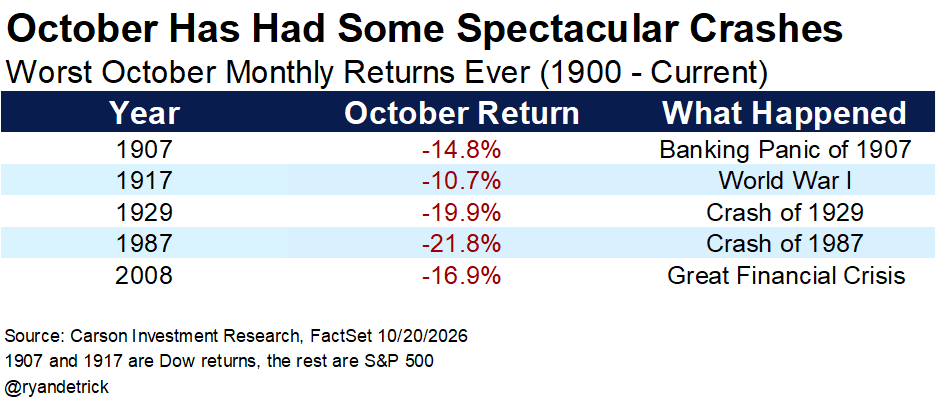
October is known for many things, with incredible market crashes likely at the top of the list. The crashes of 1929 and 1987 stand out for many investors, and who could forget the selling and volatility of October 2008? Going back further, we also saw spectacular crashes in 1907 and 1917.
Putting This Day in Context
I was in the fourth grade when the crash happened, and I really have no memory of it, as I was likely more concerned with my latest Nintendo Game Boy game or playing Legend of Zelda.
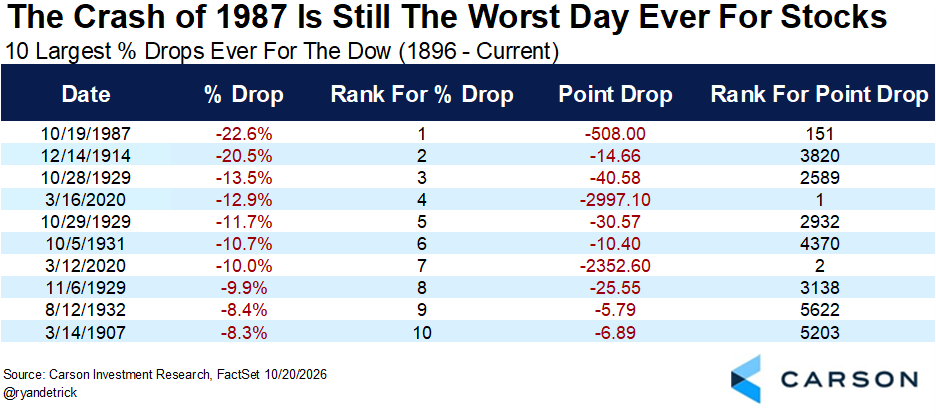
In honor of the greatest drop in stock market history, we’ll take a closer look at the crash of 1987. On Monday, October 19, 1987, the Dow fell 22.6% for the largest one-day drop in the more than 130-year history of the Dow. To this day, it is still the largest percentage drop ever, but it now ranks as only the 151st largest point decline. You ready for a wild stat? Just this year alone we’ve seen 19 days fall more than the 508 point drop 39 years ago.
Five Oh Eight
One of my favorite stories from this day was that Alan Greenspan, the newly minted chairman of the Federal Reserve Bank (Fed), was flying on a plane most of the day of the crash and no one could get ahold of him. He knew things were dicey and the previous Friday (and really the week) was ugly, but he was up there flying around, wondering how markets were doing that day.
Think about that again for a second. I fly on United specifically just to have access to Starlink and the super-fast internet it provides, while 39 years ago one of the most important people in the world couldn’t get a message that the financial system was collapsing.

Stay on Top of Market Trends
The Carson Investment Research newsletter offers up-to-date market news, analysis and insights. Subscribe today!
"*" indicates required fields
Getting back to the story, as Greenspan got off the plane, someone ran up to him and said that the Dow fell “five oh eight,” and he felt relieved, as he thought they meant it fell five points! Well, he quickly realized down ‘five oh eight’ meant we just had the worst day in the history of the stock market.
We Still Can’t Agree What Caused It
What caused it? The funny thing is that 39 years later, I’m not sure everyone can officially agree. Here are some things to know about the Crash of 1987:
- For starters, stocks were in the midst of a huge run off the August 1982 lows, with the Dow up more than 40% for the year in mid-August 1987, amounting to one stretched rubber band.
- Then consider Alan Greenspan took over the Federal Reserve Bank in August and was hiking rates to cool things off. Talk about a bad time to start a new job.
- Program trading was blamed as well. The Friday night before the crash, Louis Rukeyser was pointing out issues with program trading. (Simply put, program trading meant stocks were automatically sold as certain levels were hit. It worked fine until stocks began to fall more than expected, leading to more selling as prices dropped.)
- Currency markets were on edge as well, as the U.S. wanted Germany to weaken their currency due to the latest trade deficit numbers. The back and forth was all over the media, as recently as the Sunday before the crash.
- The selling started earlier, actually. The three days before the crash, the Dow was down 3.8%, 2.4%, and 4.6%, making it safe to say investors were on edge all weekend for how things might open on Monday morning.
- There is even speculation that President Reagan was distracted from the global turmoil because Nancy Reagan had been diagnosed with breast cancer earlier in the month and he was at her bedside, potentially adding to the volatility. I’m not saying I buy this one, but it is cited as a potential factor.
In the end, the Dow fell a then-record 508 points for a 22.6% one-day decline, topping the previous largest one-day decline of 20.5% in December 1914, when the Dow began trading after being halted for nearly five months due to World War I.
Something most investors might not know is that stocks still finished the year in the green in 1987. Sure, they were well off their highs, and the huge volatility was too much for many investors to handle, but if all you saw was the yearly gain of 2% in 1987, you’d think it was a boring year!
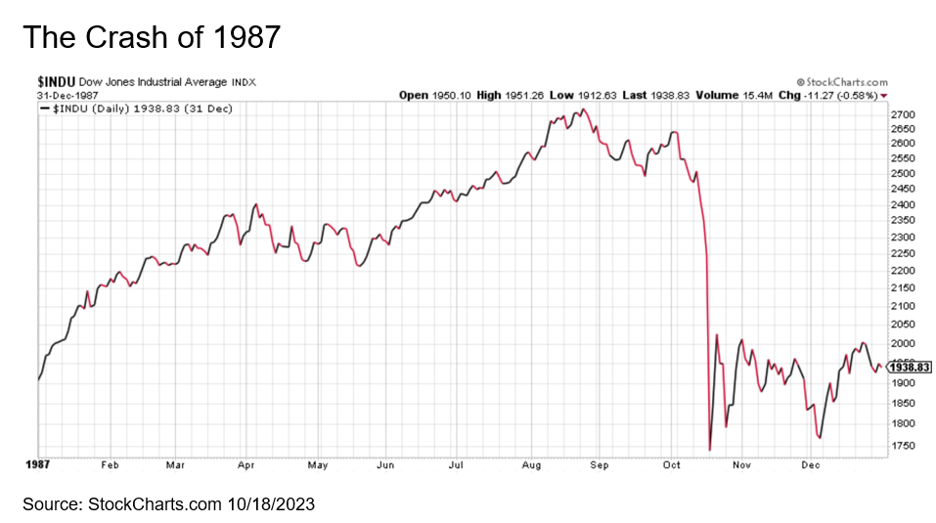
Here’s the other thing — stocks bottomed for good in early December and it was off to the races the next 12 years, as the 1990s bull market really heated up. No one in their right mind likely expected that, but it happened.
There Is More
We might not know what caused the Crash of 1987, but we also still don’t really know what caused the Flash Crash either. The Flash Crash occurred in May 2010 (when many stocks and ETFs saw huge losses, only to regain the losses by the close for one wild few minutes of trading). The truth is, with more and more computers involved, we are due to get big swings periodically.
Today we do have circuit breakers in place to help calm nerves should we see another major decline in prices, but it’ll take a huge drop for those to kick in.
Conclusion
In the end, volatility, as always, was the price of admission for investing for the long run. It is just part of the process — the bigger risk for investors is not volatility itself but failing to recognize that it’s going to happen. Just always remember that the Dow started trading on May 26, 1896, and it has seen wars, famines, pandemics, inflation, deflation, booms and busts, and more. Yet, it has always eventually come back to new highs, and whenever we have the next bear market, we don’t think this longer-term pattern of eventual new highs will change.
Thanks as always for reading, and for our latest thoughts on the AI/memory weakness, here’s our latest Glass Half Full video.
For more content by Ryan Detrick, Chief Market Strategist, click here.
9190946.1. – 20OCT26A