It’s easy to think of stocks, Treasuries, corporate bonds, commodities, and private markets as separate investments. But within a portfolio, they should be looked at as part of a whole, since developments in one corner of the market can quickly affect prices and expected returns elsewhere. Looking at asset classes in isolation risks missing the bigger picture. This is especially true now because they’re increasingly connected by one enormous force: the AI buildout. Even private equity and private credit (which were never truly independent “alternatives”) are going all in on the AI boom.
In other words, it’s all one big trade.
There’s been plenty of talk that AI capital spending is insensitive to interest rates. But this week’s market action suggested otherwise. Despite hot inflation data (more on that shortly), the 10-year Treasury yield plunged from 5.33% to 5.08% in a day. The explanation may lie in what happened to AI optimism. That’s a reminder that yields reflect more than inflation and Federal Reserve expectations; investors are constantly reassessing competing opportunities for their capital.
Investors began questioning whether AI labs will generate sufficient revenue to justify their spending. Anthropic’s revenue grew 45% in the third quarter, which is impressive, but a marked slowdown from the 140% increase in the prior quarter. Meanwhile, the cost of insuring AI-related debt has jumped. Annual premiums to insure $10 million of debt using five-year credit default swaps now stand at (via Bloomberg):
- CoreWeave: $1.1 million (10.87%, or 1087 basis points), up from $790,000 a month ago (September 15)
- Oracle: $282,000 (282 basis points), up from $194,000 a month ago
- SpaceX: $215,000 (215 basis points), up from $157,000 a month ago
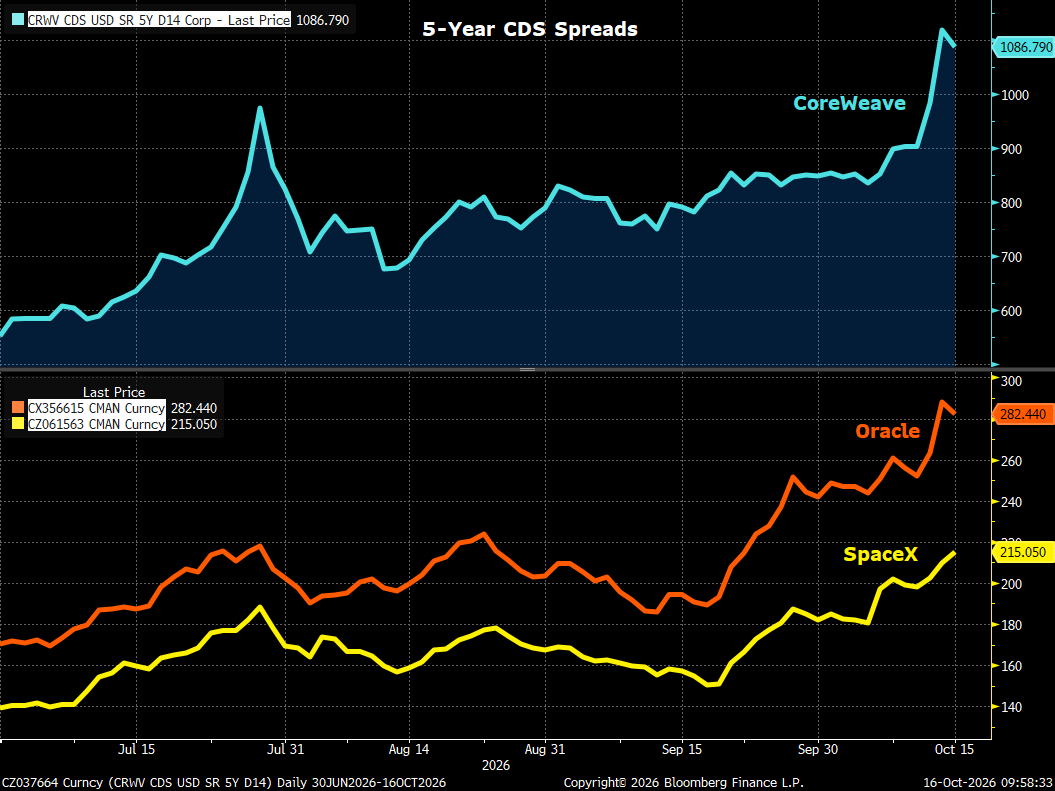
The widening spreads suggest lenders are becoming less comfortable with both the scale of the financing and the uncertainty around its payoff. Even mega-cap tech isn’t immune. Meta’s CDS cost rose to $106,000, from $55,000 at the start of the year; Alphabet’s rose to $72,000, from $37,000 (Bloomberg).
What does this have to do with Treasuries? Consider a hypothetical example: a 5% bond yield looks unappealing if AI investments promise 25%-plus returns. But if those returns become uncertain, or turn negative, that same 5% suddenly looks attractive.

Stay on Top of Market Trends
The Carson Investment Research newsletter offers up-to-date market news, analysis and insights. Subscribe today!
"*" indicates required fields
The implication is important: optimism about debt-financed AI infrastructure has itself helped push bond yields higher. When confidence wobbled, investors rushed back to Treasuries. The same optimism is also boosting nominal economic activity, which helps explain another seemingly contradictory development: inflation remaining stubbornly elevated even while some investors expect interest rates to fall. And it’s not just bond markets feeling the impact.
An Investment Supercycle Translates to Higher Inflation
A massive investment boom puts pressure on real resources and prices. It’s too convenient to blame inflation entirely on the Iran war and tariffs. The latest data suggest something broader, including bottlenecks created by AI spending.
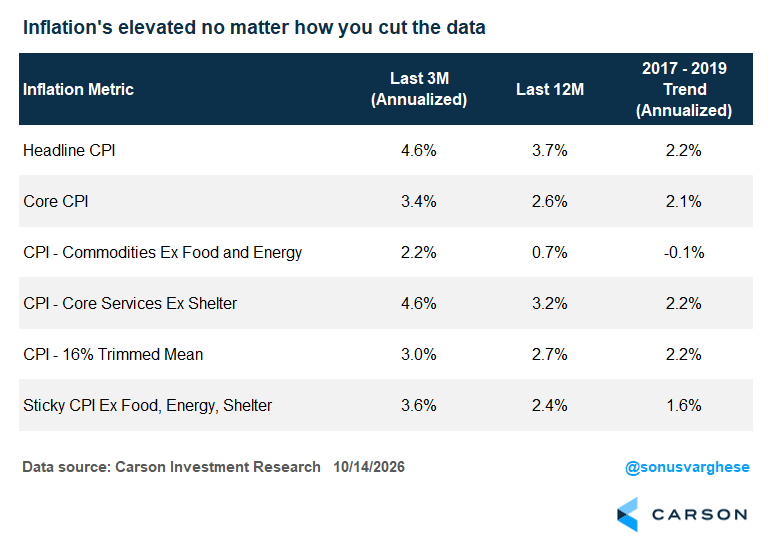
Headline CPI rose at an 8.1% annualized rate in September. Its three-month pace was 4.6%, with the 12-month rate at 3.7%. Energy matters, but inflation remains hot even when you strip it out. Over the past three months, annualized inflation ran at:
- 4% for core CPI (which excludes food and energy), versus 2.1% in 2017–2019
- 2% for core goods, versus -0.1% before the pandemic, a reversal partly reflecting tariffs and supply bottlenecks
- 6% for services excluding shelter, versus 2.2%, a particularly troubling sign of broad price pressure
- 0% for 16% Trimmed-Mean CPI, versus 2.2% — this metric excludes the 8% of CPI components with the highest and lowest one-month price changes from each tail of the price-change distribution
- 6% for Sticky CPI excluding food, energy, and shelter, versus 1.6% — this metric measures inflation for items whose prices typically don’t change frequently
I don’t know how many ways you can say we have an inflation problem that goes well beyond an energy shock. And keep in mind that the Middle East conflict remains unresolved, which is why Brent crude prices are above $105/barrel.
Producer prices tell the same story. Headline PPI rose 6.4% over the past year, its fastest pace since late 2022. Even excluding food and energy, PPI climbed 5.0%, versus a 2.2% average in 2017–2019. Unlike the disinflationary technology boom of the late 1990s, today’s AI buildout is driving up input costs.
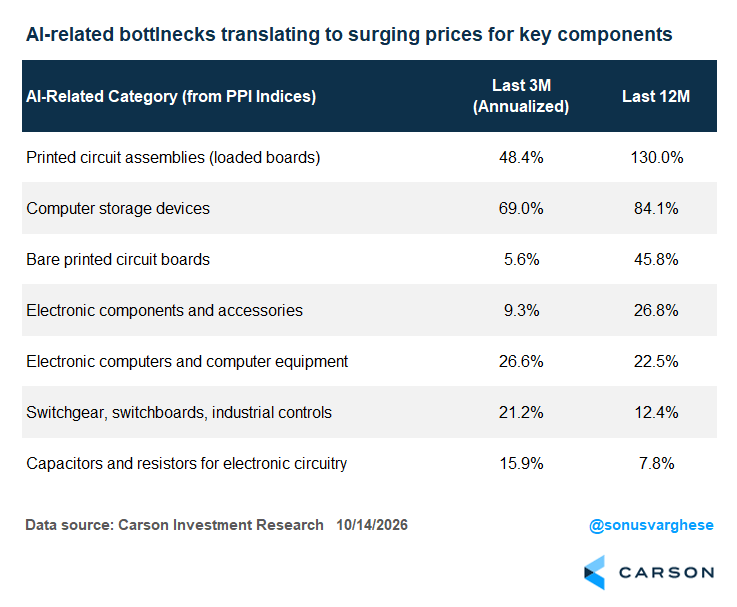
Look at some AI-linked components: printed circuit assemblies are up 130% over the past year; computer storage devices, 84%; bare printed circuit boards, 46%; and electronic components and accessories, 27%. These are not small price increases. They’re signs that demand is running into supply constraints. More spending doesn’t instantly create more electricity, chips, equipment, or manufacturing capacity. In the meantime, the businesses with scarce products or capacity gain pricing power.
Be Careful What You Wish For
Here’s the catch: sharply lower inflation could mean the AI buildout is losing momentum, particularly if prices fall because demand collapses rather than supply expands. For now, spending remains strong across businesses, consumers, and the government. Inflation is one consequence; expanding margins for energy producers and AI suppliers are another.
So if you’re hoping for much lower bond yields, cooler inflation, and broader stock market participation, consider what could get you there:
- An AI capex bust
- Rising unemployment, and/or
- Shrinking government deficits (ha, fat chance)
None would be particularly friendly to corporate profits. Lower inflation and lower yields are not automatically bullish for stocks if they arrive because the investment cycle and nominal growth are rolling over. That distinction is critical when so much of recent earnings growth is tied to one theme.
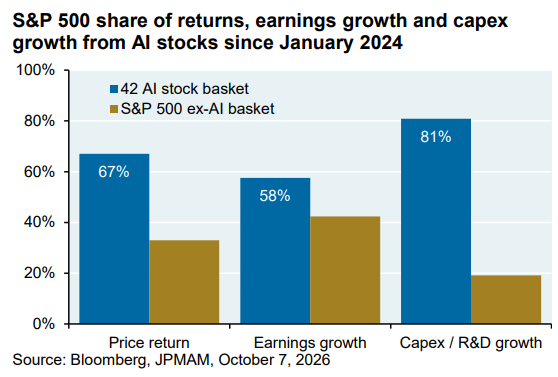
And profit growth has become remarkably concentrated. As JP Morgan’s Michael Cembalest recently illustrated, a basket of just 42 AI stocks accounted for roughly 67% of S&P 500 price returns, 58% of earnings growth, and 81% of capex and R&D growth since January 2024.
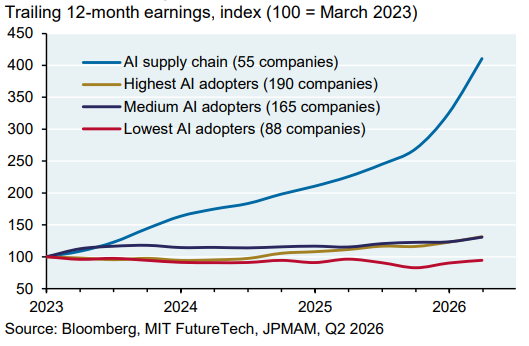
The beneficiaries are also concentrated within AI. Earnings for 55 AI supply-chain companies have quadrupled over about three and a half years, far outpacing companies adopting AI. It’s straightforward: one company’s capital spending is another company’s revenue and profits. Investors understandably focus on the firms selling the tools and infrastructure today; the eventual return on investment for the companies buying all this capacity is a different question.
This is why an AI bust matters even if the resulting recession is relatively mild. Lower yields could revive interest-sensitive sectors such as housing, but the hit to profits and equities could still be substantial.
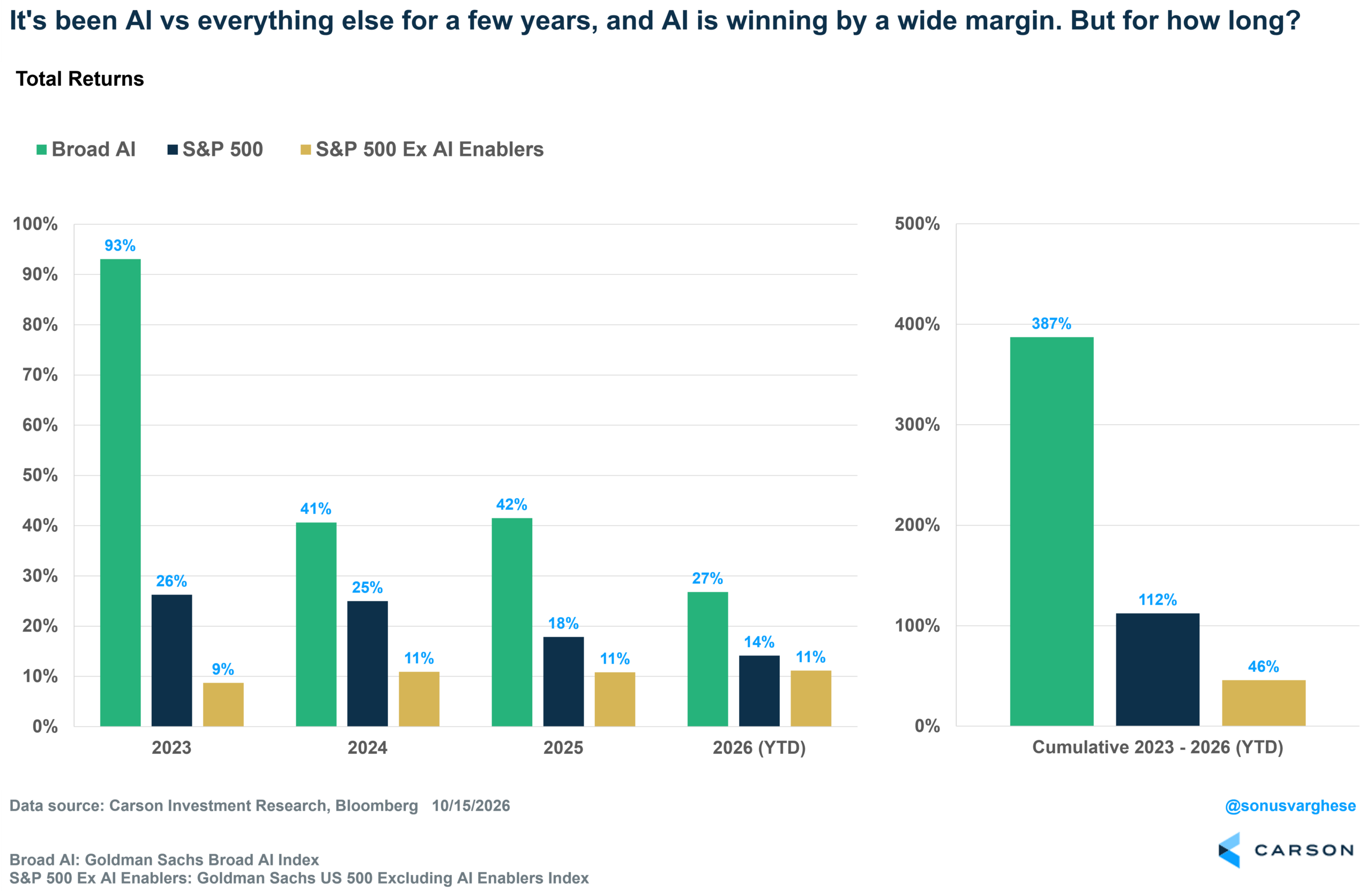
Since the end of 2022, a broad AI basket tracked by Goldman Sachs has returned 387%, or 51.8% annualized. It’s outperformed the broader index in every single year, including in 2026. The S&P 500 gained 112% (22% annualized), while the index excluding AI enablers returned 46% (10.4% annualized). That last figure is hardly terrible, but it shows just how much of the bull market depends on AI. A reversal would hurt a supposedly diversified S&P 500 whose weight in technology and technology-adjacent stocks exceeds 50%.
I’ll end where I did a few months ago, when I wrote about “how I’m learning to love the bubble, and stop worrying about it.” I have no idea what stage of the bubble we are in, nor when it will pop. And I won’t pretend that we can perfectly time the top and “get out in time, before everyone else.” Good luck with that.
Instead, as the AI wave gathers strength, I’m increasingly comfortable diversifying judiciously outside it, even at the cost of missing some spectacular gains. The goal is to ride the wave without getting wiped out on the other side. After all, if it really is one big trade, diversification matters more, not less.
For more content by Sonu Varghese, Chief Macro Strategist, click here.
9185501.1. – 16OCT26A