As we head back to school and into fall, there is no shortage of news headlines and growth stories in the ETF market. Many of those I wrote about earlier in the year are still very topical, but I wanted to share a few more observations about the market today, and address some of the questions we’ve seen about ETFs lately.
Recent Market Observations
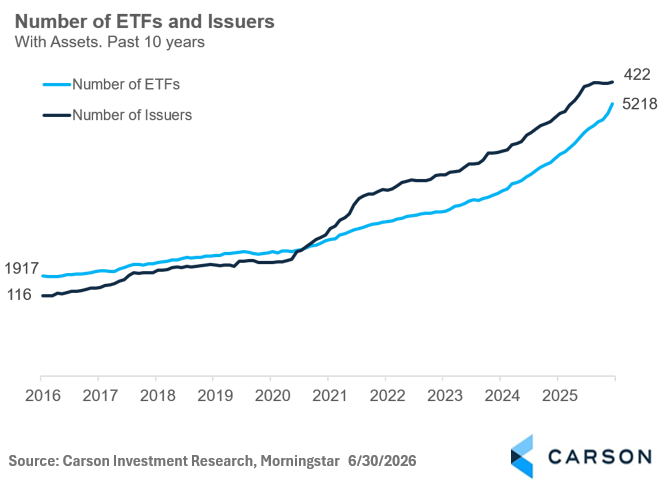
ETF issuance continues to climb in 2026, if not accelerate. There are more than 5,200 ETFs in the market today, from more than 400 different issuers. Just five years ago, those numbers were less than half — around 2,700 ETFs and only 130 or so unique issuers. If nothing else, this raises the bar for due diligence: not all ETFs and their issuers are created equal, and copy-cat products are prevalent across the industry as well, requiring careful comparison. In addition, many of these new products are labeled as active (some truly active and others less so). An increasing share of flows into the ETF space is going to active ETFs (~36% of flows). By definition, active ETFs do not adhere strictly to a stated benchmark, and there are any number of nuances to analyze and monitor based on the decisions of a management team.
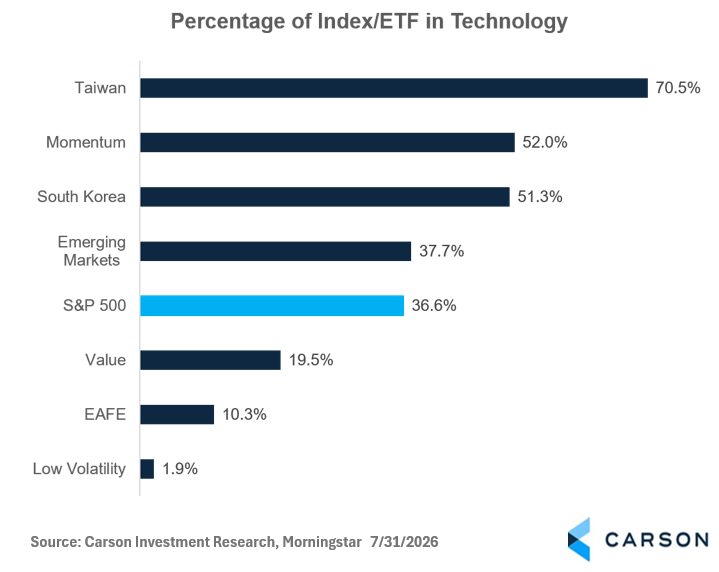
The AI trade continues to spill over to more than just technology, and many areas of the market are starting to be driven by the same macro narratives. We’ve written before about how international markets are even more concentrated than ours, but that is getting worse. Emerging markets — long considered full of “old economy” energy, commodity, and other traditional economy stocks — now have a higher technology weight than the S&P 500!
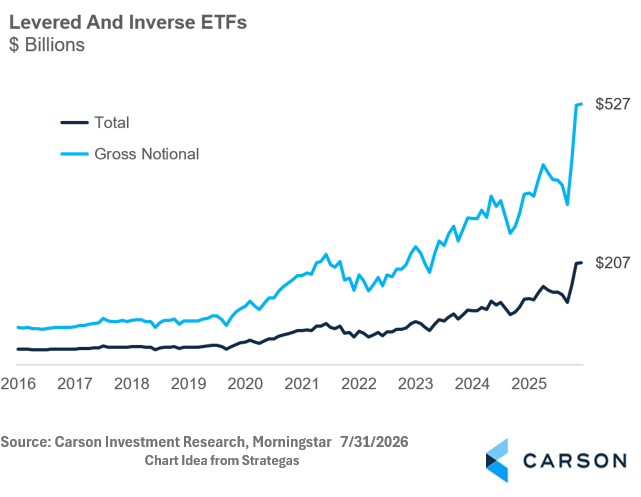
Related to this same AI trade is the explosion in single-stock, leveraged, and inverse ETFs. There are a number of different ways to look at this. We did our calculation based on the total value of assets in these products, and then applied the appropriate (gross) multiplier to those assets. $207 billion in leveraged and inverse ETFs is a drop in the bucket in terms of all ETF assets, but the “true” impact of those assets is more than half a trillion, and by some measures these products represent nearly 20% of daily market volume. These are trends that may not reverse any time soon, and they demand watching.

Stay on Top of Market Trends
The Carson Investment Research newsletter offers up-to-date market news, analysis and insights. Subscribe today!
"*" indicates required fields
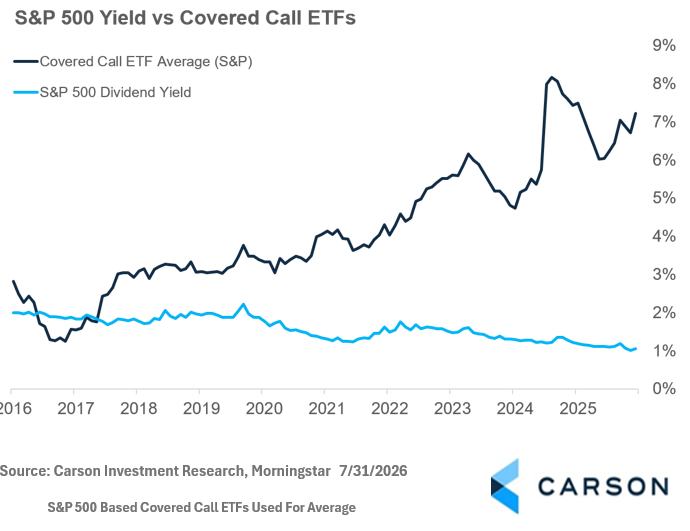
Not a new trend by any means, but covered call and derivative income strategies also continue to grow. So much so that Goldman Sachs just announced its second major ETF deal in less than a year, acquiring two different options-based ETF firms. With the increase in low-dividend-paying technology stocks in the market and the change in payout policies of companies to favor buybacks, the dividend yield of the S&P 500 is rapidly approaching 1%, likely all-time lows. As a result, derivative income strategies have gained in popularity to fill this gap, and have also seen their income generation climb as new entrants come up with innovative ways to increase yield.
351 Exchanges
Technically a piece of the tax code enacted way back in 1954, Section 351 exchanges have been a hot topic in the ETF industry for several years. Most recently, officials from the IRS and Treasury Department flagged 351 exchanges among other tax-based transactions and strategies. There was no conclusive decision, but just the mention by government officials raised eyebrows. So what is a 351 exchange anyway?
In the ETF world, a 351 exchange or conversion is a way to seed a new ETF with existing exchange-traded assets, and to do so without selling those assets. This conversion from an SMA or series of separate accounts is not a new tactic, but it has transformed a bit over the years. In its current form, many providers (big and small) solicit securities (typically appreciated stocks) to help fund the ETF. Assuming those securities pass diversification and funding requirements, the shares are exchanged for shares in a new ETF. A couple of things to remember: The new ETF shares will represent the same tax lots, basis, and acquisition dates as the contributed stock shares. In other words, the taxes simply move from, say, 50 stocks to a single ETF. Also, the diversification rules require no more than 25% in a single position, or no more than 50% in the top five positions used to fund the ETF. It is important to take both of these into account before considering an exchange.
The benefit, however, is that you now have a potentially more diversified portfolio in the ETF wrapper, and that ETF has the ability to effectively manage toward some objective without incurring gains on your shares. So if you want to maintain the intended exposure and are worried about tracking issues or concentration (to an extent), then a 351 may make sense. In my opinion, 351 exchanges work best for seeding new ETFs with existing active SMAs for taxable investors, allowing the strategy to continue being managed in a more tax-efficient way for clients. There are many more nuances with 351 exchanges worth considering and discussing, so let us know if you have questions — we also have great relationships with many of the active providers.
ETFs continue to gain market share and drive market prices in 2026, with no signs of slowing. As with anything in capitalism, there may always be some funny business along the way, but if we focus on long-term wealth accumulation using the efficiency of the ETF wrapper, in my opinion we are in good shape.
For more content by Grant Engelbart, VP, Investment Strategy & Research click here.
9086460.1. – 20AUG26A