“We really can’t forecast all that well, and yet we pretend that we can, but we really can’t.” Alan Greenspan, the 13th Federal Reserve Chairperson
First things first, we hope everyone had a great Memorial Day holiday, and a heartfelt thank you to those who have served to keep us safe. And to those who gave the ultimate sacrifice and their families, words just are not enough, but we thank you.
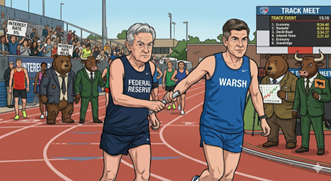
Now getting to it, Jerome Powell’s term leading the Federal Reserve Bank (Fed) is officially over, as Kevin Warsh took over last Friday. Two interesting stats to think about before we get into this blog. The U.S. Senate confirmed Mr. Warsh as Chairman of the Fed with a 54-45 vote, the closest vote in history. The voting went along party lines other than Democratic Senator John Fetterman of Pennsylvania, who voted to confirm. Second, Mr. Warsh was sworn in in the East Room of the White House. The only other Fed Chair to be sworn in at the White House was Alan Greenspan on August 11, 1987, again in the East Room, and this time under Ronald Reagan. Take note, the market crashed a couple of months later back then 😉
What a Rally
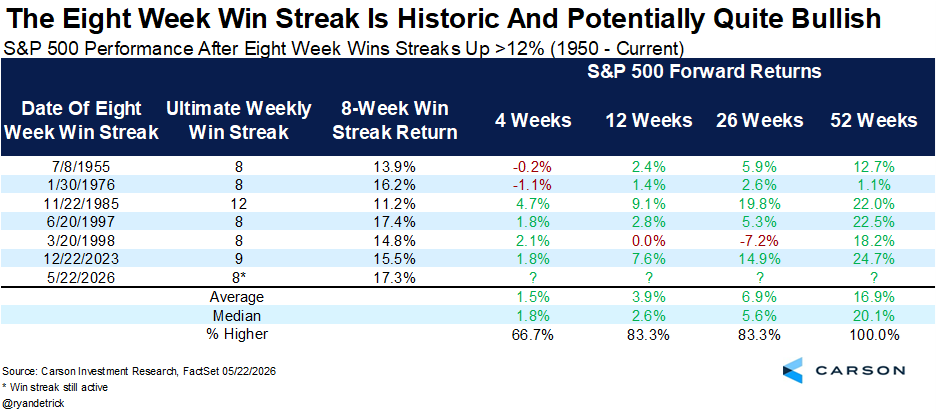
Let’s start with some good news. The S&P 500 is up an incredible eight weeks in a row, the longest win streak since nine in a row in late 2023. But during this long win streak, stocks gained 17.3%, just missing the best return ever during an eight-week win streak of 17.4% in 1997. Be aware, stocks gained more than 22% a year after that long win streak. In fact, we found only seven other times stocks gained eight weeks in a row and managed to gain at least 12% during the win streak. The future returns were quite strong, but what really stands out is that they never fell a year later and rose nearly 17% on average. We’ve continued to share why we think this bull market is alive and well. This does little to change our take there.
Goodbye, Jerome Powell
Mr. Powell took over on February 4, 2018, and the Dow promptly fell 4.6%, for the single worst one-day decline ever for a new Fed Chair. Sparking that decline was an incredible 15-month win streak (on a total return basis) going into February, and then the trade war with China started.
But despite that rocky start, here we are more than eight years later, and the S&P 500 gained nearly 170% under Powell, good for the fourth most ever. On an annualized basis, stocks gained 12.7% under his leadership, which was the third-best ever. Something that I bet a lot of people don’t know is that the best annualized return ever took place under Paul Vocker at a very strong 15.4% in eight years. Given he is known for hiking rates and breaking the back of inflation and causing a double dip recession, this might surprise most. Mr. Volcker was also the tallest Fed chairperson at 6 feet 7 inches.
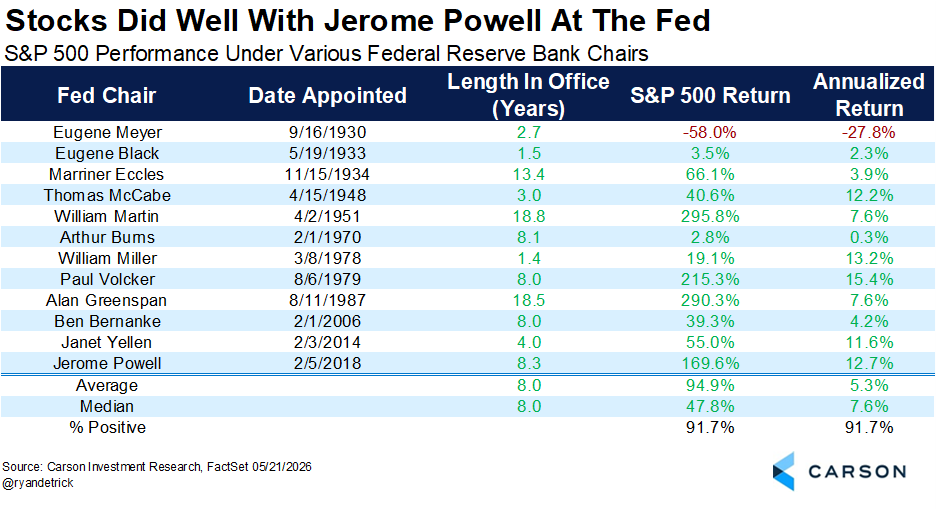
It was a busy eight years, as Powell navigated a once-in-a-century pandemic and oversaw the huge surge in inflation in 2022 due to the Russia/Ukraine war. He should have hiked rates somewhat to slow things down in late 2021/early 2022 and then had to hike aggressively in 2022 once it was clear he was behind the curve. Still, we managed to avoid a recession in 2023 (even though most expected one). Powell had to endure the White House incessantly pressuring him to cut rates (not to mention the Department of Justice investigating him) and scandals with other Fed members (multiple trading scandals). He incorrectly said that inflation was ‘transitory’ in 2022 and managed to see some Dead & Company shows along the way. Yes, he made some mistakes, but to have only two months of the economy in recession (during Covid) and huge stock market gains overall, it sure could have been worse.

Stay on Top of Market Trends
The Carson Investment Research newsletter offers up-to-date market news, analysis and insights. Subscribe today!
"*" indicates required fields
Hello, Kevin Warsh
Mr. Warsh was confirmed as the 17th chairperson of the Fed on Friday. One thing we’ve heard a lot about is how markets tend to test new Fed chairs. The most famous example is the crash of 1987, which took place just a couple of months after Alan Greenspan took over in the summer of 1987. Mr. Greenspan was hiking rates, the bond market was weak, and then it all came crashing down with a one-day drop of more than 20% on October 19, 1987.
Stocks fell more than 10% within the first three months after Volker and Burns took over, while outright crashes took place after each of the two Eugenes (Meyer and Black) became chair during the Great Depression.
Here’s the thing, though: the average max three-month drawdown is 12.0%, the median is only 7.9%, suggesting things are indeed skewed by a few large outliers. Looking at the most recent Fed Chairs (Bernanke, Yellen, and Powell), we see that things were actually fairly calm overall in the first three months.
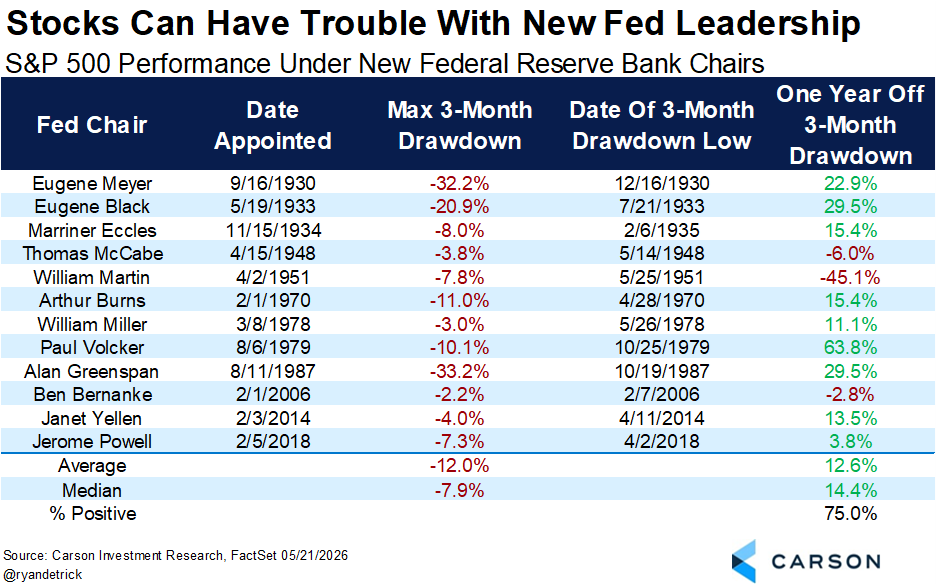
Overall, after the huge rally we’ve seen the past eight weeks, a well-deserved break could happen for any reason. Maybe it’ll be blamed on Warsh, or higher rates, or Iran, or something else. The bottom line is that new leadership by no means means market trouble, but with interest rates globally surging, we should be open to some well-deserved weakness at any time.
Thank you for reading, and for more on some of these concepts, I joined CNBC’s Morning Call with Morgan Brennan bright and early this morning. You can watch it all below. ☕⏰
For more content by Ryan Detrick, Chief Market Strategist, click here.
8945001.1. – 26May26A