

“The stock market is fun and sometimes, very painful.” Regis Philbin
The rollercoaster market continues. News and rumors are dominating the discussion, and no one seems to know what to really believe.
In today’s blog, I wanted to take a bigger look at things and show five lessons that all investors need to know, especially in today’s volatile times.
Volatility Happens
Even the best years have some bad days. Last year is a perfect example, as we had a near-bear market (down close to 20%) after Liberation Day, yet stocks soared back to new highs, and it was another good year for the bulls.
We all want to gain 20% a year forever, but that isn’t possible, and to see the solid returns that stocks can provide in the long run, you have to be able to withstand the inevitable volatility and bad times. Or as Regis put it up top, “The stock market is fun, but sometimes very painful.”
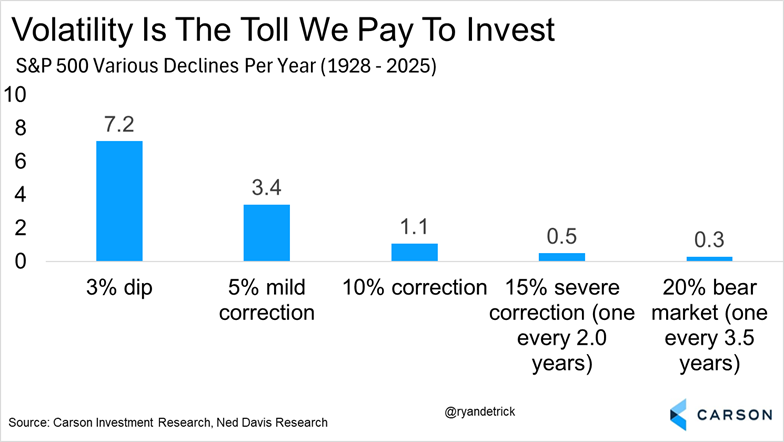
During times like this, we like to share this chart. On average, you get one 10% correction and more than three 5% mild corrections a year. Given we just saw our first mild correction this year, it’s good to remember that it is perfectly normal to see some market jitters and volatility, as it happens most years.
Earnings Drive Long-Term Stock Gains
Lesson two is that earnings and profit margins matter a lot.
We get it, the headlines are quite bad, and confusion reigns. But as of now, we do not see a pending recession in the US, and by the end of 2026, it should be another solid year for investors.
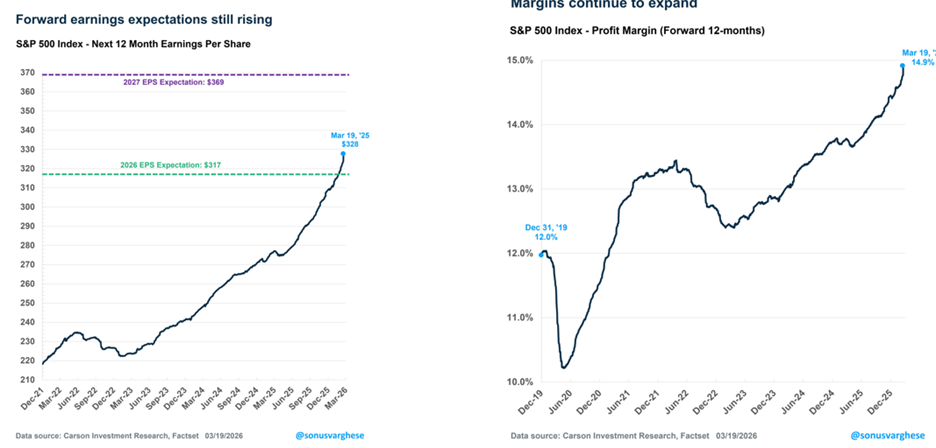
One bit of good news is that earnings continue to soar, with various groups showing no major stress from a change in consumer or business demand yet. Last week, we saw various airlines report solid guidance, and AI demand has shown no signs of slowing either. In the end, S&P 500 forward 12-month earnings estimates hit another new high last week, as did profit margins. There aren’t many better indicators for what stocks will do than earnings and profit margins, and this should be comforting for investors. Even though the headlines are scary, it doesn’t mean we should ignore good news when it’s there.
The Negative Sentiment Is Building, and That’s a Good Thing
Lesson three is sentiment matters.
Yes, the S&P 500 was recently about 7% off the late January highs, but if you saw some of the sentiment indicators, you would think it’s much worse. That’s a good thing. Often, the more extreme the emotion, the greater the benefit of being contrarian. That doesn’t mean we’re calling a bottom. But greater fear means more bad news is likely already priced into the market, making an upside surprise more likely. Six years ago this week, for instance, stocks bottomed after a vicious 34% bear market during COVID, and, incredibly, in some cases, we see more fear now than during a 100-day pandemic year. Oh, and stocks have nearly tripled since then.
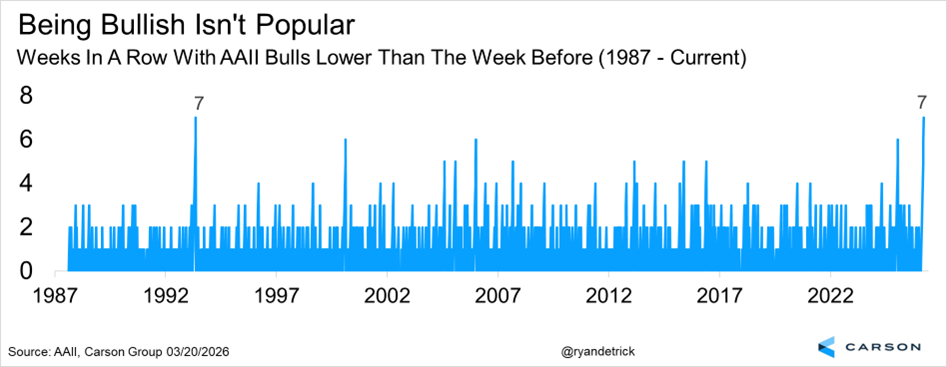
I looked at sentiment last week in 11 Reasons Sentiment Says To Remain Bullish, but one more piece to the puzzle that caught my attention was that the number of bulls in the American Association of Individual Investors (AAII) has decreased a record-tying seven weeks in a row. We find out tomorrow if this will go to a record eight, but either way, this is another way to show just how on edge most investors really are.

Stay on Top of Market Trends
The Carson Investment Research newsletter offers up-to-date market news, analysis and insights. Subscribe today!
"*" indicates required fields
Corrections And Bear Markets Happen
Lesson four is corrections, and bear markets happen.
The S&P 500 moved into a 5% mild pullback last week. The big question now is, could it get worse? We looked at all the 5% mild pullbacks since World War II and found that things moved into a correction (down 10%) about 25% of the time, and only 12.4% of the time did it move into a bear market (down 20%).
Add to this that our very own Barry Gilbert, VP, Asset Allocation Strategist, wrote about these ‘bad years’ and provided some much-needed perspective just a few weeks back.
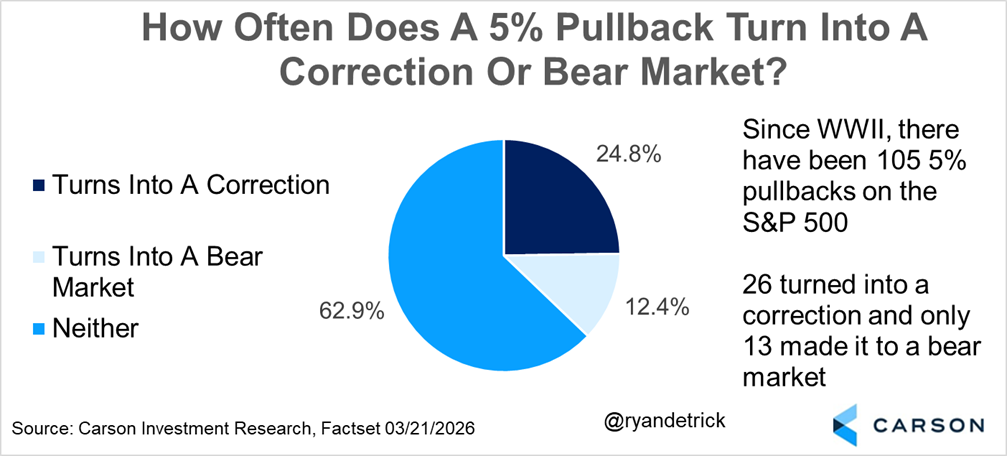
Of course, if the situation in the Middle East gets worse, then the selloff could absolutely get worse. But with so many anticipating the worst and expecting another bear market right around the corner, it is important to put into context that the most likely scenario is that stocks don’t go into a bear market, which remains our base case.
Putting 2026 Into Perspective
The final lesson to always remember is that most years have scary pullbacks, yet when all is said and done, the full year usually does just fine. Last year, for instance, saw stocks down 15% for the year in early April, and pure panic was in the air, yet in the end, stocks still gained close to 17%.
Looking at all the years since 1980, the average peak-to-trough correction was 14.1%, with the full year up a very solid 10.7%. I’ve done a lot of client presentations so far this year, and one thing I’ve said many times is that you can do yourself a big favor by expecting stocks to see a double-digit correction each year. If it doesn’t happen, that’s great. But if it does? You are better prepared for it.
Peeling back the onion a tad more, and we found that 24 years (out of the past 46 since 1980, so more than half) were down at least double digits at some point during the year, and 14 times stocks finished the year higher. In fact, the average full-year gain over those 14 years was a very impressive 17.4%.
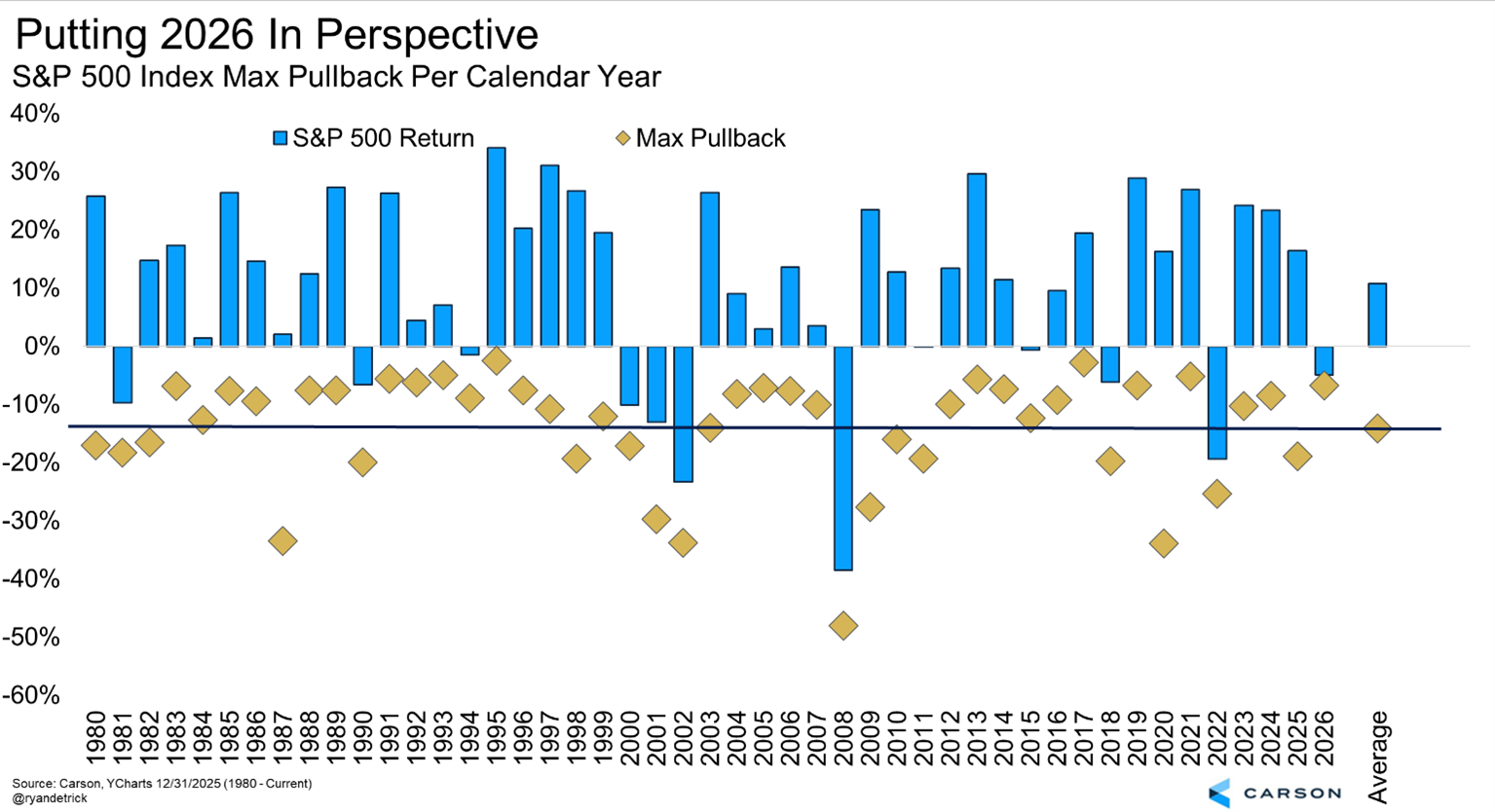
There is a good chance that in each of those years when stocks were down at least double digits, the overall feeling was one of worry. They say the stock market is the only place that things go on sale and everyone runs out of the store screaming, and I agree. When you look at it this way, you can plan for weakness and volatility and use them to your advantage.
In conclusion, the headlines and volatility aren’t fun for anyone, but it is all part of longer-term investing. We remain optimistic that this too shall pass, and investors will be rewarded once again for sticking to their investment plans. Lastly, I was honored to join Morgan Brennan on day one of her brand new show on CNBC called Morning Call. You can watch the full panel discussion below, where I discussed some of these lessons.
For more content by Ryan Detrick, Chief Market Strategist, click here.
8841359.1. – 25MAR26A