
Shares of Moderna surged a whopping +177% last Wednesday. The move came on the heels of a milestone readout from a medicine in its oncology portfolio known as Intismeran. Intismeran is a personalized cancer treatment designed to help the immune system recognize and attack a patient’s cancer cells based on the unique mutations in that patient’s tumor. The results represent an important milestone for Moderna’s oncology ambitions and potentially the beginning of a much broader application for personalized mRNA medicines in cancer.
A Dire Diagnosis
All too often, melanoma patients receive devastating news: the cancer has returned or spread. For the 200,000 new diagnoses of melanoma annually in the US1 and EU2 combined, and for all those currently living with the condition, treatment options came with low success rates. Melanoma is one of the more aggressive forms of skin cancer, and its biology makes it particularly challenging to treat. Unlike many diseases where patients share relatively similar underlying biology, the mutations driving one patient’s melanoma can look very different from those driving another patient’s cancer. This variability has historically made the idea of a single, uniform treatment difficult.
Merck’s Breakthrough
Modern oncology has developed two complementary ways to take advantage of the body’s natural immune defenses to help overcome this genetic differentiation among melanoma patients: remove the brakes from the immune system that cancer treatments impose, and teach the body which cells to target.
Merck’s Keytruda helps the body ‘release the brakes on the immune system’ otherwise experienced during cancer treatment to help the body naturally fight the damaged cells. Keytruda has been a resounding success, with sales of this medicine growing from $500 million in 2015 to over $31 billion in 2025 (FactSet data).
In this latest melanoma-focused trial, Keytruda was shown to produce recurrence-free survival of 49.1% at the 4 year mark, as shown below3. Trial results showed that Keytruda provided patients a path to healthier and longer lives, though scientists believed it could still be improved upon. If Keytruda released the brakes of the immune system, perhaps we could teach our body which cells to attack.
Moderna’s mRNA technology
Messenger RNA gained popularity during the Covid-19 pandemic, with Moderna sequencing the genome and developing a vaccine for this infectious disease within weeks of the outbreak. This Covid-19 vaccine was heralded for its speed to market powered by Moderna’s mRNA platform, but what might have been overlooked is the targeting potential offered by mRNA.
Rather than injecting the patient with a vaccine based on a generic genome, Moderna’s personalized cancer treatment is developed after sampling tissue from each patient’s tumor. This mRNA treatment then teaches the patient’s body how to most effectively fight their disease rather than a generic sample.
Moderna saw the potential for their personalized treatments, known as Intismeran, to boost the effect seen from Keytruda in melanoma patients. If Keytruda releases the brakes on the immune system, Intismeran gives the immune system better directions on which cells to attack.

Stay on Top of Market Trends
The Carson Investment Research newsletter offers up-to-date market news, analysis and insights. Subscribe today!
"*" indicates required fields
Moderna and Merck chose to launch clinical trials with a combination treatment of Keytruda + Intismeran in melanoma. The two companies knew that melanoma is hard to treat given that genetic mutations can vastly differ between patients.
But therein lies the large opportunity: a successful trial outcome in one of the most genetically diverse diseases may signal that the combination could be effective in more genetically uniform diseases and potentially aid an even larger patient population.
The Results
As highlighted above and shown in the chart below, results from phase 2 trials treating melanoma with Keytruda alone saw a 49.1% recurrence-free survival rate at 4 years post-treatment. When adding Moderna’s Intismeran to the treatment plan, the recurrence-free survival rate jumped to 72.4%. Although the companies have yet to release full phase 3 trial data, the headline results announced last week for successfully meeting its interim analysis is a landmark milestone. As the Wall Street Journal put it, “[this] trial not only met its primary goal of preventing cancer from coming back, it also cleared a secondary goal of preventing the cancer from spreading throughout the body.”5
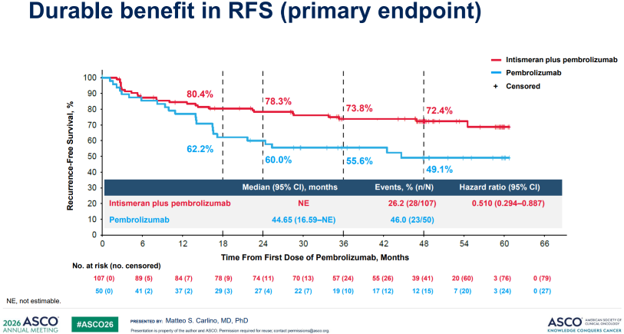
Slide courtesy of Moderna3
Moderna CEO Stephane Bancel went further to say that these “positive results from the Phase 3 INTerpath study…marks the first and only combination regimen to demonstrate a clinically meaningful improvement over [Keytruda] alone. We have started to demonstrate the potential of an entirely new class of medicine—and an entirely new way of thinking about cancer care: using the information encoded within an individual patient’s cancer to design a specific therapy that helps train their immune system to fight it. The possibilities ahead are only beginning to come into view.”4 Moderna’s Intismeran remains in clinical trials working to attack lung, bladder and kidney cancers, among others.
Moderna’s Melanoma Milestone is the first time personalized mRNA has demonstrated clinical success in a large phase 3 cancer trial. Melanoma, and other cancers, too often come with devastating news and low treatment success rates. But last week’s news offers new hope to those facing unthinkable options. Moderna’s personalized mRNA platform may extend far beyond just one medicine to give us all a chance at a longer and healthier life.
- https://seer.cancer.gov/statfacts/html/common.html
- https://gco.iarc.who.int/media/globocan/factsheets/populations/940-european-union-27-fact-sheet.pdf
- https://irp.cdn-website.com/89dd0539/files/uploaded/Intismeran+5-yr+Update+Oral+Presentation_ASCO_28May2026.pdf
- https://www.modernatx.com/ir-insights-phase-3-intesmeran
- https://www.wsj.com/health/pharma/moderna-cancer-vaccine-3d863ff3
For more content by Blake Anderson, CFA®, Director, Portfolio Management, click here.
9091719.1. – 25AUG26A