Welcome to Carson Investment Research’s Earnings Check-In. This series is built weekly from FactSet’s Earnings Insight report (John Butters, VP, Senior Earnings Analyst with FactSet), with index weights and market caps sourced from YCharts, and aggregation performed in-house. We tie every figure to FactSet’s published numbers, then add Carson’s perspective on top of that. We publish our Earnings Check-In weekly during earnings season.
Last week in The Shortage Quarter, I set a simple test for Meta, the first of the big AI spenders to report. If it held its profit margins, kept its spending plans, and its stock rallied, I’d take that as a sign the worries about the cost of the AI buildout were early. Meta beat on profits and kept spending, and its stock still fell 7% the next day. That told me I was asking the wrong question. Whether AI buyers keep spending matters less now than how they’ll pay for it, and the answer lies in their cash.
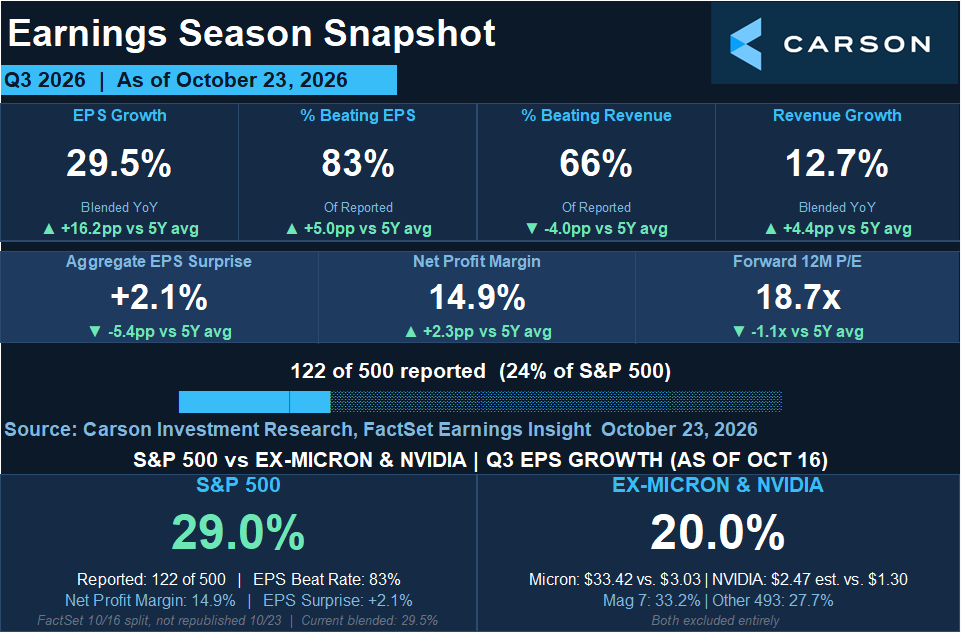
Start with earnings, because they look healthy. About a quarter of S&P 500 companies have reported, and blended earnings growth, which combines actual results with estimates for companies that haven’t reported yet, is 29.5%, up from 29.0% in last week’s report. 83% of companies beat analysts’ estimates, though by less than usual, partly because analysts raised estimates during the quarter and set a higher bar. Profit margins are 14.9%, second only to last quarter’s record. The ex-Micron and NVIDIA panel still shows October 16 numbers because FactSet didn’t update that breakdown this week.
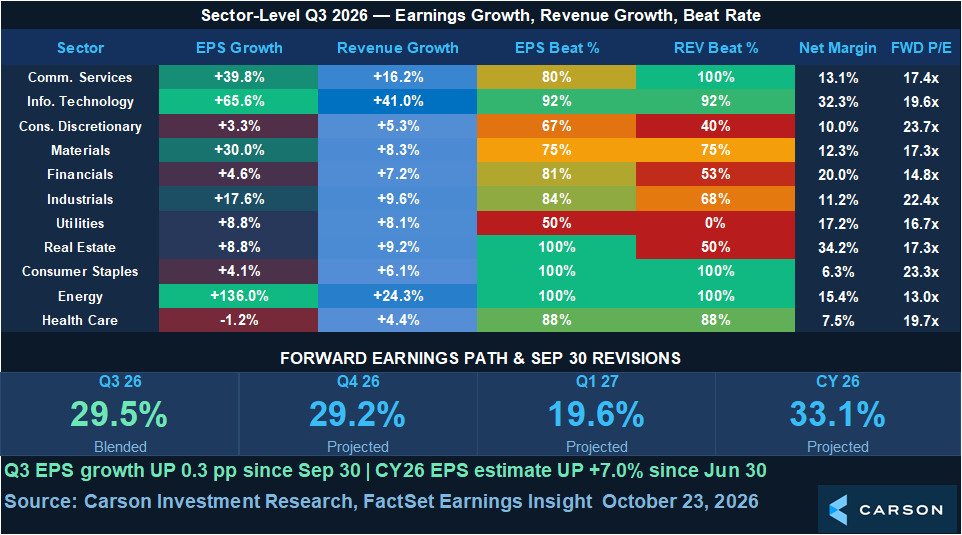
Energy and Technology are still doing the heavy lifting, Communication Services slipped to 39.8% from 50.2% almost entirely because of Meta, and analysts are still raising their fourth-quarter estimates. If you only looked at earnings, you’d have little reason to worry, which is why Meta’s week is worth slowing down on.
What Meta Taught Us
On paper, Meta missed. FactSet records earnings of $3.83 a share against an estimate of $6.54, but that includes a $9.89 billion legal settlement. Excluding it, Meta earned $7.40 per share, about 13% above the estimate by my math, on revenue that grew 26%. Its operating margin did slip to about 35% from 40% a year ago, so some of the buildout’s cost is reaching profits, just more slowly than many expected. Investors have also been forgiving of misses this season, with stocks dipping just 0.4% on average after a miss compared with a 5-year average of 3.1%, according to FactSet—a 7% drop points to something other than the earnings.
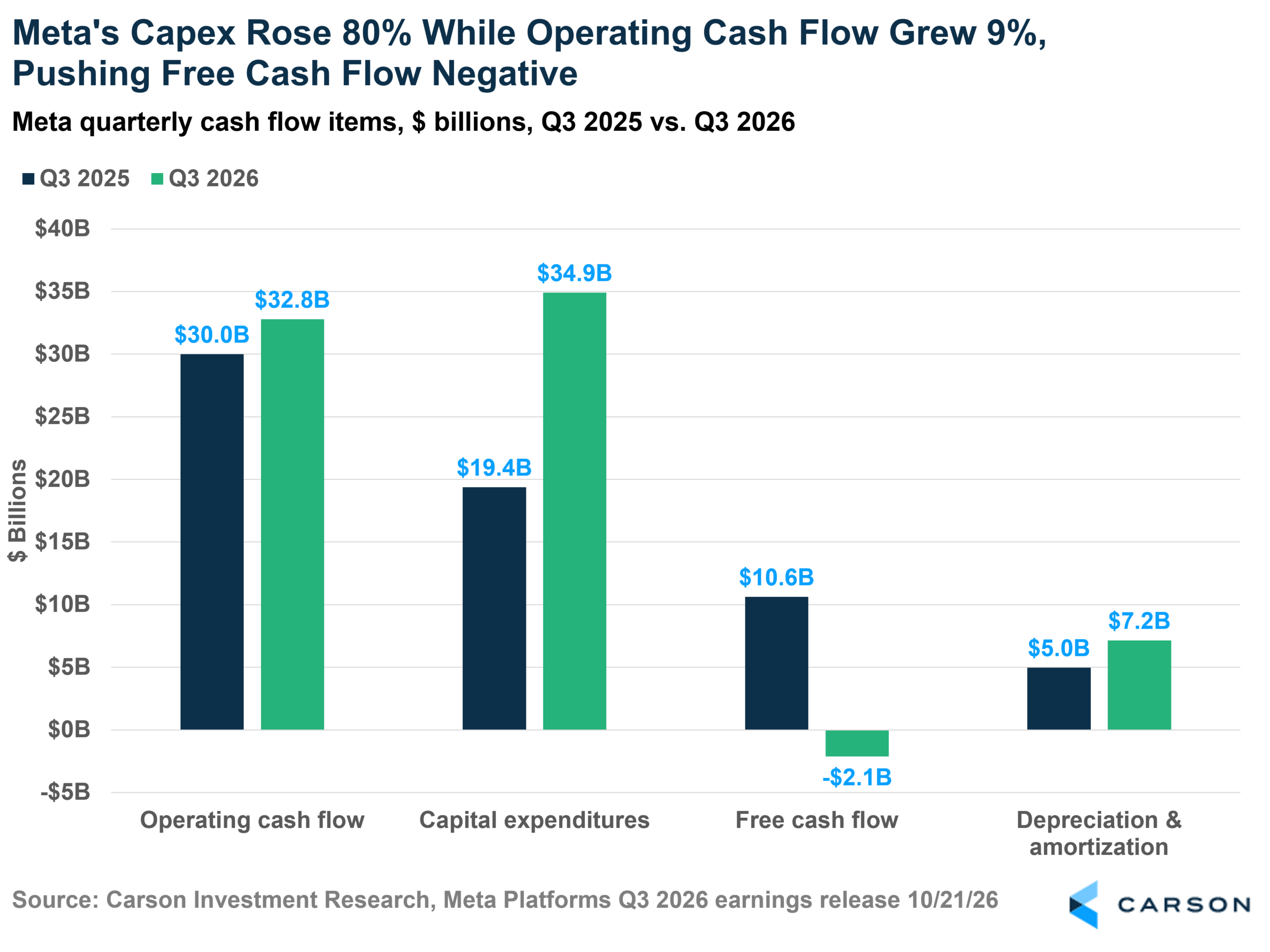
That something shows up in the cash flow statement. Meta spent $34.9 billion on data centers and the equipment inside them in the third quarter, up 80% from a year ago, while the cash its business brought in grew just 9%. Its spending outran its cash for the first time in at least a decade, according to the Financial Times (“FT”), and free cash flow, what’s left after paying for that spending, fell to-$2.1 billion. Meta’s full-year guidance implies it will spend even more in the fourth quarter.
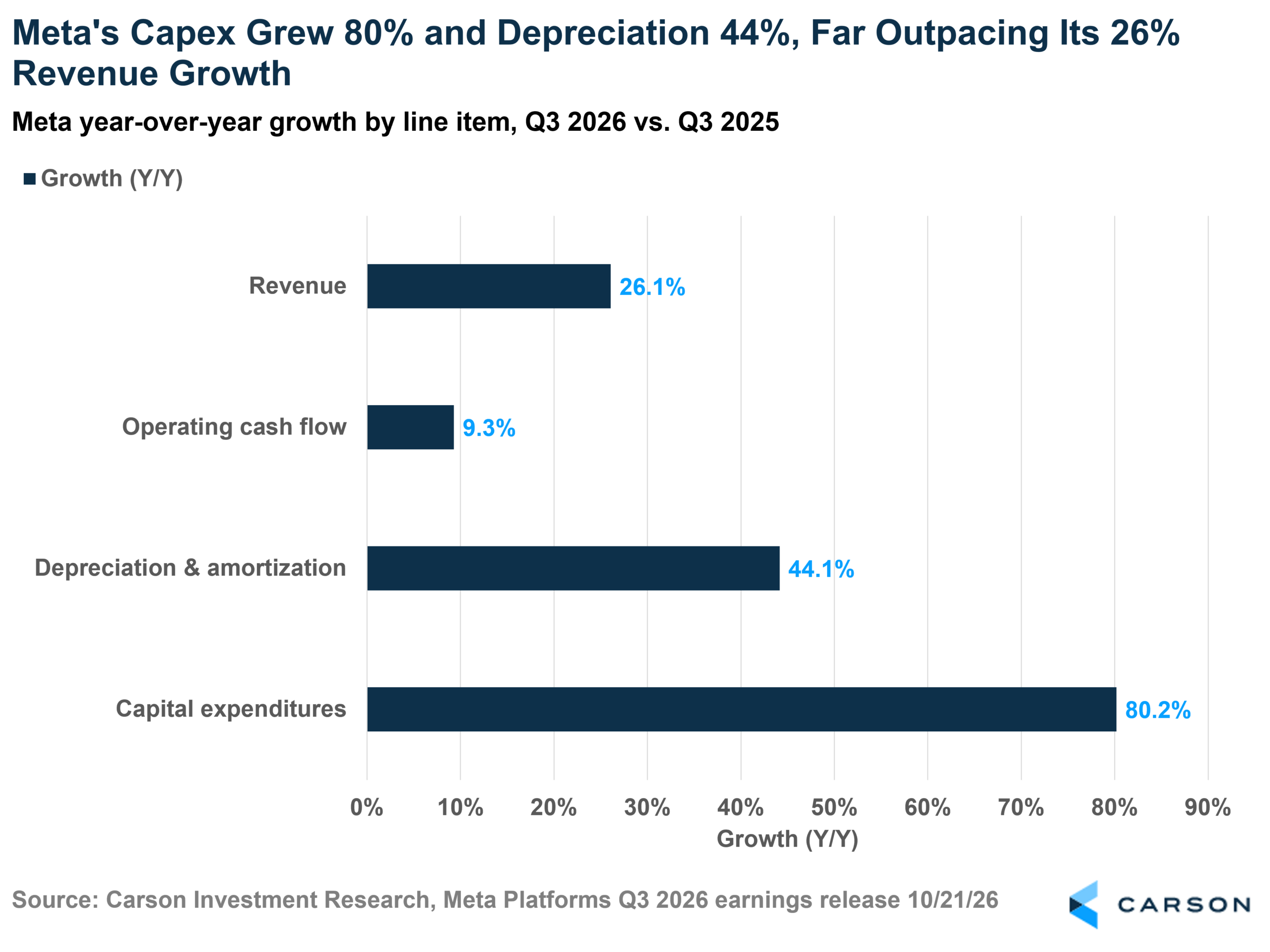
Profits and cash can split like this because of how big purchases get counted. If you buy a $40,000 car you plan to drive for ten years, you might think it costs $4,000 a year, but your bank account knows the full $40,000 is gone. Companies treat data centers the same way. They spread the cost over the equipment’s life, what accountants call depreciation, so only a slice hits the profit line each year. Meta counted $7.2 billion of depreciation this quarter against $34.9 billion of spending. Back in August, in Checking Our Own Work, I said record profit margins depended partly on the cost of the AI buildout staying off the income statement. Most of Meta’s cost still hasn’t reached its profits, but it has already left its bank account.
Paying for It
When the cash coming in doesn’t cover what you’re spending, you borrow or raise money from investors, and Meta is doing both. Its long-term debt is up $22 billion since December, and it announced a new class of stock with no voting rights, saying in the filing that it expects to need “hundreds of billions of dollars” over several years. The board committee that designed the plan considered borrowing more but warned that more debt could hurt Meta’s credit rating, so it chose stock. Non-voting shares let Meta raise that money without diluting Mark Zuckerberg’s control of about 61% of the votes.
The timing also relates to Zuckerberg personally. California voters will decide on November 3 on a one-time 5% tax on residents worth more than $1 billion, and according to the FT, he planned to leave the state if it passed. The deal lets him sell the new shares without giving up votes, including enough to cover the tax, in exchange for staying in California for eight years.

Stay on Top of Market Trends
The Carson Investment Research newsletter offers up-to-date market news, analysis and insights. Subscribe today!
"*" indicates required fields
I think the new share class was a big part of the stock’s drop. It tells shareholders to expect a lot more shares down the road, with less say in how the company is run. I wouldn’t pin the whole 7% on it, since a New Mexico judge ordered Meta to pay $25 billion over the Cambridge Analytica case the same day, and oil jumped the next day. Still, the share class is Meta’s answer to how it pays for AI, and that answer is outside money.
Why the Whole Index Should Care
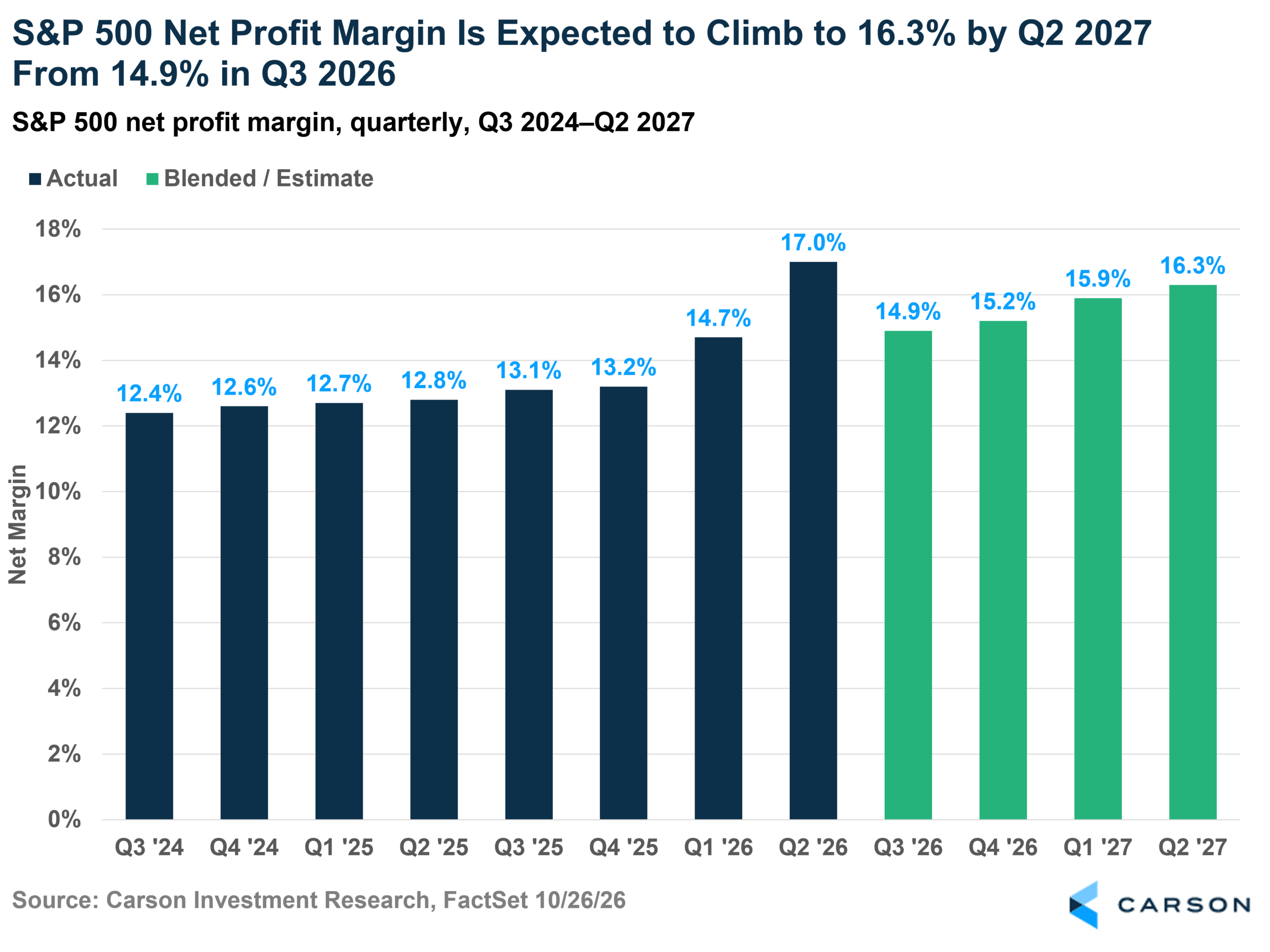
If Meta’s spending stayed inside Meta, this would be a Meta story. Much of what AI buyers spend on chips becomes revenue for sellers like NVIDIA and Micron, and sellers book that profit right away while buyers spread the cost over years. That’s a big reason Technology’s profit margin jumped to 32.3% from 27.5% a year ago. Analysts expect margins to climb to 16.3% by mid-next year. That path leans on the buyers being able to keep paying, and Meta just showed its own cash no longer covers the bill. To be fair, Meta’s revenue grew 26%, and spending ahead of the payoff is what a buildout looks like. One quarter of negative free cash flow isn’t a verdict on whether the spending works.
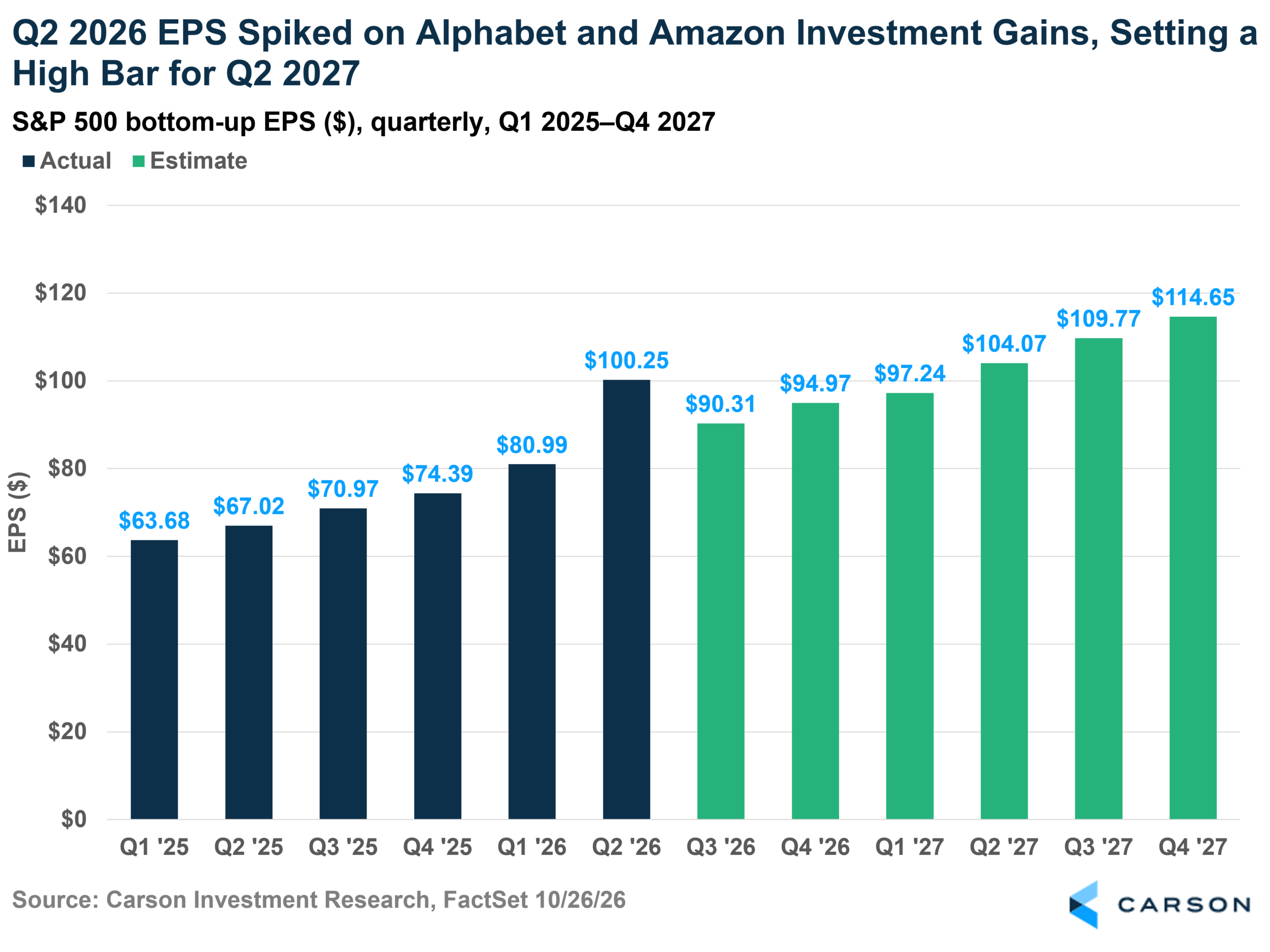
This also isn’t the first time this year that earnings and cash went separate ways. Second-quarter earnings per share jumped to $100.25 partly on paper gains from Alphabet and Amazon’s investments in AI companies, according to the FT, profits that never arrived as cash. That inflated quarter is why FactSet’s growth estimate for Q2 2027 is only 2.9%, and it’s one more reason I’d rather follow the cash this season.
What Investors Are Paying
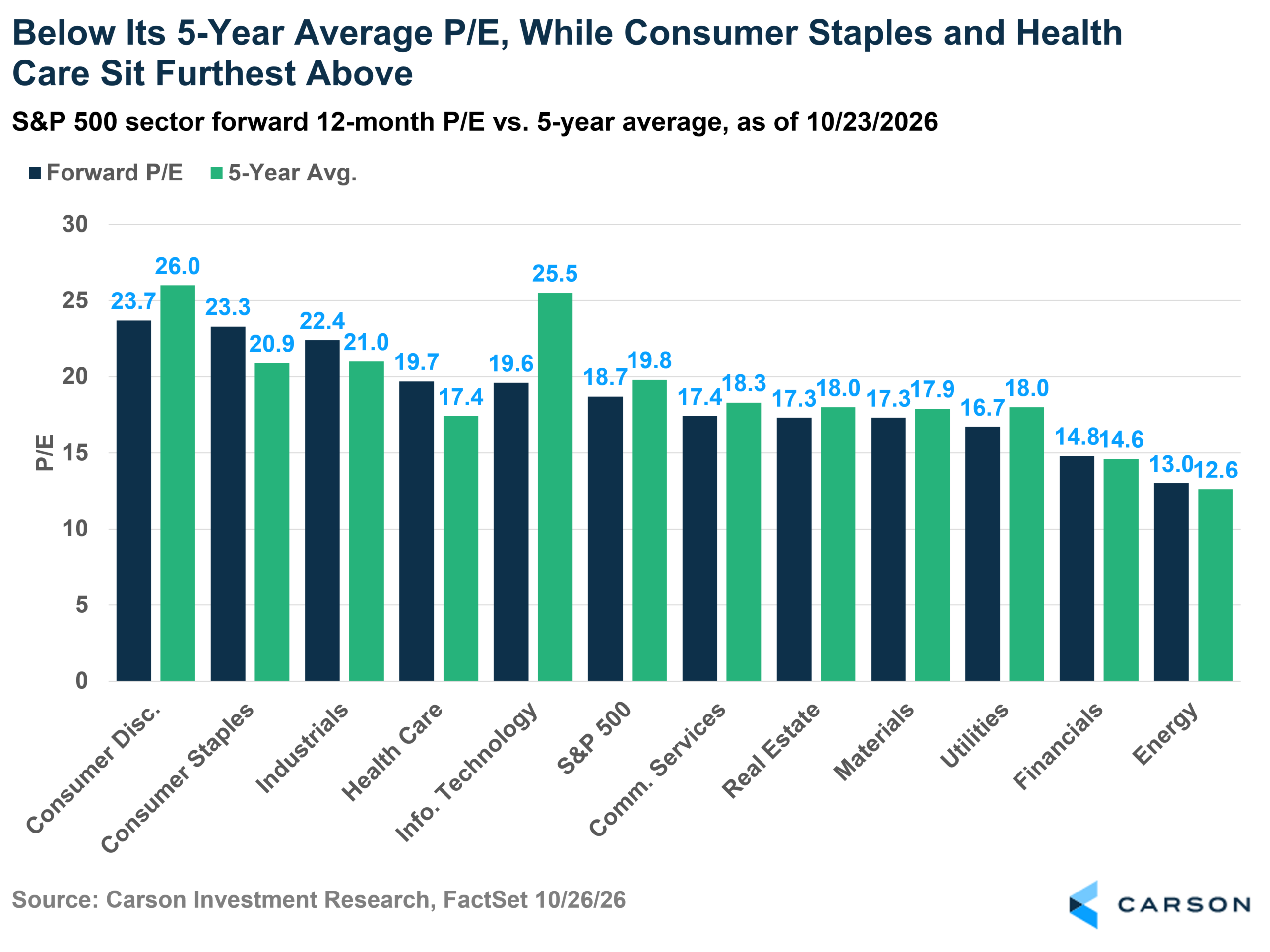
Investors seem to be adjusting already, paying less for each dollar of expected earnings even as analysts raise their estimates. Technology, mostly chip sellers, trades at 19.6 times next year’s expected earnings, well below its 5-year average of 25.5 and below Consumer Staples at 23.3, even though analysts expect Technology earnings to grow 42% next year. My read is that investors are discounting the sellers’ profits because those profits depend on buyers who now need outside money to keep paying. There’s a simpler explanation I can’t rule out, which is that investors usually pay less for chip profits they think are near a peak—the shortage argument from last week. My colleague Sonu Varghese showed the same shift in prices in You Want Market Breadth? You Got It, but Be Careful What You Wish For.
What Would Change My Mind
Alphabet, Microsoft, and Amazon report this week, and they’ll tell us whether Meta is the rule or the exception. My colleague Blake Anderson’s test in Tech Spenders Outpace Receivers As Earnings Approach is whether the buyers’ revenue is growing faster than their spending, and Meta failed it. Blake also found investors have rewarded the spenders over the past 13 weeks, so the market hasn’t given up on them. I’ll add free cash flow to his test. If the other three are still paying for their buildouts with their own cash, Meta’s problems are mostly Meta’s. If they look like Meta, paying for AI becomes this season’s story, and that matters more with the 10-year Treasury yield near 5%. As Sonu and I wrote in Can Rate Hikes Slow the AI Boom?, the dot-com buildout survived six rate hikes and ended when the investments stopped looking like they’d pay off. A company paying with its own cash can wait a lot longer for that payoff than one paying with borrowed money.
Reporting This Week
179 S&P 500 companies report this week, including 10 in the Dow, and the Fed meets in the same stretch. Meta showed that buyers are still spending. This week we find out whether the rest of them can still pay for it themselves. Be back next Tuesday.
By Harry McDonald, Analyst, Investment Research
9203860.1. – 27OCT26A