I was honored to be a guest on Facts vs Feelings last week! Ryan, Sonu, and I tackled one of the hottest topics of 2026 – the SpaceX IPO. Below are some of the charts I referenced when talking about SpaceX (the company) and SPCX (the IPO)! I’ve added a couple of additional points we didn’t have time to cover in the podcast, but might still be top of mind for investors as the IPO date approaches.
The following is not an endorsement to buy, sell, or hold SpaceX or any other stock mentioned.
SpaceX Plays in Large and Growing Industries
Of SpaceX’s $18.7 billion in total revenue in 2025, $11.4 billion came from their ‘Connectivity’ segment, which is predominantly Starlink. Starlink’s orbital broadband aims to compete against industry incumbents like Verizon, AT&T, and T-Mobile, which are massive businesses.
Despite Starlink only producing a fraction of the industry’s revenue ($11.4 billion compared to $352 billion, as shown below), Starlink boasts much higher operating margins. This higher operating margin, in my opinion, suggests that Starlink benefits from very lucrative economies of scale and may indicate visibility into future profit growth.
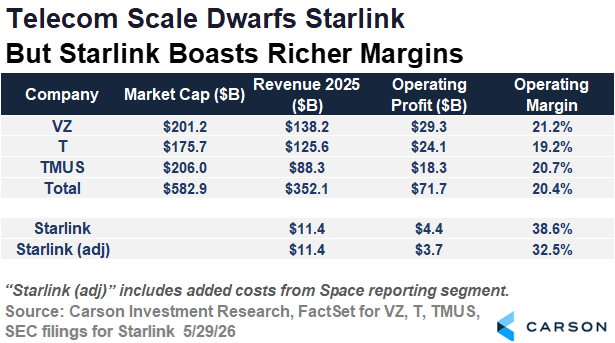
In this regard, SpaceX looks a lot like Tesla, in my opinion. Musk has positioned these businesses in entrenched industries (broadband, and automobiles, respectively) with new technology (orbital satellites instead of radio towers, and electric vehicles instead of internal combustion engines) to deliver outsized profit margins at even a fraction of industry share (Tesla produces roughly 16-18% gross margins, where as General Motors and Ford produce 9-12% gross margins, based on FactSet data).
Whereas Tesla is investing these outsized profits from electric vehicles into autonomous driving and humanoid robots, SpaceX may be investing profits from Starlink into orbital data centers and AI models. And there are early proof points that these investments are paying off, with SpaceX striking a deal with Anthropic worth up to $15 billion annually.1

Stay on Top of Market Trends
The Carson Investment Research newsletter offers up-to-date market news, analysis and insights. Subscribe today!
"*" indicates required fields
SpaceX (the IPO)
SpaceX has seemingly created a race amongst index providers to alter inclusion rules.
- Nasdaq on May 8th added a “Fast Entry” pathway for “new listings…ranking within the top 40 of current Nasdaq-100 constituents…[to be] evaluated on their seventh trading day and, if eligible, added shortly thereafter.” Companies previously were evaluated at the annual December reconstitution.2
- S&P Dow Jones Indices on April 30th previewed a “fast-track addition” for “MegaCap” companies – should a company have a market cap equal to or greater than the 100th largest company in the index (and qualify as ‘MegaCap’), it could be added to the index with five days’ lead time.3
- Additionally, these proposals would have waived the indices’ profitability criteria, noting “A company that is determined to be a MegaCap company as of the evaluation date is not required to pass the Financial Viability Criteria to be eligible.”3
- However, it does not appear this adjustment from S&P Dow Jones is progressing, as the index provider chose not to alter their rules after receiving feedback from the public (as of June 4th, 2026)5
- FTSE Russell on May 26th amended their inclusion process to assess “IPOs with an investable market capitalization greater than the market-adjusted total market capitalization breakpoint for the Russell Top 500, as of the previous reconstitution, will be eligible for potential fast entry inclusion. Eligible fast entry IPOs will be added after the close of the fifth trading day.”4
SpaceX may have forever altered index construction!
What it means for the index, and the other constituents, may be profound. If SpaceX comes into the S&P 500 (in potentially a year’s time), other constituents must become smaller in the index. Below is a hypothetical case of SPCX being added to the S&P 500 at a roughly 2.9% weighting (should SPCX be worth $2 trillion). Note that these are hypothetical, and the index reserves final allocation discretion and may make alterations based on free-float adjusted market capitalization.
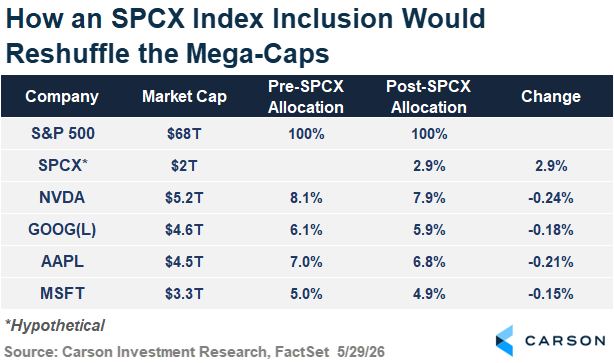
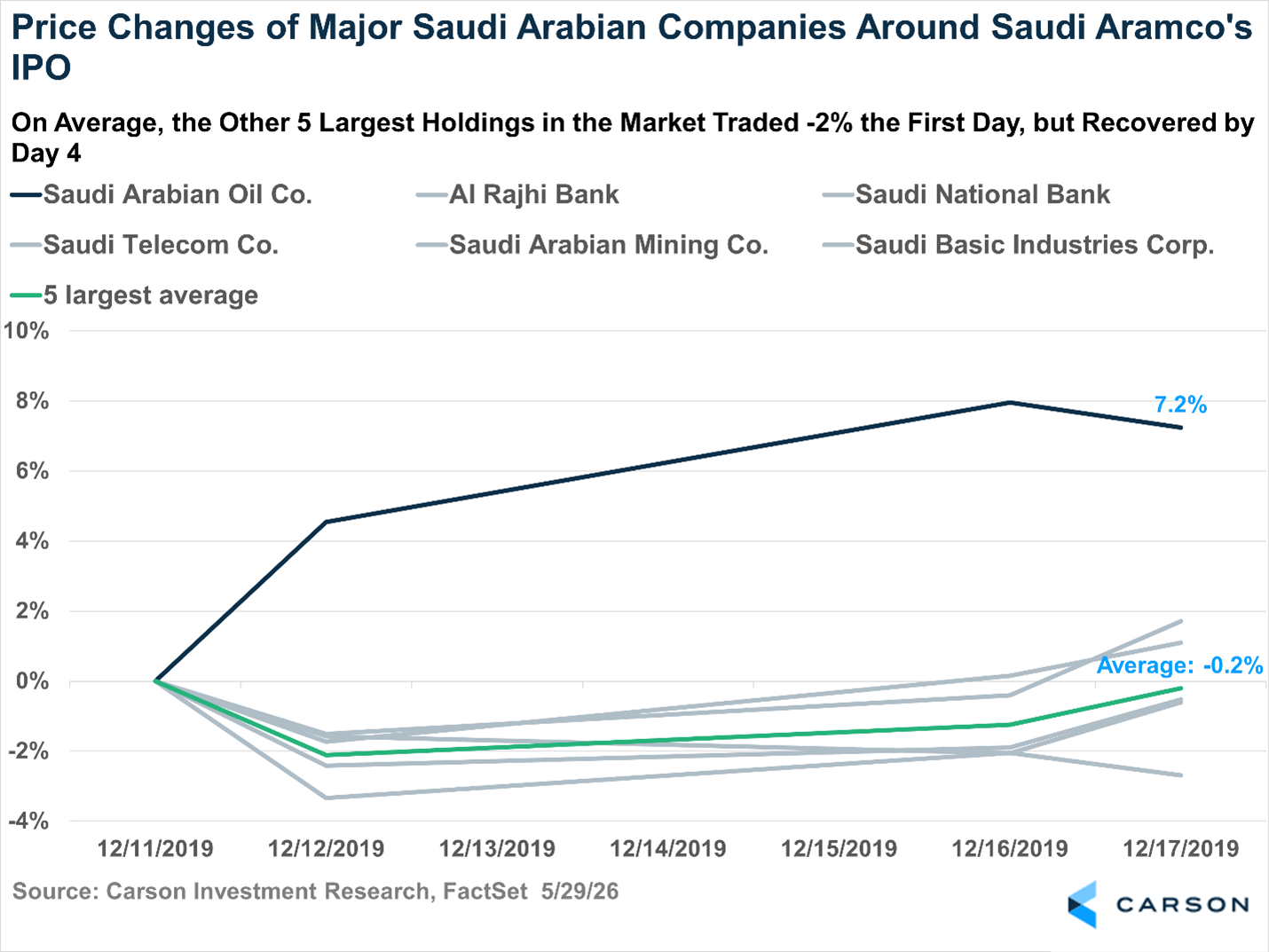
What we didn’t have time to touch on in the podcast is the potential impact on all those other constituents seeing a reduction in index weighting. A close analog to SpaceX being included in the S&P 500 may be Saudi Aramco IPO’ing and subsequently being added to that market’s index.
Saudi Aramco was the largest IPO deal at the time (raising roughly $26 billion), and when the company joined the Saudi Arabian index, it instantly accounted for about 8% of the market’s value (FactSet data). While Saudi Aramco was met with a warm reception, the other 5 largest stocks in that market were not. On average, the other 5 most valuable stocks traded -2% the day Saudi Aramco was included, as shown in the chart below (FactSet data). But by day 5 post-inclusion, these other 5 stocks had rallied back to be, on average, just -0.2% below where they were before Aramco’s inclusion.
SpaceX is poised to be one of the largest market stories of 2026. It’s already altered how major indices are constructed. And all of this comes before it has even started trading. All eyes are on the Nasdaq exchange floor in the coming days as buyers and sellers come together.
Check out the full Facts Vs Feelings episode below!
- https://www.axios.com/2026/05/20/anthropic-spacex-compute
- https://www.nasdaq.com/newsroom/nasdaq100-index-methodology-update-why-now
- https://www.spglobal.com/spdji/en/documents/indexnews/announcements/20260430-1483123/1483123_spdji-us-indices-megacaps-consult-20260430.pdf
- https://www.lseg.com/en/media-centre/press-releases/ftse-russell/2026/ftse-russell-introduces-ipo-fast-entry-enhancements-for-russell-us-indexes
- https://press.spglobal.com/2026-06-04-S-P-Dow-Jones-Indices-Consultation-on-Treatment-of-MegaCap-Companies-Results
For more content by Blake Anderson, CFA®, Director, Portfolio Management, click here.
8964452.1. – 8JUNE26A