In the third quarter, the Bloomberg US Aggregate Bond Index (“Agg”), the most widely used bond benchmark, fell 3.5%, its worst quarter since Q4 of 2022 (-4.8%). Suddenly, the trauma of 2022 was back for bond investors, and they once again forgot how bonds worked. I’ve anecdotally heard so much fear of bonds lately that I think we can fairly call this shift a relapse of bond derangement syndrome.
For me personally, I am no particular fan of bonds. I personally prefer stocks for the short and long run. But I am a fan of smart investing decisions. If aggressive equity positioning is not appropriate for your risk tolerance or doesn’t fit your financial plan (which is true for most investors), bonds are still an attractive way to diversify portfolio risk.
But they are not the only way. We are still strong advocates of “diversifying diversifiers.” But bonds can still legitimately be a primary portfolio volatility buffer and source of diversification. If the 60/40 is dead (an allocation of 60% stocks, 40% bonds), it’s only because it shouldn’t have been a thing in the first place. We were blinded by an extended period of extraordinary bond strength and low stock correlations. But if you call it the 60/40* portfolio, with the asterisk signaling a 40% allocation largely to bonds, but also Treasury bills and other diversifiers, then the 60/40* is very much alive and well.
I think the Carson Investment Team does an excellent job helping investors avoid the worst behavioral biases associated with stock investing. Many of those same arguments apply to the bond world too. It’s not as important a message on the bond side, since stocks are both a more significant driver of returns and more volatile. But bond derangement syndrome can lead to mistakes on the bond side similar to the mistakes investors make with stocks.
5 Symptoms of Bond Derangement Syndrome
- Do you understand that stock declines are normal but treat any moderate bond decline like a Greek tragedy?
- Are you steadfast that we should not treat every threat to stock markets as the reincarnation of the Great Financial Crisis, but take your bearings for bond markets from 2022?
- Do you focus on earnings for stocks and most of the time look past valuations because earnings are the main driver of stock returns, but focus obsessively on interest rate changes for bonds and ignore yields, which play an even stronger role for bond returns than earnings do for stocks?
- Have you ever said or thought, “I just don’t want to own any bonds in my moderate portfolio; they’re just too risky,” when the worst year for bonds on record is about the same as the average intra-year decline for stocks?
- Have you had someone present to you an investment vehicle that supposedly can replace your bond allocation, with recent bond returns as evidence, and embraced it without looking at the longer-term history, the forward-looking expectations, or costs?
If you answered yes to one or more of the above, you may be suffering from bond derangement syndrome.
Now all of the above is a little tongue-in-cheek. Bonds have their risks. And it is always important to keep in mind that very short-maturity Treasury bills, which investment professionals often refer to as “cash” (they don’t usually mean literal cash), are an alternative to bonds to consider. Bills do usually (not always) have a lower yield than bonds and have had a lower long-term return, but it also basically has no default risk and no volatility. Since 1992 (first shared history available), the Agg has had a 4.6% return; “cash” has returned 2.6%. But keep in mind that the lookback includes an extended period of ultra-low short-term interest rates.
Don’t Take Your Bearings from the Worst Bond Year on Record
Yes, 2022 was a very bad year for bonds; by most accounts, the worst on record dating back to the early 20th century. The Agg fell 13% in 2022. But that’s just a typical intra-year drawdown for stocks (the S&P 500 average intra-year drawdown is about 14.3%). Over the next three years, the Agg returned 5.5%, 1.3%, and 7.3%, an annual average growth rate of 4.7%. That’s 14.6% over the three years, just a little better than offsetting 2022’s decline.

Stay on Top of Market Trends
The Carson Investment Research newsletter offers up-to-date market news, analysis and insights. Subscribe today!
"*" indicates required fields
But then rates were low at the end of 2021, so if bonds are supposed to get you your yield over the long run, they more or less did their job over even a shorter timespan. (And yields aren’t low anymore.) Now Treasury bills did a little better over those three years of gains (4.9%), and much better if you include 2022. But if you asked most investors how bonds did from 2023 – 2025, I don’t think you would get many estimates near 5%.
Lessons from History
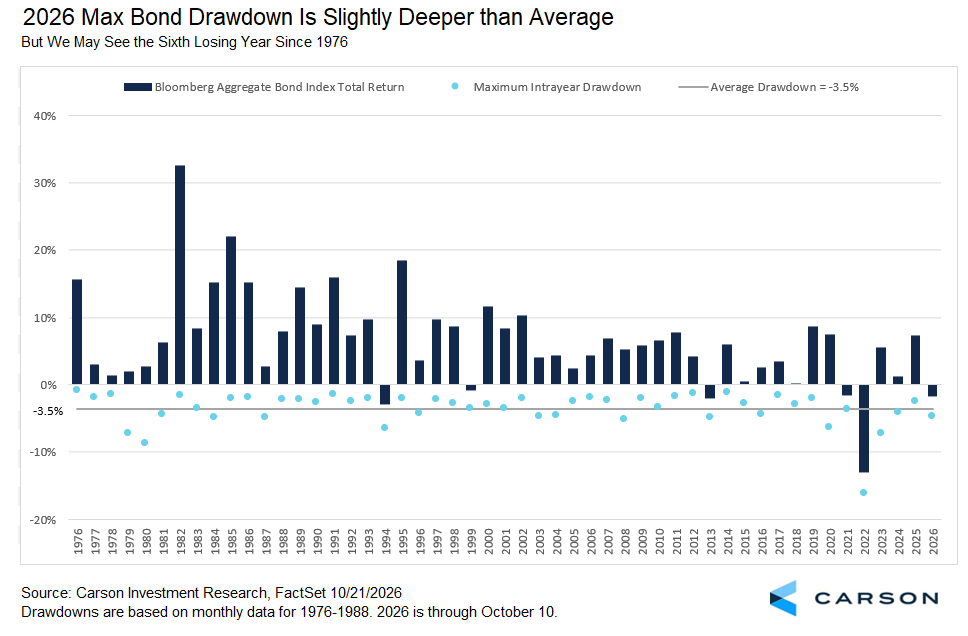
Let’s caution right away that prior performance is no guarantee of future returns. But rather than focus on 2022, let’s focus on the longer track record. The Agg has been around since 1976. From 1976 to 2020 (45 years of returns), it had only three years of negative returns. Then came 2021 and 2022, with their -1.5% and -13.0% losses. That was followed by three years of gains (discussed above). And now we may get our sixth negative return for the Agg in 2026. (The Agg was down 1.7% year to date as of Tuesday’s close.)
Despite relatively rare negative years, bonds have risk. You can see it in the pattern of intra-year drawdowns. We often share the chart of yearly stock declines to help make the point that declines are normal and to avoid panicking with every drawdown. Here are bond intra-year declines, which have averaged 3.5% historically, top to bottom. This year has been a little worse at -4.6%. Like stocks, volatility is the price we pay to invest in bonds, and there is a decline at some point every year. The decline for the Agg is about ¼ the decline for the S&P 500, but the risk premium you historically get above Treasury bills is also much smaller for stocks. The mistaken belief that bonds never go down is an important contributor to bond derangement syndrome. Correcting that to thinking of bonds as risky assets, lower risk but still risky, may help.
2022 Was an Unusual Year, and Chances of a Repeat Are Quite Low
You can also see on that chart what an outlier 2022 was. 2022 was a perfect storm of three different factors:
- Starting yields were extremely low.
- Since rates were very low, they were more vulnerable to a large move higher.
- There was an unusually strong catalyst for just that kind of move.
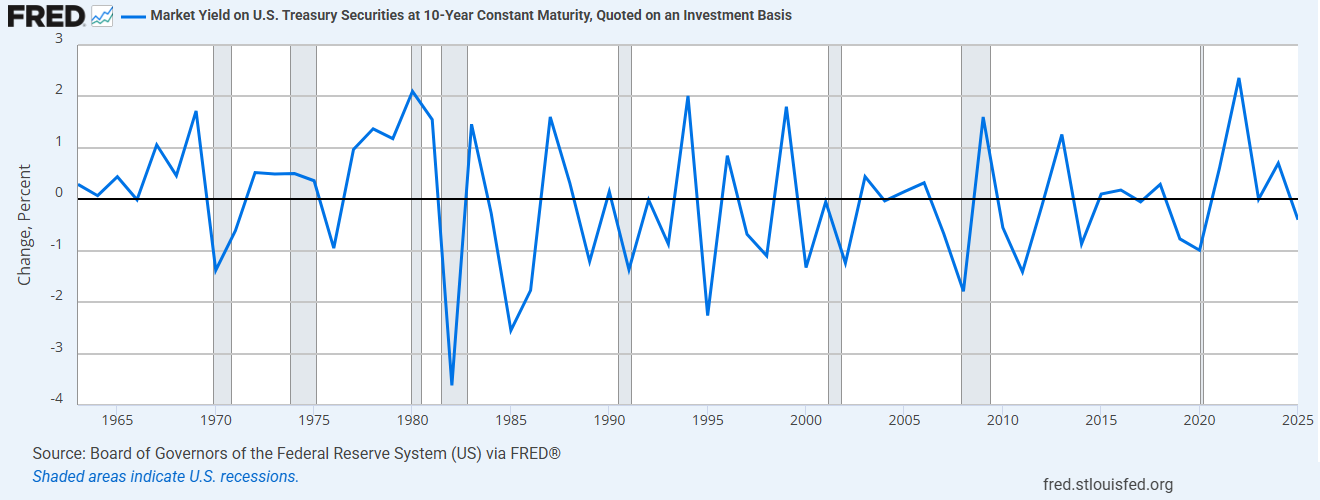
Below is the annual percentage point change in the 10-year Treasury yield based on year-end values. 2022 is the largest move on record. There are other years that were close, but those years also had higher starting yields, so you didn’t get anything on nearly the same scale as 2022. The worst of the three down years before 2021 (1994, 1999, and 2013) all had higher starting yields, which buffered some of the impact on rates. The worst of the (1994) saw the Agg decline 2.9%.
Bond Prices Don’t Go Down When Rates Go Up
Well, they do. You weren’t misinformed by the finance articles you have read or the finance course you might have taken. But there’s an important sense in which they actually don’t. No matter what interest rates do, the price you get for a bond at maturity (assuming no default) is unchanged by the path of interest rates getting there. If rates were at 2% when you bought a bond and 4% when it matures, the price you get at maturity is still exactly the same. How can that be? If bond prices fall when rates rise, how can rates go up a full 2 percentage points and the price at maturity still be par? I mean, it had to be falling at some point, right?
The main reason is there’s another force that impacts bond prices. It is very small, almost meaningless on a day-to-day basis, but like a river that carves out a canyon, over the life of a bond it is practically all that matters and ultimately indifferent to rate changes. It’s just the pull of par, the process of accretion or amortization to par in bond lingo. While almost invisible on a day-to-day basis, the pull of par together with the impact of coupon payments ultimately determines almost all of a bond’s return, and both are indifferent to rates (for fixed-rate coupons). Also, since they’re slower, steady forces, you could say that the parts of a bond’s returns they represent are uncorrelated to stocks, which gives risk a different meaning for bonds. The true driver of a bond’s (or bond portfolio’s) return over its lifetime is uncorrelated with stocks.
It’s a little like taking your dog out for a walk on a very long leash. You steadily progress through your walk, which is your bond slowly realizing its yield. Your dog runs back and forth, sniffing this, barking at that. Your pup’s movements are volatile and make up all the action in short time frames. But ultimately you finish your walk. Throw in that you slowly shorten the leash as the walk proceeds until your dog is just heeling as you head up your walkway, and you get some sense of how bond volatility works. You taking your walk—that’s the work a bond’s yield is doing. Your dog wandering here and there—that’s the short-term effect of interest rates. But in the end, you both get home at the same time. Yields do all the work. That’s why the yield when you purchase a bond determines its expected return over its maturity. It’s just in the bond math. Bond derangement syndrome gives all the attention to the dog.
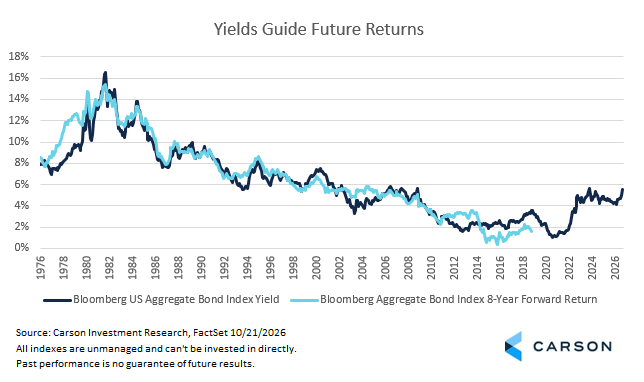
What does that mean for bond investors now? The yield on the Agg is currently 5.45%. That means over the next eight years, you’ll very likely get something close to a 5.45% return for an Agg-like bond portfolio even if in the short term there may be uncomfortable fluctuations. For a bond portfolio, you won’t get exactly that number, but constrained by the bond math, the difference doesn’t get very large. Historically, you’re +/- 1 percentage point from the predicted value 75% of the time, and you’re never way off.
The yield for a Treasury bill right now is about 4.2%. That 1% or so extra return is large enough to be meaningful, especially when compounded. The eight-year return for the Agg, if realized, would be 52% versus 39% if short-term rates stayed where they are and you stayed in bills. That’s not a life-changing difference, but it’s meaningful, especially if it makes up a large portion of your portfolio.
Investment Takeaways
The aim here wasn’t to revive the 60/40 or even argue for bonds over bills. And we wouldn’t ignore other ways of diversifying the 40 in the 60/40, both by going outside of bonds (managed futures, natural resources) and by how the remaining bonds are managed. The point really was: don’t avoid bonds just because of bond derangement syndrome, which the financial press sometimes seems to propagate like a fast zombie plague.
For more content by Barry Gilbert, VP, Asset Allocation Strategist, click here.
9193945.1. – 21OCT26A