Welcome to Carson Investment Research’s Earnings Check-In. This series is built weekly from FactSet’s Earnings Insight report (John Butters, VP, Senior Earnings Analyst with FactSet), with index weights and market caps sourced from YCharts, and aggregation performed in-house. We tie every figure to FactSet’s published numbers, then add Carson’s perspective on top of that. We publish our Earnings Check-In weekly during earnings season.
Welcome back! Four times a year, public companies report how much money they made in the quarter that just ended, and Wall Street calls that stretch earnings season. Third-quarter reporting kicked off last week with the big banks, and for the next couple of months I’ll check in every Tuesday on how S&P 500 companies are doing and what it could mean for investors.
If you’re new here, the second quarter was a big one. S&P 500 earnings grew 52.4% from a year earlier, the strongest quarter since 2021, and profit margins hit a record. One-time investment gains (holdings of private company stock) at Alphabet and Amazon helped, but earnings still grew 33.8% without them. In our final post of that season, Where the Baton Ended Up, I said strength was being handed off to technology and energy heading into Q3, and that whether it held would largely come down to the price of oil.
Coming back after six weeks off, I tried to treat that view the way I treat most of my views lately, as a map that might be out of date. So before getting into this week’s numbers, I want to start with what changed while we were away.
What’s Changed in Six Weeks
Oil prices did hold up, with West Texas crude averaging $85.68 a barrel in the third quarter, 32% above a year ago, and analysts now expect Energy earnings to grow 127.6% this quarter, up from 102.5% when we signed off. They also kept raising their numbers for the market as a whole. Analysts normally trim their estimates as a quarter goes on, by 2.2% on average over the past five years. Still, this time they raised them by 1.4%, and a record 72 companies told investors to expect better results than analysts had forecast.
The backdrop got tougher at the same time. The Federal Reserve raised interest rates in September for the first time since 2023, and the 10-year Treasury yield climbed to over 5%, near its highest level in more than two decades. Stocks still hit a new all-time high on October 6, but last week AI-linked stocks sold off hard, and the PHLX Semiconductor Index fell 11.4% in five days.
The First Week of Q3
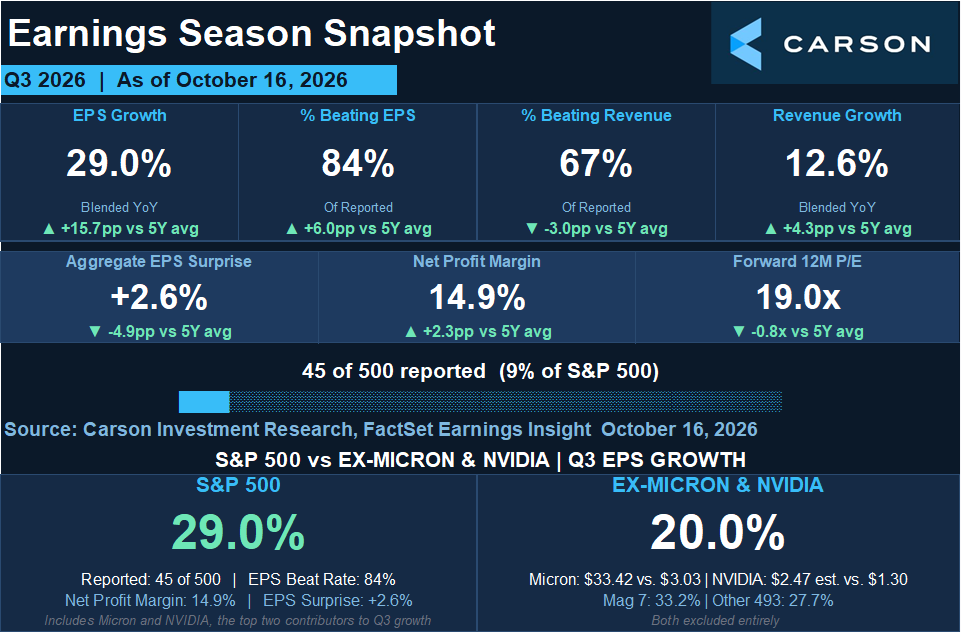
About 9% of S&P 500 companies have reported so far, and most of them are banks. The headline number is “blended” earnings growth of 29.0%. For blended earnings growth, FactSet combines actual results from companies that have reported with analyst estimates for the ones that haven’t, so this number will move around as real results replace estimates. If it holds, it would be the third straight quarter of earnings growth above 25%.
Growth slipped from 29.4% last week, mainly because analysts changed how they build one estimate. Most analysts covering Eli Lilly now count a one-time charge for buying the rights to experimental drugs, which cut Lilly’s expected earnings to $5.60 a share from $10.03 and flipped the whole Health Care sector to a 2.6% decline. Nothing about Lilly’s business changed that week, and excluding drug makers, Health Care earnings are growing 7.4%.
So far, 84% of companies have “beaten,” meaning they earned more than analysts expected, which is above the 5-year average of 78%. The beats have been smaller than usual, 2.6% above estimates in aggregate versus a 5-year average of 7.5%, and I’d mostly chalk that up to the banks. JPMorgan came in 6.0% below estimates and Bank of America 17.1% below, according to FactSet.
Profit margins, the share of each sales dollar companies keep as profit, are 14.9%, the second-highest FactSet has recorded since 2009. The forward P/E is 19.0, meaning investors are paying about $19 for every dollar of profit companies are expected to earn over the next year, a bit below its 5-year average of 19.8.
The bottom of the dashboard is where this season’s story starts to take shape. Take out just two companies, Micron and NVIDIA, and Q3 earnings growth falls from 29.0% to 20.0%.
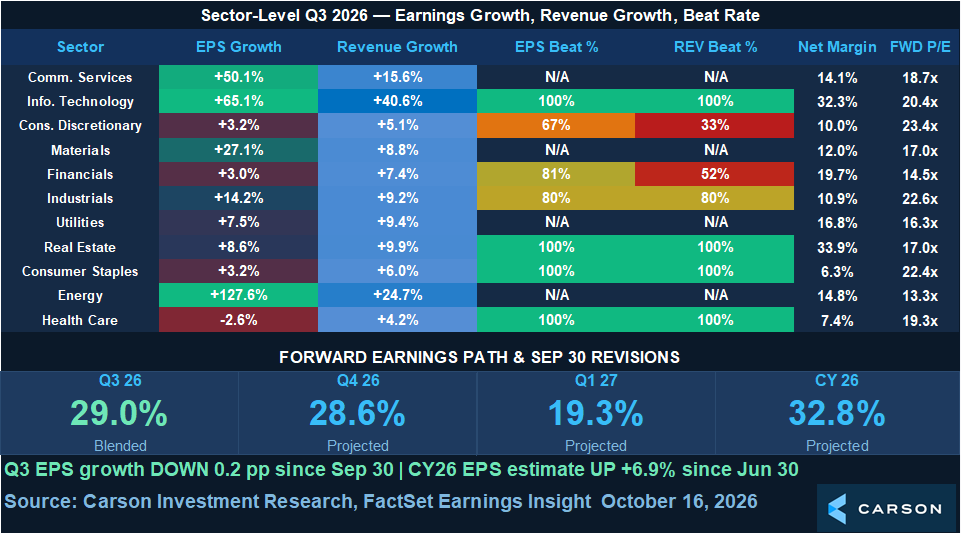
The sector table shows the same thing from a different angle. Energy earnings are expected to grow 127.6% and Technology earnings 65.1%, far ahead of everything else, while several sectors are growing in the single digits. N/A boxes have not reported yet.
A Quarter Built on Shortages
Micron, NVIDIA, and the energy companies leading this quarter are all selling things the world can’t get enough of right now, and that’s the thread I want to follow this season.
NVIDIA makes the processors that power AI, and Micron makes the memory chips those systems need. Micron earned $33.42 per share in its latest quarter, up from $3.03 a year ago. My colleague Sonu Varghese, our Chief Macro Strategist, wrote last week that so much of the market now depends on the AI buildout that stocks, bonds, and commodities have become one big trade. One piece of evidence he pointed to was producer prices for computer storage devices, up 84% over the past year, because supply hasn’t kept up with demand.
Energy tells a similar story, just with a different product. Refiners, the companies that turn crude oil into gasoline and diesel, are on track for 482% earnings growth after diesel margins hit record highs. By my math, using FactSet’s October 9 report, removing Energy would lower Q3 growth by about 4 points.
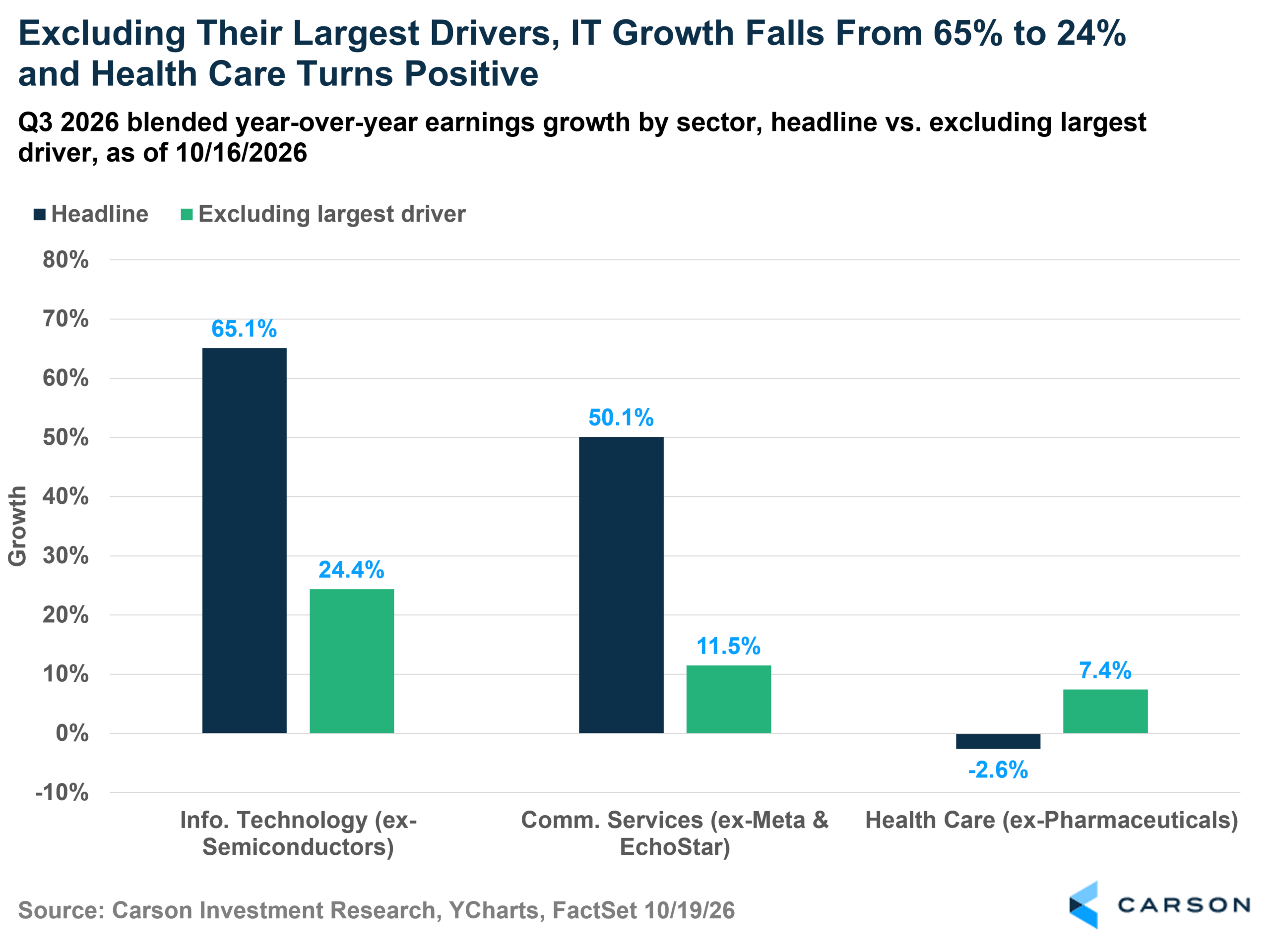
None of this means the rest of the market is weak. Strip out semiconductors, and Technology earnings are still growing 24.4%. Strip out Meta and EchoStar, both of which are being compared against year-ago quarters that included huge one-time charges, and Communication Services is growing 11.5%. Outside the shortages, earnings look healthy, just a lot more normal.
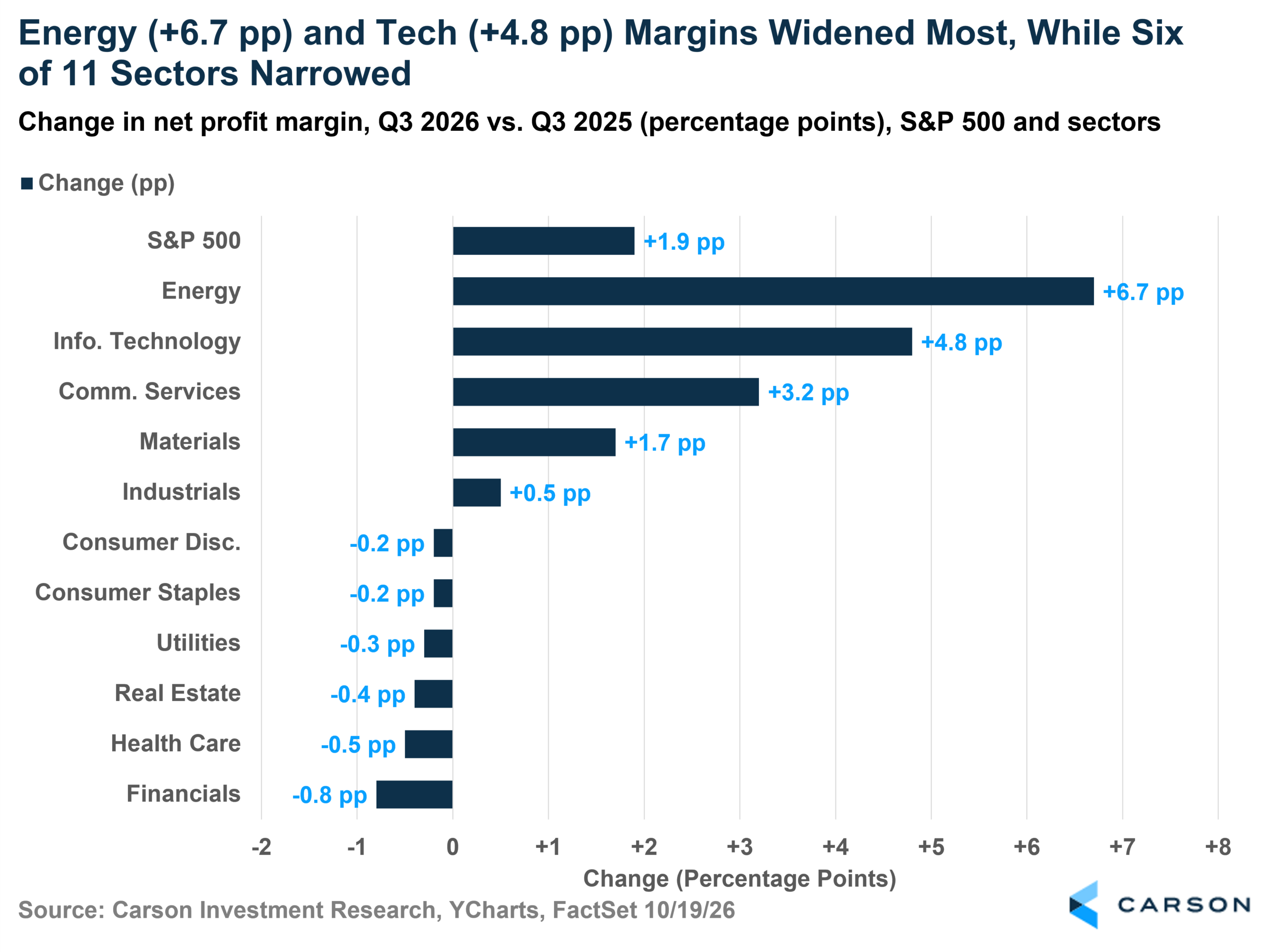
Margins show where the extra profit is coming from. Compared with a year ago, Energy margins are up 6.7 percentage points, and Technology margins are up 4.8 points, while six of the eleven sectors keep less of each sales dollar than last year. When something is scarce, sellers can charge more, so the biggest margin gains are showing up where there are shortages. The catch is that shortage profits tend to last until supply catches up, and much of the AI spending boom is an effort to catch supply up.
Two Ways to Read It
I don’t know how long these shortages last, and I’m not sure anyone does. What I can do is lay out what each answer would look like and watch for the evidence. Right now, investors and analysts are betting in opposite directions.
Investors are acting like the chip shortage is closer to its peak. Since the quarter ended, Micron is down 17.5%, and NVIDIA is down 6.2%, while the refiners Marathon Petroleum and Valero are up 20.9% and 14.7%. Micron is the biggest single contributor to S&P 500 earnings growth this quarter and beat its estimate, and the stock still fell. In my view, that’s investors trying to price the turn in the chip cycle before it shows up in reported earnings.
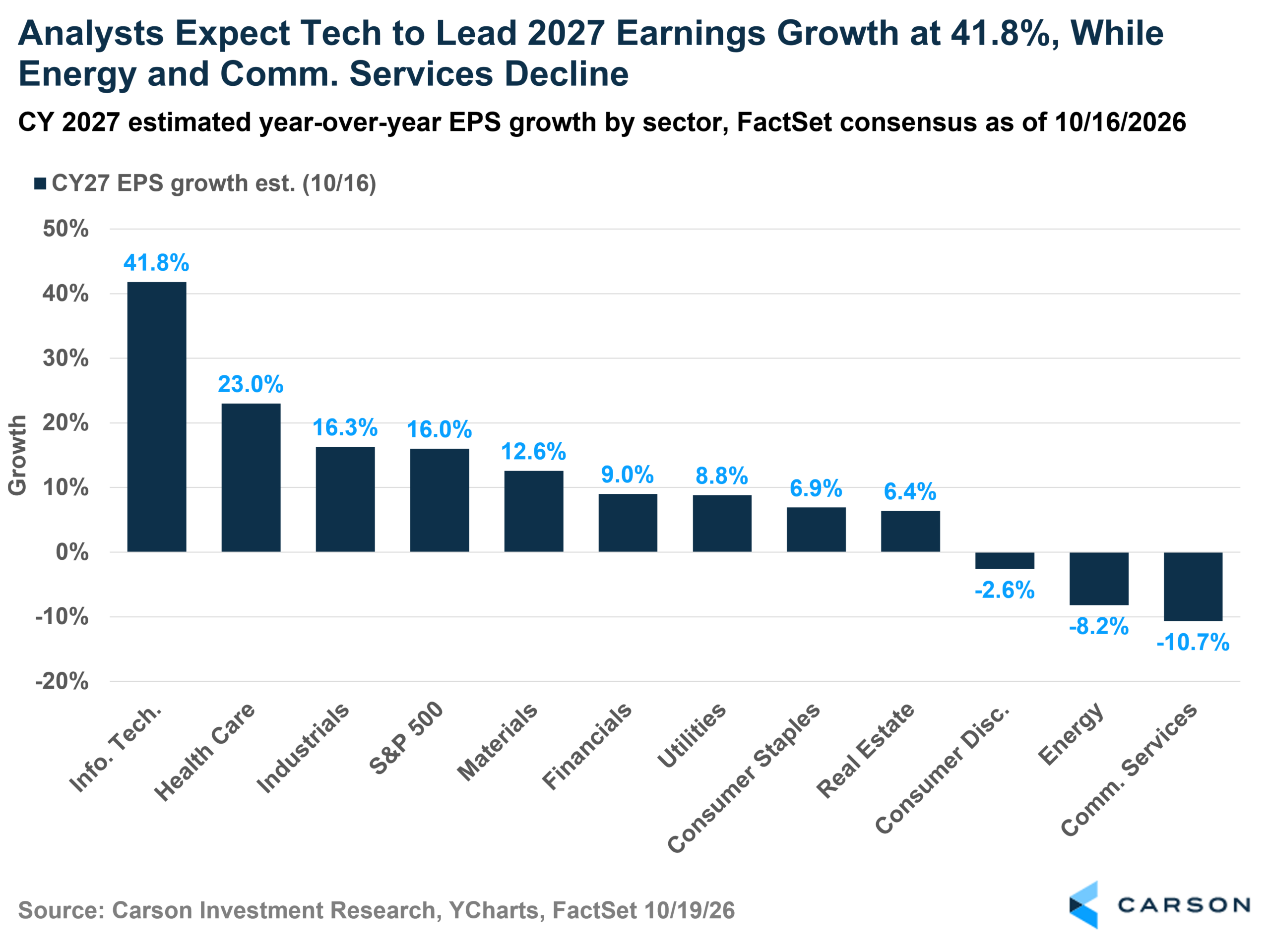
Analysts see it the other way. They expect Technology earnings to grow 41.8% in 2027 and Energy earnings to fall 8.2%, betting the chip shortage keeps paying, and the oil windfall fades. I’d take those numbers with a grain of salt, since estimates more than a year out tend to start optimistic and then come down. Either side could be right, and the companies that will help decide it start reporting on Wednesday.
Now the Buyers Report
The chip shortage lasts only as long as the biggest buyers keep spending. Meta, Alphabet, Microsoft, and Amazon operate the giant data centers that AI runs on, and they’re among the largest customers for the chips Micron and NVIDIA sell. Meta and Tesla report on Wednesday, and Alphabet, Microsoft, and Amazon follow next week.
The buyers also test something I wrote about in August. In Checking Our Own Work, a late-season look back at Q2, I said record profit margins could last as long as two things held. The first was that labor stayed cheap, and it has. Workers’ share of business income fell to its lowest level since 1947 in the second quarter, which I dug into in my post on why the job market feels broken for people my age. The second was that the cost of the AI buildout stayed off the income statement.

Stay on Top of Market Trends
The Carson Investment Research newsletter offers up-to-date market news, analysis and insights. Subscribe today!
"*" indicates required fields
That cost shows up slowly. When a company spends billions on chips and data centers, it doesn’t count the whole bill as an expense right away. It spreads the cost over the years the equipment is expected to last, which accountants call depreciation, and that yearly charge comes out of profit. The bigger the buildout gets, the bigger those charges get.
Meta is the first real test because it’s the first of the big buyers to report, and expectations already point that way. Bloomberg consensus expects Meta’s adjusted operating income to come in at $18.8 billion, below a year ago even with revenue above $63 billion, and its operating margin to slip just under 30% as its AI costs grow, according to the Financial Times (“FT”). If that’s what Meta reports, it would be one of the first clear signs of the buildout landing on profits.
I’ll be listening for how much more the buyers plan to spend in 2027, since that goes a long way toward deciding how long the chip shortage lasts, and whether they can show what they’re getting back. After Q2, only 2% of S&P 500 companies put a number on their AI productivity gains, according to Goldman Sachs analysts cited by the FT.
What Would Change My Mind
If Meta keeps margins steady, sticks to its spending plans, and the stock rallies, I’d say the worry about buyers’ costs is early, and analysts’ view gets stronger. If the buyers signal they’re slowing down, the stock market’s read gets stronger, and the chip shortage is probably closer to its peak.
The risk I can’t dismiss comes from history. Last week, Sonu and I looked back at 1999 in Can Rate Hikes Slow the AI Boom?. The Fed raised rates six times during the dot-com buildout, and tech spending kept growing anyway. The boom ended when companies realized their investments wouldn’t pay off as they’d hoped, which is why I care most about buyers’ answers on spending and returns this season.
Reporting Next Week
79 S&P 500 companies report next week, including five in the Dow, with Meta and Tesla both scheduled for October 21.
We’ve heard from Micron on the selling side of the shortage, and on Wednesday we start hearing from the buyers. Be back next Tuesday.
By Harry McDonald, Analyst, Investment Research
9190740.1. – 20OCT26A