
I’ve written a lot about the AI investment boom, especially the hundreds of billions of dollars being poured into chips, data centers, and power. The open question has always been whether the economics behind all this spending holds up. Anthropic just gave us a fascinating look under the hood, in the S-1 prospectus it filed ahead of its IPO.
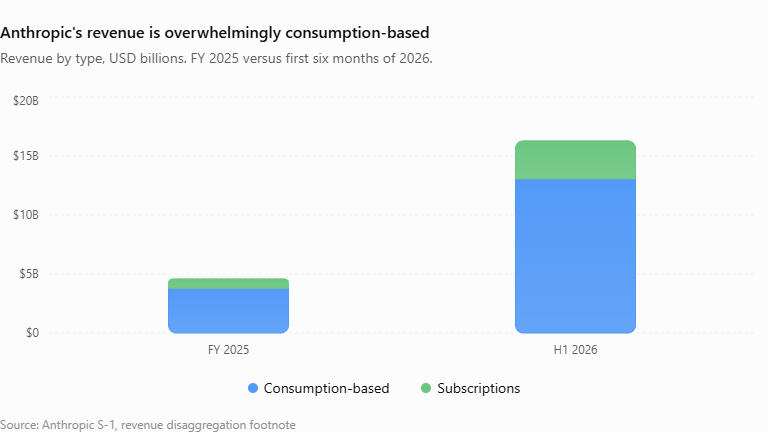
Anthropic generated $16.3 billion in revenue in the first half of 2026, compared to just $1.2 billion a year earlier. That’s nearly 14 times more. And this is mostly a consumption business. About 80% of revenue came from usage-based fees, i.e. customers paying for the AI they actually use, based on tokens processed and generated.
That last point matters a lot for one of the biggest debates around AI right now.
Cheaper AI, More Expensive Compute
When you ask a model like Claude or ChatGPT a question, it breaks the text into small pieces called tokens (1,000 tokens is roughly 750 words). AI companies are largely selling tokens, and they produce them using GPUs. Think of it like a factory: GPUs are the machinery and tokens are the output.
Here’s what worries the bears. Token prices are falling fast as competition heats up, while the cost of renting GPUs is rising. That’s not exactly a recipe for profits, especially when companies are committing hundreds of billions to the buildout.
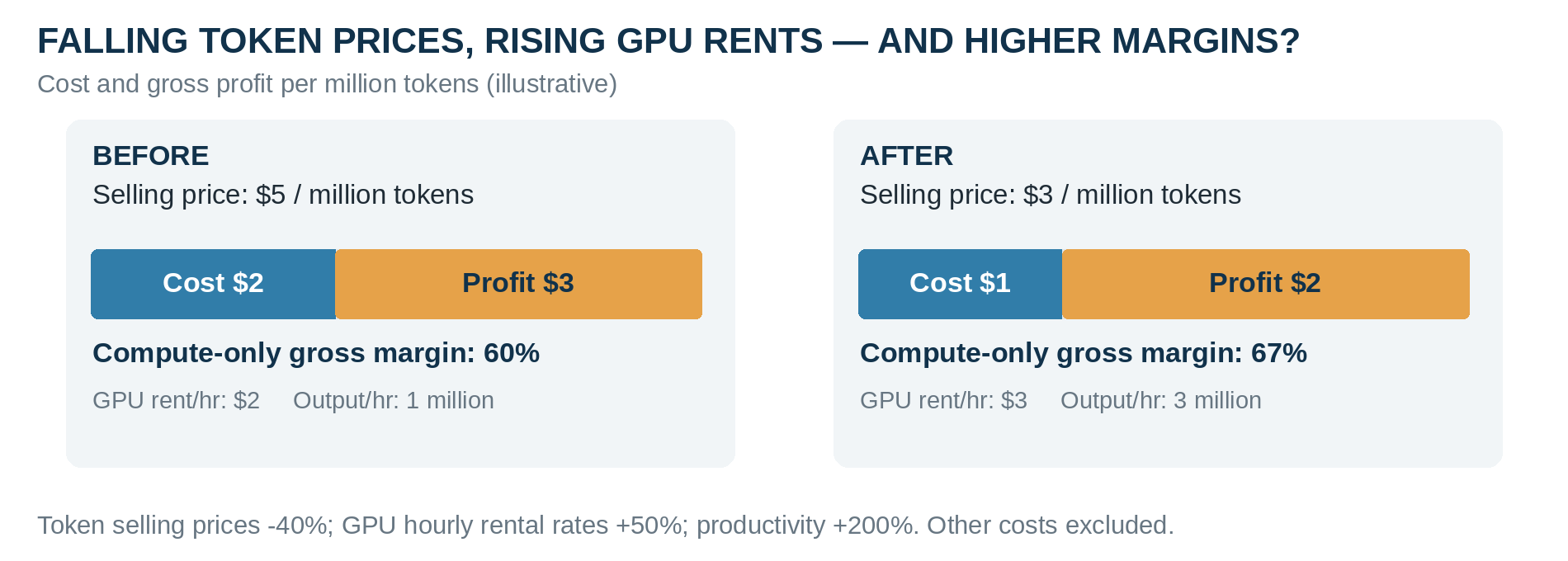
What that argument misses is productivity. Take a hypothetical AI company, ModelCo. It sells a million tokens for $5 and rents a GPU for $2 an hour, which produces a million tokens. That’s a 60% gross margin on compute.
Now say ModelCo cuts its price 40% to $3, while GPU rents rise 50% to $3 an hour. Looks ugly. But if better chips and software let that same GPU-hour produce three million tokens, the cost of producing a million tokens falls to $1, and ModelCo’s margin actually rises to about 67%.
Source: Carson Investment Research 10/28/26
For Illustrative Purposes Only
In other words, the price of computing power can rise even as the cost of producing AI falls. That means profit margins can stay intact, or even improve, while token prices are falling.
Wright’s Law Meets Jevons’ Paradox
Anthropic’s S-1 suggests this is playing out in real life. Blake Anderson, Director, Portfolio Management, one of the portfolio managers on our team, has been digging through the filing and sent me this gem:
“Diffusion also accelerates as our models become more capable and efficient, allowing us to lower the cost per task for customers. For example, Claude Opus 5.5 reduced customer costs per task by approximately 40% compared to Claude Opus 5. Lower costs per task drive greater usage, which in turn drives broader diffusion of Claude. Our compute efficiency allows us to deliver these reductions while preserving our margins.”
Opus 5.5 launched at $20 per million output tokens, versus $25 for Opus 5. So Anthropic cut prices 20%, customer costs per task fell 40% thanks to efficiency gains, and margins held up. (I did wonder why they said “preserving” margins rather than “increasing.”)

Stay on Top of Market Trends
The Carson Investment Research newsletter offers up-to-date market news, analysis and insights. Subscribe today!
"*" indicates required fields
Blake’s take is that this is Wright’s Law in action, and I think he’s right that it explains a lot of the economics. Wright’s Law says production costs fall by a consistent percentage every time cumulative output doubles. One thing I’d add is that the cost reductions come from cumulative production and learning across firms. So the gains get spread across the industry rather than accruing solely to the largest producer. There’s an interesting point to be made here about talent, and the fact that California doesn’t enforce non-competes.
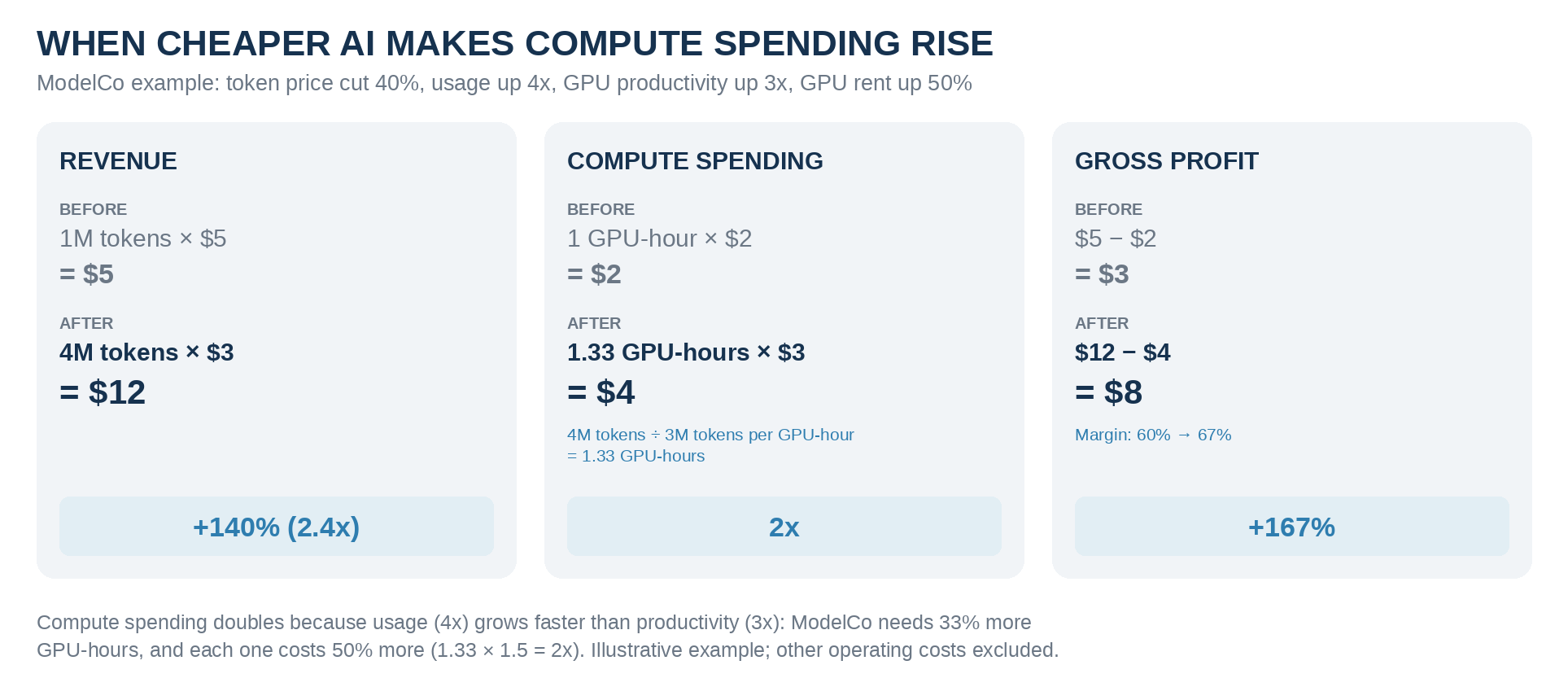
Then there’s Jevons’ Paradox, named after the 19th century economist William Jevons. He observed that more efficient coal use increased total coal consumption, because cheaper energy encouraged more economic activity. Something similar could happen with AI. Go back to ModelCo: if usage quadruples after its 40% price cut, revenue more than doubles, and its spending on compute doubles too. Here’s the math:
Source: Carson Investment Research 10/28/26
For Illustrative Purposes Only
I think Wright and Jevons reinforce each other. Lower costs drive greater usage, and more “AI production” creates more opportunities for learning, efficiency, and further cost reductions.
The S-1 backs this up. When Anthropic launched Opus 4.5 in November 2025 with more capability at a lower price, quarter-over-quarter revenue growth accelerated from 48% in Q4 2025 to 132% in Q1 2026. Anthropic credits other factors too, but that’s Jevons in action. Meanwhile, the unit economics improved dramatically:
- Anthropic spent about $2 on compute for every $1 of revenue in the first half of 2025
- A year later, that had fallen to about 55 cents
- That’s the closest comparison to ModelCo’s compute margin, and Anthropic’s compute costs include training new models as well as serving customers
That’s before everything else, like salaries, sales and marketing, and stock-based compensation. Even after all of that, Anthropic generated nearly $1 billion in operating profit in Q2 2026, an 8% operating margin (19% excluding stock-based compensation). So far, the bullish thesis behind AI unit economics is holding up. Falling prices haven’t meant falling margins.
The Paradox Inside the Buildout
But there’s a paradox here in the face of all this capex spending. The same productivity improvements that make AI more efficient and attractive also raise the question of whether the infrastructure buildout is worth it.
If efficiency improves faster than usage grows, the industry needs fewer GPU-hours to do the same work. If token consumption doubles but GPU productivity quadruples, a lot of the capacity being built today could end up idle, or renting at much lower prices.
Anthropic’s S-1 shows just how big these bets are. The company disclosed about $637 billion in infrastructure arrangements with seven providers, including $431 billion in minimum spending commitments and equipment lease payments. For perspective, Anthropic generated $4.6 billion in revenue in all of 2025!
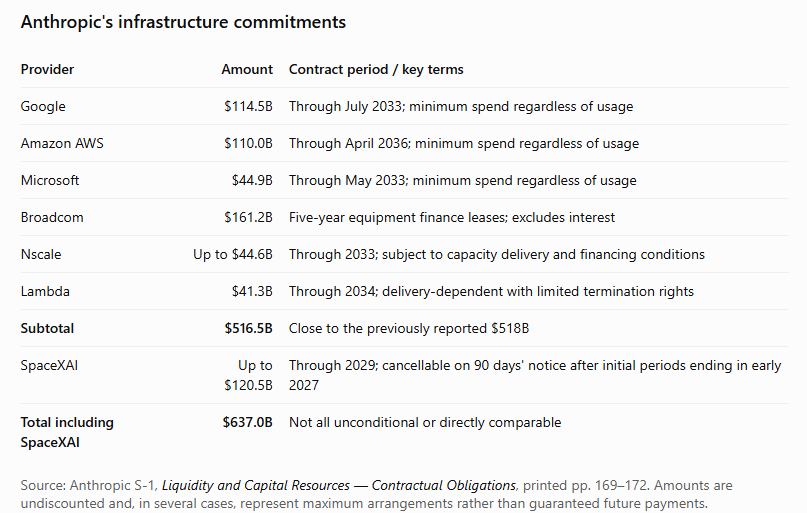
Several of these agreements are take-or-pay, meaning Anthropic pays for capacity whether it uses it or not. That gives the infrastructure providers revenue visibility, but shifts a lot of the utilization risk to Anthropic. One company’s capex is another company’s revenue and profits. That doesn’t mean the entire chain is profitable.
An AI lab can also earn attractive margins serving existing models and still lose money once you account for training the next one. The data centers also take years to build, and the chips inside them can become commercially obsolete quickly. And as I wrote back in August, more and more of this is being financed with debt, at a higher cost. Just this week, banks demanded higher rates to finance a $63 billion chip deal tied to Anthropic.
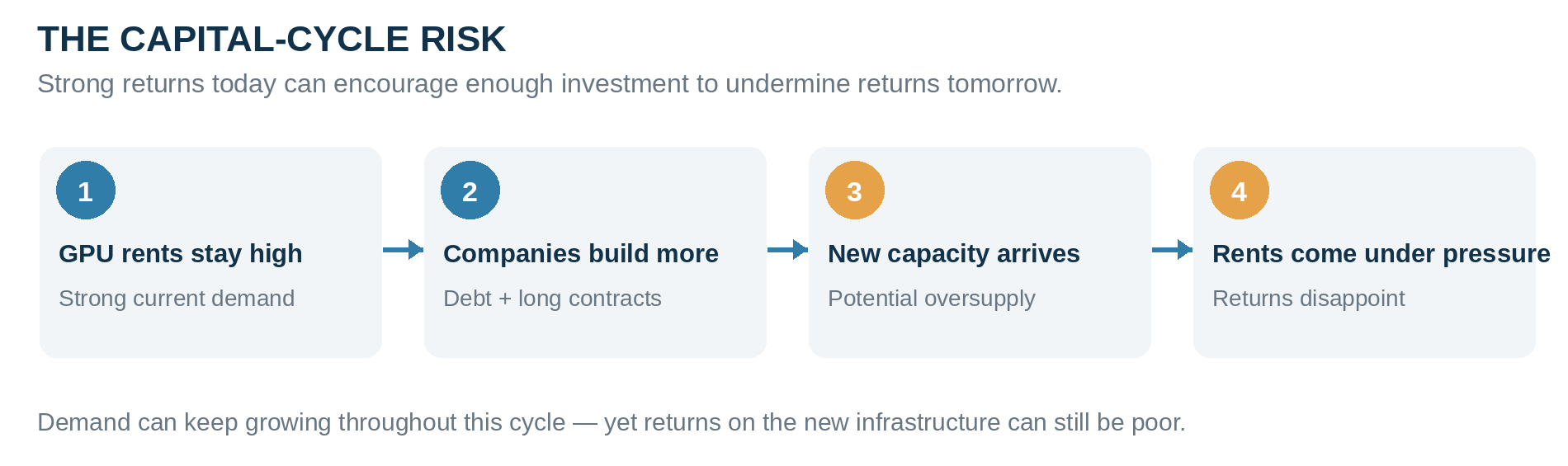
This is the classic capital cycle:
Source: Carson Investment Research 10/28/26
For Illustrative Purposes Only
What makes sense for each company individually can end up being a disaster for the industry collectively.
AI Can Win Even If Investors Don’t
Ultimately, I think AI can be very successful without the folks financing the buildout earning attractive returns. That’s pretty much what happened with every other investment supercycle over the last 150 years: railroads, telecom, housing, shale. Fiber-optic builders in the late 1990s were right that internet traffic would explode. So much capacity got built that prices collapsed anyway, and many of those who financed it took enormous losses.
So as AI unit economics get better (potentially by a lot!), there’s still an open question whether there’ll be sufficient returns on the enormous infrastructure being built, and increasingly financed at a higher cost.
I’m not suggesting an AI bust is around the corner. Far from it. Anthropic’s filing is compelling evidence that AI can generate attractive economics at scale, and that cheaper AI drives more demand. But investors are financing tomorrow’s capacity at today’s expectations.
The railroads got built, and the country was far better for it. Same with the tech boom in the late 1990s, and the fiber optic buildout. Plenty of the folks who financed them never got their money back.
For more content by Sonu Varghese, Chief Macro Strategist, click here.
9206083.1. – 28OCT26A