
Starting this week, the most-watched sporting event on the planet officially kicks off. What makes this year’s FIFA World Cup more special for the United States is that this is the first time our country has served as a host of the tournament since 1994. However, this year’s tournament has two unique traits compared to past World Cups. This year will be the first World Cup to feature a field of 48 countries, which is 16 more from the last World Cup in 2022, hosted in Qatar. Additionally, the hosting responsibilities of the World Cup in the past have been handled by an individual country or a joint pairing between countries. For this year, the United States will predominantly be hosting, however tournament sites will also be held in both Mexico and Canada. The prior 2022 World Cup, which was held in Qatar, generated record-breaking attendance and television viewership worldwide, further amplifying the event’s massive international reach and marketing power for companies and other entities with vested interests.
Although optimism has been high for the economic benefit that would be expected for the U.S., as well as certain industries and other tourism enterprises, it is possible that this World Cup may incur a diluted impact compared to past World Cups. Sharing the hosting with both Mexico and Canada may impact historical economic boosts amongst geopolitical tensions that have limited entries into the U.S and deterred desire from those with an unfavorable view of our political ambitions. These factors are just the tip of the iceberg on where optimism may experience a shortfall. Will these factors amongst others be as impactful as they sound to the U.S. economy and companies who have leveraged sponsorships for the tournament? Time will tell. But to better understand the current landscape of this event, we must dive into both negative positioning and opportunities for the U.S. and market participants for this year’s FIFA World Cup. Let’s get the ball rolling.
Historical GDP Benefit of Host Country
When a country has historically hosted the World Cup, it has experienced a small, short-term boost in GDP that levels off in the long term. FIFA has long stated that the World Cup will drive economic and consumer activity, and even more so came out and said that this year’s World Cup will result in a boost to US GDP of $17.2 billion, which is around 0.2% of quarterly GDP. FIFA and the WTO estimate that the World Cup this year could generate $80.1 billion in global output, with an addition of $40.9 billion to global GDP. However, according to Goldman Research, their data suggests that economic advantages are modest and fall short of the optimism generated by entities such as FIFA and its surrounding promoters. Included in their research is that there is significantly higher evidence that the winner of the World Cup will experience a slightly higher GDP boost than the country that hosts it.
Although hosting the World Cup is not a driving barometer itself for sustained GDP growth, it does coincide with events that happen in the market on both sides of the spectrum. In the chart below, BofA Securities highlighted the alignment of hosting the World Cup with events that transpired in the host countries’ economies and markets.
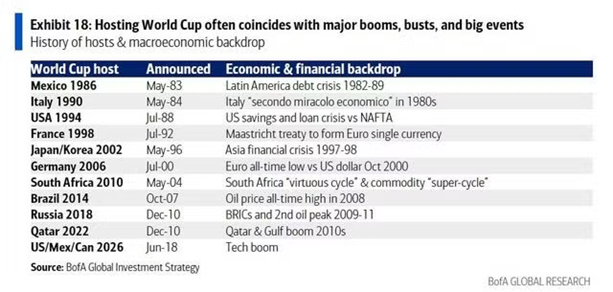
Pertinent to the U.S., you can see that in 1994, the United States endured a financial collapse of sorts with the savings and loan crisis. With greater spirits so far in 2026, we are enjoying a current bull rally that is enjoying the ride on the coattails of tech and AI.
Where Initial U.S. Optimism is Not Materializing
Unfortunately, the historical optimism of playing host may have plagued the estimated potential monetary gain for U.S. cities, tourism and hospitality industries, and other companies that positioned themselves to benefit from the World Cup presence. To keep it as simple as possible, prices are very high for everything, everywhere. This is not just a notion on current inflation, but a summary of how FIFA and travel industries have outpriced their services for the demand to remain present. Starting from the very beginning, if you are an international fan, you will already be incurring a hefty flight cost with airlines that are able to charge a higher ticket cost due to travel options and their own battles with high operating costs ( I have a separate piece on the current state of the airline industry here for those who are curious for more information on that topic). But after a fan pays that fare, they are faced with exorbitant hotel and hospitality costs once they make it to any of the host cities at hand. Adding an additional layer onto that, to attend a match in person, you will need to purchase a ticket that is unprecedentedly high and facing legal headwinds on the current pricing. Adding those all those up is a hefty price tag for anyone, even for Americans who are not dependent on international flights. Good luck, especially to the fans who didn’t ask their significant other first prior to locking down tickets and travel accommodations; that’s a credit card statement that can go down in infamy.
Parsing out that quick jog through a fan’s experience, every topic at hand has nooks and crannies that make the pricing and demand more interesting than what shows on the surface. Starting with air travel, although flight costs are expected to be high, that is an underwhelming factor when compared to a separate major impediment to international attendance. The United States has implemented barriers that bring difficulty or full denial for fans to attend, depending on which country they are citizens of. Policies are in place that mandate for 39 countries that are now subject to full or partial U.S. visitor visa suspensions. Of that group, 19 of those countries are completely restricted and have no legal pathway to attend matches on U.S. soil. Four of those nations with complete restrictions, which are Haiti, Iran, Senegal, and the Ivory Coast have teams competing in the tournament field. Beyond outright bans, citizens of 50 countries are also subject to visa bonds of up to $15,000 just to secure a temporary visa, which has been waived for ticketholders who opted into FIFA’s priority visa scheduling system and obtained the ticket through official FIFA channels. Amidst these legal complexities, fans from nations that are not the subjects of these rulings are boycotting attendance due to their disapproval of how the U.S. has implemented these regulations.
Lodging and other hospitality industries were eager to benefit from initial speculation on attendance numbers once the U.S. was announced to be a host. From that initial announcement until now, obviously, geopolitical tensions have risen, as well as barriers impeding the number of fans who are seeking these services. Although those statements are true, demand is still well below expectations. Hotels have posted high sticker prices for the months leading up to the World Cup based on optimism and to capitalize on the demand surge during the weeks of competition. This chart below shows the pricing strategy of hotels in host cities that was created by FCM Consulting, Americas via Forbes.
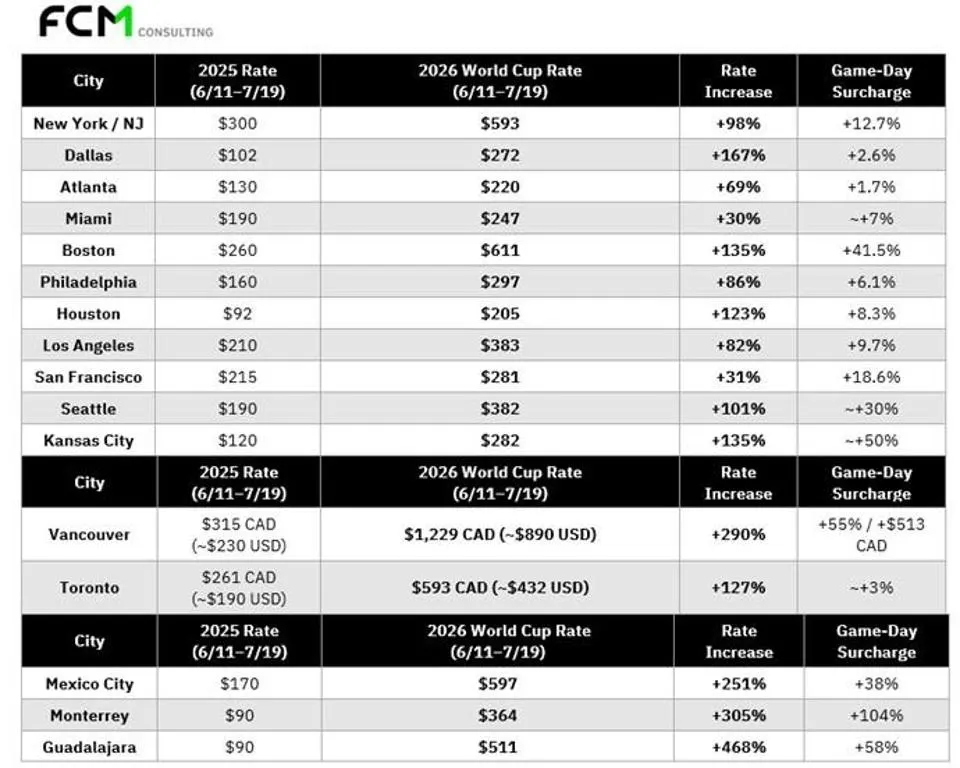
As you can see, rates have increased significantly, which is not out of the norm for an event taking place. But the pricing strategy has more layers than simple raising due to demand. The AHLA is the largest hotel association in the United States and has stated that the increase in prices and unfulfilled demand is partially responsible from FIFA themselves. The AHLA states that FIFA reserved and blocked too many rooms in advance, creating a false sense of demand. FIFA later canceled many of its initial blockings. ALHA says the downstream effect of these actions from FIFA created a surge in pricing from hotels and an illusion that they would have a sufficient number of bookings to capture the profit they initially sought, which has failed to live up to initial speculation. FIFA has not recognized this accusation, but hotel numbers have shown their own truths. According to BBC, major sentiment from hotel chains states that they are under-booked due to the artificially high prices they initially posted (on top of other costs a fan would need to commit to). Rates have recently dropped as hotels look to recapture some of that demand and attribution to their bottom lines.

Stay on Top of Market Trends
The Carson Investment Research newsletter offers up-to-date market news, analysis and insights. Subscribe today!
"*" indicates required fields
Now for the main intention for a fan, attending the World Cup is a lifelong dream for many. Unfortunately, lumped into the basket of surged prices, ticket prices have been much higher than fans initially expected and are not seeing the fulfillment in demand that FIFA anticipated. Match tickets have a massive discrepancy from prior World Cups leaving fans disappointed and confused about the excessive markup. The issue with the pricing structure that has faced the 2026 World Cup tickets is not from independent resellers driving up the secondary market, rather the prices are set by FIFA themselves. Shown below is a chart from Ticket Data that shows the immediate spike in pricing, and the high level at which the prices of tickets have sustained.
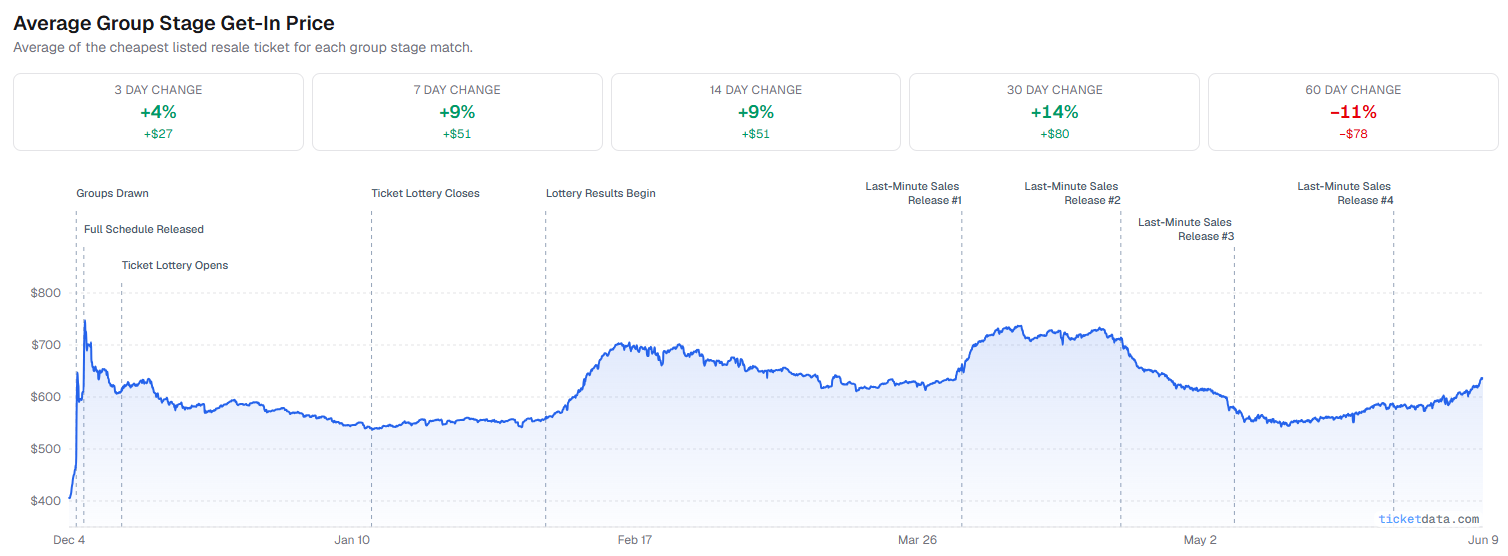
FIFA is using a demand-driven dynamic ticket pricing system, which has driven prices way past those of previous tournaments, and this has caught the attention of political powers in the United States. The Attorneys General for New York and New Jersey issued subpoenas to FIFA in late May to attempt to gain an understanding of how they came to such unprecedented prices. Why this inquiry from the Attorneys General seems to have a sticking point lies with the fact that FIFA’s official resale site collects a 15% fee from both the buyer and the seller on transactions. Another layer to an already complicated and expensive bill for spectators.
As a reader, you must expect that we have hit the end of the road on industry price gauging. Unfortunately, you would be incorrect. One final notch is the domestic travel price hike that municipalities are establishing for transportation to and from the matches. The major storyline for this portion is how New York City has received brash feedback regarding the surge pricing of its train fares that would take fans to and from New Jersey for the tournament matches. The initial pricing came out to be $150 round trip per commuter, which after heavy criticism and private funding contributions, has been reduced to $105. That still was not good enough according to citizens of New York and visiting spectators, and an additional fare cut has been made to reduce the cost to $98 per person. There seems to be some irony in the fact that New York has issued subpoenas for high ticket pricing when they happen to be implementing their own money grab.
After navigating through all those hoops, can the U.S. economy, hospitality and travel industries, and other secondary benefactors still be optimistic that they will be a part of a once in a generation demand surge like initially anticipated?
Sponsoring Companies Vying to be Propelled in the Markets
Other benefactory interest from the World Cup can come with a steep price tag as well, but the price includes premier exposure of their products and brands over the course of the world’s largest sporting event. This would of course be the sponsorship rights, which companies view as a more sought-after marketing tactic than the Super Bowl or other large events. The basis of this is mainly tied to the time spread that the World Cup has to offer compared to a one-day ad during the Super Bowl. A quote from Corinne Casagrande, EVP and Director of Strategy at AMS, illustrates this as “The World Cup is different. It is rarer, more spread out, and harder to price perfectly. That creates more opportunities for marketers to find value and potentially generate stronger media ROI.” As the tournament goes on, fan engagement increases and deepens with the products and services presented to fans. The total valuation of the sponsorships has expected to grow more than 55%, from $1.8 billion in 2022 to $2.8 billion for this year’s World Cup.
Vesting this interest from a marketing perspective seems to make sense due to the pure exposure of the event but seeing how this sponsorship ties into the markets is where the rubber truly meets the road. To take a deeper look at how sponsoring company stocks perform in World Cup years, I pulled the consistent sponsors from the 2010 World Cup and on to view their performance in the calendar year before, during, and after the World Cup that year. These companies are Adidas, Budweiser, Coca-Cola, Fox (first publicly traded in 2022), McDonald’s, and Visa. Shown in the chart below, the performance for each of these companies displays an average for the time segments of the World Cup year based on averages calculated from Cup years 2010 to present day.
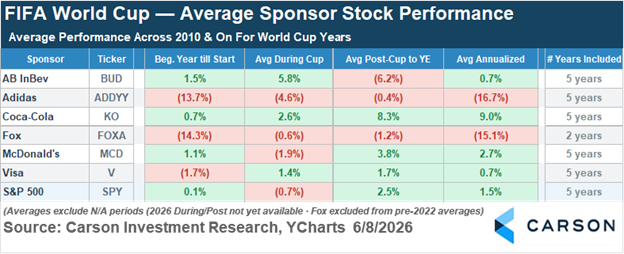
The biggest takeaways from this data start by seeing that Coca-Cola is the clear winner in prior World Cup years by outperforming the S&P before, during, after, and overall annual averages compared to the S&P 500. McDonald’s may not be as clear a dominant past performer as Coca-Cola in the context of this data, but modestly outperforms the S&P by average before and after the World Cup with a 1.2% annual outperformance. On the other hand, you see a drastic underperformance in the averages of Adidas and Fox compared to the S&P 500. Fox has only one year, 2022, which was a challenging year in the stock market, to base this average. Adidas has been a fundamental sponsor in the history of the World Cup, with their average annual performance since 2010 yielding a -16.7% performance that was very surprising. But individual stocks are only part of this story; the timing of the World Cups matters as well, and the years in which they fell into. Here in the chart below, you can see how the S&P performed each year compared to the aggregate average of sponsorship performance in those years.
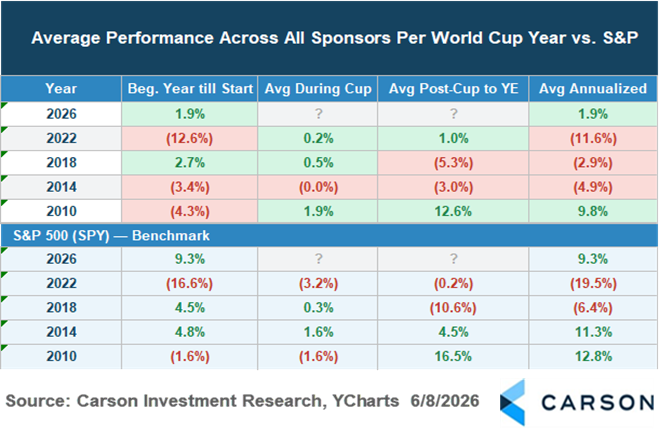
When looking at individual companies, we saw that some thrived while others did not in these World Cup years. As an aggregate, sponsors have tended to outperform the S&P 500 during the World Cup in three out of the four prior tournaments. Although the aggregate may not outperform the S&P’s annual return, the drawdown of this group is not as severe as that of the S&P in 2018 and 2022. This suggests that this group could have defensive outperformance when the World Cup falls in a year with broader indices and equities are struggling.
Can Expected Monetary Flow be Captured
For this group of sponsors, and other industries and companies that have looked to benefit from their positioning with the World Cup taking place on American soil, the overall benefits may not be as high as initially anticipated. With geopolitical tensions and restrictions in place, in combination with high costs at every level of travel for a fan to view the matches, the traffic necessary to garnish a high revenue may not be there for the host cities and in the stadiums. Some companies are reliant on this in-person traffic from attendance and travels such as the obvious hotel industry, but other sponsors, such as Budweiser (AB InBev) who has the sole alcohol rights for stadium sites for the World Cup. Coca-Cola also has the independent rights for selling non-alcoholic beverages in the stadiums, but has released themed FIFA World Cup cans to generate demand and brand marketing to the everyday American consumer. Broadcasting rights for FOX play to the hearts of those who are unwillingly to pay such high costs to attend matches, with exclusive U.S. English broadcasting rights they are positioned well to capture a high demand this tournament. McDonald’s, a familiar face in American culture, is utilizing its marketing genius to promote the World Cup via themed Happy Meal gifts and themed limited-time-only collectible cups. The Golden Arches are no novices on incentivizing consumers to their stores, and a low-cost solution could benefit many American families looking to enjoy the World Cup, especially for their children.
We have learned that the World Cup may not be as beneficial as promoted by FIFA initially, which led to higher optimism than will more than likely play out. Keeping our eye on the ball as investors is key to correctly position and allocate on differences of pure optimism and those companies that are correctly positioned for success.
A final note: U-S-A!
By Joel Riha-Aldrich, Analyst, Investment Research
8969232.1. – 9JUNE26A