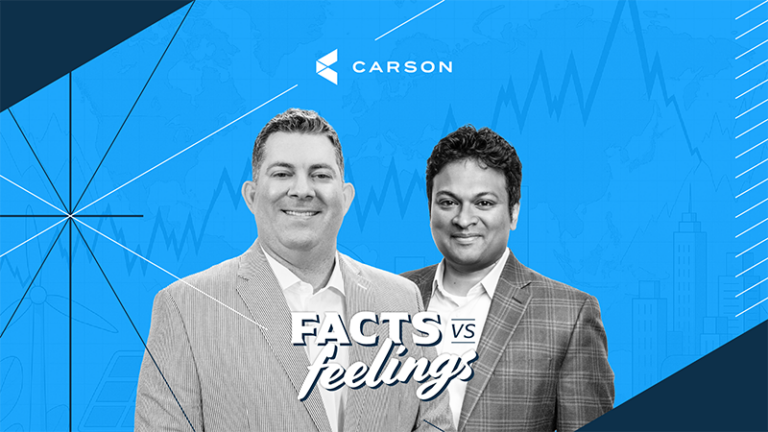
Celebrating 200 episodes, Ryan Detrick, Chief Market Strategist at Carson Group, and Sonu Varghese, Chief Macro Strategist at Carson Group, take Facts vs Feelings on the road to Boston for a live show, joined by special guest Art Hogan, Chief Market Strategist at B. Riley Wealth.
Art opens by explaining his opinion on why the market keeps climbing despite bubble fears and Fed uncertainty: Second-quarter earnings growth came in far above expectations, broadening out across all 11 S&P 500 sectors rather than staying concentrated in mega-cap tech. That broadening, he argues, is why the equal-weight S&P 500 and the Russell 2000 are outpacing the market-cap-weighted index this year.
The conversation moves to the Fed, where new Chair Kevin Warsh’s terser, less transparent communication style rattled markets around his last two meetings. Sonu and Art debate whether AI should be viewed as an inflationary force, adding “workers” to the economy rather than acting as the historically disinflationary technology wave investors expect. They also dig into hyperscaler CapEx, rising CDS spreads on tech debt, and why Art thinks the field of dominant AI players will eventually narrow.
Art also makes the case against comparing today’s AI buildout to the dot-com bubble, citing real business models versus the 2,600 companies that went public between 1995 and 2000. Carson’s Barry Gilbert, VP, Asset Allocation Strategist, joins to discuss how to actually invest in AI through a barbell approach, and the episode wraps with reflections on 200 episodes, gratitude for the team behind the podcast, and a toast with Art.
Key Takeaways
- Q2 2026 S&P 500 earnings growth beat expectations dramatically, with estimates that started around 13% rising above 23%, driving multiple compression from 23x to 19x forward earnings even as prices rose.
- For the first time in five quarters, all 11 S&P 500 sectors are showing significant earnings growth, with eight of 11 posting profit margin growth, explaining why the equal-weight index and Russell 2000 are outperforming the cap-weighted S&P 500.
- Fed Chair Kevin Warsh’s less transparent communication style, including terse statements and non-committal press conferences, has unsettled markets around his last two meetings despite no actual policy surprises.
- NVIDIA is trading at a valuation multiple lower than the broader market despite 65-70% margins, reflecting investor uncertainty about whether AI mega-cap spending is near a cyclical peak.
- Small caps have returned roughly 21-22% year-to-date, with leadership shifting from unprofitable, speculative names early in the year to more profitable small caps as the market broadens out.
- Credit default swap spreads on hyperscaler debt are rising as investors reassess these companies from “capital-light, free-cash-flow-positive” to “capital-heavy, free-cash-flow-negative,” with the market pricing in that only a handful of AI players will ultimately survive.
Jump to:
0:00 — Live From Boston for 200
2:43 — Art Hogan Joins the Bar Talk
3:06 — Earnings Growth Explains the Rally
6:10 — Market Breadth and Nvidia Valuations
9:02 — Pencils Down Origins and Rituals
10:08 — Fed Communication and Inflation Anxiety
13:40 — AI Spending Versus Productivity Payoff
16:57 — Small Caps Benefit from Broadening
19:50 — Hyperscalers Debt and Credit Skepticism
23:41 — Timeless Advisor Advice Plus Bubble Myths
27:31 — Why Profit Margins Keep Rising
30:20 — How to Invest in AI Diversified
35:52 — Contrarian Ideas International and Software
39:39 — Gratitude Growth and a Carson Invite
43:15 — Final Toast with Art Hogan
Connect with Ryan:
- LinkedIn: Ryan Detrick
- X: @ryandetrick
Connect with Sonu:
- LinkedIn: Sonu Varghese
- X: @sonusvarghese
Questions about the show? We’d love to hear from you! factsvsfeelings@carsongroup.com
Carson Group is committed to advancing financial literacy. Schedule a consultation to learn how Carson can help you help your clients and grow your business.
9070612.1-0826-A