
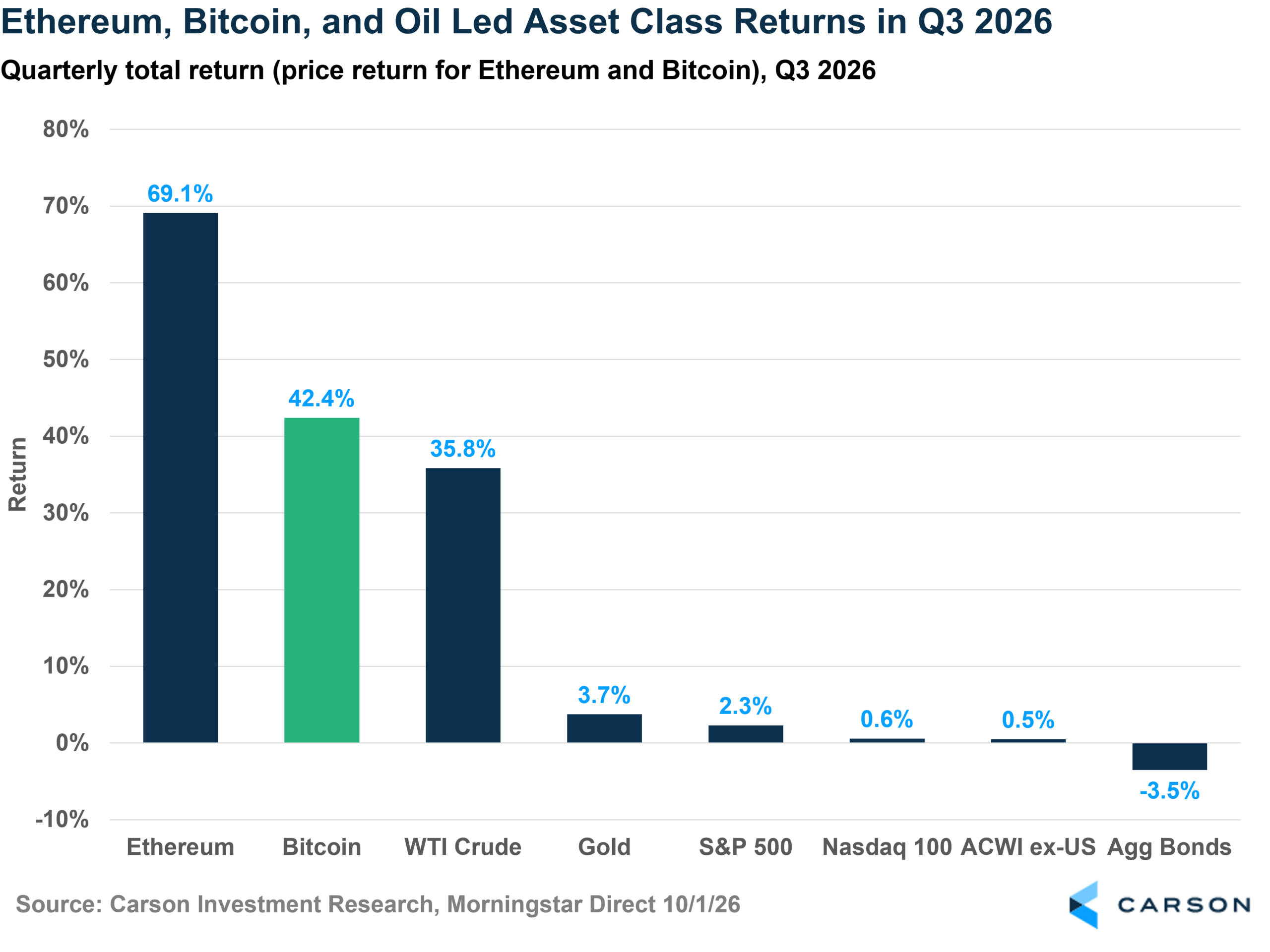
Previously the darling of headlines, Bitcoin and crypto have slid to the back of the room, as prices have failed to keep pace with equities. Bitcoin is down roughly 25% over the past year, but has recently seen a rebound that may have some legs – even in the face of macro headwinds. Prices fell from the last year’s highs into the spring, with another leg down in early summer to find a low near $60k in mid-summer. This price action led to large increases in short interest across futures markets and ETF products. On August 19th, the Treasury announced longer-dated bond repurchase support, and officials supported (and touted) the Clarity Act as something that should be passed. This triggered a massive liquidation (short squeeze) in Bitcoin and other cryptocurrencies, pushing prices up nearly $10k in a very short time.
Although the Clarity Act – which would help define regulation for crypto markets – ultimately did not proceed to a vote due to procedural red tape, the market absorbed that disappointment in stride, and Bitcoin has maintained a price near $85k. This is despite continually higher yields, a Fed rate hike, and signals of future hikes. On top of this, despite the price action, we are seeing large increases in transaction volumes and blockchain usage across major protocols, and large institutions are still investing and building in the space.
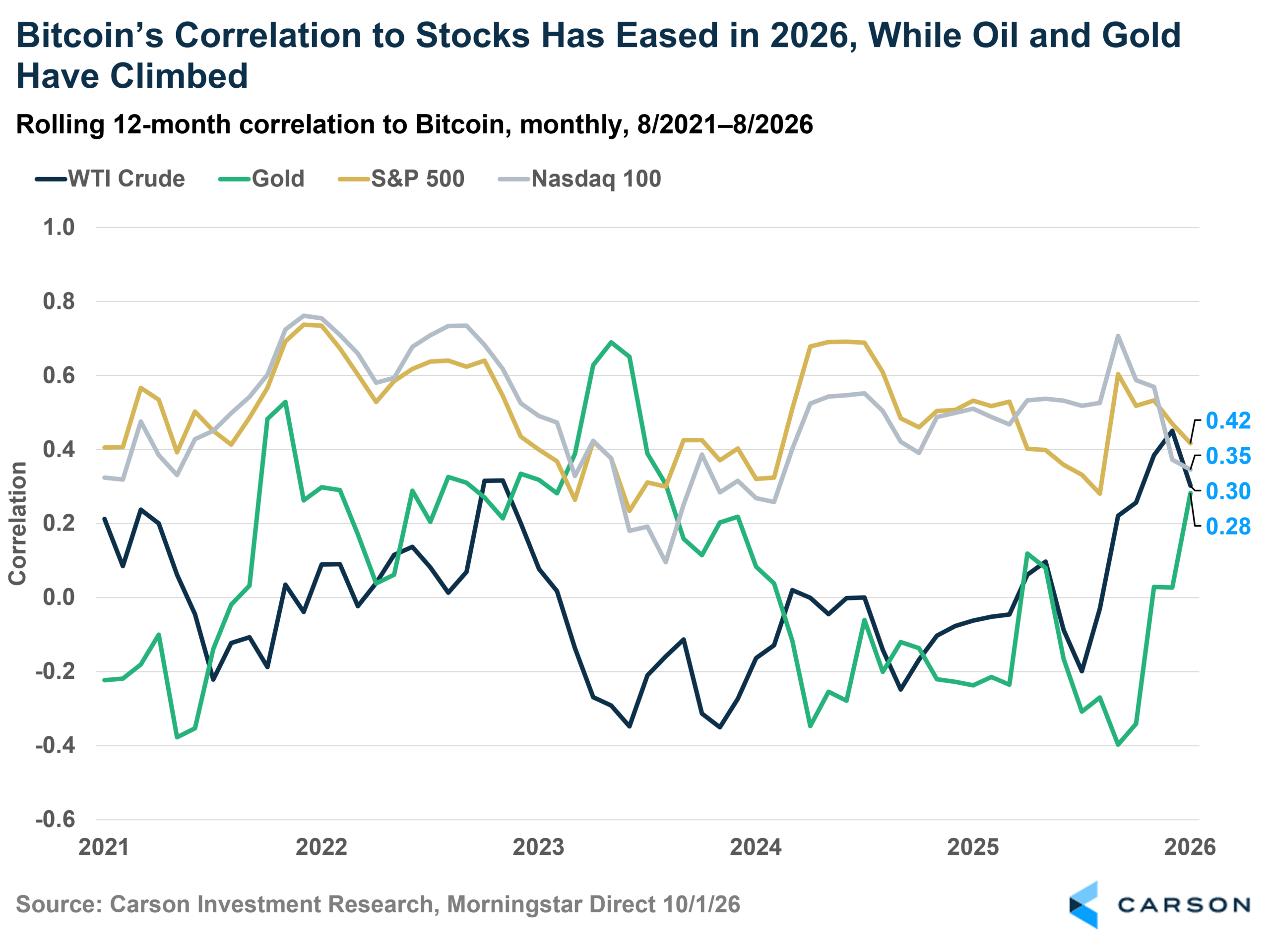
Correlation of Bitcoin with other asset classes has also been on the move lately. Crypto can get a bad rap as being “levered Nasdaq” exposure, but that has broken down this year in particular. We’ve written and talked before about the “Debasement” trade that supports non-dollar stores of value, such as gold and Bitcoin. Watching the correlation between Bitcoin and gold is an important barometer of the sentiment towards the US dollar (and, frankly, a slew of other qualitative metrics). Currently, that correlation has been increasing on a rolling basis but is still at a level where gold and Bitcoin are very diversifying from each other.
How will A.I. (S.I.?) Affect Crypto?
The question of AI’s impact on crypto is a very natural question nowadays, with many answers. Of course, I do not profess to have all the answers, but here are a few thoughts that make sense:
- A.I. makes it easier for novices and professionals alike to build on top of blockchains, or develop their own. Everyone from individuals to corporations now has the computer science skills at their fingertips to create enhanced networks and applications.
- Agentic AI can benefit greatly from both blockchain and crypto micro–payments. Crypto has the unique ability to be distributed in extremely small payment amounts (less than a penny), which could lead towards stablecoins and other digital assets being used as a way to “pay” A.I. agents for working on behalf of a network, company, or individual. There is a lot more here that’s beyond the scope of today, including how the stablecoin market may revolutionize the financial system.
- Bitcoin miners. Bitcoin mining companies have been large users of power for some time now, as the compute needed to mine Bitcoin requires large GPU farms and cooling capabilities. There is a natural breakeven to these costs and the price of Bitcoin – as well as the cost to “sell” compute capacity OR power to A.I. datacenters. Many firms have realized this and are changing or at least modifying their businesses to adapt.
- Less directly related to A.I., but the concept of tokenization is beginning to show up in a big way. Physical and financial assets are being tokenized, and regulatory agencies are paving the way for more. I’m not going to profess that trading stocks 24/7 is healthy by any means, but having access to ownership of tokenized financial products, alternatives, homes, businesses, or other physical assets opens the door to tremendous opportunities.

Stay on Top of Market Trends
The Carson Investment Research newsletter offers up-to-date market news, analysis and insights. Subscribe today!
"*" indicates required fields
Finally, I do want to address the “elephant in the room” with cryptocurrency and quantum computing. Worries that the blockchain could be “hacked” seem to come and go, but what is hopeful here is that 1) signs point to true quantum power being a ways away, and 2) networks have already begun to update their protocols to prevent any disruption. More to come on this over time, of course.
Sliding “to the back of the room” in financial markets can often be a really good thing. Less attention and fewer headlines lean towards asset classes that aren’t the shiny new toy, but could have true long-term staying power. Through each cycle, cryptocurrency continues to adapt and evolve, with more and more adoption of various use cases than meets the eye.
For more content by Grant Engelbart, VP, Investment Strategy & Research, click here.
9156612.1. – 1OCT26A