
With the school year just getting underway, many families are experiencing college move-ins that are emotional for several reasons. For freshmen, it is a turning point in life with newfound freedom and independence. For the parents it is often bittersweet. Watching a child that is “leaving the nest” can bring a mix of pride and a sense of sadness. But college can also introduce a different kind of worry, which is the financial strain associated with college expenses. It’s no secret that attending college can be financially burdensome for students and their families. And with every tuition bill that comes, that burden can become more apparent, especially if the proper planning steps weren’t addressed years earlier.
As you cheer on your alma mater this fall on the gridiron, you may find yourself hoping that one day your child gets to share the experiences you once had. Providing this future, or a unique experience of their own, starts with thoughtful planning. Let’s review what you should be thinking of while constructing a 529 plan to best accomplish your family’s goals and help reduce future financial stress.
Default Age-Based Glide Is Not “Right” for Everybody
A 529 plan is a tax-advantaged investment account that is designed to help families save for education costs. These accounts are typically created by parents, grandparents, and anyone close to the beneficiary, and the accounts have no annual contribution limit. It is worth noting that any contributions from an individual that exceeds $19,000 annually will trigger gift tax reporting. (Reporting does not mean there’s a gift tax. Rather, it’s a record of progress toward the lifetime gift limit of $15 million.) The growth in the account is tax-free, and withdrawals are tax-free as well if they are used for qualifying expenses such as tuition costs, room and board, and class materials. An additional benefit to this type of account is if there is a leftover balance at the end of the beneficiary’s education, the remaining amount can be directed to further education, a new beneficiary, or a transfer up to a lifetime limit of $35,000 (as long as the 529 account has been open for at least 15 years) into the beneficiary’s Roth IRA. All of the details and requirements of that process can be found on the 529 resource website here.
Once you have a 529 started, you have to decide how to allocate it. Thoughtful allocation that aligns with your family’s current funding and goal timeline is imperative for you to get the most benefit out of your account.
A common structure for a 529 account would be a target enrollment date strategy that emphasis growth early and aims to derisk to preserve gains as the first tuition date nears. The chart below from Morningstar shows a typical age-based glide path for a portfolios allocation over time as the target date approaches.
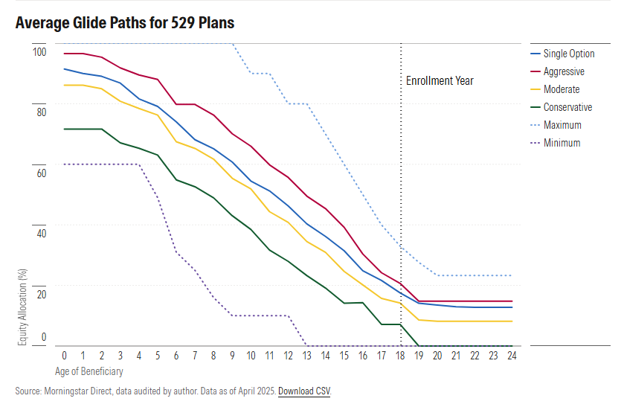
A glide path strategy has positives and negatives, partly depending on the current state of your 529 plan. There is a common misconception that the age of the beneficiary is what dictates the risk allocation for the plan. Age is an obvious factor given it determines when funding will be needed. However, many other factors play into how the risk structuring should be handled, such as if the account is currently under or fully funded, whether it may extend beyond an undergraduate education, or if the account is structured to serve as a cascading legacy across siblings or grandchildren. For example, you may choose a more aggressive path for an underfunded 529, while an overfunded account may call for a more conservative approach. While glide paths provide broadly useful guidance, they still should be viewed in context and in some cases can lead to the wrong approach.
Funding Certainty Is a Key Input in Risk Decisions
An additional important factor in 529 planning is funding certainty, the likelihood a target funding level will be reached and the risks if it isn’t due to a market downturn. This comes down to whether the plan is the sole source of funding, or whether backups like scholarships, loans, or additional gifts exist to cover any gaps in account growth. Understanding the degree to which a 529 funding is essential versus supplementary can play an important role in determining risk levels. This is also complicated by variability in costs from school to school.

Stay on Top of Market Trends
The Carson Investment Research newsletter offers up-to-date market news, analysis and insights. Subscribe today!
"*" indicates required fields
A potential market downturn can be less damaging from a recovery standpoint when there is a longer time horizon until funding is needed. But 529s generally have a much shorter time horizon than a retirement account and are often liquidated in four years (but see the qualifiers above). That makes risk allocation a more immediate and challenging problem, especially if you are relying solely relying on account growth to cover costs.
The charts below illustrate data from the S&P 500 Total Return Index, spanning the 2008 financial crisis and 2022 bear market, to show how detrimental a downturn can be in the latter years of a 529 plan if the risk in your strategy is not aligned with your goals.
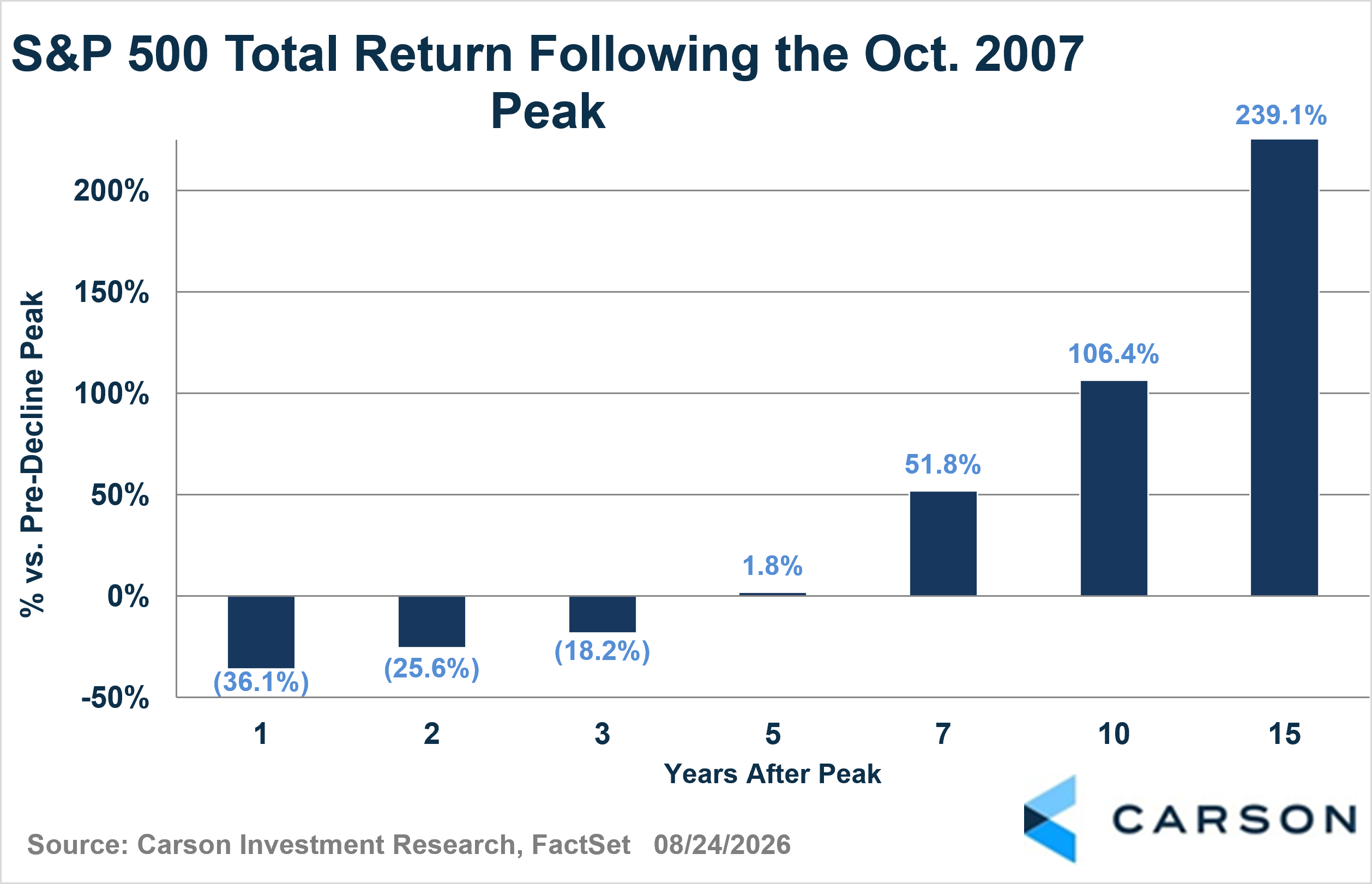
From the peaks achieved in October of 2007, accounts that needed to withdraw funds within three years would still have been underwater from the peak, while those with five or more years to spare were able to recover and achieve growth, especially by the seven-year mark and beyond.
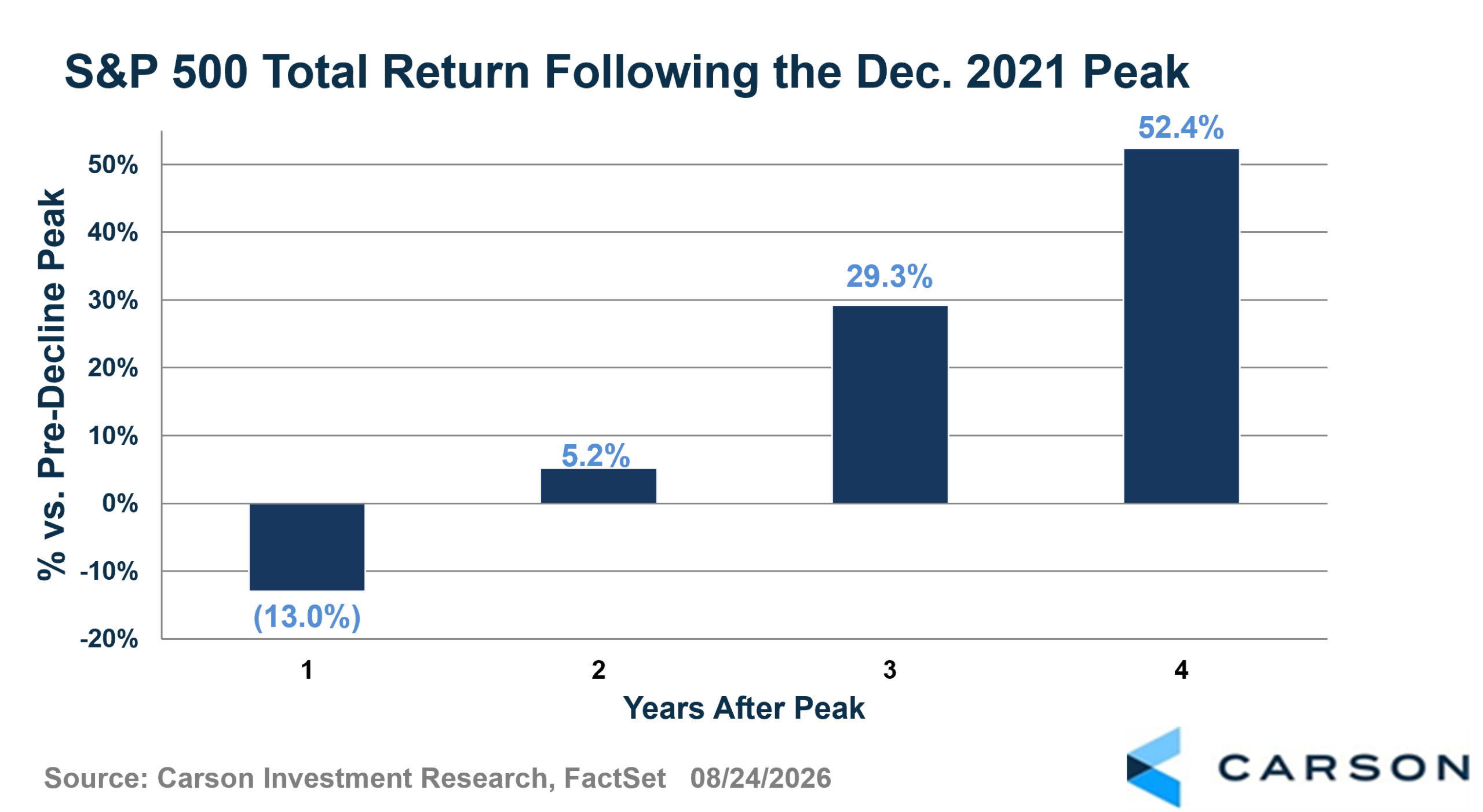
The bear market in 2022 achieved a faster recovery (and less severe drop); however, those who may have been banking on growth in the last two years of their account may have been susceptible to diminished value. Funding certainty is of extreme importance in the final 3-5 years, since there is less time to recover before enrollment. As the timeframe decreases, there is more time to recover from a potential downturn.
Lasting Takeaways
The main takeaway is there is no single allocation structure appropriate for a 529 plan based solely on age. Allocations across the plans lifetime will most certainly change and glide paths are a great starting point. But several other factors can have a meaningful impact on having the right allocation at the right time. But whatever the path, saving is a great start and the earlier you can begin the better. 529s provide substantial tax savings, and that already puts you ahead of the game.
By Joel Riha-Aldrich, Analyst, Investment Research
9100179.1. – 28AUG26A