Nvidia’s results and forecast last night speak to the overwhelming strength of technology spending that appears to be continuing. The company handily beat expectations and used the earnings call to reinforce the idea that AI is rapidly being adopted by enterprises and consumers alike. In the face of investors questioning Nvidia’s role in future AI spending, the company’s forecast and strategy may help set anxious investors at ease.
The Results
Nvidia posted revenue of $96.2 billion, or growth of roughly 106% year-on-year, which is the company’s highest growth rate in eight quarters. It’s an astounding growth rate for one of the largest companies – by both revenue and market cap – in the world. This revenue figure beat the company’s $91 billion guidance by $5.2 billion, a larger beat than last quarter’s $3.6 billion beat. Further, non-GAAP gross margin reported by the company landed at 75.0%, which is stable from last quarter’s 75.0% result despite booming memory input costs. Stable gross margins for the company may be a way for investors to see that Nvidia maintains strong pricing power for its products amid growing competition.
Investor Hesitancy
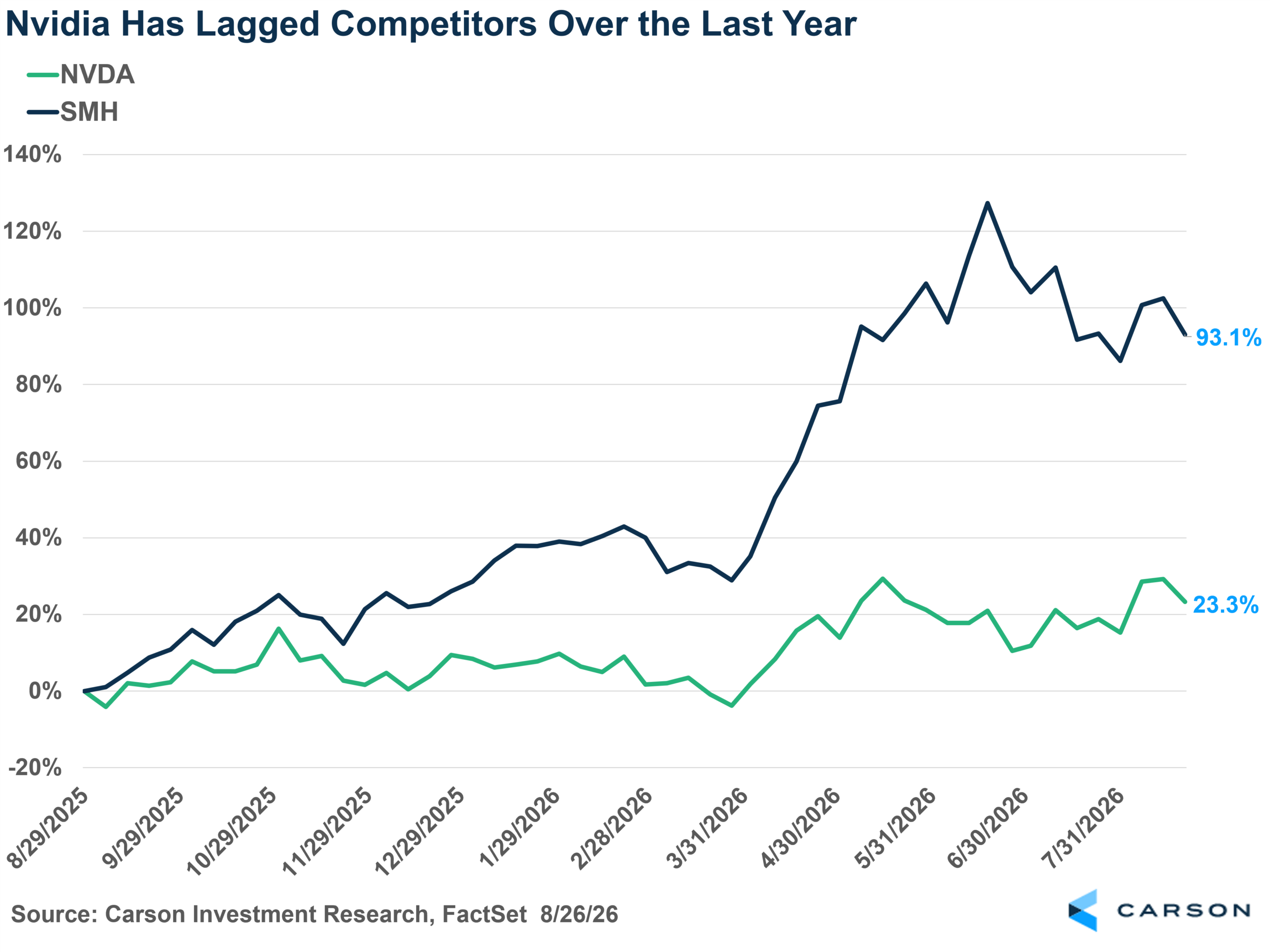
These results fly in the face of some recent investor hesitancy and are helping the stock trade higher today. Nvidia entered this earnings report notably lagging its semiconductor peers. As shown in the chart below, Nvidia stock has returned about 23% over the last year whereas a broader semiconductor ETF has returned about 93%.
Nvidia investors may have been hesitant to buy the stock over the last year perhaps because of Nvidia’s declining share of spend in these capital expenditure budgets. Shown in the chart below is estimated 2026 hyperscaler CapEx (now estimated at around $826B), Nvidia’s estimated 2026 revenue (about $396B before last night’s earnings call), and Nvidia’s implied share of spending. Although Nvidia’s revenue estimates have increased along with total capital expenditure estimates, Nvidia’s revenue estimates haven’t kept pace.
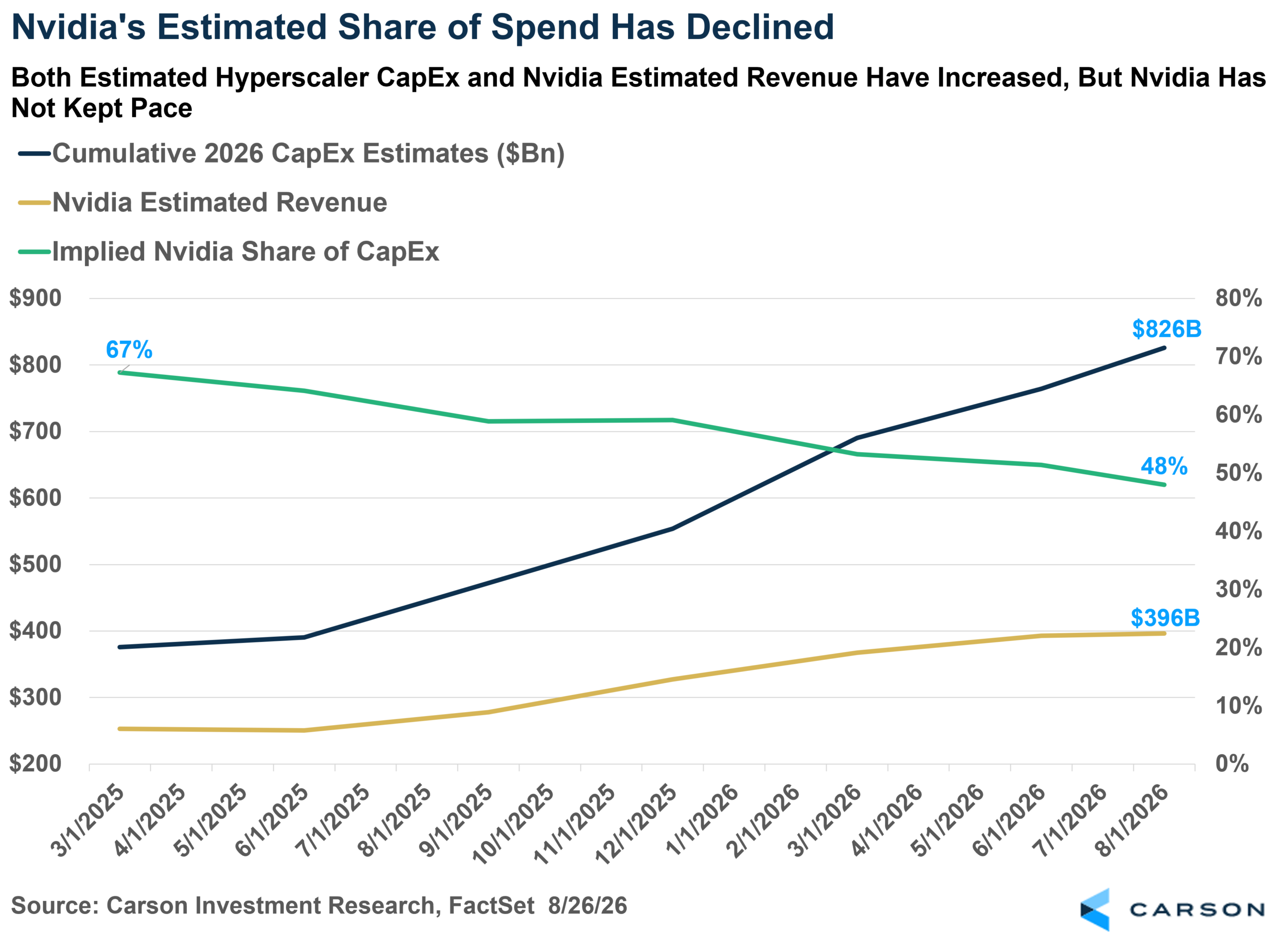
In March of 2025, the street expected Nvidia to capture roughly 67% of these capital expenditure budgets in 2026. But those expectations have dropped and the street now expects Nvidia to collect around 48% of this spending. That’s a meaningful loss of market share and may have been what has weighed on the recent stock price return of Nvidia.

Stay on Top of Market Trends
The Carson Investment Research newsletter offers up-to-date market news, analysis and insights. Subscribe today!
"*" indicates required fields
Perhaps Nvidia’s lower expected market share had led investors to other companies who are gaining market share of capital expenditures. But that’s not to discount the giant of the industry.
Company Commentary
Nvidia used the company’s earnings call to talk about how the AI adoption fueling the spending on this buildout is continuing, noting “the surge in AI demand is driving a global infrastructure buildout…closed and open models alike, adoption is skyrocketing.”1
And speaking to their competitive advantage amid investor hesitancy, the company believes “Nvidia has three unique capabilities that are engines power our growth. [Our] architecture runs every model. Second, is our full stack AI factory platform…our ability to extreme codesign to deliver performance gain every generation. Third is the combination of that full stack AI factory and rich CUDA ecosystem, allowing us to extend AI into markets a single chip alone can never reach.”1 Said differently, Nvidia aims to be a one-stop shop for AI production driven by superior design and system efficiency which drives mass adoption and potential network effects.
Nvidia believes this strategy can help them maintain exceptional growth. The company provided rare forward-looking guidance, saying “We expect to grow revenue by approximately 70% in fiscal 2028.”1 FactSet consensus estimates were for growth of 45% before the earnings call, and the company’s forecasts represents a large upside surprise. Further, Nvidia continued by saying that “we expect supply to remain a bottleneck…our supply allows us to confidently deliver 70% [growth]. We are going to continue to work with our supply chain to increase on that” implying that demand for Nvidia’s products may be above that 70% estimated growth.1
With such a large revision to estimated growth, Nvidia’s estimated share of spend may very well increase and may turn investor attention back to the largest company in the industry.
Nvidia’s results handily beat expectations. Stable gross margins amid booming input expenses may also give investors comfort that Nvidia is maintaining pricing power. Although Nvidia has lagged competitors in the last year as others in the industry appear to be capturing more spending, Nvidia’s strategic commentary and above-consensus forecast may help turn attention back to the giant of the industry.
For more content by Blake Anderson, CFA®, Director, Portfolio Management, click here.
9097975.1. – 28AUG26A