
This series is built weekly from FactSet’s Earnings Insight report (John Butters, VP, Senior Earnings Analyst with FactSet), with index weights and market caps sourced from YCharts, and aggregation performed in-house. We tie every figure to FactSet’s published numbers, then add Carson’s perspective on top of that. We publish our Earnings Check-In weekly during earnings season.
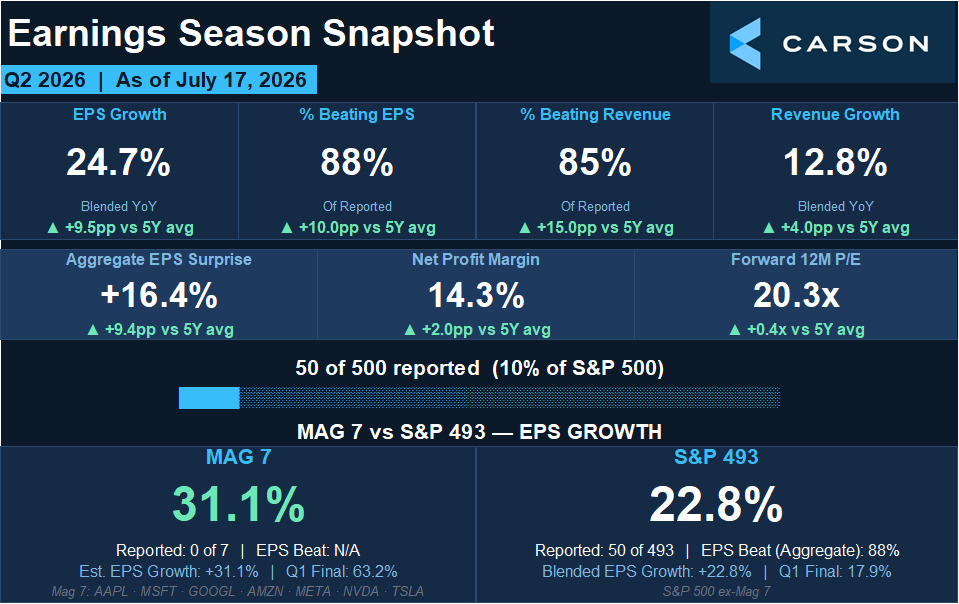
Last week, I said the banks would set the tone. They most certainly did. With 10% of the S&P 500 now reported, blended earnings growth for Q2 sits at 24.7%, already above the 23.2% analysts expected at the start of the quarter. If that number holds, it would be the second straight quarter of 20%-plus earnings growth. Earnings season is just getting started, but the first read on the quarter is very strong!
Here’s the season at a glance so far:
Source: Carson Investment Research, Earnings Insight, FactSet 7/17/2026
What Changed This Week
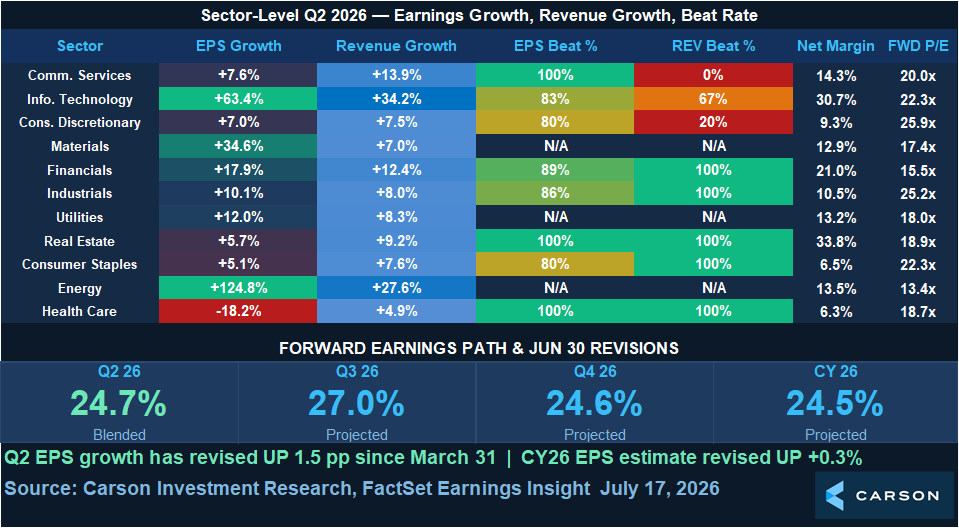
Blended EPS growth moved from 22.5% last week to 24.7% this week. Nearly all of that jump came from one place: the Financials sector, where earnings growth has surged to 17.9% from just 5.5% at the end of June.
The quality of the beats stands out as much as the quantity. So far, 88% of reporters have topped earnings estimates, well above the 5-year average of 78%. And they aren’t just squeaking by. Companies are beating estimates by 16.4% in aggregate, more than double the 5-year average of 7.0%.
Revenue tells the same story. Blended revenue growth ticked up to 12.8% from 12.3% last week, with 85% of companies beating sales estimates (5-year average: 70%). If 12.8% holds, it would be the strongest revenue growth since Q2 2022. Growth this quarter isn’t just about increasing margins, but also about the top line doing real work.

Stay on Top of Market Trends
The Carson Investment Research newsletter offers up-to-date market news, analysis and insights. Subscribe today!
"*" indicates required fields
Forward estimates are rising too. Analysts now project 27.0% earnings growth for Q3 and 24.5% for full-year 2026. Meanwhile, the forward 12-month P/E of 20.3 is slightly below its level on June 30 (20.4). Since quarter-end, earnings estimates have climbed faster (+1.1%) than the index itself (+0.5%). Earnings are, for the current moment, outrunning the price.
The Banks Delivered
The size of the Financials sector beats was remarkable. JPMorgan reported $7.70 in EPS against a $5.59 estimate (a figure that included $1.56 of one-time gains, but would have still been a big beat without them). Goldman Sachs posted $20.98 versus $14.51 expected. Travelers nearly doubled its estimate at $10.04 versus $5.41. Outside the banks, UnitedHealth ($6.38 vs. $4.91) and Micron ($25.11 vs. $20.86) added heavyweight beats of their own.
Here’s how the full sector scoreboard stacks up. Energy, Materials, and Utilities show N/A on beat rates because none of their companies have reported yet—their growth figures are still estimates. And that red 0% for Communication Services revenue is accurate: every company in the sector that has reported so far missed on the top line.
Source: Carson Investment Research, Earnings Insight, FactSet 7/17/2026
Our Take: The Broadening Is (Finally) Showing Up
For quarters, S&P 500 earnings growth has been about the Magnificent 7. This quarter, the other 493 companies are expected to grow earnings by 22.8%, their best growth since Q4 2021. Four of the five largest contributors to Q2 growth aren’t Mag 7 names at all (Micron, Chevron, Exxon Mobil, Broadcom). And by Q4, analysts expect the “other 493” to outgrow the Mag 7 for the first time in years! A broader earnings base is a healthier earnings base.
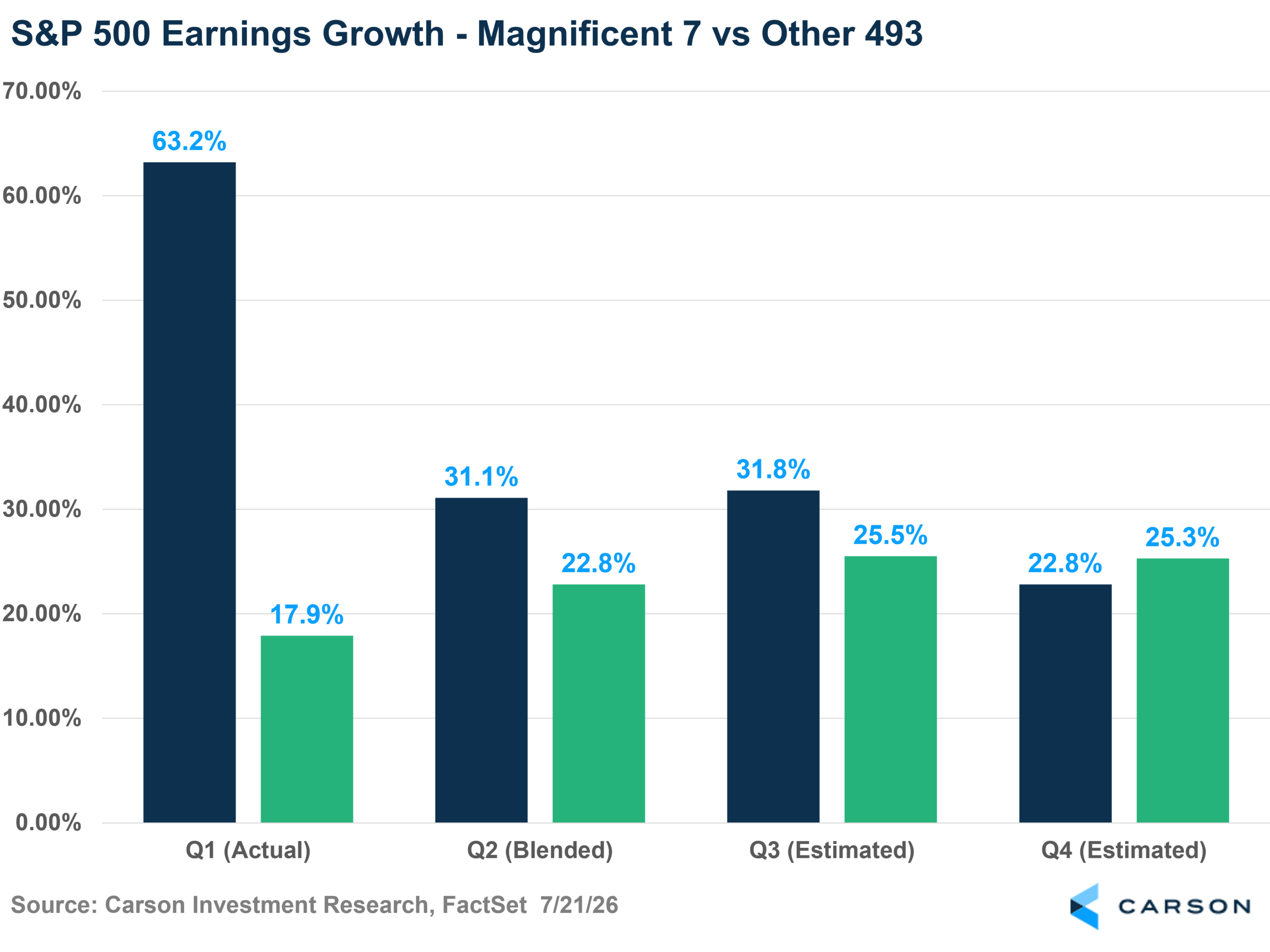
However, there are two big factors to consider. First, concentration hasn’t disappeared. According to Butters, if you strip out Micron and NVIDIA, that 24.7% growth rate decreases to 16.8%. Two (massive) companies still account for roughly a third of the index’s growth. Second, the market isn’t paying up for good news. Companies beating estimates have seen their stocks fall 0.1% on average around the report, versus a typical 1.0% gain, while misses are being punished with a 9.0% average drop, which is three times the normal penalty! We flagged this exact scenario last week: expectations were high coming in, and the bar to impress is even higher. Read week 1’s report here.
Another side note was the Health Care sector, which shows the worst growth of any sector at -18.2%, but that’s mostly an accounting artifact. Analysts are now including one-time R&D charges in their estimates for Merck and Eli Lilly. Exclude those two names and the sector would be growing 6.6%. The direction of that headline number is not the direction of the business.
Reporting Next Week
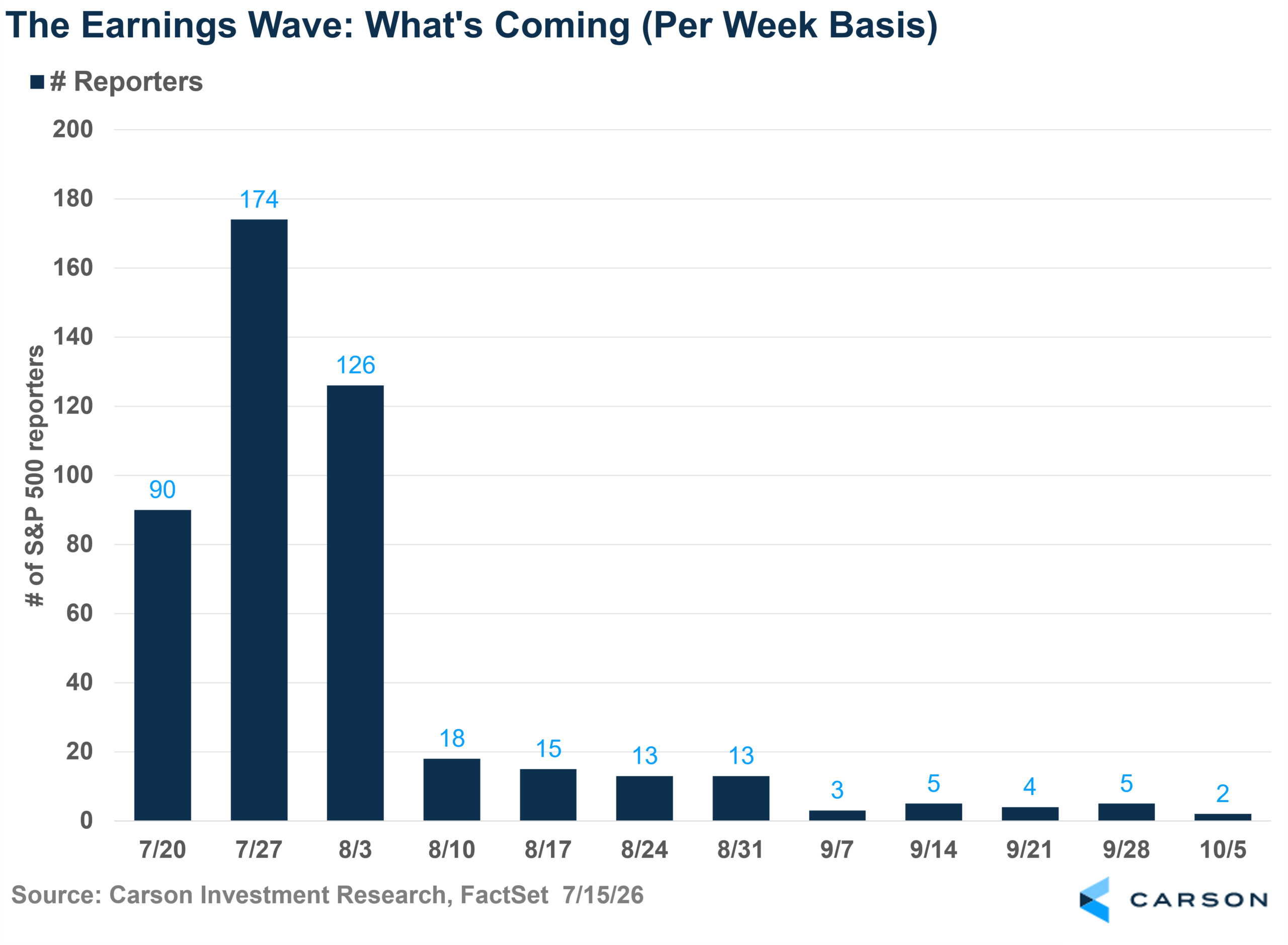
The season widens out fast from here: 86 S&P 500 companies report next week, including four Dow components, before the megacap tech wave arrives in late July. This is the stretch where we learn whether the strength beyond the banks is real.
Strong start, rising estimates, and a market that refuses to be impressed. We’ll see whether corporate America can keep clearing the bar. Back next Tuesday.
By Harry McDonald, Analyst, Investment Research
9034594.1. – 21JULY26A