Fed Chair Kevin Warsh’s speech in Jackson Hole last week captured a lot of headlines for its hawkish tone. The longest speech given by a Fed Chair since Janet Yellen in 2017, Warsh’s comments had a lot more than a description of the economy (hot) and policy rates (not restrictive). What didn’t get too much attention was what Warsh said about AI.
Warsh has been a bit of an AI “bull,” in that he’s been on record saying that AI-led productivity gains would lead to disinflation (or deflation), thus allowing the Fed to keep rates where they are (or even lower them). That view has clearly shifted, with no sign of any AI-led disinflation yet. In fact, it’s been the opposite in the near term— price pressure from AI-related bottlenecks has been pushing inflation higher.
Warsh raised a lot of interesting questions about AI:
- Will it raise productivity, and if so, when?
- Will token usage be complementary, or competitive, with labor?
- Will the next generation of AI models be as capital intensive?
- What will be the equilibrium price of tokens, and will it diverge amongst tokens (“heterogeneity”), with growing sums paid for access to the best frontier models and token prices for older models falling to the level of their marginal cost?
- What will be the market structure around AI? How much value accrues to owners of scarce assets (chips, labs, energy) and how much to businesses and labor?
- What are the broad implications for workers and the employment side of the Fed’s mandate?
All of these have significant policy implications, and for now Warsh is leaving answering these questions to the task forces he’s set up, though he did note that the recommendations from these committees will only come later and have no bearing on policy recommendations. However, it would’ve been useful if he had described more of his thinking around these questions, and how he would respond himself. There’s one in particular I’m interested in (and likely a lot of other folks too).
Will AI be complementary or competitive with labor?
Take the question of whether token usage will be complementary or competitive with labor.
If AI is complementary with labor, that would imply it makes workers more valuable (rather than replacing them). Example: an analyst can cover three times as many companies, or a salesperson can manage a lot more accounts. In other words…
AI -> higher worker productivity -> higher value hiring an additional worker -> higher labor demand -> higher wages
We could see a higher productivity growth environment with accelerating wage growth, which could push consumption higher and strengthen aggregate demand. The big question in this scenario is whether demand will rise faster than the productive capacity of the economy. This would put upward pressure on inflation and raise interest rates (similar to the 1990s). So the AI boom can be inflationary, at least during the transition (before AI becomes a positive supply shock, if it ever does).

Stay on Top of Market Trends
The Carson Investment Research newsletter offers up-to-date market news, analysis and insights. Subscribe today!
"*" indicates required fields
If AI is competitive with labor (firms can increase production without hiring as many workers), productivity can rise while employment pulls back. For example, say a company previously needed 1,000 workers producing $200 million of output. With AI, it can produce $250 million with 800 workers. If even the remaining workers receive higher wages, the labor cost per dollar of output falls.
This scenario would lead to lower aggregate demand. Workers typically consume relatively more of their labor income, whereas profitable companies and/or wealthy owners of these companies tend to consume relatively less of their capital income. So shifting the balance from labor to capital can reduce consumption relative to productive capacity.
One wrinkle here is that during the interim period, we could see strong output growth with higher inflation and weaker real wage growth as well. After all, margin expansion is the other side of inflation, and if inflation is elevated it can take a bigger bite out of wages (i.e., lower real wage growth). But this is unlikely to be sustained for very long, as weaker real wage growth will ultimately translate to lower consumption and weaker aggregate demand.
The two scenarios I’ve laid out are very different, and the monetary policy implications are huge. Here’s a table showing the differences:
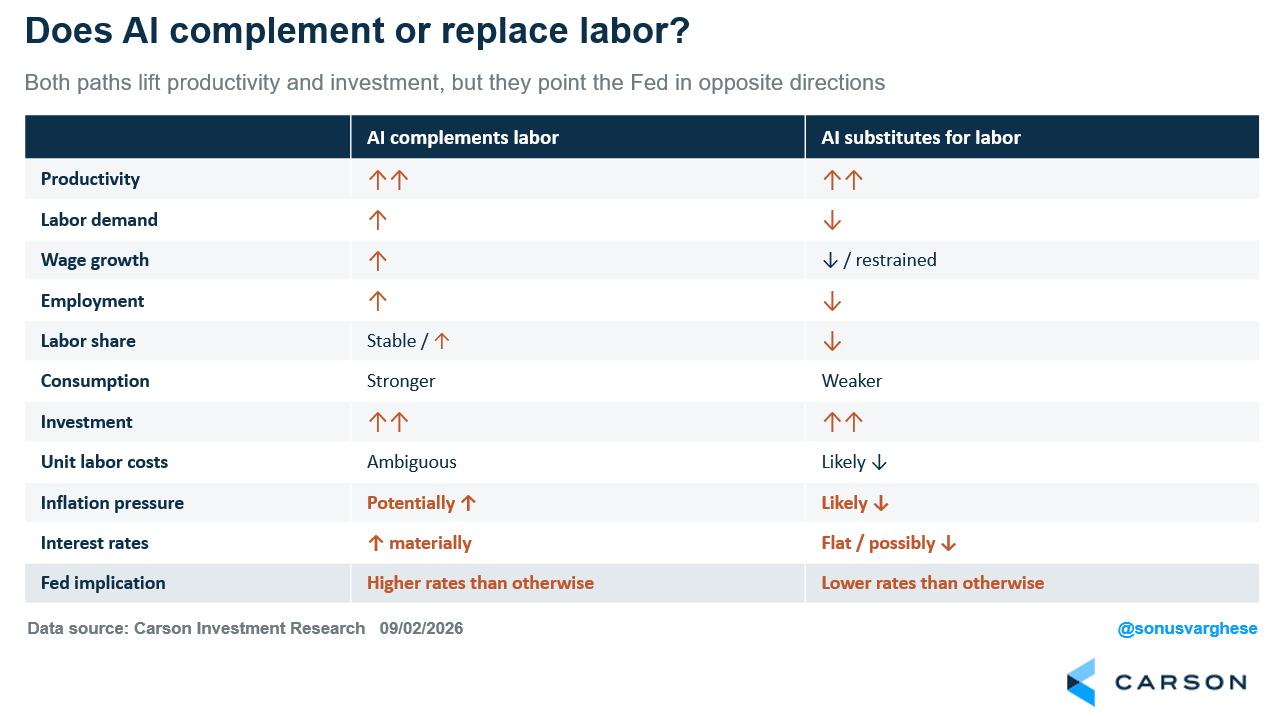
To summarize:
- If AI makes workers more productive, we could get a high-productivity, high-wage, high-investment economy that requires structurally higher interest rates.
- If AI replaces workers, we could get a high-productivity, weak-wage economy with much more disinflationary pressure and a lower equilibrium policy rate.
Where are we at now?
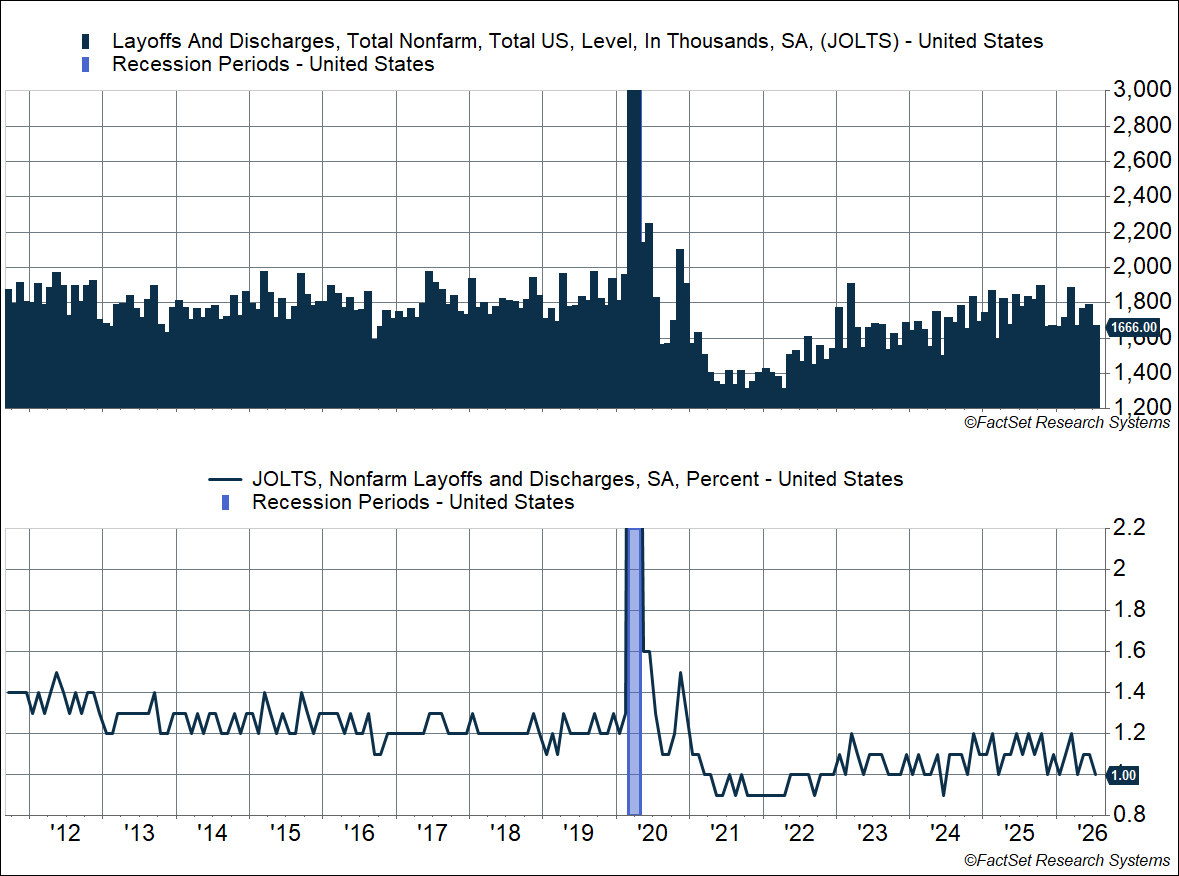
It’s hard to say one way or the other, but one positive thing is that the unemployment rate is near historical lows at 4.1%. There’s no jobs-apocalypse yet, and for now, AI seems to be complementary. In fact, layoffs have been low recently, averaging just around 1.7 million per month over the last three months (through July). Back in 2019, we were close to 1.8 million. Keep in mind that the workforce is also larger now, and if you normalize for that, the layoff rate has fallen to 1.0%, lower than the 1.2-1.3% average in 2018-2019 (a period we associated with a strong labor market).
In my opinion, we clearly have an investment/capex boom right now. Profits are also surging, in large part due to margin expansion, primarily at chip companies and industrial/energy companies. As I noted earlier, the other side of that is elevated inflation, which is pulling real wage growth lower. That doesn’t mean activity is weak: far from it, as nominal GDP growth is running close to the late 1990s pace. However, a large part of that is from inflation, and real growth is lagging (as I discussed in my prior blog).
The big picture is that we’re in a period of strong nominal GDP growth, low unemployment, an investment boom, and stubborn inflation. The stock market is booming, and household net worth is surging. I believe that’s clearly helping to boost consumption.
For now, policy is getting increasingly accommodative even if the Fed doesn’t cut rates. In fact, raising the fed funds rate by 0.25-0.5% may not even matter much in this environment. However, there’s still a lot of longer-term uncertainty as to whether AI will be complementary with labor, or whether it’ll replace it.
For more content by Sonu Varghese, Chief Macro Strategist, click here.
9108069.1. – 2SEPT26A