“It is human nature to overestimate risk and underestimate opportunity.” Jeff Bezos
Here are a few things I’ve been thinking about lately.
Bad Days Happen
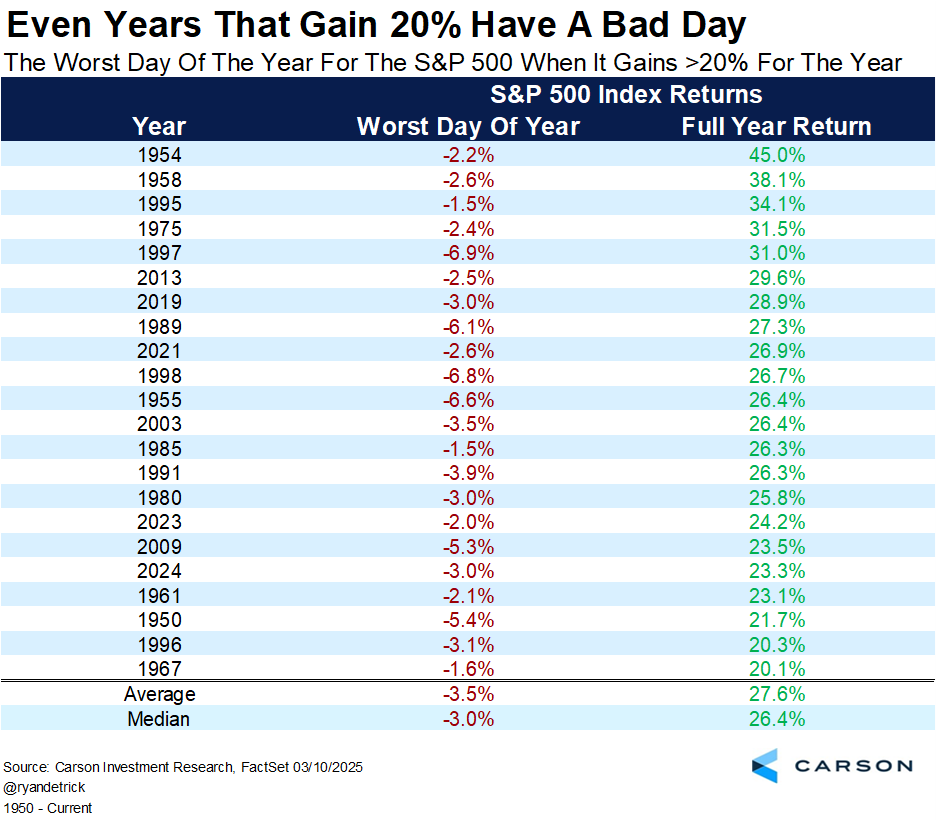
Last Friday, the S&P 500 fell 2.6%, marking the worst day of the year. Yes, it didn’t feel good, but after the historic nine-week rally, it would have been foolish not to expect some type of give-back. Something to know is even the best years have bad days. In fact, we found that 22 years gained at least 20% in a given year, and the average worst-day return was a loss of 3.5%. In fact, there was a day in 1997 when the S&P 500 tanked nearly 7%, yet stocks still gained more than 30% that year.
Breadth Is Holding Up Well
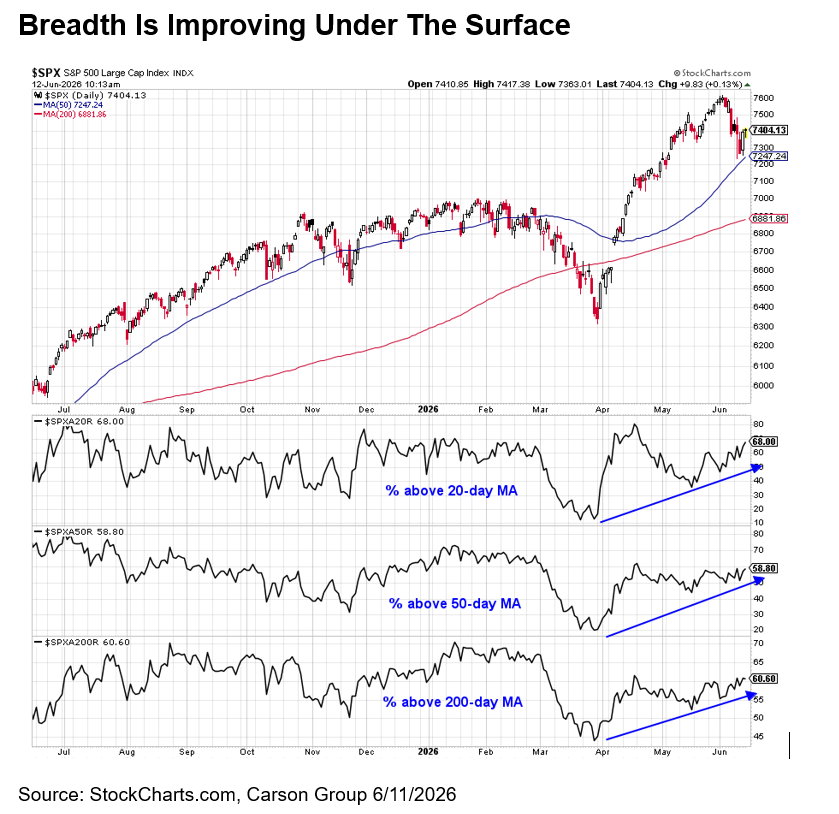
Yes, technology has been taking a well-deserved break, but other areas and sectors are holding up quite well. In fact, on Tuesday, the S&P 500 fell, yet advances outnumbered the decliners by a 2-to-1 ratio, an extremely rare development.
I’ve been encouraged that the number of stocks in the S&P 500 above their 20-day, 50-day, and 200-day moving averages has all been increasing recently, even as the overall market price has weakened. This is a clue that things aren’t just falling apart; under the surface, things are doing well, and money is rotating.
About That Nine-Week Win Streak
Yes, the S&P 500’s nine-week win streak ended recently. And maybe you would expect forward returns after such a strong run to give back a little. But historically, that’s just not what we’ve seen. After a nine-week streak or longer ends, the S&P 500 is higher a year later 80% of the time with an average gain of 9.8%. That’s only about average for all periods, but it’s important to remember that “average” historically is solidly bullish.
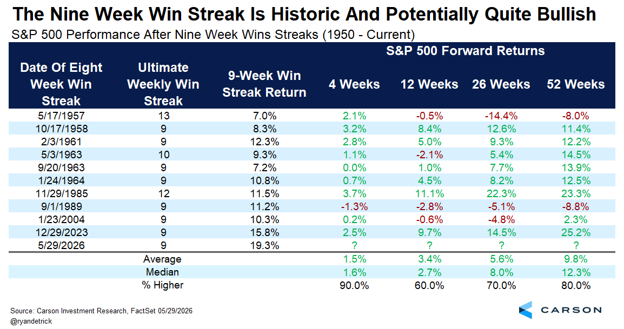
This is also the strongest nine-week return we’ve ever seen to start a streak of nine weeks or longer. Streaks with stronger returns have tended to mean a better follow-up in the next 52 weeks, with the S&P 500 averaging over 20% in the 52 weeks following the prior top three nine-week win streak returns (2023, 1961, 1985).

Stay on Top of Market Trends
The Carson Investment Research newsletter offers up-to-date market news, analysis and insights. Subscribe today!
"*" indicates required fields
Stocks Don’t Peak In June
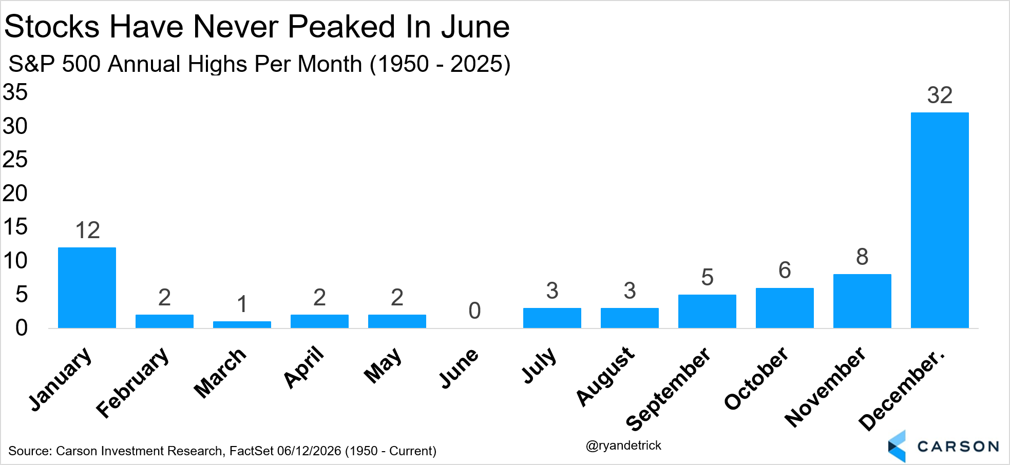
The most recent all-time high was on June 2 and pulled back a max 4.5% so far, but could this really be the peak for the year? We remain bullish, so we don’t think so, but something to think about is that June is the only month in history that hasn’t seen the ultimate peak for the year. Yes, most years peak either in January or December, which makes sense, but we don’t think this year will be the first one to peak in June, and this is another positive for the bulls.
What A Two-Month Rally
Stocks soared for the two months off the late March lows, so some weakness in June isn’t a big surprise. Here’s a nice way to show this.
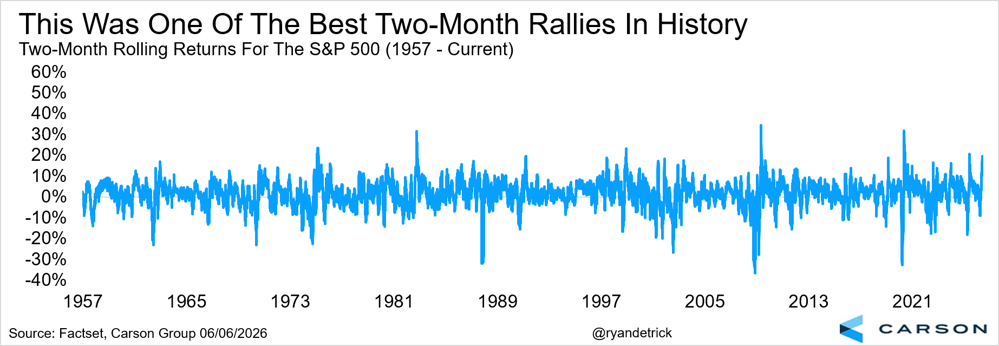
Putting more context around this, the S&P 500 gained 19.5% in only two months off the late March lows. This was one of the greatest two-month rallies in history, but previous large rallies were all quite bullish going forward.
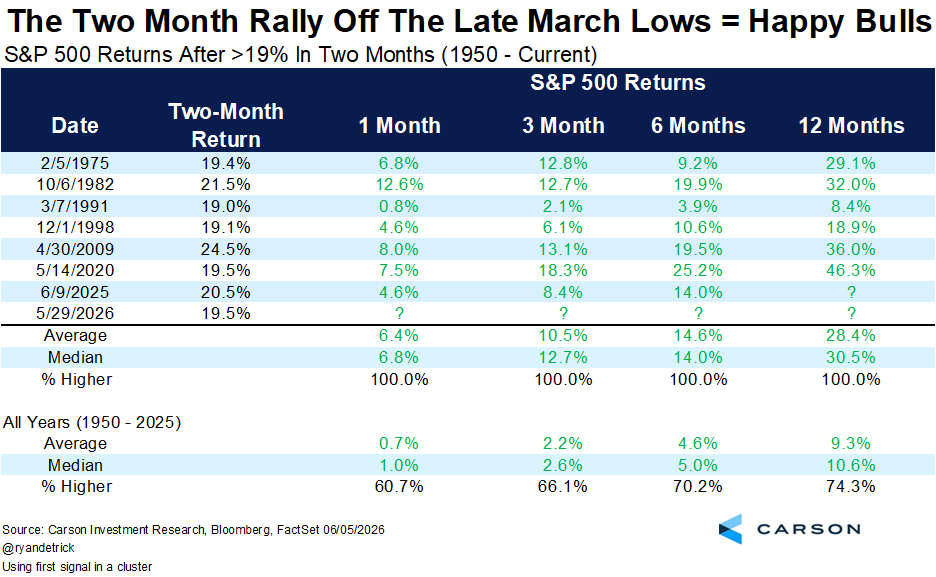
We found only 7 other times in history when stocks gained more than 19% in 2 months, and in every case, they were higher 1-, 3-, 6-, and 12-months later, with a median return a year later of more than 30%.
Thanks as always for reading, and I hope everyone is off to a great start to summer! Our latest Facts vs Feelings this week was a fun one, as we live from Wrigleyville in Chicago and were joined by Jim Bianco, founder of Bianco Research, and Jeff Kilburg, Founder of KKM Financial.
For more content by Ryan Detrick, Chief Market Strategist, click here.
8975646.1. – 12JUNE26A