Federal Reserve (Fed) Governor Chris Waller recently said that sternly staring at inflation until it melts before our withering gaze is not an option. Yet that appears to be exactly what the Fed plans to do.
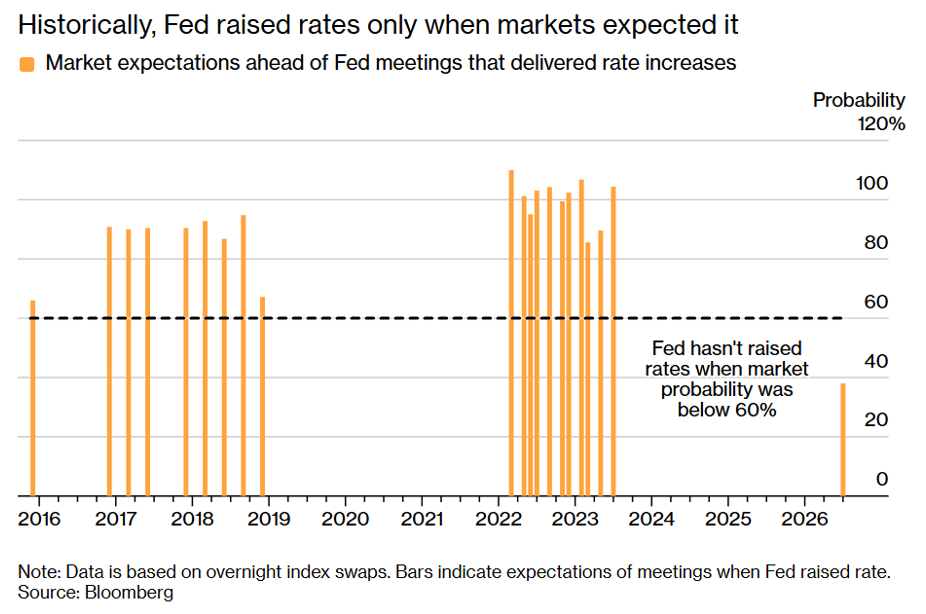
The Fed kept rates unchanged at its July meeting in a 9-3 vote, with three dissents showing the committee is not united behind the inflation staredown. Markets had priced a 30%-40% chance of a hike, creating the largest gap between expectations and the decision since September 2024, when the Fed cut 0.50 percentage points. Historically, the Fed has raised rates only when the pre-meeting probability was at least 60%.
Source Date: 7/29/26
So, the decision itself wasn’t a surprise—that was our expectation all along. Almost everything else was.
Optimism, but Why?
The committee, especially Chair Kevin Warsh, sounded highly optimistic about an economy it says is expanding at a solid pace on the back of:
- Strong productivity growth and capital investment
- Job gains keeping up with the workforce
Yet real (inflation-adjusted) GDP grew at a measly 1.5% annualized pace in Q2, partly because of weaker net exports and an inventory pullback. Over the past six quarters, growth has averaged just 1.9%, below the 2010-2019 trend of 2.4% and the 2.9% pace in 2023-2024. That does not indicate a strong productivity environment. Even with zero labor force growth, productivity would be about 2%; with hours worked rising, it is closer to 1.5%, matching the relatively weak 2005-2022 pace.
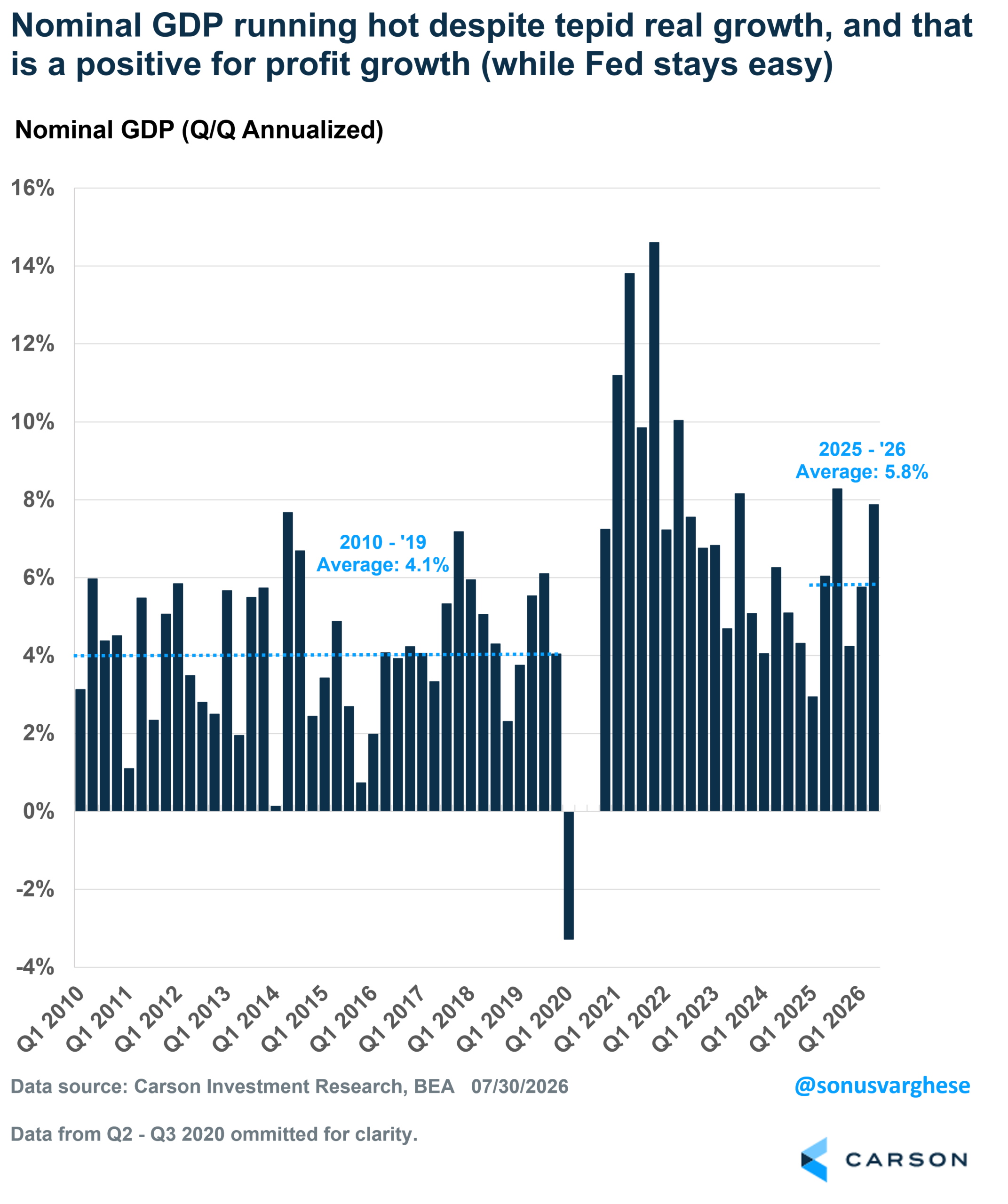
Meanwhile, nominal GDP is running hot: 7.9% annualized in Q2 and 5.8% over the past six quarters. That is well above the 2010-2019 trend of 4.1% and slightly above the 5.6% pace in 2023-2024, when real growth was stronger and inflation was easing. As we discussed in our 2026 Outlook and Midyear Outlook, this is inflationary growth (which can be good for companies because revenues and profits come from nominal spending).
Inflation Remains a Problem
Inflation remains elevated and broad-based, with pressure from Middle East bottlenecks, AI-related constraints, tariffs, and core services excluding housing. It’s not just oil prices.
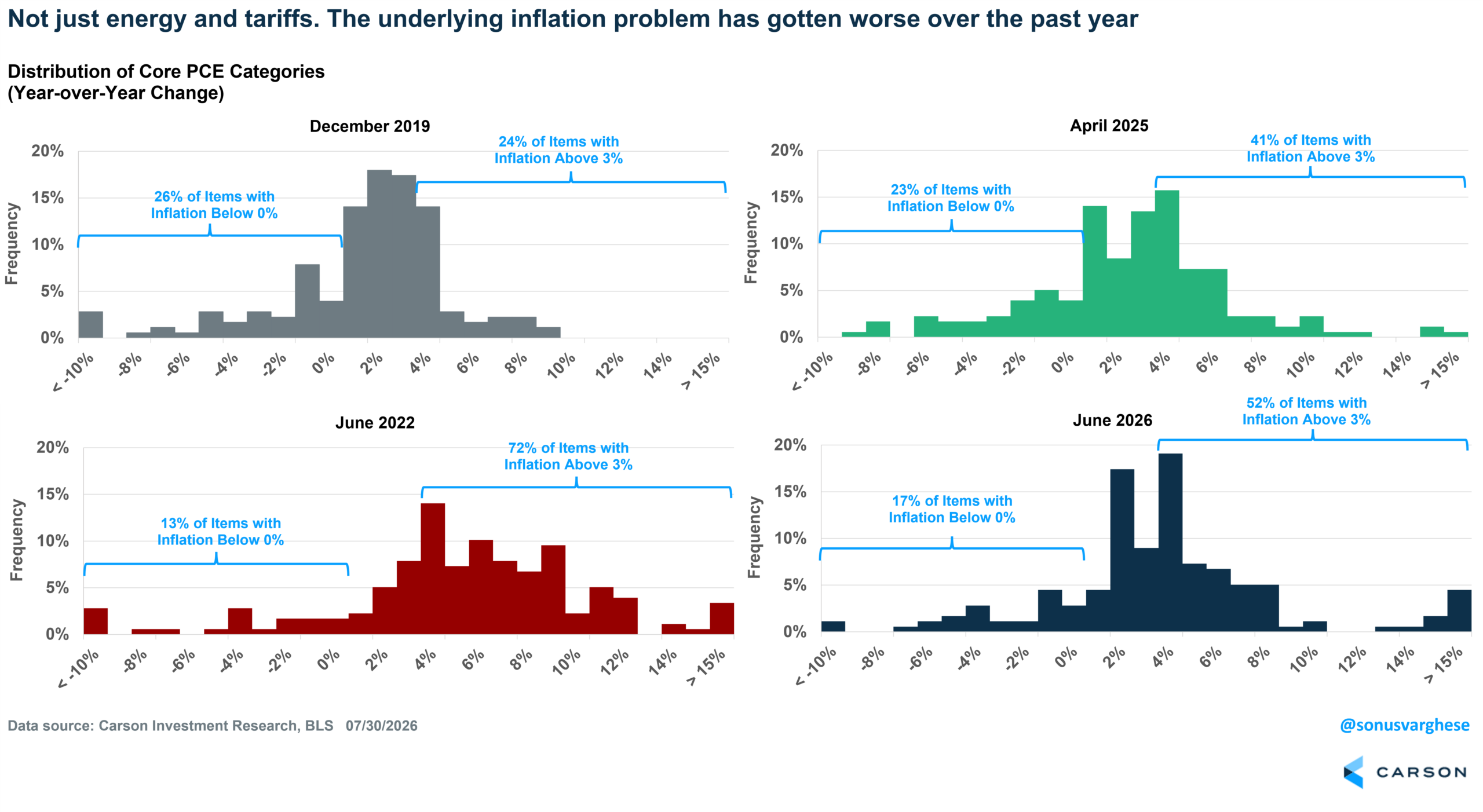
The Fed’s preferred inflation gauge, the core Personal Consumption Expenditures Index (PCE), rose just 0.1% in June. But much of the softness came from idiosyncratic price declines that are unlikely to persist. Looking across 178 core PCE items, inflation broadened dramatically by June 2022, narrowed through last year without returning to normal, and has worsened again since April 2025 (post-Liberation Day). The share of items with inflation above 3% (and above 4% in parentheses) shows the shift:
- December 2019: 24% with 3%+ inflation (10% with 4%+ inflation)
- June 2022: 72% (58%)
- April 2025: 41% (25%)
- June 2026 52% (33%)
A Fed Chair Looking for Reasons (Excuses?) To Be Dovish
In the eight weeks since Kevin Warsh became Fed chair, he has repeatedly said the Fed remains committed to its 2% inflation target, including at this meeting’s press conference. But saying it is one thing; explaining how to achieve it is another. Warsh’s press conference lasted 45 minutes but he managed to say a lot without saying much at all.
At the margin, his comments veered dovish as he appeared to be looking for reasons not to hike:
- He downplayed AI-related price pressures, saying strong capex prepares the ground for future growth (and supply).
- He attributed the recent rise in market rates to economic strength rather than to expectations that the Fed would respond to elevated inflation.
- He suggested higher market rates could substitute for a Fed hike, saying, “rates are higher today since markets have made decisions.”
- He favored lowering inflation through a credible commitment to the target, and lower inflation expectations, rather than by raising rates to reduce demand.
- He implied the Fed could eventually use a broader set of inflation measures instead of PCE, which would further obfuscate the framework.
All this is puzzling.
There is no sign AI-related price pressure will ease soon. Think of an AI agent as another worker in the economy: if AI raises productivity, replaces some workers, and accelerates innovation, the amount of work (and the price of AI) could rise. In a strong economy, labor costs also rise, but faster wage growth supports demand and can require higher rates to contain inflation. Unlike technologies that produced disinflation, AI could instead generate inflationary growth.

Stay on Top of Market Trends
The Carson Investment Research newsletter offers up-to-date market news, analysis and insights. Subscribe today!
"*" indicates required fields
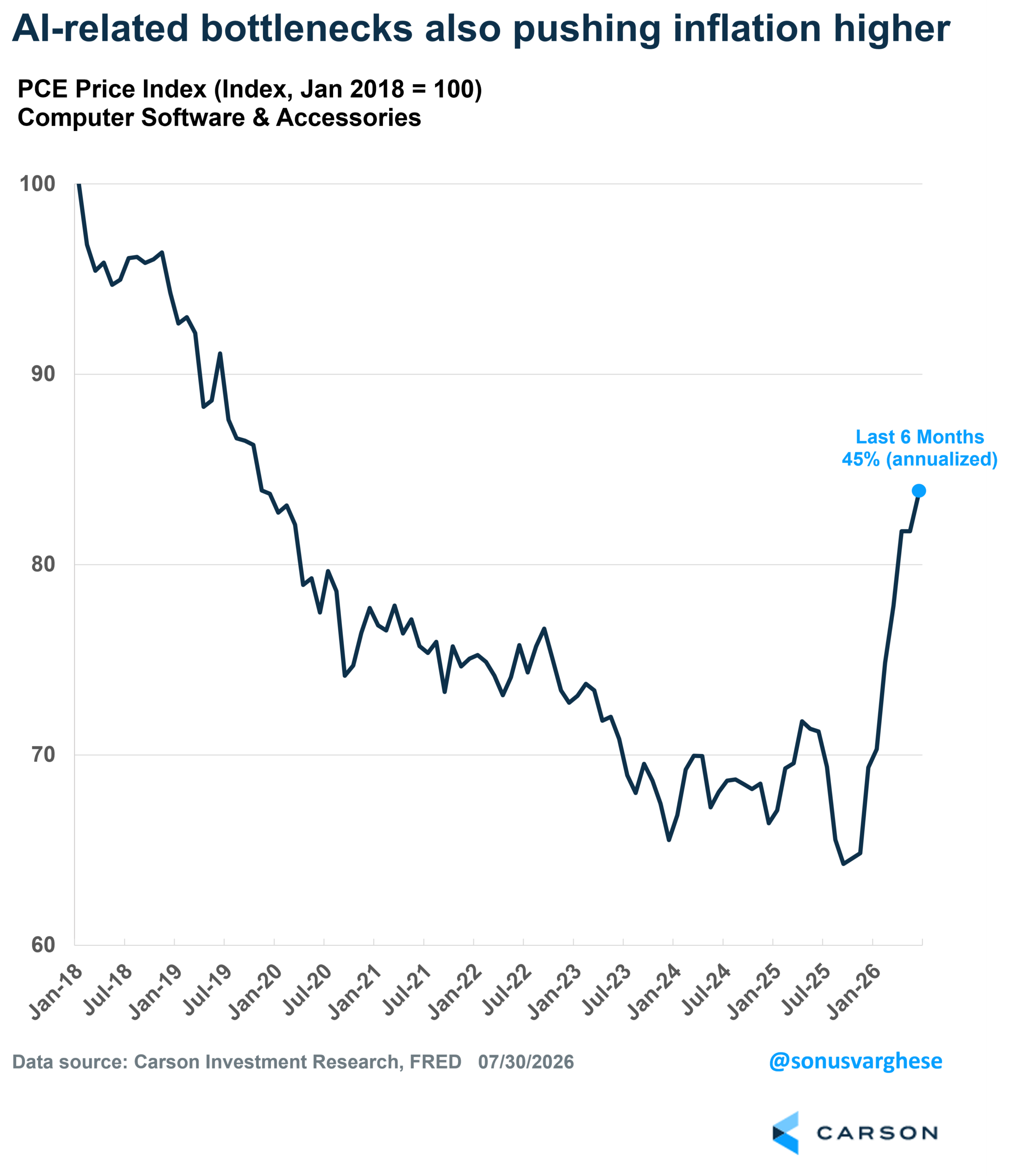
There is no certainty, but the current evidence points to inflation from AI bottlenecks. The PCE price index for computer software and accessories is up 45% annualized this year, reversing six years of price declines in six months. Companies are also spending heavily on AI capital projects with uncertain returns and higher hurdles, which argues for a higher cost of capital, and higher interest rates.
Warsh also appears to be kicking the can down the road, waiting until year end for committees to propose alternatives to rate hikes, such as using the balance sheet or inflation expectations, and/or a broader set of inflation measures.
Most confusing was his suggestion that the recent rise in market interest rates has done the Fed’s job for it. Short-term rates actually fell after the meeting, reflecting the dovish bias (the one-year yield dropped to 4.0%) while longer-term yields surged.
Asked why policy rates should not be higher, Warsh said he would not describe the decision as a pause. In his view, the long end of the yield curve has done the Fed’s work, and he added, “we’re trying not to interfere with that market signal.”
Sorry, this makes no sense to me. Short-term rates fell because markets expect a more dovish Fed in the near term. That increases the risk that inflation worsens and the Fed eventually has to act, which is why long-term rates jumped:
- The 10-year yield hit 4.70%, which is close to the highest level we’ve seen since January 2025.
- The 30-year yield hit 5.23%, a 19-year high.
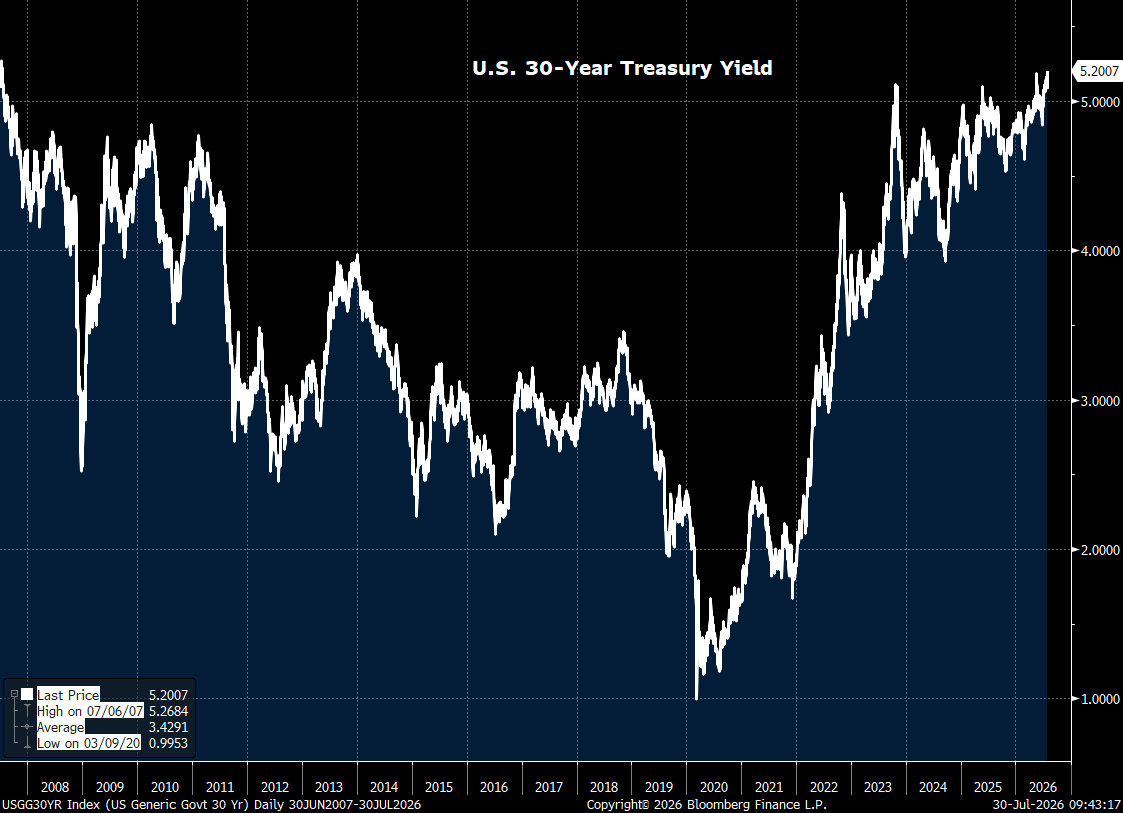
Long-term rates are rising because markets expect more inflation and, eventually, a more hawkish Fed. Saying those higher yields are doing the Fed’s work is perplexing. The Fed is effectively pushing them higher by signaling a willingness to tolerate a hotter economy and more inflation in the near term. In other words, the Fed is so dovish that it is hawkish.
This is also implicit forward guidance, whatever Warsh calls it that or not. Markets cannot ignore the Fed because expectations for policy are central to Treasury pricing. Warsh said the market is finally responding to the data rather than the Fed, but the post-meeting bond moves suggest otherwise. Uncertainty also remains high: markets now assign a 62% probability to a September hike, close enough to a coin toss. We are heading into the next meeting with almost as much uncertainty as this one. That means we will keep talking about the Fed, whether Warsh wants us to or not.
For more content by Sonu Varghese, Chief Macro Strategist, click here.
9051456.1. – 30JULY26A