The Federal Reserve’s next meeting is this week (July 27-29th), and the level of uncertainty around what they may do is the highest we’ve seen in recent years, especially this close to a meeting. The probability of a rate increase is 37% (as priced by the futures market), which is as good as a coin toss (50%), i.e., maximum uncertainty. The committee is clearly divided on the inflation outlook, and Fed Chair Warsh has refused to say which way he’s leaning (nor how he may choose to make up his mind), and this uncertainty is being reflected in markets. Warsh has said he wants “messier meetings”, which is all well and good when you don’t have an inflation problem, but that’s not the case now.
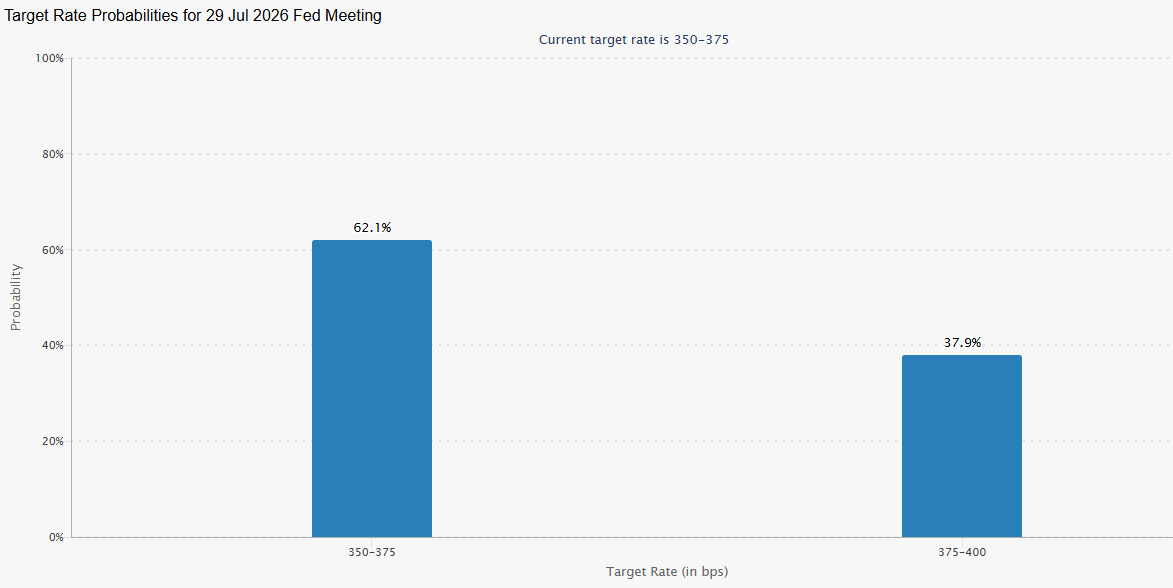
Source: FedWatch – CME Group
The market thinks the Fed has an inflation problem and will eventually combat it with higher interest rates. US Treasury yields have risen along with oil prices, though oil prices only serve to crystallize the inflation problem. As we’ve been pointing out since the start of the year, the Fed’s inflation problem goes beyond energy, and is a more broad-based problem:
- Energy prices are rising again, and that’ll put pressure even on core inflation via airfares
- Supply chain bottlenecks emanating from the Middle East, especially for things like fertilizers, are going to put upward pressure on food prices – keep in mind that restaurant prices are included in core inflation
- Tariffs continue to hit input prices for manufacturers, and as a recent study from Federal Reserve researchers found, these are yet to fully translate to consumer prices
- AI-related bottlenecks are pushing prices higher for chips and all sorts of electronics equipment, including computers
- Services ex-housing inflation is still running hot, telling you that wage growth is likely running hotter than the pre-pandemic pace (feeding into faster nominal spending growth).
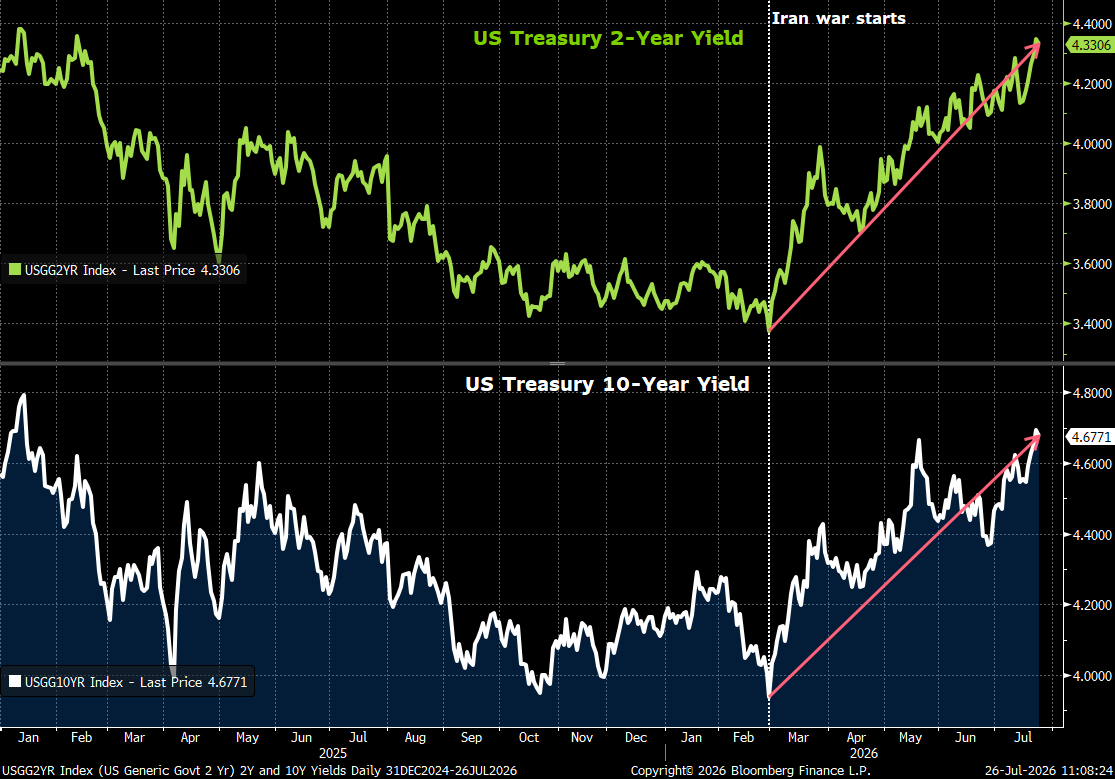
The messy inflation outlook has resulted in higher short- and long-term yields.
- 2-year Treasury yields hit 4.33%, 0.96%-points higher than the 3.37% level on the eve of the war (February 27th) – this is the highest since early 2025
- 10-year treasury yields hit 4.68%, 0.74%-points higher than on the eve of the war, and also the highest since January 2025
The 2-year yield is essentially the market’s expectation for average short-term policy rates over the next two years. The current policy rate is at 3.63% – a 2-year yield of 4.33% is 70 bps above that, which implies the market expects the market to raise rates 3 times (0.25%-points each time) and keep them elevated.
But Wait, Rate Hikes Likely Won’t Result in More Oil (Or Chips)
This is a common line of thinking right now: how will rate hikes “solve” the inflation problem? It’s not like higher interest rates will result in more oil being produced, or even more semiconductor chips. If anything, higher interest rates may further crimp supply as producers pull back.
However, a recent speech by Fed Governor Chris Waller tackled exactly this question. The overall speech was clearly hawkish, albeit conditional on data. He said he’s in favor of holding rates steady if core inflation begins to cool, but he would consider near-term hikes if it remains hot or accelerates. The good news is that the June CPI data came in really soft the day after his speech, but the bad news is that the softness was not broad-based. The Fed’s own preferred measure of inflation, the personal consumption expenditures index, is going to be hotter. The inflation problem hasn’t gone away.
Waller accepts the basic premise: higher interest rates cannot create more oil, semiconductors, memory chips, or shipping capacity. Monetary policy cannot directly repair the supply side.
But that does not make monetary policy irrelevant. The Fed may not control the initial supply shock, but it can influence whether that shock becomes persistent, economy-wide inflation.
The distinction is key between:
- The first-round effect: Oil supply falls, so oil and gasoline prices rise.
- The second-round effects: Higher energy costs spread to transportation, manufactured goods, and services; businesses raise prices more broadly; consumers continue to spend strongly enough to absorb those increases; wage and price behavior adjusts; and inflation remains elevated after the original oil shock fades.
Rate hikes are aimed primarily at preventing those second-round effects.

Stay on Top of Market Trends
The Carson Investment Research newsletter offers up-to-date market news, analysis and insights. Subscribe today!
"*" indicates required fields
One: Rates can bring demand into line with reduced supply
A negative supply shock means the economy can temporarily produce fewer goods and services at existing prices. If aggregate demand remains unchanged, too much spending is chasing reduced available supply.
Higher rates restrain interest-sensitive spending, credit creation, investment and asset-price-supported consumption. They therefore bring demand into better alignment with constrained supply.
The goal is not to manufacture more oil. It is to stop total nominal spending from continuing as though the supply loss never happened.
Consider a stadium that suddenly has 20% fewer seats. The Fed cannot build more seats, but it can reduce excess demand so that ticket prices do not keep cascading upward across the entire event economy. That adjustment can be painful, but the alternative can be sustained inflation.
Two: The Fed targets overall inflation, not oil’s relative price
A supply shock should raise the relative price of the scarce item. Oil becomes more expensive compared with other goods.
But that does not automatically require prices throughout the economy to keep rising. For inflation to remain elevated, other prices must also increase or total nominal demand must accommodate the shock.
A tighter policy allows oil prices to rise while exerting downward pressure elsewhere. Consumers who spend more on gasoline have less to spend at restaurants, retailers, or on other services. Higher rates reinforce that reallocation.
In other words:
- The Fed cannot stop oil from becoming relatively more expensive.
- It can resist an increase in the general rate of price inflation.
What Next?
The most important point Waller made is that he’s not considering rate hikes simply because oil prices increased. As we pointed out at the top (and since the beginning of the year), inflation is more broad-based, and Waller acknowledges that. His concern is that underlying demand and broader pricing dynamics may already be too strong, independent of the direct energy effect.
The good news is that inflation expectations (as implied by markets) are consistent with the Fed’s 2% target, but that’s because investors expect the Fed to raise rates and keep them elevated. Whereas if the Fed tolerates high inflation and expectations become unanchored, it may later need much larger, faster, and more persistent rate hikes, increasing recession risk.
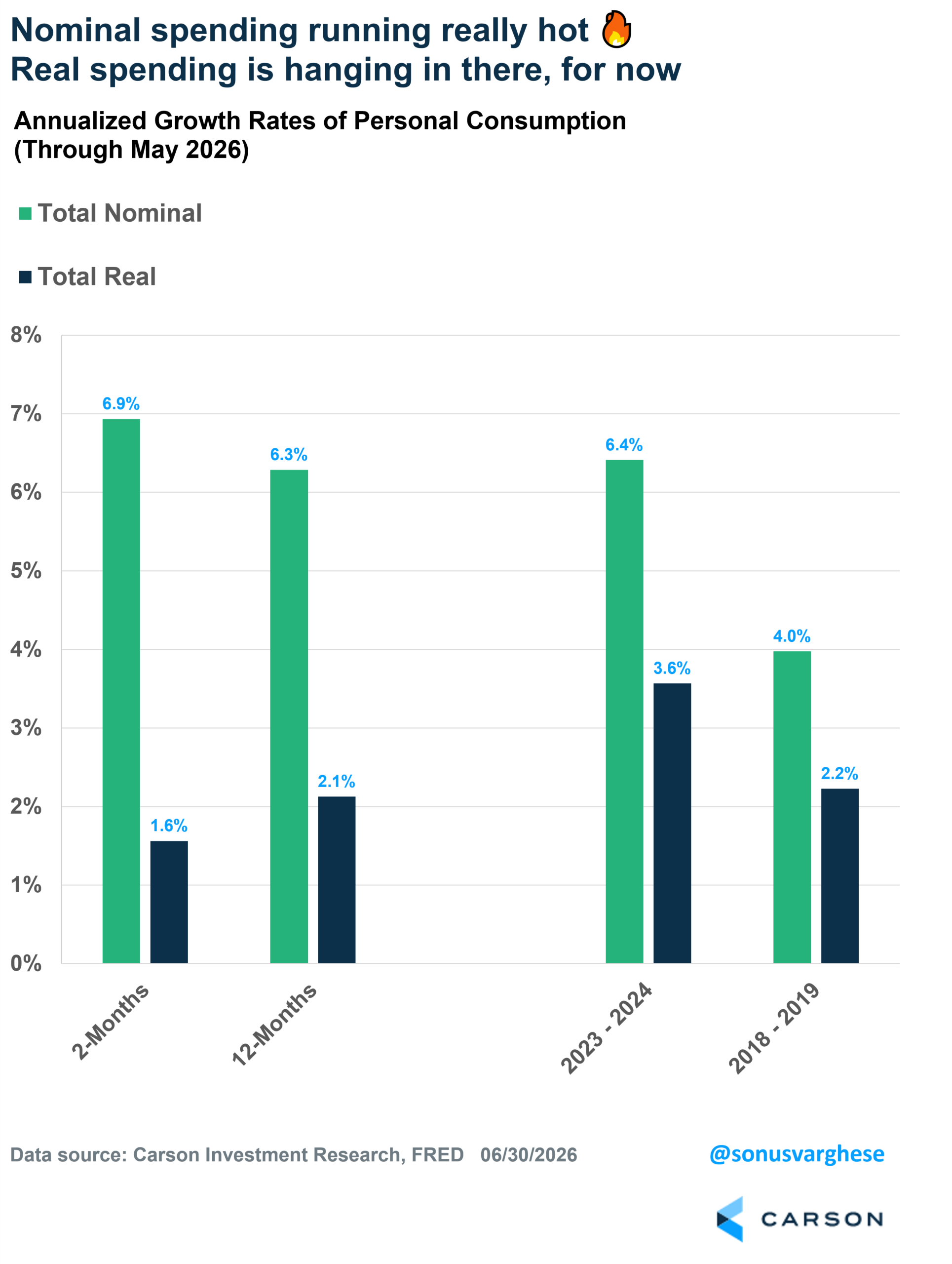
The Fed cannot reverse a supply shock, but it controls the nominal-demand environment in which the shock occurs. If demand remains resilient, inflation is broadening, and employment is already near maximum, keeping policy too loose could validate and propagate price increases. Nominal consumer spending has clocked in at an annualized pace of almost 7% over the last two months for which we have data (April-May), and 6.3% over the prior twelve months. That’s hot. Note that inflation-adjusted “real” growth is ok but well below the 2023-2024 pace and even the 2018-2019 trend of 2.2%.
Waller also recognizes the risks. The labor market is not as overheated as it was in 2022, so additional tightening is more likely to raise unemployment rather than merely reduce vacancies.
Ultimately, the next several core-inflation readings will matter a lot. The next several core-inflation readings matter, never mind Warsh’s preference for not giving “forward guidance”. The Fed’s going to have to differentiate between a temporary relative-price shock that should be looked through and a generalized inflation process that requires demand restraint.
For more content by Sonu Varghese, Chief Macro Strategist, click here.
9046501.1. – 28JULY26A