
Welcome to Carson Investment Research’s Earnings Check-In for the week ending August 28, 2026. This series is built weekly from FactSet’s Earnings Insight report (John Butters, VP, Senior Earnings Analyst with FactSet), with index weights and market caps sourced from YCharts, and aggregation performed in-house. We tie every figure to FactSet’s published numbers, then add Carson’s perspective on top. We publish our Earnings Check-In weekly during earnings season.
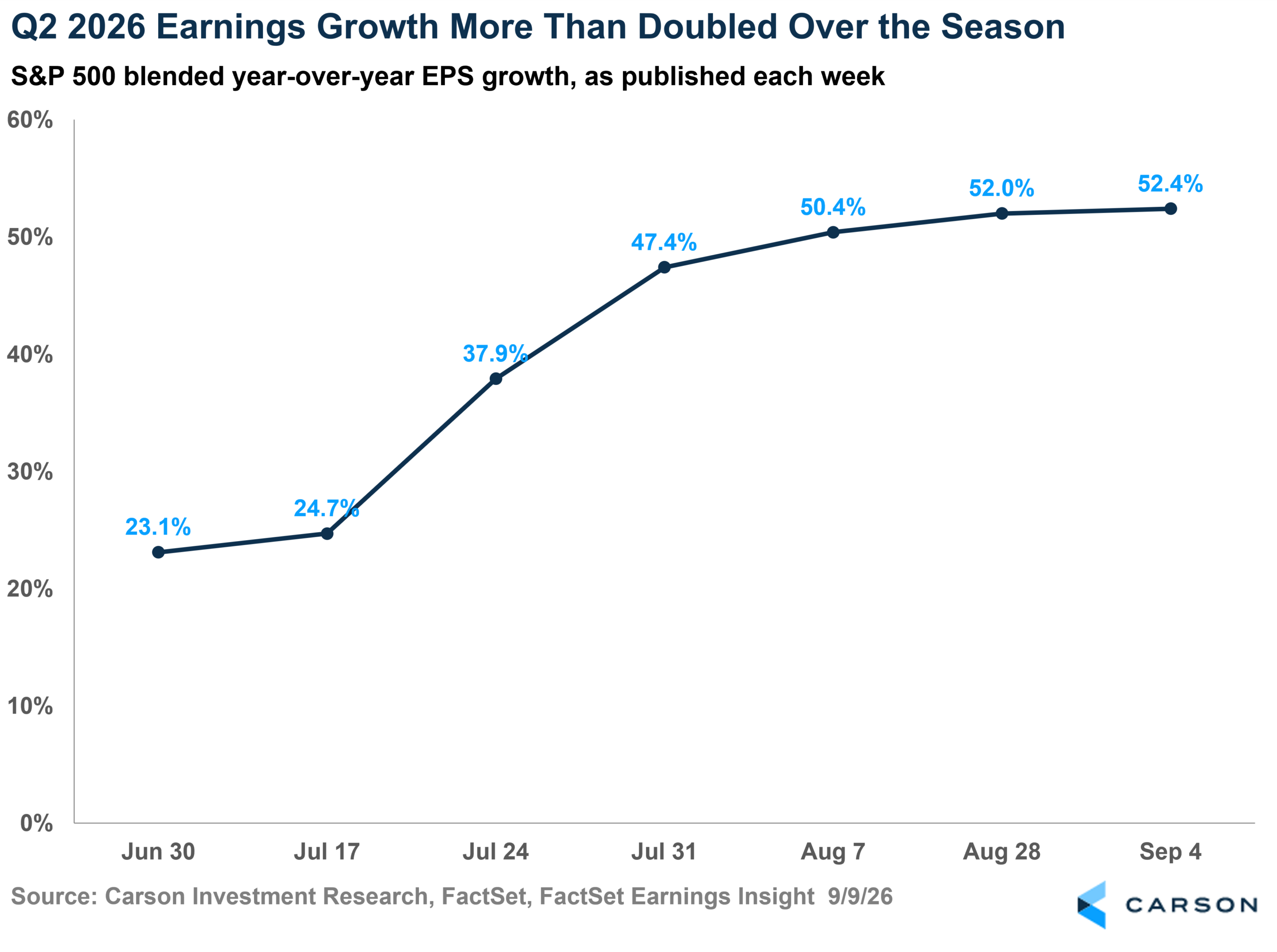
Back in July, I wrote that the banks would set the tone, and they did. At 10% reported, Q2 blended earnings growth was 24.7%, already ahead of the 23.1% analysts had penciled in on June 30.
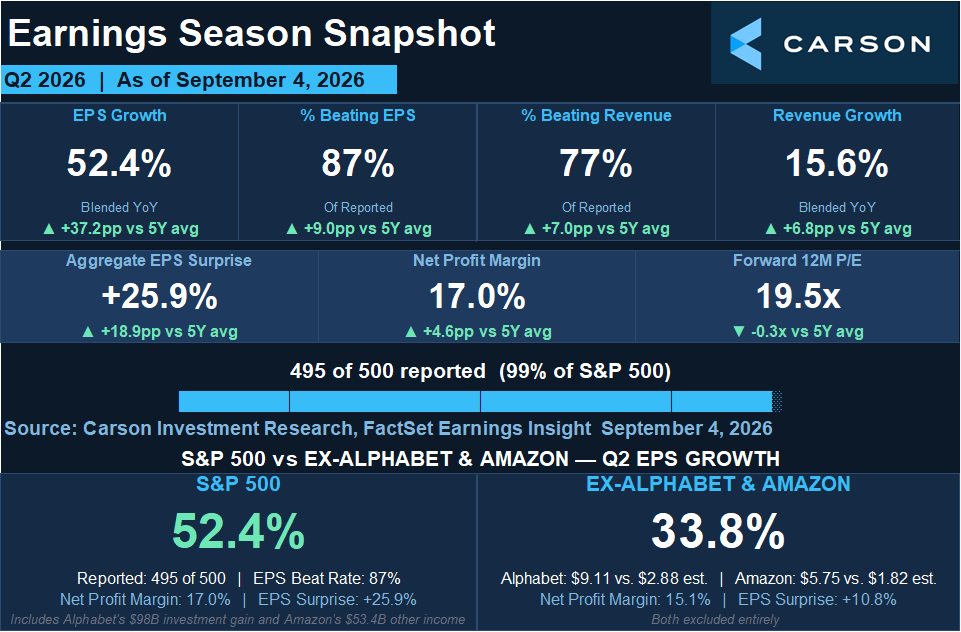
Ten weeks later, Q2 is finished at 99% reported. The number is a staggering 52.4%, which is more than double where we started!
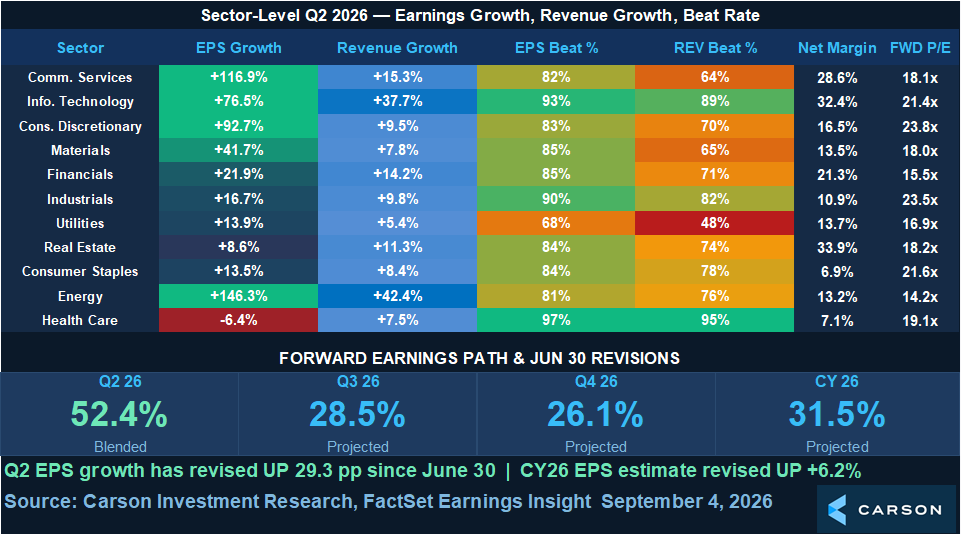
Q2 2026 goes into the books as the strongest earnings quarter since 2021, with revenue growth of 15.6% and a net profit margin of 17.0%, the highest FactSet has recorded since it began tracking the metric in 2009.
Here is the season at a glance:
What I find more interesting, looking back across the season, is why the number kept changing.
The Baton Kept Getting Passed
The season opened with financials. Then Alphabet reported $9.11 per share against a $2.88 estimate, a 216% beat that moved index growth from 24.7% to 37.9% in a single week. Amazon followed with $5.75 against $1.82, and the index went to 47.4%. Two companies did roughly two-thirds of the season’s revision in just fourteen days.
Then we broadened. Strip Alphabet and Amazon out entirely, and the index was still growing 28.8% at the end of July and 33.8% at the finish. The gap between the headline and the ex-both number barely moved. So, the broadening wasn’t the rest of the index closing on two megacaps; it was a combination of everything else catching up on its own, which is why by the end of August I was writing that the other 493 were catching up.
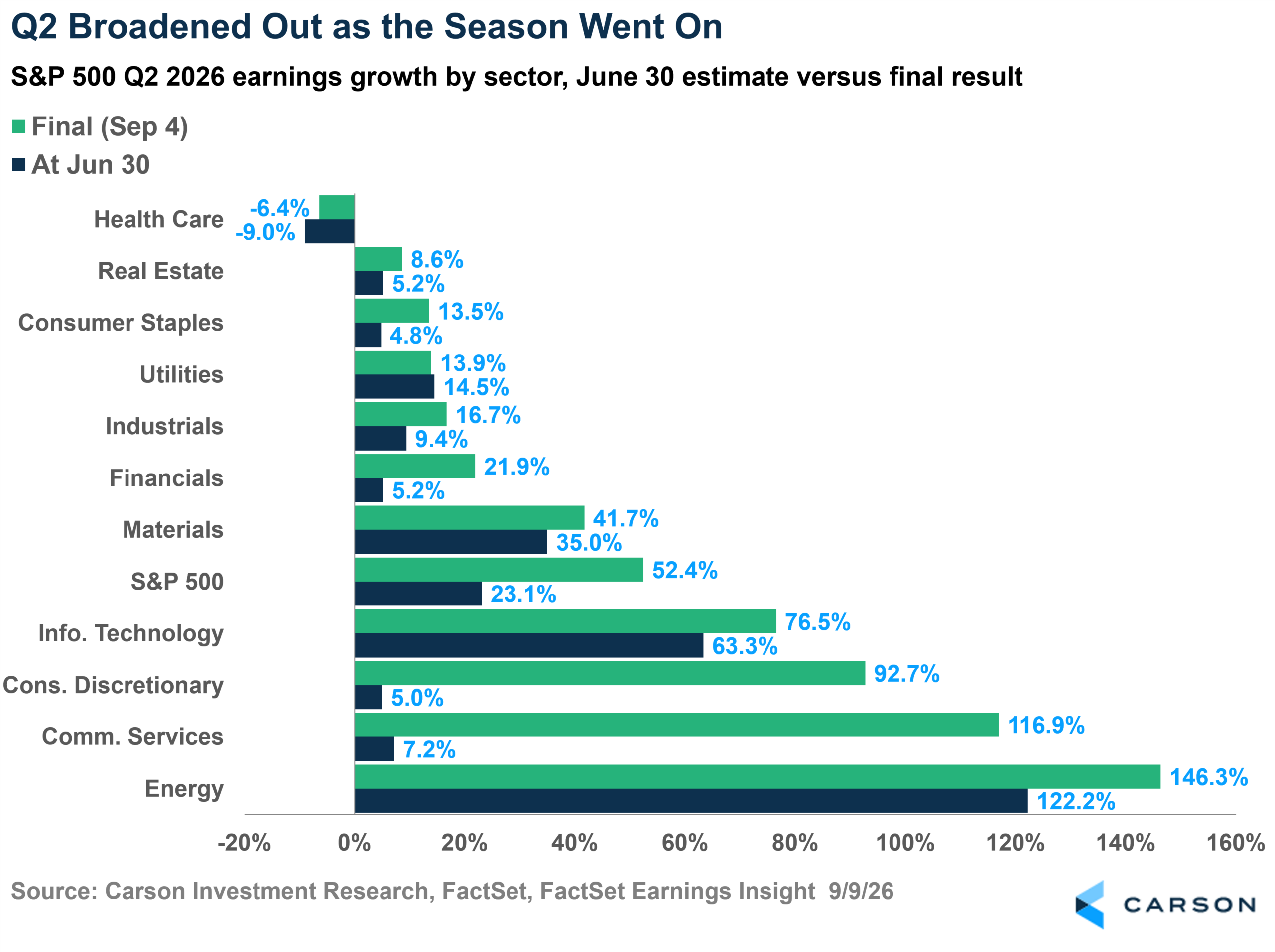
The sector detail bears that out. Communication Services were expected to grow 7.2% on June 30 and delivered 116.9%. Consumer Discretionary went from 5.0% to 92.7%. Financials went from 5.2% to 21.9%.
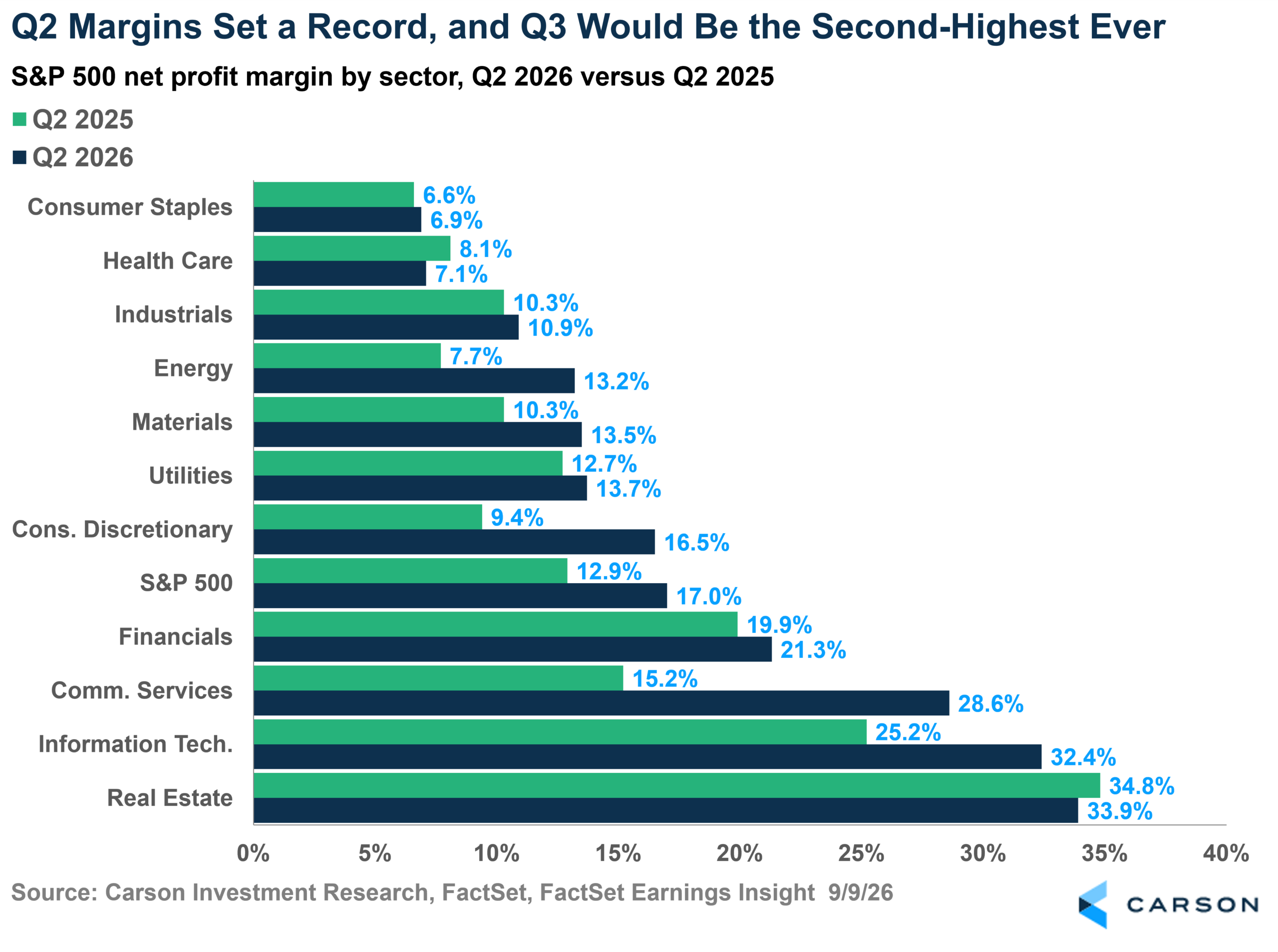
Along the way, the margin record fell three times. It was 14.8% coming out of Q1, 15.7% in late July, and 17.0% at the finish.
Where the Baton Went Next
Analysts have already moved to the third quarter, but I want to stay in Q2 for just a bit longer. Since June 30, the Q3 estimate for S&P 500 earnings has risen from $782.8 billion to $794.5 billion, an increase of $11.7 billion, or 1.5%. Two sectors carried the weight heavily for that estimation to increase. Information Technology added $8.9 billion, and Energy added $6.1 billion. Everything else, on net, went backward.
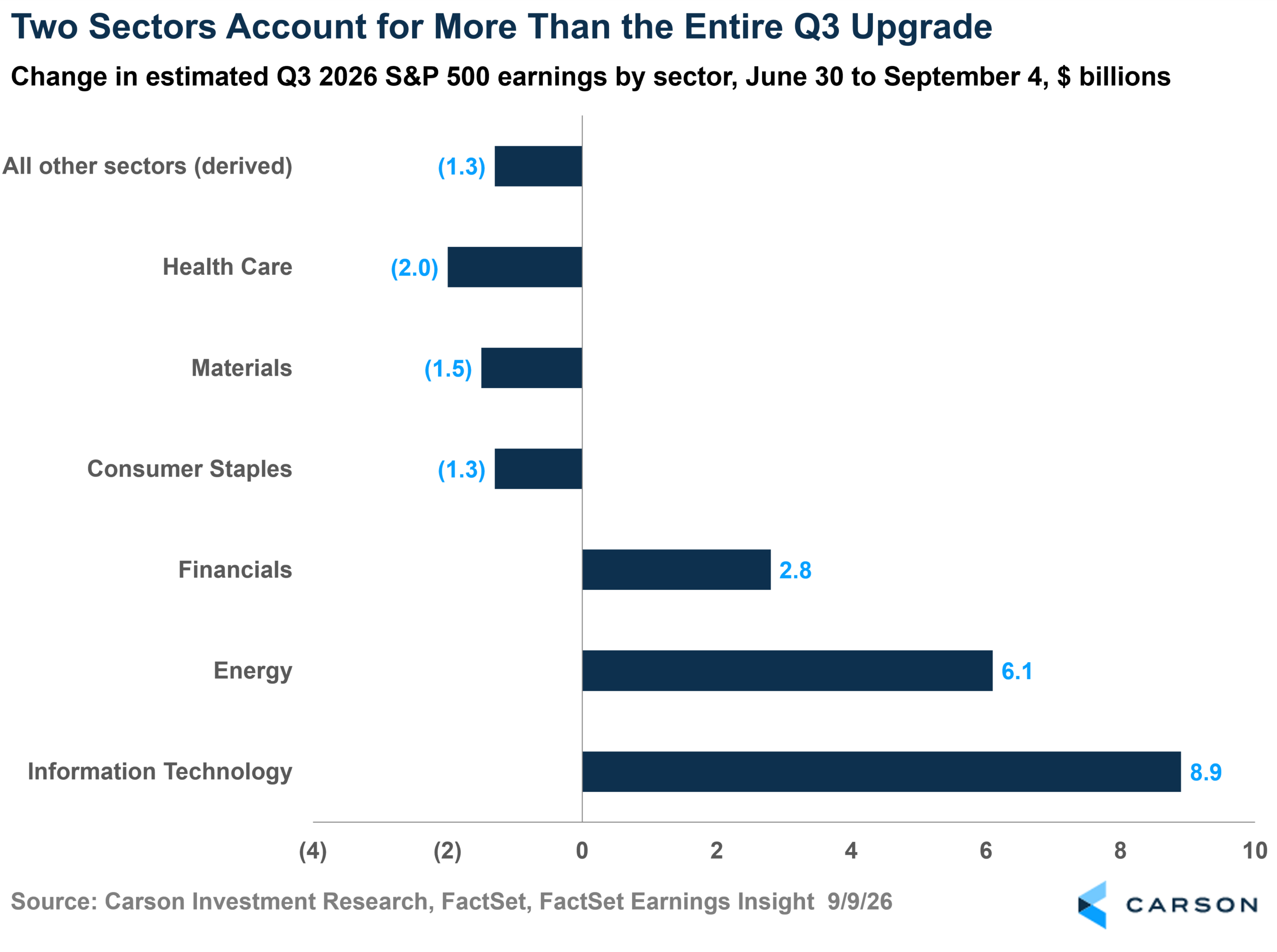
Information Technology isn’t much of a surprise. It’s the largest sector in the index by a wide margin, so it moves the dollar figure more than anyone else. My colleague Blake Anderson wrote in August about how firmly Nvidia’s guidance pointed that way.
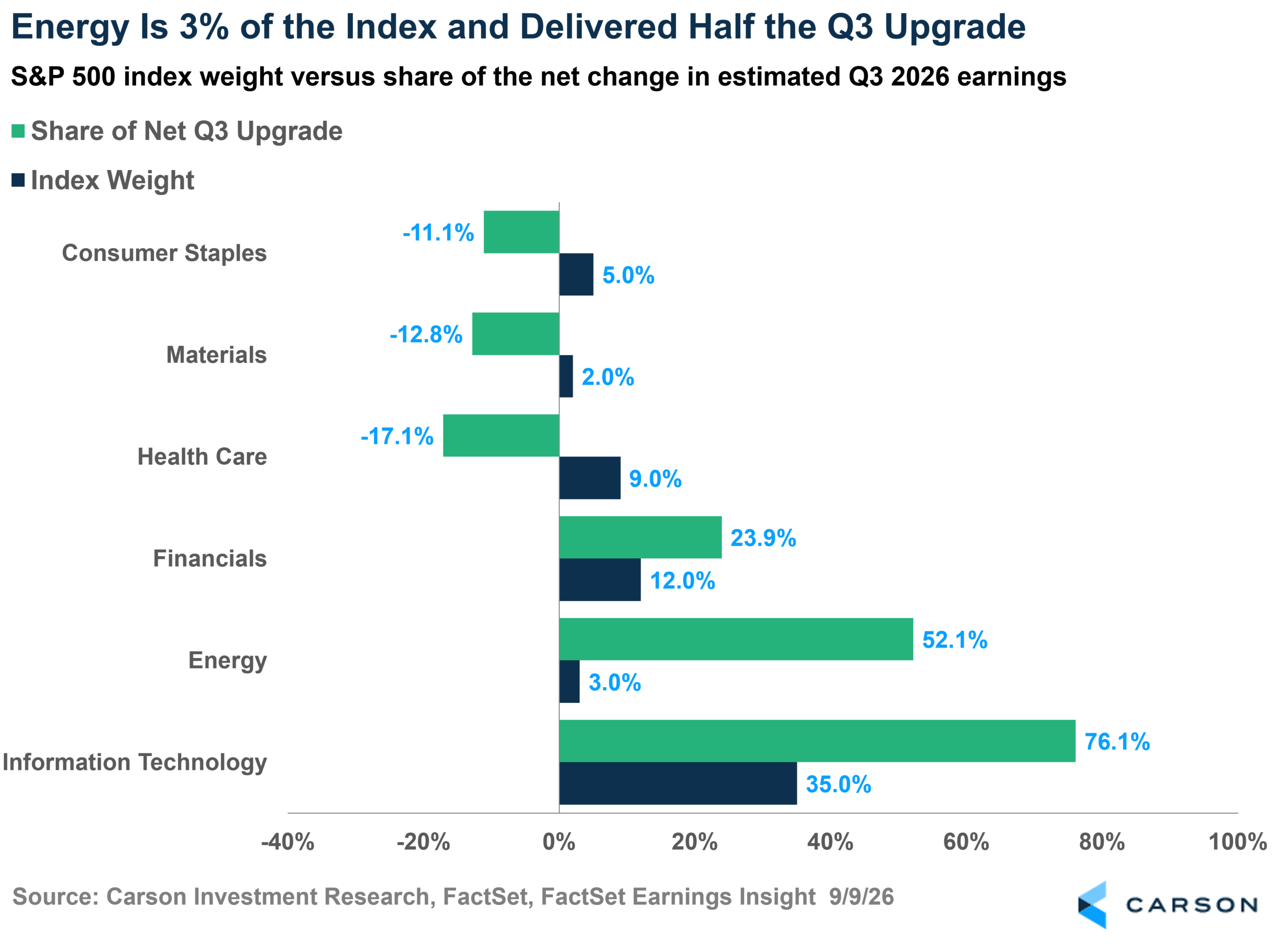
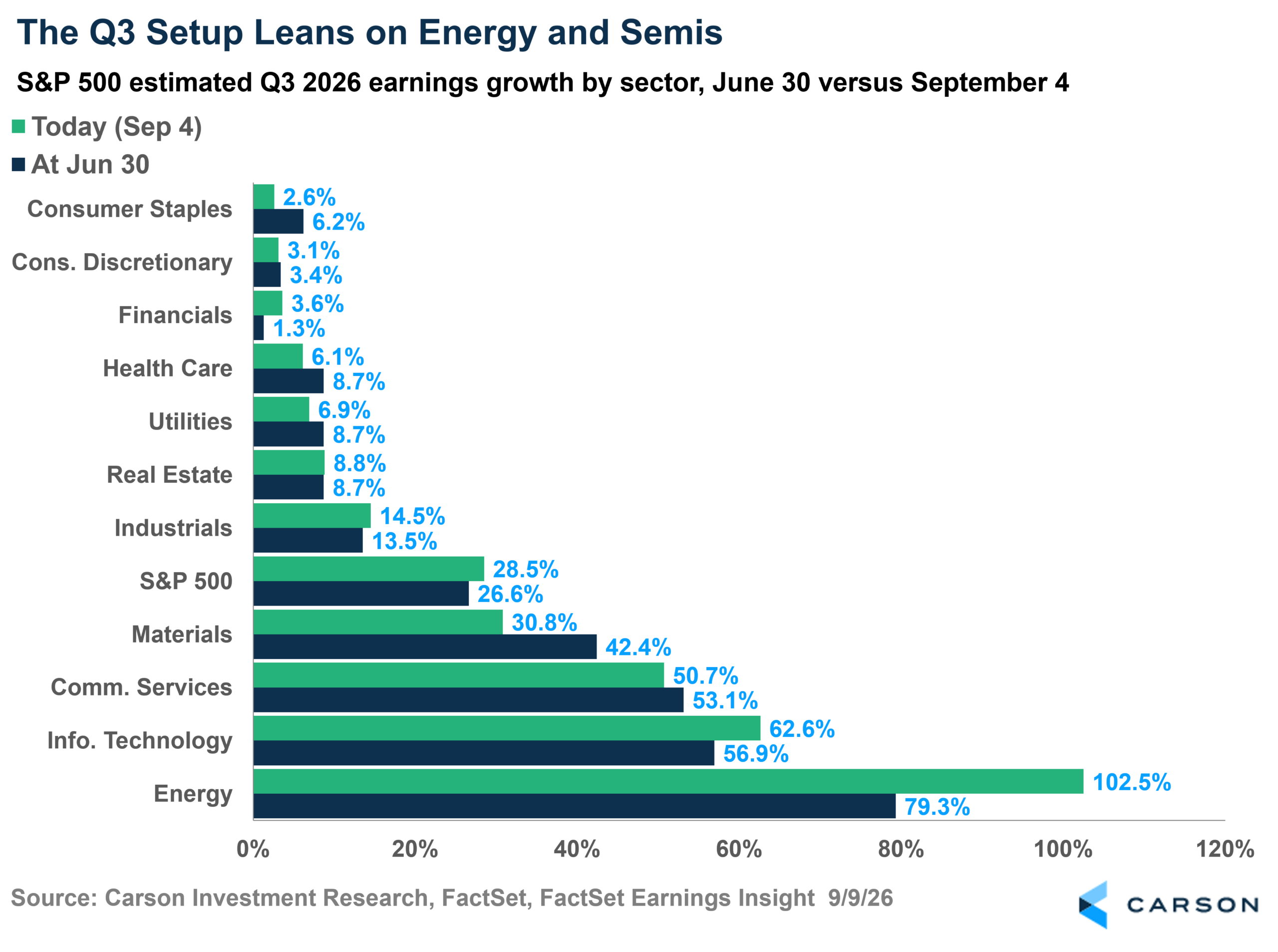
Energy, however, is about 3% of the S&P 500, and it delivered more than half of the entire net increase in the index’s third-quarter earnings estimate. Its expected growth rate for the quarter went from 79.3% on June 30 to 102.5% today. FactSet and Mr. Butters have been pretty direct on why: oil has risen roughly 31% since the quarter began.
Two Things That Cut Against This
First, all eleven sectors are projected to grow both earnings and revenue year over year in the third quarter. Expectations aren’t narrow at all. What’s concentrated is the change since June 30, and those are entirely different claims.

Stay on Top of Market Trends
The Carson Investment Research newsletter offers up-to-date market news, analysis and insights. Subscribe today!
"*" indicates required fields
Second, and more important, the Energy piece is a price story rather than a business story, and prices move. FactSet built its Q3 Energy math on crude around $91. Coincidentally, Brent went above $100 today five days after the report these numbers come from, so if anything, the figure understates where Q3 is heading. But Brent also hit $126 in April and fell back to $70 in July.
Analysts seem to agree that it doesn’t last. Their current estimate has Energy earnings falling 11.8% in 2027.
The Setup For October
Only six S&P 500 companies report next week, so the calendar is effectively empty until the banks open third-quarter season in the middle of October.
Companies are walking in unusually confident, in my view. Of the 111 that have issued Q3 guidance, 70 have guided above the prior consensus. That’s 63% positive against a five-year average of 41%, and 44 of those 70 are in Information Technology.
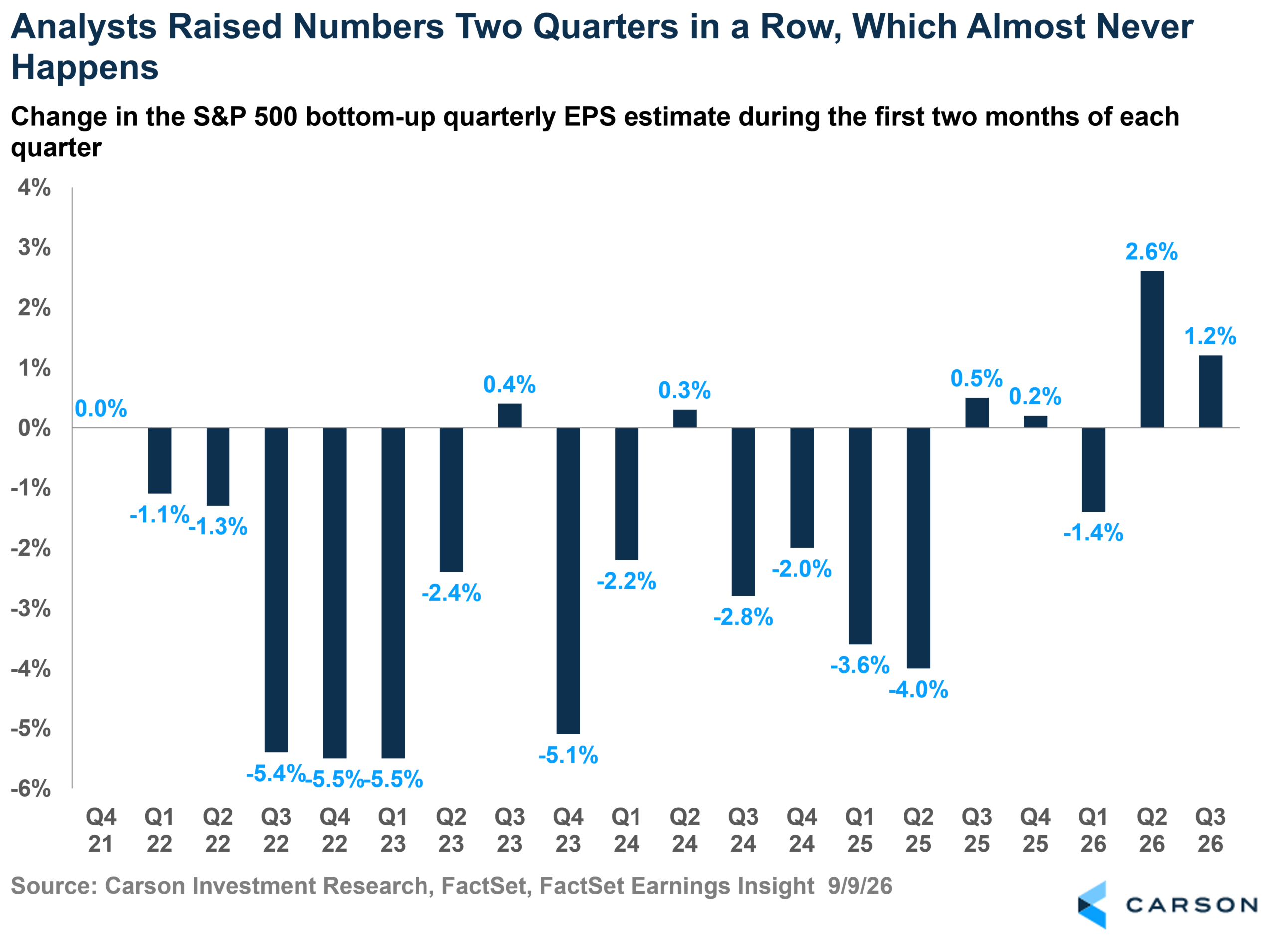
Analysts are sharing this confidence too. They almost always cut estimates as a quarter progresses. Over the past twenty years, they’ve taken the quarterly estimate down by an average of 3.1% during the first two months. This year they raised it by 1.2%, the second straight quarter of upward revisions. Across the twenty quarters of FactSet charts, the increase has topped 1% exactly twice, and both times were this year.
What I’m Watching
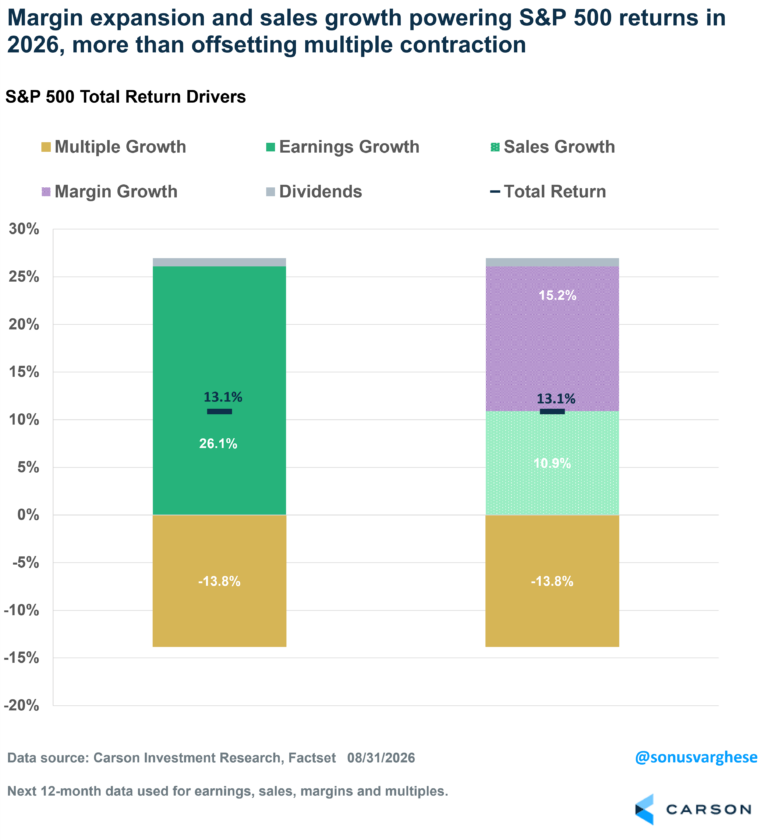
Margins tie the whole season together. Another colleague of mine, Sonu Varhese, Chief Macro Strategist, shows the S&P 500’s 13.1% total return through August came entirely from profits, with margin expansion contributing more than sales growth, while the multiple worked against the index. Healthier than a market being repriced upward on the same earnings, and it fits what the rest of the economic data has been saying all year.
It also means the earnings have to keep showing up, because there’s no valuation cushion doing the work. Q2 delivered a 17.0% margin against a five-year average of 12.4%. Q3 is estimated at 14.9%, still the second-highest FactSet has ever recorded. In my view, there isn’t much room above those numbers, but maybe I’m proved wrong once again.
Wrapping Up
Q2 2026 finished at 52.4% growth, 15.6% revenue growth, an 87% beat rate, and a record margin, after starting the quarter at 23.1%. Every stage of the season had a different engine behind it. The handoff into Q3 has landed with technology and energy, and whether that holds comes down largely to the price of oil.
Like last quarter, this series takes a break between seasons. We’ll be back when third-quarter reporting begins in the middle of October. See you then!
By Harry McDonald, Analyst, Investment Research
9118014.1. – 9SEPT926A