Welcome to Carson Investment Research’s Earnings Check-In. This series is built weekly from FactSet’s Earnings Insight report (John Butters, VP, Senior Earnings Analyst with FactSet), with index weights and market caps sourced from YCharts, and aggregation performed in-house. We tie every figure to FactSet’s published numbers, then add Carson’s perspective on top of that. We publish our Earnings Check-In weekly during earnings season.
The Q2 figures below are the ones FactSet published on August 7, and they are the most recent available. Earnings Insight did not run on August 14 or August 21. However, that does not mean the quarter stood still. Roughly 25 more S&P 500 companies have reported since, including Walmart, Home Depot, Target, Lowe’s, and Cisco, so the blended numbers have almost certainly moved. What’s missing is the recalculation, and we get that on August 28 from Mr. Butters.
Which makes this a good week to check my own work. Two weeks ago, I split the quarter into the parts I thought would repeat and the parts I didn’t. Some of that can now be marked, and the one company that can still meaningfully change the quarter reports Wednesday.
The Current Quarter
With roughly 88% of the index reported, blended earnings growth was 50.4%, the strongest since Q2 2021. Revenue grew 15.0%. The EPS beat rate was 86%, up from a five-year average of 78%. Net profit margin came in at 16.9%, a record in FactSet’s data going back to 2009, and the forward 12-month P/E sat at 20.0.
By any measure I have, that is an excellent quarter. It is also one I spent most of July adding caveats to, because Alphabet’s $98 billion investment gain and then Amazon’s $54 billion pushed a large amount of non-operating income into an index-level earnings number. Both are real accounting events; however, neither is a repeatable business result.
What I Said We Wouldn’t Keep
Energy was first on that list. The sector grew earnings 147% in Q2 on 42.5% revenue growth and was one of the two biggest contributors to revenue growth for the entire index, almost all of it from a single input. Oil averaged $92.55 in the quarter against $63.68 a year earlier. I called that a war premium and said it was already unwinding.

Stay on Top of Market Trends
The Carson Investment Research newsletter offers up-to-date market news, analysis and insights. Subscribe today!
"*" indicates required fields
However, it hasn’t unwound. Brent has spent August hovering around $90, give or take, and on Monday, Treasury Secretary Scott Bessent announced a sanctions package aimed at the countries and banks still buying and moving Iranian oil, on top of the naval blockade in place since April. I do still expect Energy’s contribution to shrink, since as of August 7 analysts modeled 94.3% growth for Q3 and an outright decline in 2027. But I was early, and I had the reason wrong. My colleague Michael Barczak’s primer on the Strategic Petroleum Reserve points to a better one. The reserve held 298.7 million barrels on August 7, the lowest level since January 1983, down from about 415 million at the start of the year after the U.S. released 172 million in March as part of a coordinated drawdown across IEA countries. In my view, a good part of why $92 oil hasn’t turned into something worse is that governments have been selling into it, and there is a lot less of that left than there was in February. Nothing about Iran is settled as of right now, so I’d note that the input which made Energy the best sector of Q2 is the same one that raises costs for most of the other ten.
What I Said We Would Keep
Margins, with conditions attached. I wrote that the record holds as long as labor stays cheap and the capital buildout stays off the income statement.
Revenue grew 15.0%, and net margin went from 12.9% a year ago to 16.9%. Multiply those two together, and you land very close to the reported 50.4%. This quarter’s earnings growth was mostly a margin event, which means margin durability is the quarter’s durability.
The second condition is where I’d focus now.
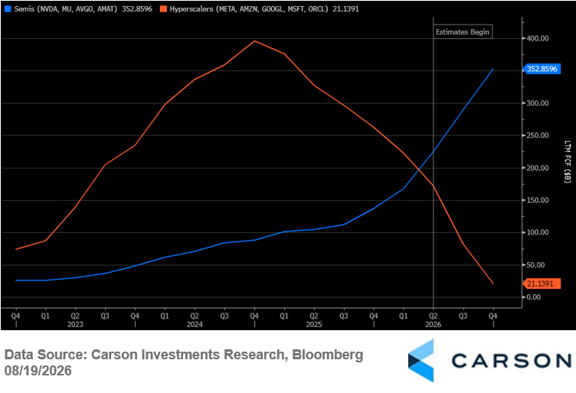
Trailing free cash flow across Meta, Amazon, Alphabet, Microsoft and Oracle peaked near $400 billion at the end of 2024. On current estimates, it falls to about $21 billion by the end of this year, while the same measure across Nvidia, Micron, Broadcom and Applied Materials climbs toward $353 billion. The companies selling AI compute are on track to generate more cash than the companies buying it.
The buyers are covering that gap with debt, and Sonu Varghese walked through the plumbing last week. Incremental debt funded roughly 9% of hyperscaler capital spending in fiscal 2024 and about 32% by the middle of this year, and Alphabet’s purchase commitments and contractual obligations rose to $811 billion from $332 billion in the space of three months. None of that sits in the 16.9% margin yet. In my view, a fair amount of it eventually will, and a spending program funded with borrowed money responds to credit conditions in a way cash flow does not.
What’s left of the quarter
Nvidia reports Wednesday for its quarter ended in July. In May, the company guided to roughly $91 billion in revenue; analysts sit near $92 billion, and clearing the earnings bar means topping $51.5 billion. Nvidia has beaten expectations fourteen quarters running.
I think the print is likely to be good. I’m less sure that’s the same thing as a good day for the stock. Nvidia has fallen in the session following each of its last four reports despite beating every time, and that fits what we measured across the index on August 7, where companies that beat gained an average of 0.4% around the release against a five-year average of 1.0%.
Part of why I think that pattern holds is mechanical. Nvidia closed at $208.48 on Monday, and the most crowded position in the August 28 options chain is the $230 call, roughly 10% higher, so the dealers who may have sold those calls are holding stock against them to hedge. Once results land and the uncertainty premium drains out, those calls may lose value quickly; the hedge comes off, and stock gets sold into a good quarter unless the number is big enough to carry the price through those strikes. In my view, I expect a fairly muted reaction for Nvidia as it rounds out Q2 earnings season.
Bottom line
The sorting mostly held. The margin looks more durable to me than I expected going in, and the energy comparison looks less durable, just on a slower clock than I gave it.
FactSet publishes again on August 28. We’ll be back next Tuesday with the final numbers and a first look at Q3.
By Harry McDonald, Analyst, Investment Research
9094012.1. – 25AUG26A