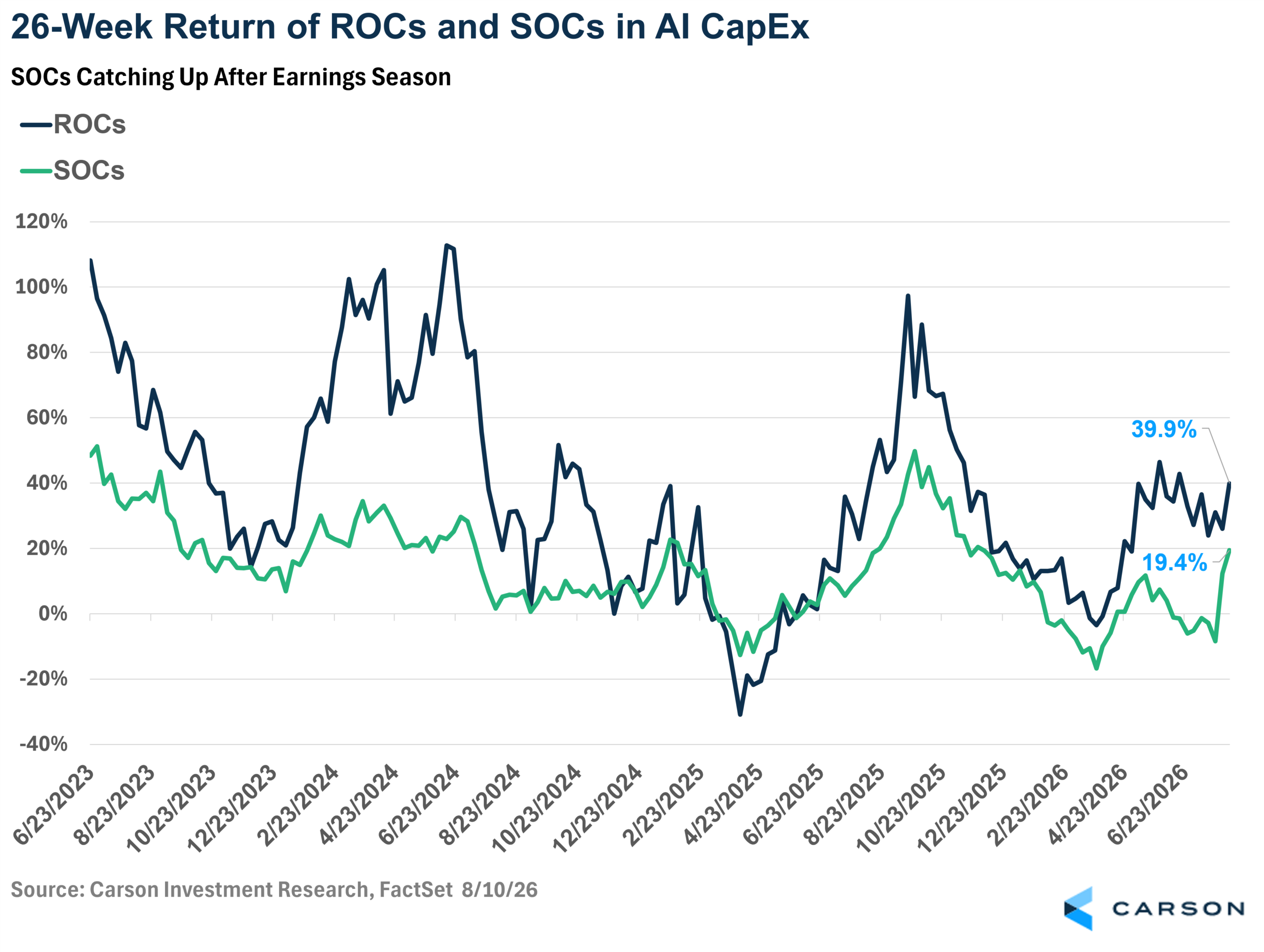
The divergence in performance between the ‘Receivers of Capital’ and ‘Spenders of Capital’ has narrowed in recent weeks. Before this latest earnings season, the relative performance was suggestive of value being transferred from spenders to receivers, rather than being mutually created. However, this earnings season lent credence to the idea that the spenders are still seeing healthy returns, and recent performance has caught up.
Positive Correlation
ROCs and SOCs can live harmoniously. For the first years of this AI CapEx boom, the returns of stock prices between these two groups were positively correlated as the market capitalizations of each bucket increased in tandem. Sure, ROCs (comprising NVDA, AVGO, AMD, MU, and other semiconductors) vastly outperformed SOCs (MSFT, AMZN, GOOGL, META, and others in the cloud computing industry), as shown below. But the two groups moved largely in tandem.
The logic of this mutual market cap increase was sound as well – the SOCs likely saw a positive return on investment in the products of the ROCs, and this could drive sustainable spending levels driven by increasing profitability.
A Catch Up
The SOCs had meaningfully lagged the ROCs coming into this latest earnings season, as I detailed in a recent blog. In July, the SOCs showed a 26-week performance of –1.4%, while the ROCs showed a +36.5% return over the same time period. To me, this sparked an idea that the market believed value was transferred from the SOCs to the ROCs, rather than being mutually created.

Stay on Top of Market Trends
The Carson Investment Research newsletter offers up-to-date market news, analysis and insights. Subscribe today!
"*" indicates required fields
But this earnings season worked to disperse that narrative. As of the end of last week, SOCs now show a +19.4% 26-week return, and ROCs show a +39.9% return over the same time period, representing a meaningful catch-up from the SOCs. It could be a signal that investors believe again in the mutual value creation between these two groups of stocks, rather than value simply being transferred.
Amazon’s Insights
Amazon CEO Andy Jassy worked to help turn this narrative from value transfer to value creation by detailing the inner workings of AWS, saying “AWS…is booming right now…we’re enthusiastic about the [return on invested capital] equation…For servers and networking equipment, on average, it takes a little less than three years to break even on that investment…We see the margins and returns in AI tracking what we saw [in early AWS days], actually a little ahead.”1 Investors may have been waiting for this sort of clarity on both the magnitude of the opportunity and a relatively high visibility to returns to reward Amazon stock and other SOCs.
For more content by Blake Anderson, CFA®, Director, Portfolio Management, click here.
9067643.1. – 10AUG26A