
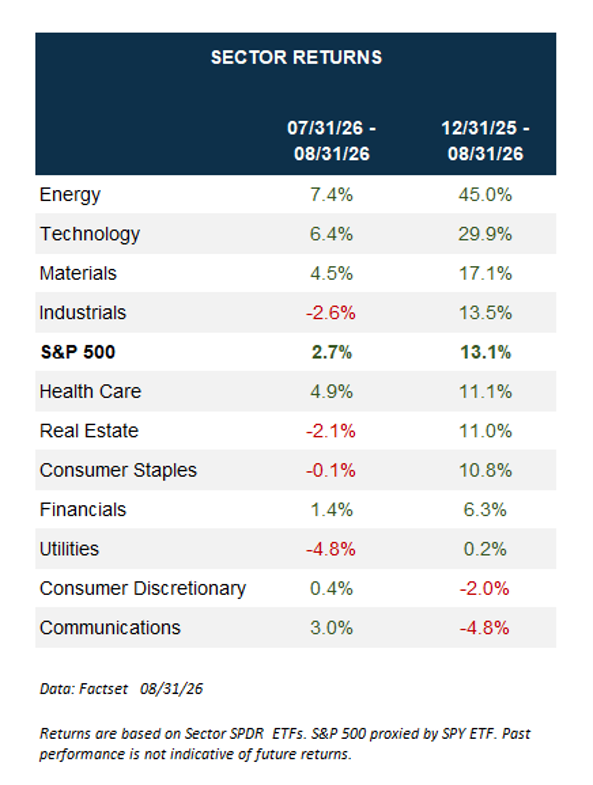
2026 has been volatile in the markets, driven by a shifting combination of economic, fiscal, and geopolitical pressures that have repeatedly changed expectations for growth, inflation, and interest rates. Investors entered the year focused on persistent inflation, labor market conditions, and the timing of Federal Reserve rate cuts, while tariffs and fiscal uncertainty added concerns around business costs, government borrowing, and Treasury yields. Geopolitical tensions intensified these pressures, most notably through the War in Iran, which disrupted global energy markets, pushed oil prices higher, and renewed fears that inflation could remain elevated even as economic growth slowed. Together, these forces have created an environment in which markets have repeatedly repriced the outlook for Fed policy, corporate earnings, and economic growth, driving sharp changes in interest rates, equity leadership, and investor risk appetite throughout the year.
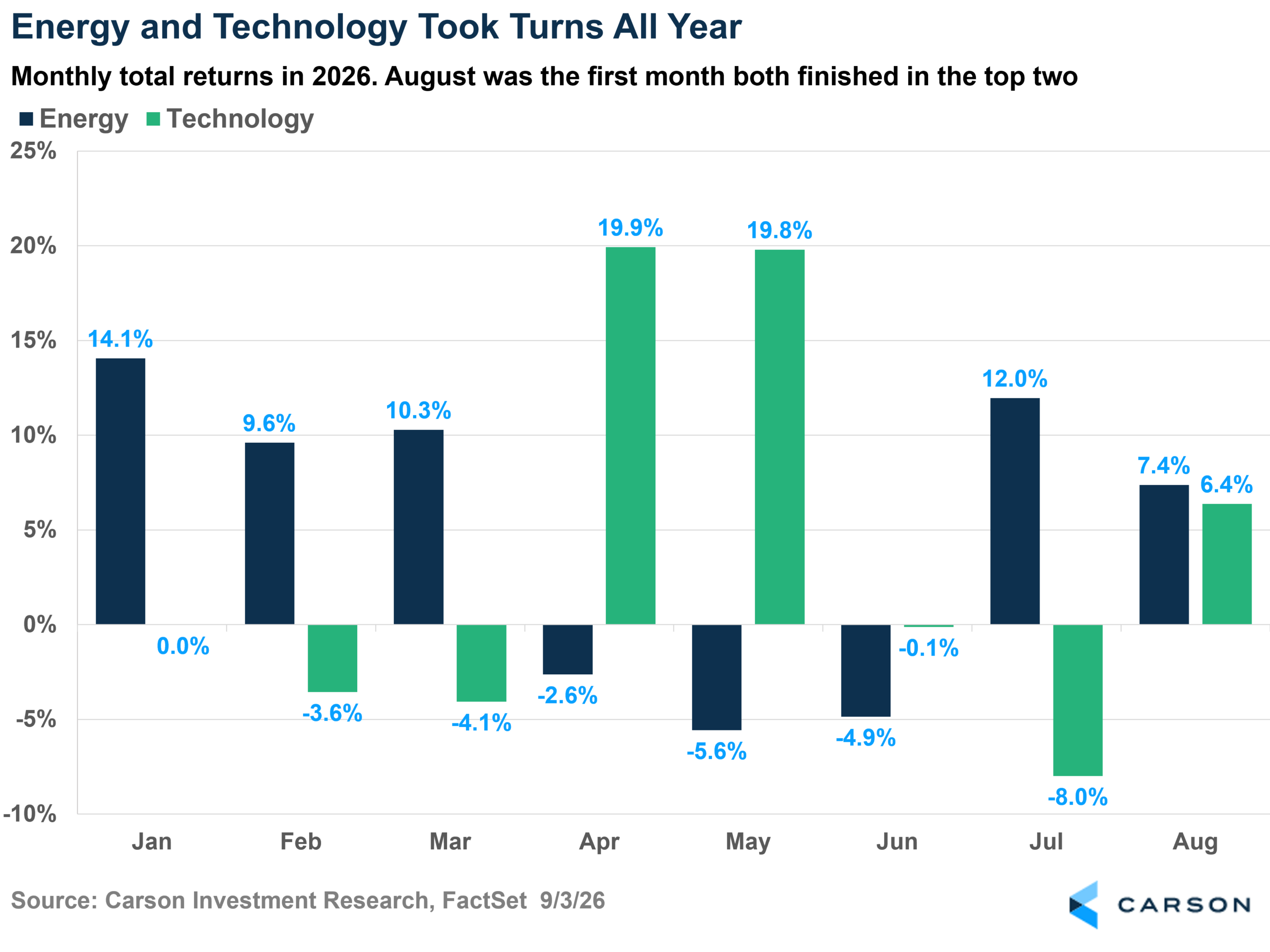
Amidst that backdrop, Energy and Technology have traded leadership throughout 2026, driven by very different forces. Energy has primarily traded on scarcity, surging as the Iran conflict disrupted oil supplies and elevated geopolitical risk, while Technology has traded on expectations for AI investment, productivity, and earnings growth. The two trends intersect through inflation, as higher energy prices can keep interest rates elevated and potentially constrain AI capital spending. A deeper connection is also emerging outside of market performance: the rapid expansion of AI data centers is creating enormous electricity and resource requirements, increasingly linking technology growth with energy production and infrastructure. As AI investment expands and energy availability becomes a larger constraint on data-center development, these sectors are likely to become more intertwined over time.
This level of market volatility, along with underlying leadership changes, is typically an environment where active management performs well relative to passive indexes. Managers can dynamically address changing market conditions in real time, and active equity managers tend to favor companies with higher-quality fundamentals rather than more speculative names. These types of stocks tend to be more resilient than stocks trading predominantly on momentum or sentiment. Contrary to that expectation, we have not seen active management outperform broadly in 2026.

Stay on Top of Market Trends
The Carson Investment Research newsletter offers up-to-date market news, analysis and insights. Subscribe today!
"*" indicates required fields
Individual asset classes have different drivers of idiosyncratic performance, so sweeping generalizations about market conditions are difficult, and the drivers behind active manager underperformance differ across the board. Fixed income managers have had to battle changing expectations for the Federal Funds Rate and inflation driving up yields and spreads, leading to relative weightings in duration, credit, and asset-backed securities driving relative performance rankings. Small-cap stocks have been see-sawing between negative-EPS stocks and positive-EPS stocks, from a performance perspective, which we wrote about here.
Large-cap active managers have generally struggled because of what they don’t own. Because the benchmark has large absolute and relative weights in mega-cap technology and AI-related stocks, many active managers are structurally underweight that market because of diversification and concentration concerns. Energy stocks have been beaten up over the past few years and tend to be cyclical, with performance highly linked to extraneous factors rather than current-period fundamentals. For these reasons, many active managers were underweight these sectors at the start of the year.
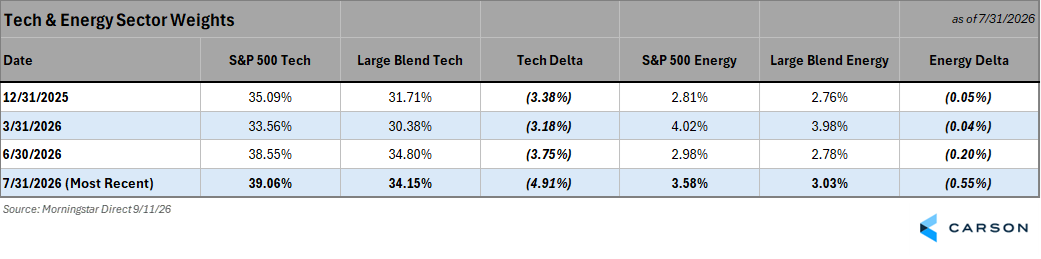
Using a representative peer group of the top 40 active managers in the Large Blend peer group by AUM (only using 1 share class, the cheapest, for each manager), you can see both Technology and Energy have been consistently underweight throughout the year.
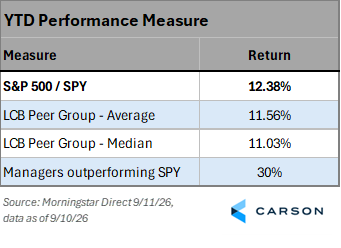
Of those 40 managers, only 12 have outperformed the S&P 500 YTD as of market close on September 10th, with the average fund underperforming by ~80bps and the median fund underperforming by ~130bps.
We have seen significant changes in market leadership over the course of 2026, which in itself has been interesting and a change of pace from much of the past 5+ years. Despite a changing environment that could have benefited active management, many managers have not been able to take advantage of this opportunity. That is why the Carson Investment Research team focuses heavily on developing a deep qualitative understanding of an active manager’s investment process and portfolio characteristics, so we can help our advisors and clients navigate changing market conditions with investment ideas that fit their portfolio needs and goals.
By Michael Barczak, VP, Investment Due Diligence
9127486.1. – 15SEPT26A