
Oil prices have surged over the last few weeks, taking nationwide average gasoline prices to $4.31/gallon, the highest ever for this time of year. Diesel has hit a record $6.20/gallon. That matters because diesel is what moves food and other goods across the country, allowing higher oil prices to seep into a broad array of goods and services. With the situation in the Middle East heating up, the inflation outlook has deteriorated quickly.
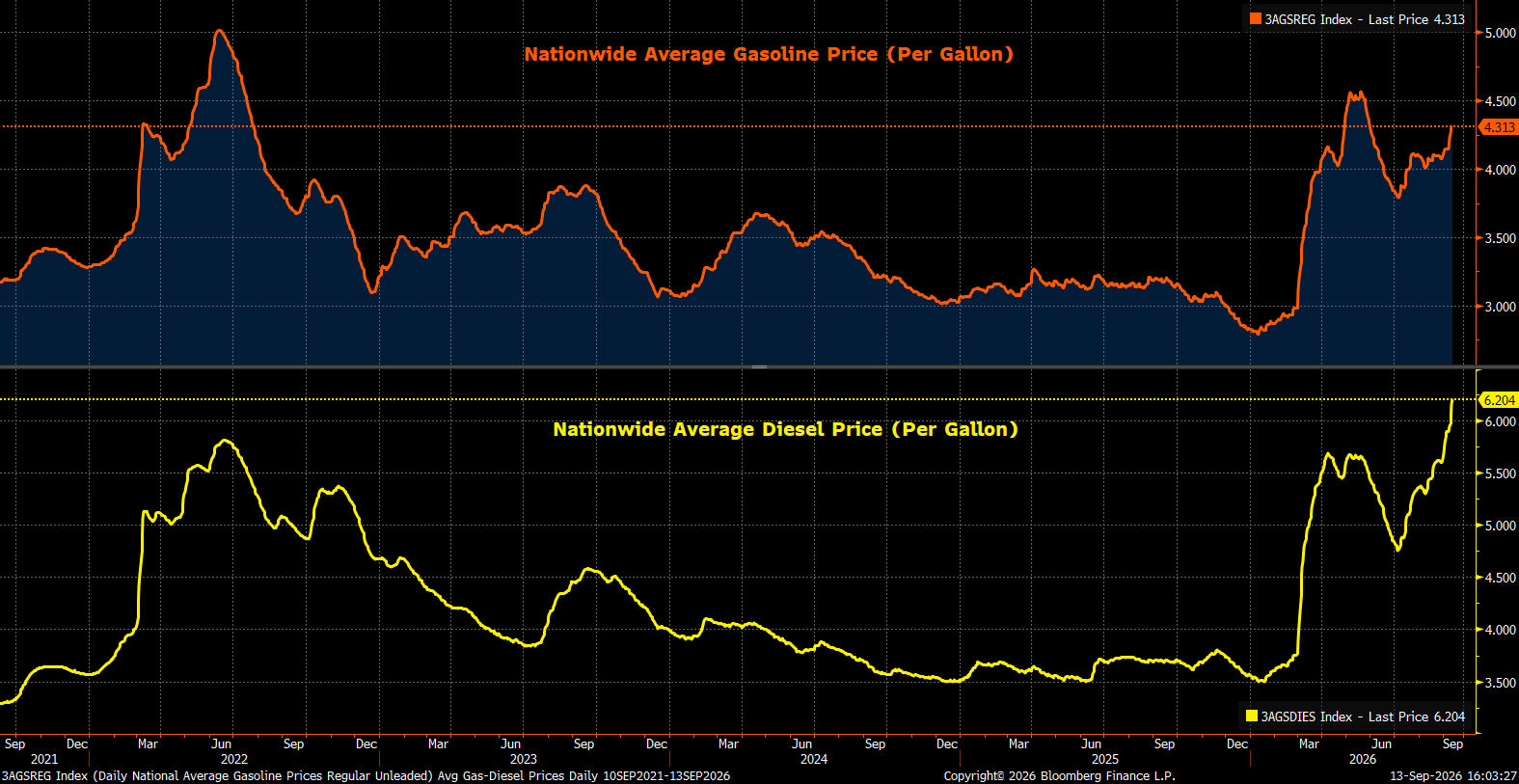
Source: Carson Investment Research, Bloomberg 9/13/26
The bad news is that the recent surge in oil prices and its derivatives is not reflected in the August inflation reports we got last week. Those reports were not a huge surprise, but it’s worrying that elevated inflation readings no longer surprise us. And worse data is likely coming.
Gasoline and diesel prices were already creeping higher in early August, and that boosted the headline consumer price index (CPI) to a 0.4% m/m gain (equivalent to a 4.9% annualized pace). That offset the prior two months of soft readings, but CPI is up 3.4% over the last twelve months. Core CPI, which excludes volatile food and energy prices, didn’t offer much comfort, rising at a 3.5% annualized pace in August though the core index is up just 2.4% over the past year.

Stay on Top of Market Trends
The Carson Investment Research newsletter offers up-to-date market news, analysis and insights. Subscribe today!
"*" indicates required fields
You could look at the core CPI rate of 2.4% year-over-year inflation and conclude that inflation data doesn’t look too bad. The problem is that it’s skewed by soft rental inflation, which makes up 42% of the core basket. The broader personal consumption expenditures (PCE) index, the Fed’s preferred measure, puts much less weight on shelter, about 17% of core PCE. August PCE data won’t arrive until the end of the month, but CPI and producer price index (PPI) data give us a good read. One caveat is that the government is changing how it calculates inflation for several items, including portfolio management services, legal fees, and computer software and accessories. Taking that into account, Employ America estimates:
- Core PCE is expected to rise 0.28% m/m in August (equivalent to 3.4% annualized pace)
- That will take the core PCE measure to 3.1% year-over-year
Those are aggregate numbers. Under the hood, inflation is elevated across the board, well beyond anything tied to energy.
Take services inflation. Core services CPI excluding shelter rose at a 6.3% annualized pace in August and is up 3.1% over the past year. August was boosted by an idiosyncratic jump in wireless phone services, which is tempting to dismiss. The problem is that several other services households regularly use are also running hot.
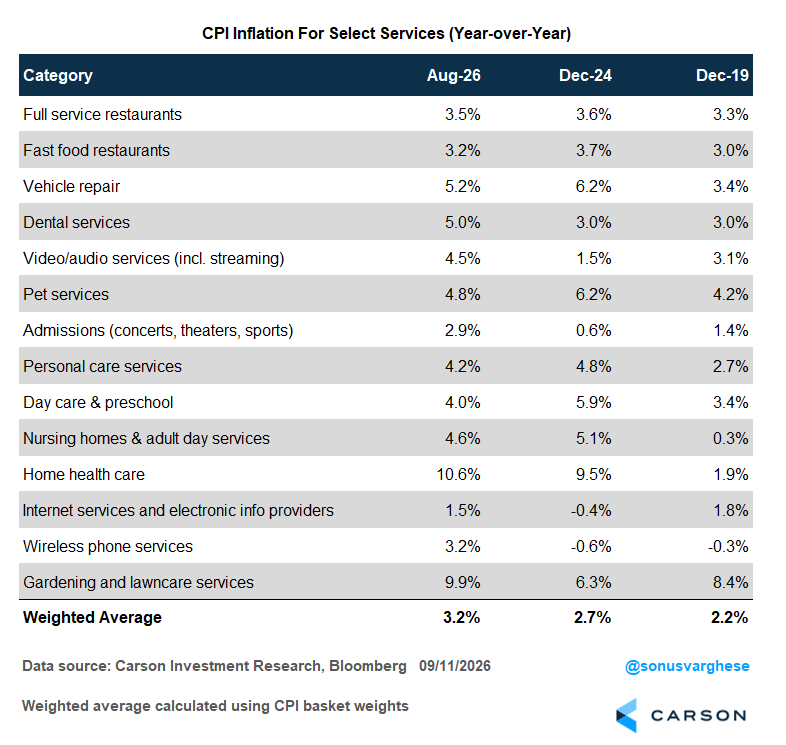
The table below shows year-over-year inflation for 14 of these categories versus the end of 2024 and 2019. Their weighted average is running at 3.2%, compared with 2.7% at the end of 2024 and 2.2% at the end of 2019. In other words, these prices are not just above pre-pandemic levels — they’ve accelerated over the past 18 months even as aggregate core CPI looks benign. And they matter: together these categories make up almost 17% of the overall CPI basket, or about 21% of core CPI.
Things are heating up on the industrial side too. The August PPI report showed elevated inflation across a wide range of key intermediate goods used in manufacturing:
- Electronic computers & equip: + 23% y/y (3M annualized 75%)
- Electronic components: +28% y/y (3M @ 13%)
- Electrical machinery equip: +14% y/y (3M @ 9%)
- Steel mill products: 23% y/y (3M @ 41%)
- Wire & cable: 20% y/y (3M @ 20%)
- Plastic packaging products: 6% y/y (3M @ 12%)
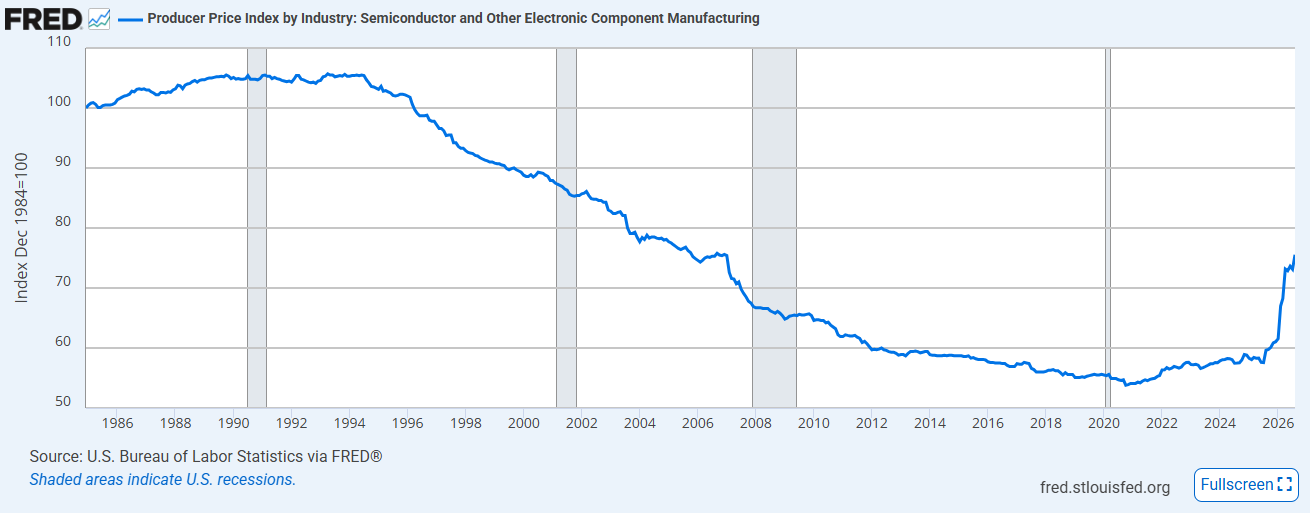
A lot of this reflects tariffs, including on steel and aluminum, and the AI buildout. Two AI-related bottlenecks stand out. PPI for semiconductor and other electronic component manufacturing has risen at a 15% annualized pace over the last three months and is up 27% from a year ago. That surge has wiped out more than 20 years of deflation.
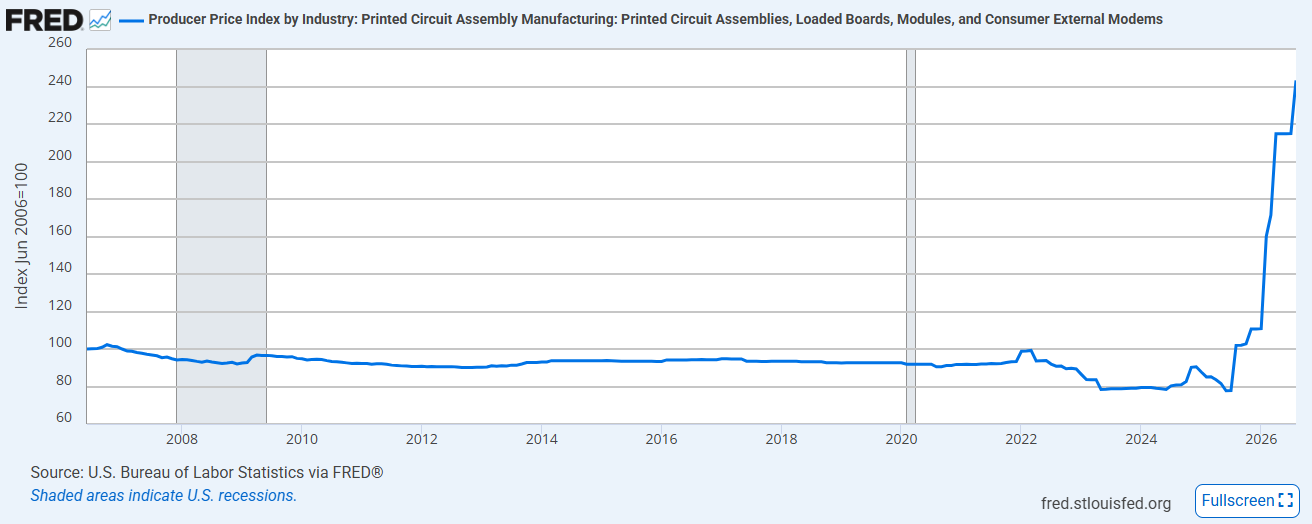
Manufactured printed circuit boards are even more extreme: prices rose at a 65% annualized pace over the last three months and are up 139% from a year ago. As the chart below shows, the recent increase is unprecedented.
There’s another side to this data: revenue and profits for semiconductor chip makers. One person’s inflation is another company’s profit source, and the AI boom neatly captures that. Demand for AI-related inputs is far outrunning supply, which is why prices are surging alongside profit growth. That profit growth, in turn, has been a major driver of the stock market near record highs.
The Fed May Be Poised to Start A New Rate Hike Cycle
The most common argument against Federal Reserve rate hikes is that higher interest rates cannot increase the supply of oil or reopen the Strait of Hormuz. That is certainly true, but the breadth of the inflation problem makes it increasingly untenable for the Fed to sit on the sidelines. The economy is running hot: unemployment is historically low at 4.1%, manufacturing and services activity are strong, businesses continue to report rising input costs, and nominal GDP growth is running above 6 (even if inflation explains a meaningful portion of that).
That is why markets are pricing an 86% probability of a rate hike at this week’s Fed meeting. And the Fed rarely hikes just once. The question could quickly shift from “will they hike?” to “how many more hikes are coming, and how quickly?” Markets are currently pricing in roughly 3.7 hikes over the next year, i.e., three hikes plus a 70% chance of a fourth.
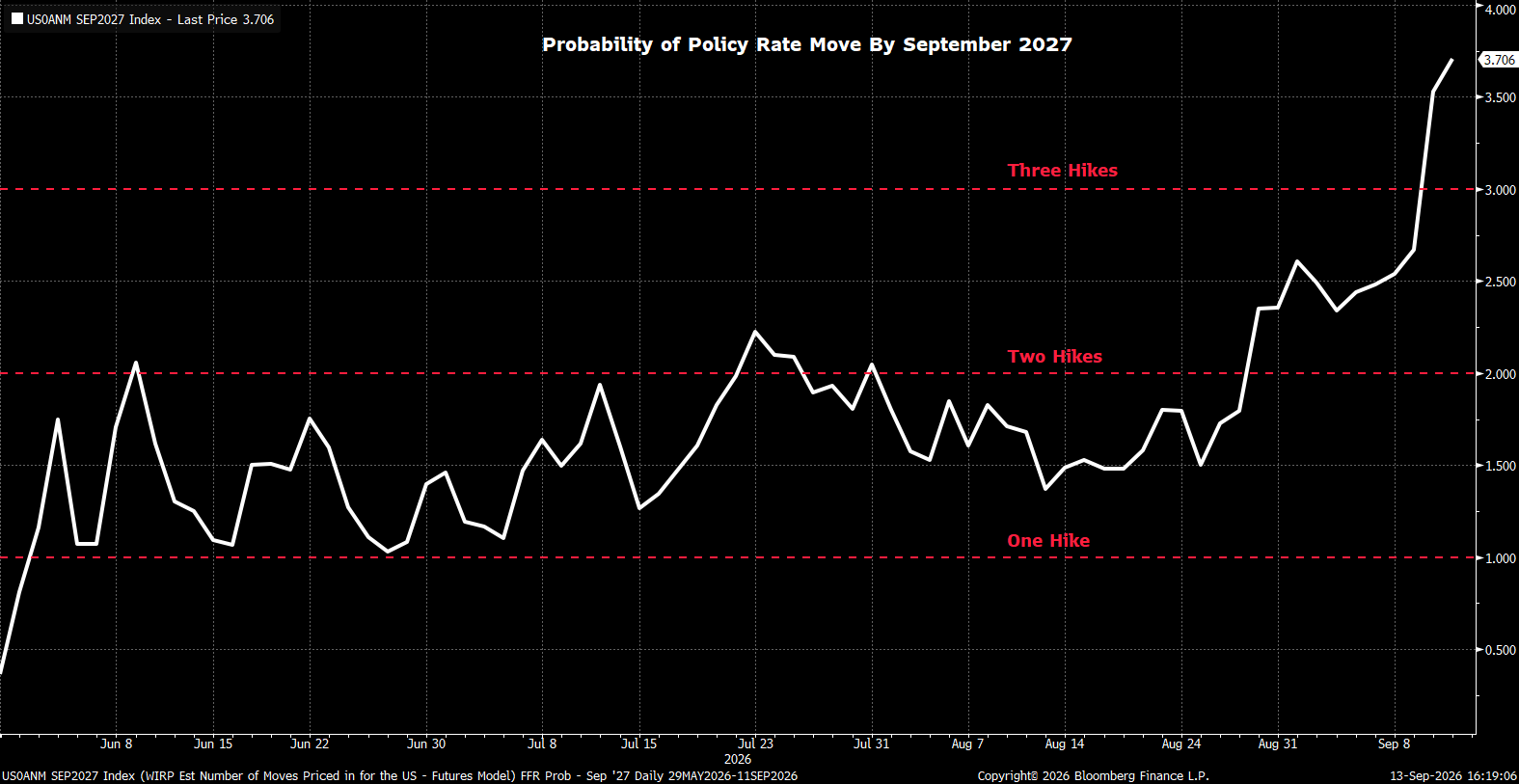
Source: Carson Investment Research, Bloomberg 9/13/26
The expected degree of tightening would take the policy rate from 3.6% to about 4.5% over the next year. That sounds significant but given how hot the economy is running in nominal terms, it may not slow things much, especially the AI buildout. As I wrote a few weeks ago, nominal GDP growth is close to what we saw in the late 1990s, when interest rates were higher. Short-term rates averaged about 5% from 1995 to 1999, while the 10-year Treasury averaged around 6%. The 10-year has recently surged to almost 5%, but that is still below late-1990s levels.
All this suggests the economy is poised to keep running hot even if the Fed kickstarts a new hiking cycle this week. That should keep corporate revenues and profits growing at a strong pace, which remains a tailwind for stocks.
For more content by Sonu Varghese, Chief Macro Strategist, click here.
9124588.1. – 14SEPT26A