
“An object in motion tends to stay in motion, and an object at rest tends to stay at rest, unless acted upon by an external force.” Sir Issac Newton
First off, happy Groundhog Day! And as Bill Murray taught us many years ago, don’t drive angry! Now, let’s get to it.
An effect widely known as the January Barometer looks at how the S&P 500 does in January and what it may mean for the next 11 months. It is known by the saying, ‘So goes January, so goes the year,’ in the media. The late Yale Hirsch first presented the phenomenon in Almanac Trader in 1972. Today, the Almanac is carried on by Yale’s son, Jeff. I’ve known Jeff for years, and I must say, he is great, and I believe the work they do is some of the best in the industry on market seasonality, calendar effects, and many other indicators.
So let’s look at the January Barometer. For starters, four years ago, in 2022, we saw the S&P 500 lower in January, and it was followed by a vicious bear market. Then the past three years stocks were higher in January, and we’ve seen yearly 15%+ gains three years in a row for the first time since the late 1990s.
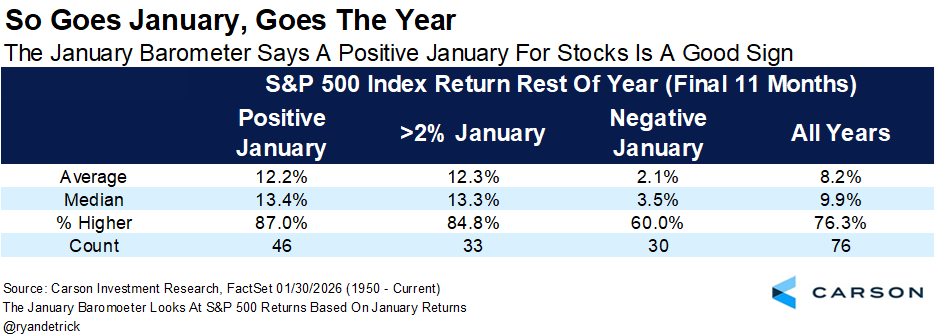
Historically speaking, when the first month was positive for the S&P 500, the rest of the year was up 12.2% on average and higher 87.0% of the time. And when was that first month lower? The index was up about 2.1% on average, the rest of the year, and higher only 60% of the time. Compare this with your average year’s final 11 months, up an average of 8.2% and higher 76.3% of the time, so clearly the solid start to 2026 could be a positive for the bulls.
If 87% sounds at all familiar, that’s because it’s how often the full year has been positive when the first five days of the year finished up more than 1% (like we saw this year). Not bad, not bad.

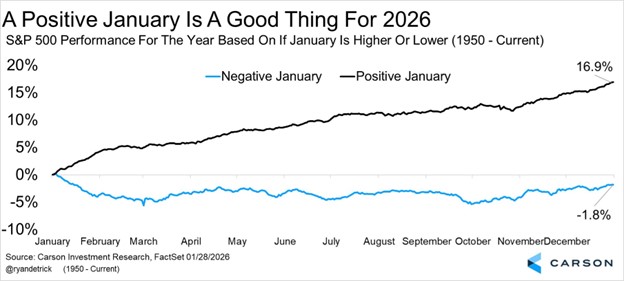
Take another look at that famous Newton quote from above. Markets certainly aren’t physics, but it’s a nice way to describe markets’ tendency to trend based on how they start the year. If January is higher, the S&P 500 has gained an average of 16.9% for the full year, with an overall upward bias most of the year, even after the first month. Compare that with when January is lower — the full year has struggled and has been down on average. Indeed, what the first month of the year has done has often picked the direction for the full year.
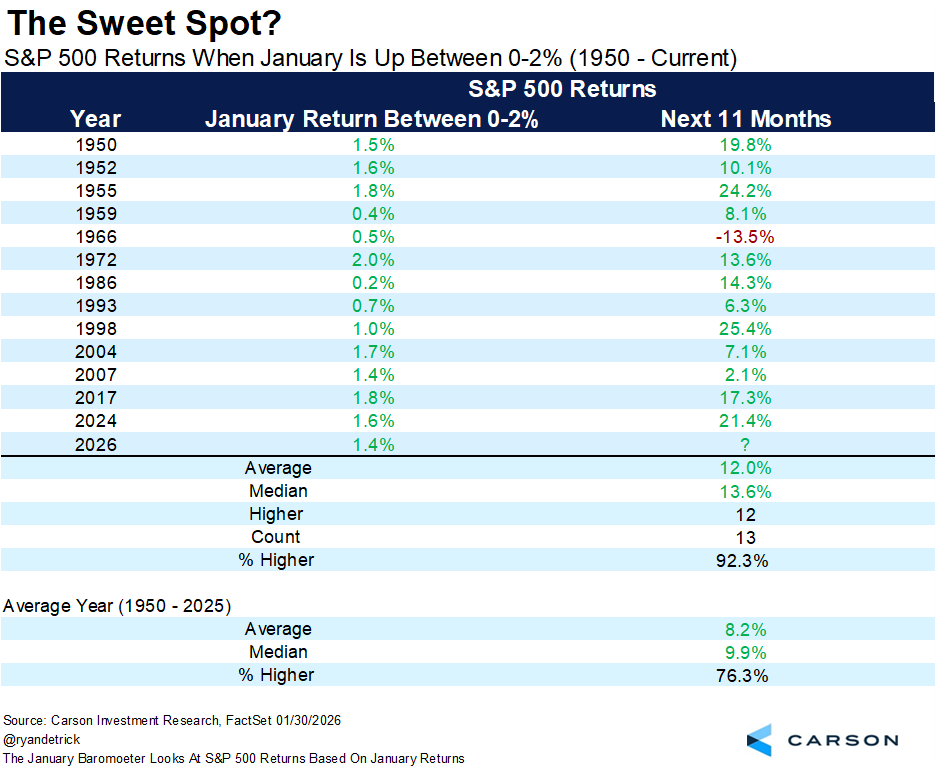
In the end, the S&P 500 did see gains this January, but they were fairly modest, although this might be a good sign. Below we show all the times January gained 0-2% and you can see that continued strength has been perfectly normal, as stocks have only been lower the final 11 months once in history.
February Is the Banana Peel Month
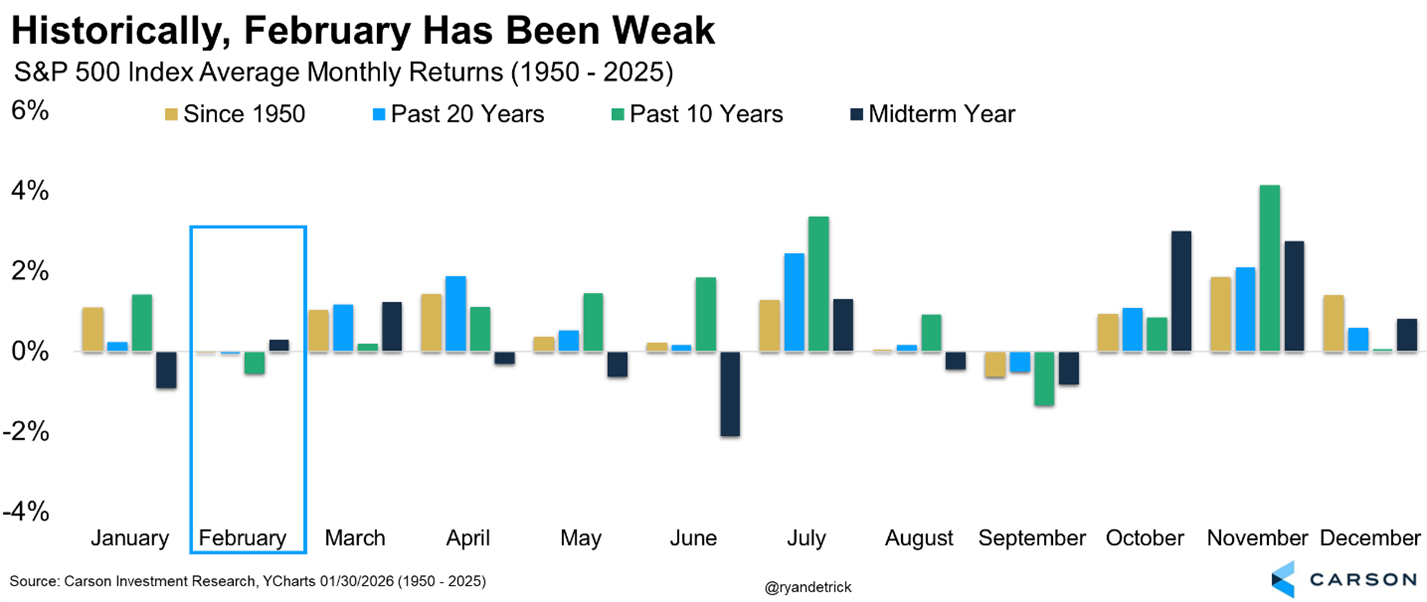
We will discuss this more soon, but I wanted to leave you with some thoughts on the potential for volatility during the shortest month of the year. Be aware February has been lower three of the past four years, four of the past six years, and five of the past eight years. So we’ve definitely seen some weakness in February lately, but it doesn’t end there. February is one of two months (along with September) that have had a negative average return the past 10 years, 20 years, and since 1950. As my friend Sam Stovall, Chief Investment Strategist at CFRA, likes to say, “History isn’t gospel, but a guide.” Another way to put it — we don’t have to have weakness this month, but it wouldn’t be abnormal.
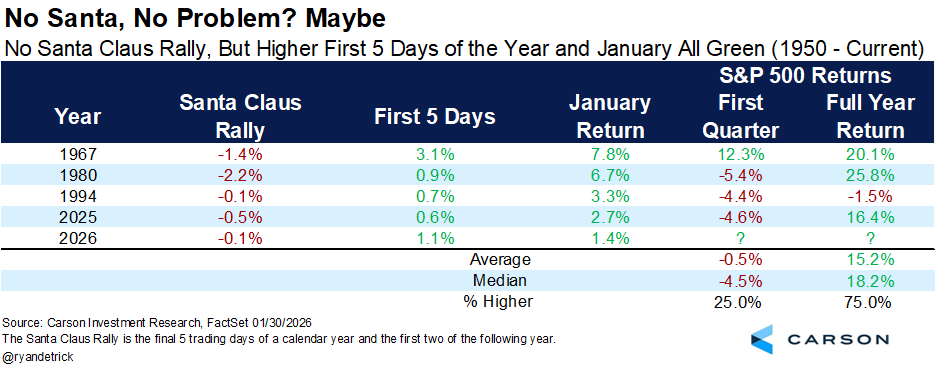
Lastly, we didn’t see a Santa Claus Rally this year (gains the last five trading days of December and first two trading days of January), but the first five trading days of the year and January were both higher. What caught my attention, looking at prior occurrences, is that the first quarter has been quite weak lately, suggesting February and March have been troublesome. The good news is that for the full year, stocks were up double digits three out of four years.
Overall, there are many things to watch, and the possibility of a banana peel in February is one of them. Big picture, though, we remain optimistic, and no, we don’t blindly invest only in how January does, but we think this is yet another clue this bull market is alive and well. Thanks for reading, and I was honored to join Kelly Evans and Dominic Chu on CNBC’s Power Lunch on Friday to discuss the new leadership at the Fed and more.
For more content by Ryan Detrick, Chief Market Strategist click here.
8749637.1. – 2FEB26A