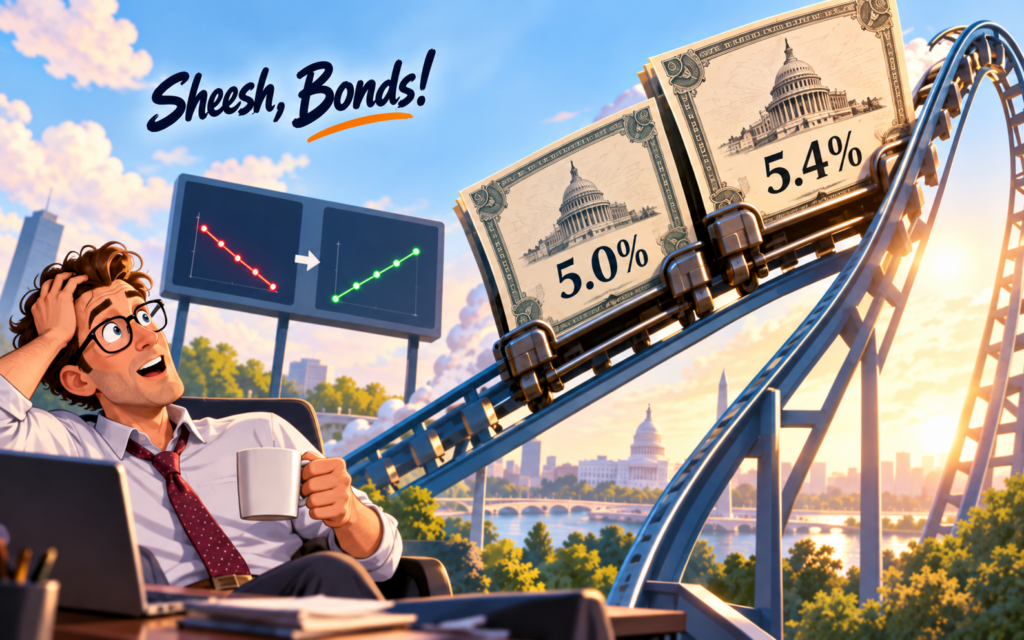
Treasury yields, particularly on the long end, have shot higher recently and over really any period you measure. Yesterday, the 10-year closed at exactly 5.00%, with the 30-year (aka long bond) nearing 5.4%. The recent jump is pronounced even amongst the steady increase in rates this year. The bond market has effectively taken control as the economy and job market continue to run hot and inflation data is providing no relief on the back of higher-still oil prices.
The Curve Has Completely Flipped
A year ago the Treasury curve was still upside down at the front, which we call an inverted yield curve. One-month bills paid more than three-year notes, and the 10-year sat right around 4%. Today we are looking at the mirror image. Bills are actually a touch lower than they were (the Fed did cut along the way), but from one year out, everything is higher, and the further out you go, the bigger the move. The 10-year is up roughly a full percentage point, and the long bond is up about 70 basis points.
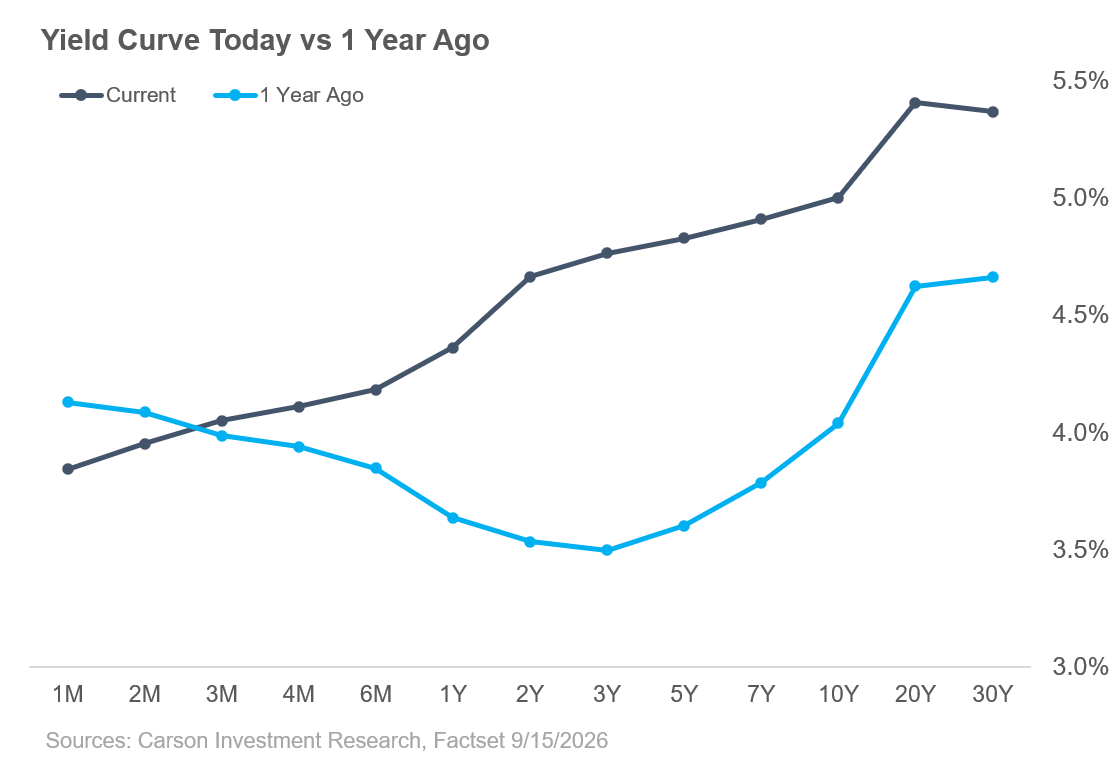
This move is actually exactly what you would expect given the forces working against interest rates – inflation, deficit spending, economic strength, etc. This has not been fun for the bond portion of portfolios, but there are always silver linings. A positively sloped yield curve means investors are compensated to take on more interest rate risk, and they can also benefit from “rolling down the curve” as bonds get closer to maturity. It also creates opportunities for bond ladder investors, as their reinvestment income is incrementally higher at the next rung.

Stay on Top of Market Trends
The Carson Investment Research newsletter offers up-to-date market news, analysis and insights. Subscribe today!
"*" indicates required fields
There also can be some opportunity in the short-term part of the yield curve. Treasury rates remain well above those of money markets (even if/when the Fed hikes) without extending maturity very much. We wrote about this a couple of months ago, and since then these trends have gotten more pronounced, and the opportunity still remains.
What is Priced In?
Reportable short positions in Treasury bond futures are sitting right around 2 million contracts. That’s near the highest level in the 20 years of data shown, roughly double where positioning was in 2022 when the Fed was hiking aggressively, and four times the lows of 2015. There are some semantics to these numbers (basis trade, etc.), but really no matter where you look, bonds appear to be hated.
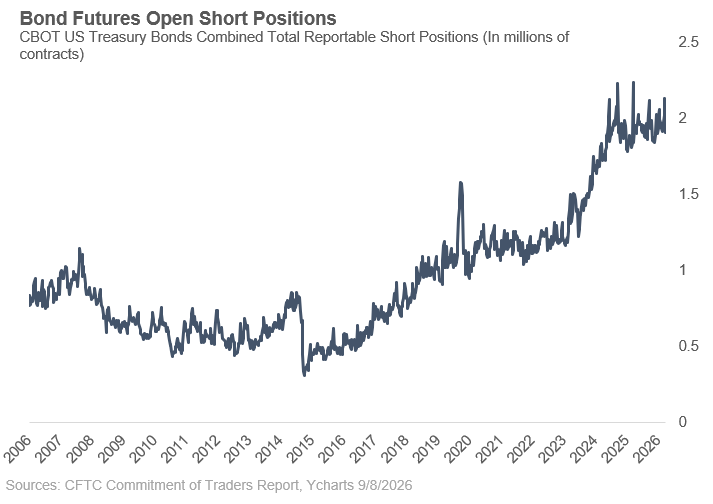
With a high level of short positions, any incremental positive news can result in large moves either direction. We’ve seen this contribute to interest rate volatility already this year as the headlines on geopolitics and inflation ebb and flow. This will be very important to watch today (Fed day 9/16/26 at the time of writing).
Short-Term Pain creates Long-term Potential Gain
While it may not seem like it, bonds have a “self-healing mechanism,” assuming they do not default. Higher interest rates affect a number of things, but eventually the bond should end up back at its par value at maturity. This also makes bonds more attractive now than in decades, depending on how you measure. We’ve done this before, but taking a look at bond yields and spreads relative to history is a helpful exercise to understand where we currently are.
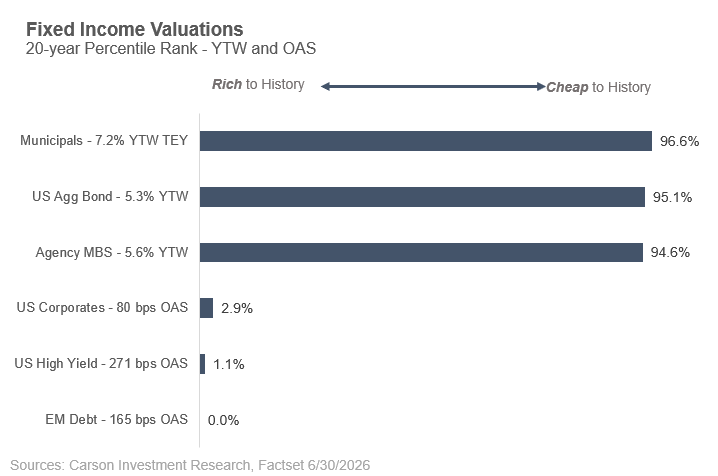
On a 20-year percentile basis, the high-quality, rate-sensitive parts of the bond market are about as cheap as they’ve been in two decades. Municipals sit at the 97th percentile with a tax-equivalent yield around 7.2%. The broad Agg is at the 95th percentile, yielding 5.3%. Agency mortgage-backed securities are at the 95th percentile, yielding 5.6%. You are being paid more to own Treasuries, munis, and mortgages than at nearly any point since before the financial crisis.
Credit spreads remain extremely tight and have even tightened more since we last looked at this. While high-yield bonds are still slightly positive for the year (compared to the broad aggregate index, which is now down 1.46% YTD), that pales in comparison to what the equity market has done. We have been positioned in high-quality fixed income and underweight bonds outright, but there will be a time to move out the duration curve.
Today’s financial marketplace offers bond strategies of all shapes and sizes, and even ways to get lower-risk portfolios with zero fixed income or interest rate risk. We can help you navigate all of that. But in the meantime, we’ll be watching bonds closely for opportunity.
For more content by Grant Engelbart, VP, Investment Strategy & Research, click here.
9129715.1. 16SEPT26A