
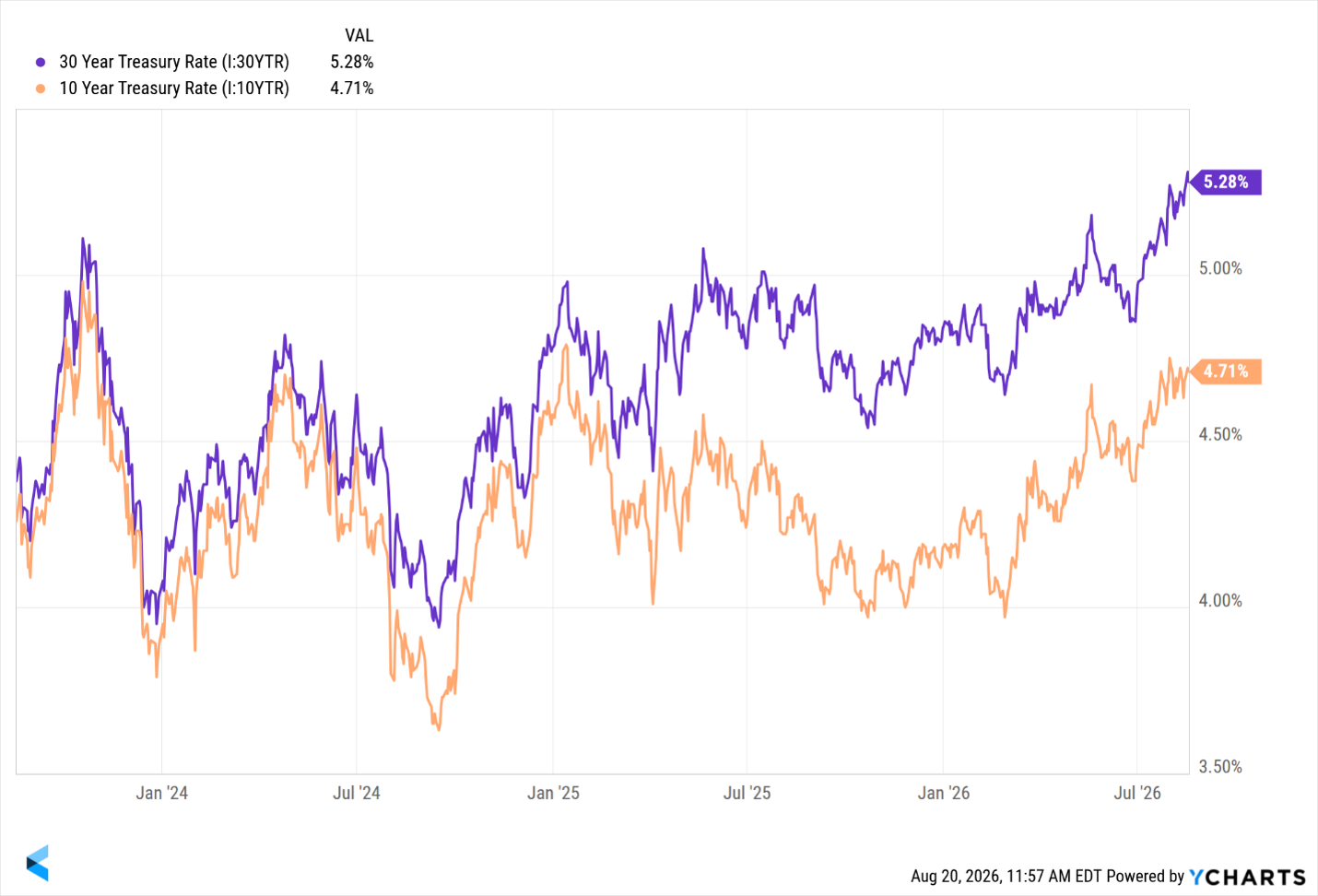
Long-term interest rates have moved sharply higher in recent weeks, putting renewed pressure on consumers, businesses and the federal government. The 30-year Treasury yield reached nearly 5.34% on August 18, its highest level since 2007, while the 10-year yield climbed toward 4.7%. Against that backdrop, the Treasury Department announced on August 19 that it will at least double certain buybacks of long-dated Treasury securities beginning in September.
The announcement initially sent bond prices higher and yields lower, but some of that relief quickly faded. On August 20, the 30-year yield moved back above 5.2%, and the 10-year rose toward 4.68%, as investors questioned whether buybacks can meaningfully counter the forces pushing long-term rates higher.
What Treasury Buybacks Aim to Accomplish
A Treasury buyback occurs when the U.S. government repurchases Treasury securities before they mature. Unlike Federal Reserve quantitative easing, the Treasury does not create money to finance these purchases. The government still needs to fund its overall borrowing requirements, meaning debt retired through buybacks generally must be offset by issuance elsewhere.
Treasury’s current buyback program has two primary objectives: liquidity support and cash management. Liquidity-support buybacks allow investors and dealers to sell older, less-liquid “off-the-run” securities back to Treasury, improving market functioning and allowing dealers to recycle their balance sheets more efficiently. Cash-management buybacks help Treasury manage fluctuations in its cash balance and reduce volatility in Treasury bill issuance.
Buybacks can also influence the supply-demand balance for particular maturities. If Treasury purchases long-term bonds while financing those purchases through greater issuance of shorter-term securities, it effectively removes some interest-rate risk, or “duration,” from the market. Greater demand and reduced net supply of long-duration bonds can push their prices higher and yields lower.
A Brief History of Treasury Buybacks
Source: TreasuryDirect.gov 8/24/26
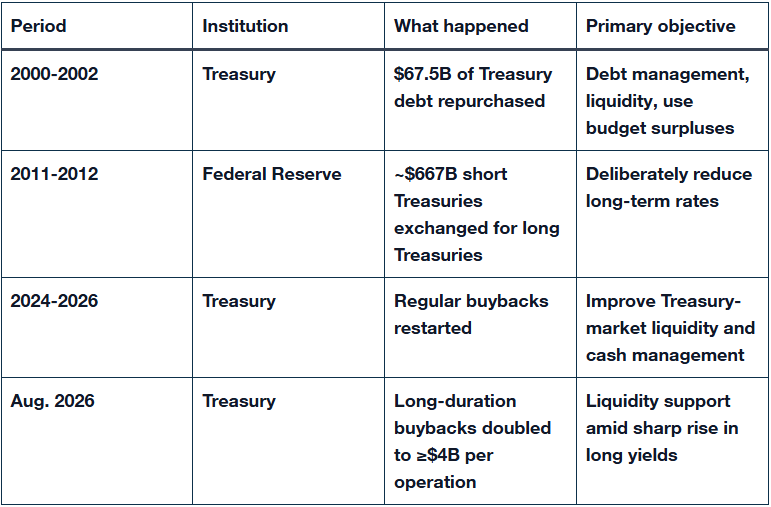
Treasury buybacks are not new. The first modern program began in March 2000, although the economic circumstances were dramatically different.
During the late 1990s, the federal government ran budget surpluses, and Treasury’s financing needs were declining. Smaller borrowing requirements threatened to reduce the size and liquidity of newly issued benchmark Treasury securities.

Stay on Top of Market Trends
The Carson Investment Research newsletter offers up-to-date market news, analysis and insights. Subscribe today!
"*" indicates required fields
Treasury responded by buying older securities while maintaining larger benchmark auctions. Then-Treasury Secretary Lawrence Summers identified three major benefits: improving benchmark liquidity, managing the average maturity of federal debt, and using excess government cash efficiently. Between March 2000 and April 2002, Treasury conducted 45 buyback operations totaling $67.5 billion.
Buybacks remained largely dormant for more than two decades before Treasury revived a regular program in May 2024. The new program was designed primarily to improve liquidity and cash management, not to influence interest rates. Treasury established regular purchases of less-liquid securities across different maturity ranges. By late 2025, Treasury reported repurchasing more than $115 billion for liquidity support and another $113 billion for cash management.
Why the 2026 Announcement Is Different
The August announcement is notable less because Treasury is conducting buybacks and more because of when and where it is increasing them.
Treasury announced that buybacks in the 10- to 20-year and 20- to 30-year sectors will increase from a maximum of $2 billion to at least $4 billion per operation from September 9 through November 4. Treasury characterized the change as providing greater liquidity support in longer-dated securities.
But the timing is difficult to ignore.
The announcement followed a dramatic bond selloff that pushed the 30-year Treasury yield to nearly 5.34%. Rising government debt, inflation concerns, the Iran conflict and heavy corporate borrowing have all contributed to upward pressure on yields.
The move therefore looks different from the predictable market-maintenance program introduced in 2024. Treasury changed its planned operations shortly after long-term borrowing costs surged, making the announcement appear more like an effort to stabilize the long end of the yield curve.
This resembles the Federal Reserve’s historical Operation Twist strategy. If Treasury removes long-duration bonds while financing itself with shorter-term debt, the private market holds less duration. That can exert downward pressure on long-term rates without reducing total federal borrowing.
It is not quantitative easing, and the scale remains relatively small. But it raises an important question: Is Treasury moving from simply supporting market liquidity toward actively managing the consequences of rising long-term rates?
How Markets Are Reacting
The initial reaction was significant. Following the August 19 announcement, long-term Treasury yields fell by as much as 10 basis points. The 30-year yield dropped toward 5.19%, while the 10-year fell toward 4.66%. The yield curve flattened, the U.S. dollar weakened, and risk assets generally responded positively.
By August 20, however, some of that enthusiasm had faded. The 30-year yield moved back to roughly 5.22%, while the 10-year climbed to approximately 4.68%.
The reversal suggests investors recognize that buybacks may improve liquidity and temporarily alter supply-demand dynamics but cannot eliminate the fundamental reasons yields have risen. Those pressures include persistent federal deficits, inflation uncertainty, elevated oil prices, and enormous borrowing requirements. Federal debt has surpassed $40 trillion, while private-sector borrowing, particularly spending associated with AI infrastructure, is adding additional competition for capital.
Federal Reserve policy adds another complication. Minutes from the Fed’s July meeting showed policymakers remain concerned about inflation, with some officials open to additional rate increases if inflation fails to moderate. That limits the prospect of near-term monetary-policy relief for the bond market.
The result is a tug-of-war. Treasury is attempting to improve liquidity and reduce pressure at the long end of the curve, while fiscal deficits, inflation risks and heavy borrowing continue pushing in the opposite direction.
The bigger story may ultimately be the precedent being established. Buybacks themselves are nothing new. What is unusual is Treasury’s willingness to expand them quickly following a sharp increase in long-term yields.
For investors, that raises a question extending well beyond the current $4 billion operations: If long-term rates continue rising, how far is Treasury willing to go to stabilize the world’s most important bond market?
By Michael Barczak, VP, Investment Due Diligence
9090855.1. – 24AUG26A