“COMPUTER DOOMSDAY?” was a Washington Post op-ed published in 1998. It details an estimated 60% chance of economic collapse caused by a failure in telephone, power and credit card systems, among others, due to the impending millennium bug. 28 years since publication, this op-ed would probably get a lot of clicks today if it were refreshed for today’s AI Angst.
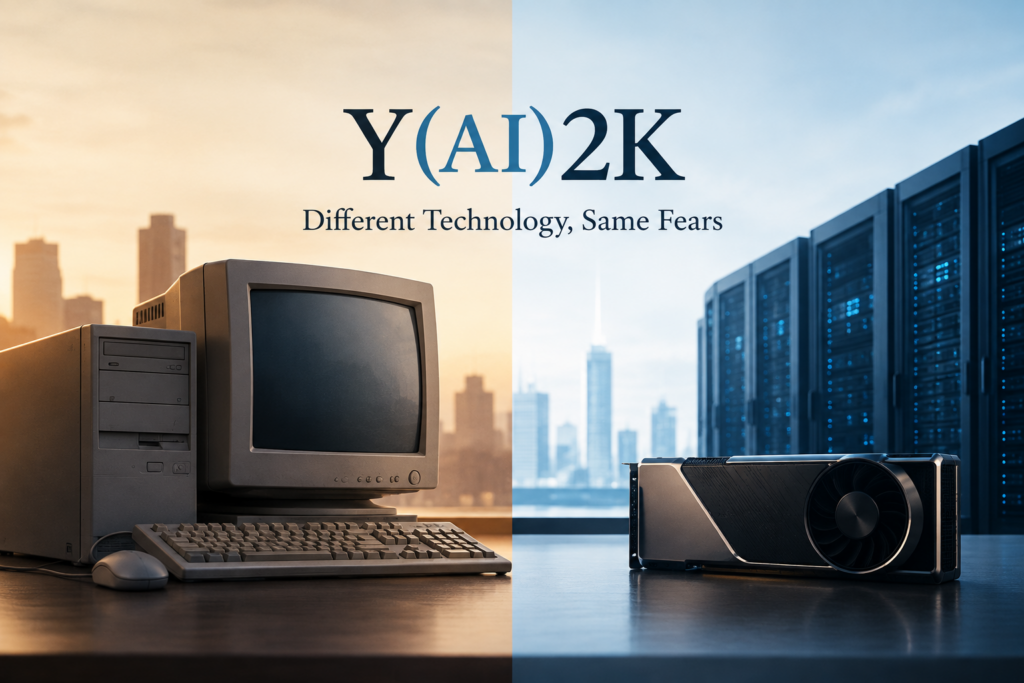
In my opinion, today’s artificial intelligence development is going through its own ‘Y2K’ moment – when fears of mass societal disruption catalyze a fundamental rethinking and retooling of nascent technology. In response to Y2K fears, the leading technology innovators of the day pushed software upgrades and refreshed hardware to ensure their products would be ‘millennium compatible.’ Technology innovators today are already working to publish safeguards and industry standards in an effort to combat these fears, and ‘compliant’ hardware that is wired to be ‘safe’ may not be far off.
Y2K
Part of the late-1990s boom in technology stocks and spending may have been driven by the Y2K phenomenon. Y2K induced fears of sudden technological depreciation driven by the millennium bug – a vulnerability in technology due to the calendar change from 1999 to 2000. Companies poured money into new technology systems that were patched for this vulnerability to increase their odds of survival.
A Federal Reserve report released in February 2000 commented explicitly that “investment in high-tech equipment over the past couple of years was likely affected to some degree by business preparations for the century date change” and resulted in a roughly 60% increase in real computer investments in 1998.2 The Los Angeles Times went a step further to say that companies were “feverishly pouring money into Y2K upgrades.”3 Companies and consumers accelerated technology purchases of these ‘safe’ systems that boosted growth in spending – albeit temporarily – to overcome these fears of mass disruption.
AI2K
There’s no shortage of AI Angst in today’s market, in my view. While the technology of the day has changed, it seems the fears haven’t. The surprising results of AI research at leading innovators have allowed this technology to grow in importance and impact in ways that even researchers could not have envisioned from inception. And this has led to real risks as well, with some researchers at these innovative companies warning of mass societal disruption caused by technological vulnerabilities. Sound familiar?

Stay on Top of Market Trends
The Carson Investment Research newsletter offers up-to-date market news, analysis and insights. Subscribe today!
"*" indicates required fields
AI Leaders of today are already taking a page from the Y2K playbook of innovating new products that are compatible with growth and safety and can work to potentially lower the probability of disruption. At the forefront is Nvidia’s Open Agent Safety Platform, which was released on September 28, 2026. Nvidia’s new Sentry product aims to “act as a hardware watchdog that can monitor and quarantine systems that attempt to move outside their boundaries in milliseconds.”4 Many other hardware and software providers in the technology industry are also releasing products to combat these disruption fears, rein in the unknown potential of this technology, and work towards generating growth safely.
Y(AI)2K
Fear sells. And calling out these risks also helps us overcome them. Y2K catalyzed an acceleration in technology spending to patch the millennium bug that was feared to paralyze society. 28 years later, the technology has changed, but the fears sound remarkably familiar. Warnings of AI disrupting our lives are plastered in the headlines. But companies at the forefront of the technology are also racing to produce more compliant systems that aim to better understand and prevent misuse to grow usage and safety.
- https://www.washingtonpost.com/archive/opinions/1998/05/06/computer-doomsday/5a4cb798-35e3-45b9-9829-b3990a60bf39/
- https://www.federalreserve.gov/boarddocs/hh/2000/february/fullreport.pdf
- https://www.latimes.com/archives/la-xpm-2001-mar-14-mn-37549-story.html
- https://investor.nvidia.com/news/press-release-details/2026/NVIDIA-Launches-Open-Agent-Safety-Platform-to-Secure-Agents-From-Testing-to-Deployment/default.aspx
For more content by Blake Anderson, CFA®, Director, Portfolio Management, click here.
9161829.1. – 5OCT26A