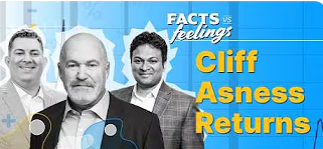
Ryan Detrick and I just celebrated recording our 150th episode of Facts vs Feelings. It’s been three years since we got started and we want to thank you all wholeheartedly for the amazing support. Our listens and views have been growing, and we’ve had a lot of fun along the way, including having some amazing guests. For our 150th episode we chatted with one of our favorites, Cliff Asness, Founder/Managing Principal/CIO at AQR Capital Management and investing legend.
This is the third time in three years that we’ve had Cliff on and we always learn something new from him. Cliff is like those amazing artists who you go listen to live to hear all the greatest hits, but then they do them differently every time making those particular renditions extra special. And at the same time, you get to hear the new music and you know it’s a future greatest hit in the making.
One: The Fartcoin People Have Succeeded
This is actually a reference to a blog from Cliff, written from a perspective of an allocator in 2035 looking back at the last 10 years and thinking about what worked and what didn’t work. Turns out, Fartcoin was the only thing that went right. Just FYI: he’s completely joking.
BUT, here’s the thing: The Fartcoin people have won in a way, simply because they’re getting all of us to talk about it.
Two: A Lot of Speculative Stuff Is Happening, But Hard to Call It a Bubble
It’s never easy to call a bubble in real time, or sometimes even in immediate hindsight. Cliff did think there are a lot of weird, hyper-speculative things happening right now, but is not sure we’re in a “bubble.”
Cliff’s called a “bubble” only twice in his career—in 1999 and 2019–2020. Both times he saw valuation spreads (difference between measures of cheap and expensive) at their largest gaps in history. But today, the spreads are not as wide, only around the 80th percentile, whereas in March 2000 and late 2020 it hit the 100th percentile. (As Cliff says, it hit a new 100th percentile.) So based on major indicators, he’d be uncomfortable calling it a “bubble.” But it’s an expensive market. After all, 80th percentile is larger than 50th percentile. Cliff did caution against market timing, especially based on his view that “people seem kind of nuts out there.” Calling markets (or segments of markets) irrational and knowing when the irrationality will end are two entirely different things.
Three: Cliff Said Nassim Taleb Is Right About the World Being Fat Tailed
I didn’t expect Cliff to bring up Nassim Taleb but he said that Taleb was right—the world is not very well approximated by normal distributions. Shorter-term events especially tend to be fatter-tailed. So you can get 3 and 4 and or even 8 standard deviation events much more frequently (to the extreme) than normal distributions would imply. So something like the recent PPI number shouldn’t be a surprise.
Four: It’s Easier to Do “Grift” These Days
Something I didn’t know was that it costs only $9 to launch a memecoin. By the way, this is not a recommendation to do so, either from Cliff or AQR or us.
Another sign, Cliff still gets job offers, which makes him worry whether the solicitors know something about how AQR’s portfolios are doing that he doesn’t. All said and done, there’s more solicitation, phishing, etc. Be careful out there.
Crucially, he said the existence of grift doesn’t mean everything is doomed. As an example, there may be a lot of grift in the crypto world, but that doesn’t mean Bitcoin is one.
Five: Cliff Met Stan Lee Once, for a Very Interesting Reason
Cliff told us a story he’s never told publicly before about meeting Stan Lee. I won’t give it away and so you have to listen to the podcast to hear it.
By the way, rest in peace Terence Stamp, who passed last week. He played Zod in Superman II, which is Cliff’s favorite Superman movie (and he recommends the Richard Donner cut—note to self to watch it over the long weekend).
Six: A Lot of Things Have Changed at AQR, But They Still Believe in Theory
For years, AQR “prided” themselves that for a new characteristic of a stock, or any other asset, to make it into their model (so that they can go long the good ones and short the bad ones), it had to pass two tests:
- It had to make economic sense.
- It needed strong statistical evidence that it does work.
But over the years, due to new machine learning techniques, they’re starting to lean a little more into the data side—but it’s done with a lot of guardrails. So, they’ve moved a bit on the theory vs “just” data spectrum toward data, but they do still care about theory.
Seven: “Capital Efficiency” for the Win
This is a topic near and dear to us, and I’ve written about how we “overlay” an alternative on top of a traditional portfolio to provide diversification and alpha. (I recently wrote a piece on how we include gold and managed futures in our portfolios.)
The “problem” with alternatives is that you have to sacrifice something in your existing portfolio. Even if you move your equities into a “very good” alternative, you can improve your risk-adjusted return but you still make less money, which may not be a tradeoff some investors are looking for. But with capital efficiency, you’re putting an overlay of some kind of diversifying asset or strategy on top of your traditional stocks and bonds. (There is a little bit of leverage, to be clear, but in pursuit of diversification.) So you potentially improve your risk-adjusted return AND your top-line return. Cliff gave a shoutout to our friends, Corey Hoffstein at Return Stacked Portfolio Solutions and the two Jeremies at WisdomTree (Professor Jeremy Siegel and Jeremey Schwartz). Full disclosure: We use all their products in our Carson House View models, and it gives me immense satisfaction that Cliff said the concept of capital efficiency is what he uses in his own portfolio.
Cliff spends some time explaining this, and I can’t recommend it enough.

Stay on Top of Market Trends
The Carson Investment Research newsletter offers up-to-date market news, analysis and insights. Subscribe today!
"*" indicates required fields
Eight: Absent Minded and Smart Is a Classic Combination
This was in the context of Ryan’s son being absent minded even though he’s a smart kid. Cliff’s perspective is that absent minded and smart is actually a classic combination that often becomes productive. So, here’s wishing Ryan’s son achieves legend status in whatever realm he chooses to dive into.
Nine: Taking Less Equity Market Risk Works Just as Well (or Better) Than Target Outcome Strategies
Cliff and his team have written quite a bit about target outcome strategies. Essentially, these strategies use options to protect against some portion of portfolio downside by giving up some of the upside. But options are expensive in a lot of ways, and in particular, buying insurance in itself can often just be too expensive (an area where he differs with Nassim Taleb). Options are also expensive to trade (especially relative to individual stocks), increasing fund fees relative to index funds and creating a higher hurdle for the value they need to create. So these strategies are essentially creating a lower octane version of equities, and Cliff and team have illustrated that some combination of stocks and cash (for example, 70% S&P 500 and 30% cash) actually works better. And it’s cheaper. If you want to take less risk, take less risk, with fewer return-eating hurdles.
The main concept here is that there is no such thing as a free lunch. As Cliff said, equity investors get higher returns because over short horizons stocks are scary. There’s a strong appearance of a free lunch in saying “you’ll get most of the upside, but it won’t be scary at all.” But if true, then everybody would be doing it.
My personal view is that with target-outcome strategies you’re getting more certainty, but there’s a cost to making investment returns less uncertain. You have to pay more for it, and that should lower your expected return even for the risk you are taking on. So it shouldn’t be surprising that a simple stocks-cash portfolio, which takes less risk but still has a big element of uncertainty, outperforms. It should.
Ten: People Will Pay for a Placebo, Even When They Know It’s a Placebo
This is also related to target-outcome strategies. If an investor invests in one of these, do they sleep better at night because they have more certainty, which in turn makes them a “better investor”? This is also an argument made for private equity, which has “lower volatility” (because it’s not marked to market), so maybe it makes investors better investors (fewer emotional bad decisions). A placebo effect if you may.
Cliff argues that’s true if you don’t know there’s a placebo effect. If you know or admit there’s a placebo effect, why not skip it altogether? Maybe someone needs the placebo to make them stick with equities over the long run, but once you acknowledge that, there’s an easier (and cheaper) way to get there.
There’s a whole behavioral question around this that I suspect will never be resolved. Now I did bring up the fact that perhaps people will not pay for a placebo once they know it’s a placebo. But as always, I learned something new from Cliff—there are real medical studies showing that the placebo effect still works to an extent even if you tell people it’s a placebo. I googled this and turns out it’s called the “open-placebo effect.”
The whole thing was amazing. I can’t recommend this enough, and I know I’ll be listening to it again, and more than once.
8331755.1.-08.27.25A
For more content by Sonu Varghese, VP, Global Macro Strategist click here