
The last several years have been unusually favorable for investors. Equities have delivered strong returns, bonds have recovered meaningfully, and credit has remained resilient. For many portfolios, nearly everything has worked.
And when everything works, diversification often goes unquestioned.
There is an irony in how we respond to diversification, or more precisely, to correlation. When markets are rising and assets move together, we tend to celebrate the outcome as evidence of a job well done. When markets fall, and assets move together, we panic. The behavior is the same; only the direction has changed.
Behaviors, Not Labels
Diversification is often described in terms of asset classes, stocks, bonds, or real estate. But true diversification is less about labels and more about behavior, specifically, how assets move relative to one another, or correlation.
Think of a household with both cats and dogs. Most of the time, they behave very differently. But introduce a strong enough stimulus, fireworks or a thunderstorm, and those differences disappear. Suddenly, both animals retreat to the same corner of the house.
The animals haven’t changed. The environment has.
Portfolios behave the same way. Research¹ shows that correlations are not stable over time; they change as market conditions change. An investor can hold the same 60/40 stock-bond portfolio for years and experience very different diversification outcomes, not because the holdings changed, but because the forces driving the markets did.
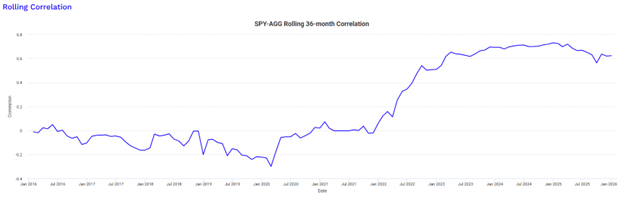
Source: Portfoliovisualizer.com

Stay on Top of Market Trends
The Carson Investment Research newsletter offers up-to-date market news, analysis and insights. Subscribe today!
"*" indicates required fields
Why Correlations Rise When It Matters Most
Correlations can rise when markets become dominated by a small number of shared drivers. In some environments, growth leads. In others, inflation, interest rates, or policy take control. When a single factor matters most, assets that normally respond to different influences can begin to react the same way. That’s why diversification can change even when portfolios don’t, and why assets like stocks and bonds can offset each other in some regimes but move together in others. This helps explain why a traditional 60/40 portfolio can appear robust for extended periods, only to behave very differently when the primary driver of returns changes. This dynamic is also what periodically gives rise to headlines declaring the 60/40 portfolio “dead”, reflecting confusion about how diversification behaves in different market conditions.
An Alternative Approach
This is where alternatives can play a constructive role. Not because they are uncorrelated across all environments, but because many are driven by return mechanisms that are structurally distinct from those of traditional assets.
Unlike stocks and bonds, which can become dominated by the same macro forces in certain regimes, some alternative investments derive returns from contractual cash flows, asset-level fundamentals, liquidity provision, or relative value rather than broad market direction. Research2 suggests that these structural features can lead to lower correlations with traditional assets and, in some cases, more stable ones over time.
Although alternatives are not risk-free, when thoughtfully selected and appropriately sized, they can help reduce a portfolio’s reliance on a single dominant market driver, particularly when traditional diversification becomes less reliable.
By Kevin Bruce, Analyst, Alternative Due Diligence
¹ Longin, F., and Solnik, B. (2001). Journal of Finance.
2 Ilmanen, A. (2011). Expected Returns. Wiley.
8814839.1. – 11MAR26A