
Market volatility typically creates opportunities for active managers to distinguish themselves. In 2026, however, the market has challenged some of the fundamental principles that underpin active investment strategies. Conventional wisdom suggests that active investment management should perform better during periods of heightened volatility and market uncertainty. When markets become unsettled, security prices can diverge from underlying fundamentals, creating opportunities for skilled managers to identify mispriced investments and outperform passive indexes.
By that reasoning, 2026 should have been a favorable environment for active management. Geopolitical conflict, elevated inflation, shifting interest rate expectations, and uncertainty surrounding artificial intelligence have created substantial market volatility. Yet active managers have generally struggled to translate those conditions into benchmark outperformance.
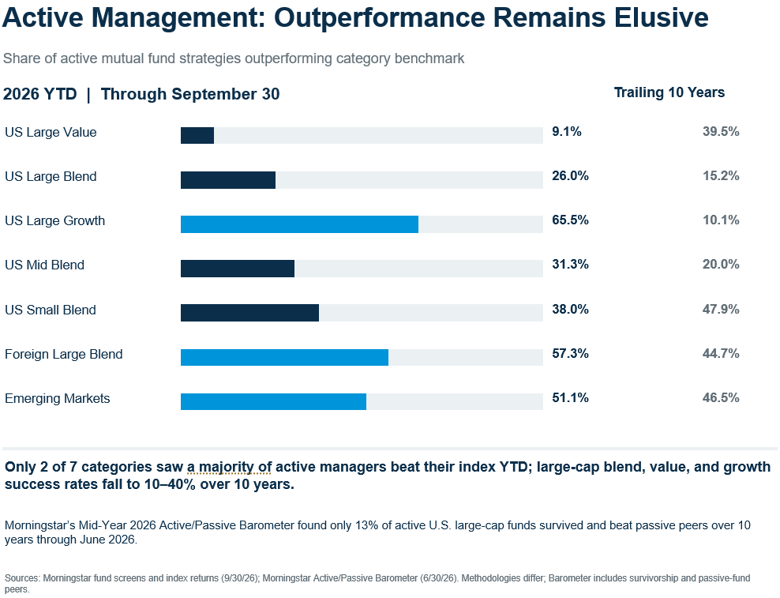
Looking at some of the major equity Morningstar categories, results have been varied for active managers this year. Only three of the seven categories have seen a majority of active managers outperform their benchmarks in 2026. The results are particularly challenging among domestic large-cap value and blend strategies, where fewer than 30% have outperformed. While sustained outperformance can be challenging, there are a number of factors working against active managers this year.
Sector Dispersion Has Punished Diversification
As discussed in my earlier blog, Sectors’ Wild Ride, performance dispersion across equity sectors has been unusually pronounced.
Before the October sell-off, technology and energy were among the strongest-performing U.S. equity sectors. Both represented areas where many active managers entered 2026 with relatively limited exposure, albeit for different reasons.
Technology presents a concentration problem. Mega-cap technology companies command substantial weights in capitalization-weighted indexes. Active managers often maintain smaller allocations to these companies to reduce concentration risk and diversify their portfolios. When technology stocks outperform, however, those prudent portfolio construction decisions can create substantial relative performance headwinds.
Energy presents a different challenge. Coming into the year, the sector’s underlying fundamentals did not necessarily support an especially compelling growth outlook. The investment case changed dramatically as the conflict involving Iran disrupted energy markets and pushed oil prices higher.
Managers who had appropriately questioned energy companies’ fundamentals found themselves underweight a sector benefiting from an extraordinary geopolitical development.

Stay on Top of Market Trends
The Carson Investment Research newsletter offers up-to-date market news, analysis and insights. Subscribe today!
"*" indicates required fields
Bloomberg reported in May that the proportion of mutual funds outperforming the S&P 500 had fallen to 28%, from more than 60% at the end of February, as AI-related mega-cap stocks regained market leadership.
The lesson is that volatility alone does not necessarily benefit active management. When returns are concentrated in a relatively narrow collection of securities or sectors, diversification can become a disadvantage over short time horizons.
Speculative Momentum Has Outpaced Fundamental Quality
A second challenge has been the persistent strength of speculative companies, particularly among smaller-capitalization stocks.
As I wrote about in my blog Non-Earners Have Led Small Caps earlier this summer, companies without positive earnings have frequently outperformed profitable businesses since April 2025. Many have benefited from enthusiasm surrounding artificial intelligence, whether through direct participation or perceived secondary exposure.
This environment conflicts with a central principle of fundamental investing: Over time, companies generating sustainable profits should provide more reliable investment outcomes than businesses whose valuations depend primarily on future expectations.
Many active managers deliberately emphasize profitability, balance-sheet strength, cash flow, and earnings quality. These characteristics can help manage downside risk, but they have not consistently been rewarded during the recent momentum-driven rally.
AI-related gains have expanded beyond software and semiconductor companies into energy infrastructure and other enabling technologies. The investment theme increasingly influenced prices across multiple industries. When investors prioritize potential future growth over current financial performance, traditional valuation and quality disciplines can struggle. This highlights the difference between a strategy being temporarily out of favor and its underlying investment thesis being fundamentally impaired.
International Positioning Has Created Additional Headwinds
International equity markets have presented a different set of challenges. Many active international managers favor developed European businesses because of their established institutions, relatively stable operating environments, and strong multinational franchises. However, European companies have faced disproportionate exposure to the economic consequences of the Iran conflict.
Europe’s dependence on imported energy leaves businesses vulnerable to rising oil and natural gas prices. Multinational companies also face higher transportation and shipping costs, while some exporters have experienced disruptions to demand and commercial activity in Middle Eastern markets (LVMH and luxury high-end automobiles are great examples). These pressures can weigh on share prices even when individual businesses maintain attractive long-term fundamentals.
Meanwhile, selective opportunities in emerging markets, particularly across Asia and Latin America, have benefited from different economic and sector exposures. Managers emphasizing developed Europe may therefore have experienced relative headwinds from geographic positioning rather than unsuccessful individual security selection.
Importantly, international results have been more balanced than those in domestic large-cap equities, with approximately 57% of foreign large-blend managers and 51% of diversified emerging-markets managers outperformed their respective indexes through September.
It is also worth remembering that short-term results do not guarantee a long-term trend. US Large Growth managers benchmarked against the Russell 1000 Growth have had the most difficult time outperforming their benchmark over the past 10 years because of the market leadership of the indexes biggest constituents (FAANG stocks, Mag-7, AI Hyperscalers). This has not been the case in 2026 where the fear of an AI bubble has dominated the news cycle for some of the benchmark’s largest names. This dichotomy is difficult to predict and almost impossible to time.
Our Investment team continues to believe active management can add meaningful value across full market cycles. Evaluating managers can sometimes be more art than science, requiring an understanding of not only whether they outperform, but also why they outperform or underperform. This is a key component of our research and diligence process, where a qualitative understanding of a manager’s investment thesis is a key component in evaluating their results.
By Michael Barczak, VP, Investment Due Diligence
9227565.1. – 9NOV26A