Thursday’s massive selloff (November 5th) has everyone worried about technology stocks after the blue tsunami on Election Day. I wrote about this in my prior blog and why everyone’s suddenly nervous about data centers. Thursday’s selloff more than erased the large post-election gains. But look at the two-day returns:
- S&P 500: -2.8%
- Nasdaq: -4.2%
- Dow Jones Industrial Average (Dow): -0.5%
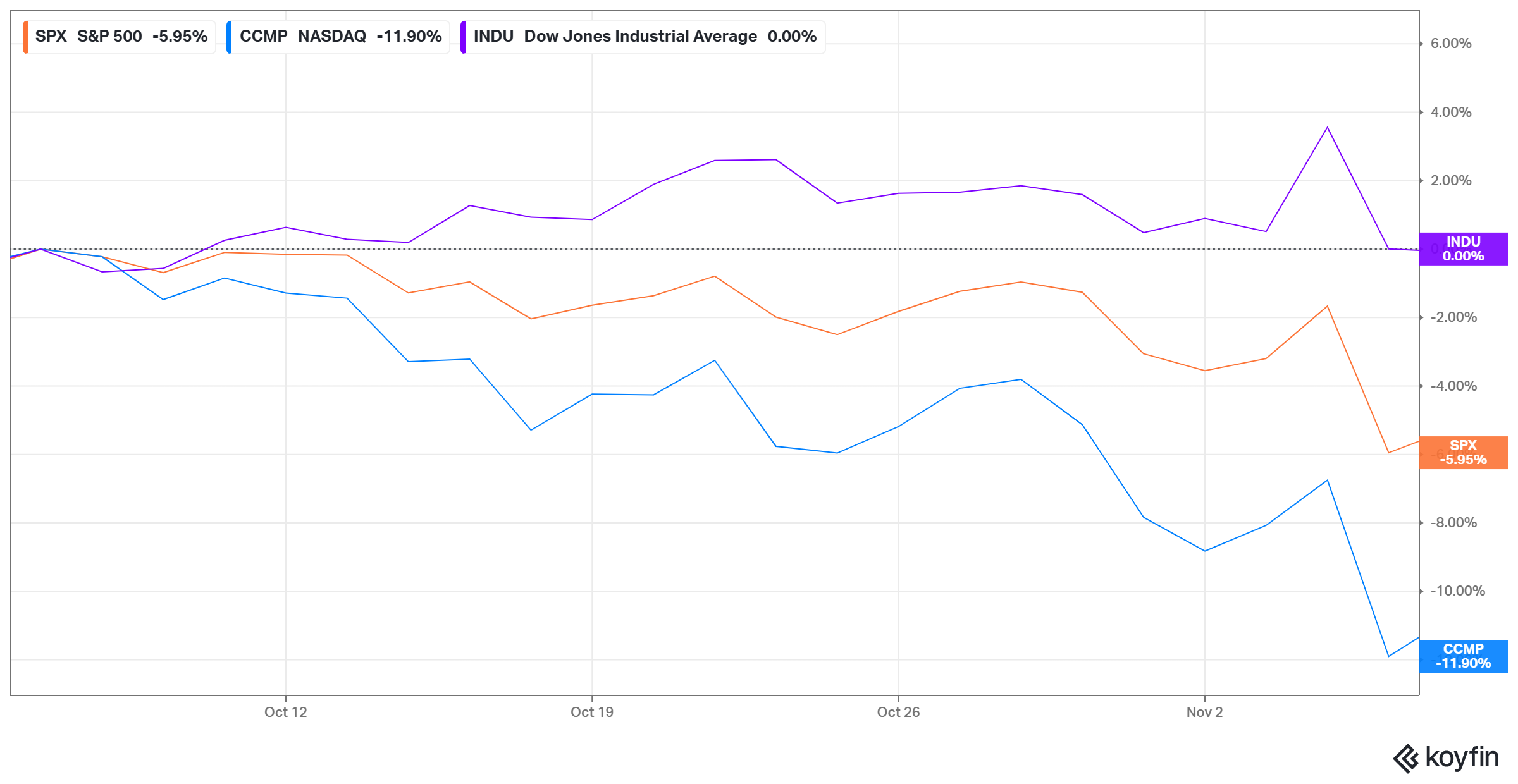
That performance differential between the Dow and Nasdaq tells you a lot about this market. And it’s not just a two-day phenomenon. Since the Nasdaq peaked on October 6:
- S&P 500: -5.95%
- Nasdaq: -11.90% (a “correction”)
- Dow: 0.00%
The Nasdaq is in correction territory, while the Dow has been flat. That’s a big divergence.
Concentration’s A Problem
When we talk about the ‘stock market,’ we’re usually referring to the S&P 500. Historically, that’s made sense because it’s been a broadly diversified index.
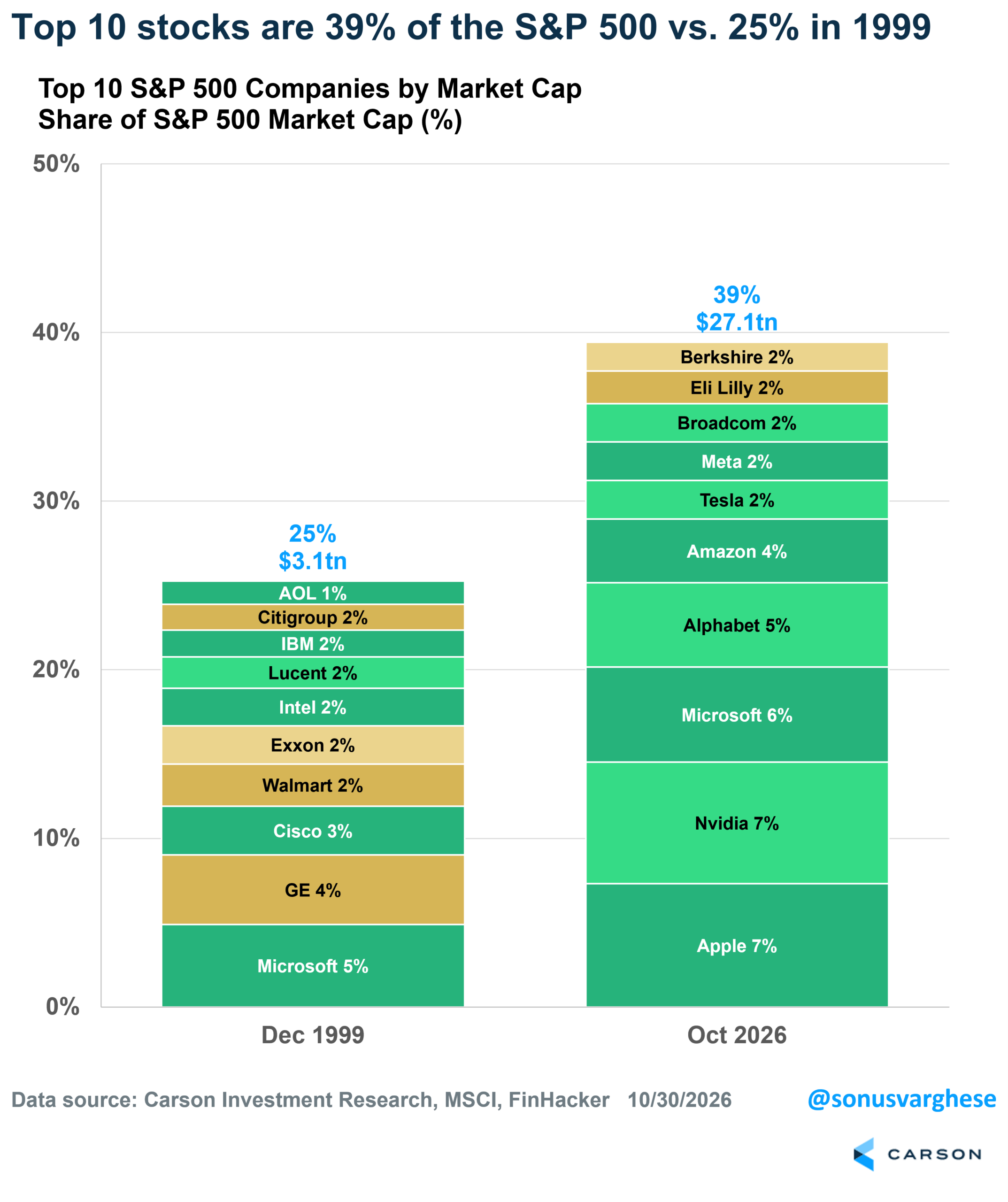
The problem is that it’s less diversified now. Consider the concentration of the 10 largest stocks in the S&P 500 today versus December 1999, near the peak of the dot-com bubble.
- In December 1999, the top 10 stocks accounted for 25% of the index. Four were non-tech companies (GE, Walmart, Exxon, and Citigroup), while technology names accounted for 15%.
- Today, the top 10 account for a whopping 39% of the index, with eight technology-related names making up 35%. The other two are Eli Lilly and Berkshire Hathaway.
That’s a massive difference.
It’s not just the largest stocks. Technology and communication services together account for 46% of the S&P 500 today, versus 37% in December 1999. Meanwhile, financials, health care and energy make up just 26%.
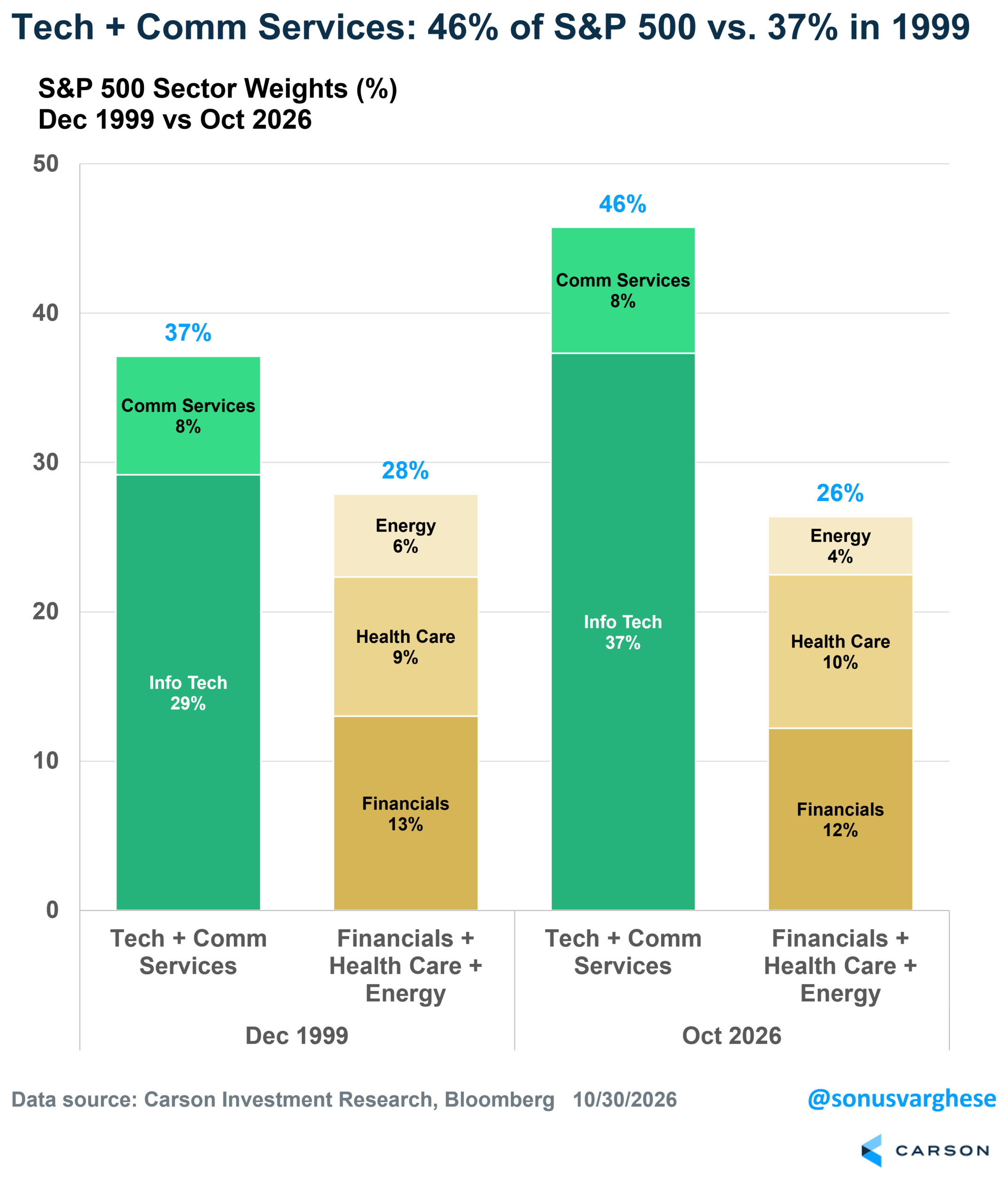
In short, we have a lot of concentration, and when technology stocks take an outsized hit, so does the S&P 500. But here’s the thing: You don’t have to invest in the stock market exactly the way the S&P 500 is constructed. You can be more diversified than the index. Recent market action beyond the headline indices also shows why that matters.
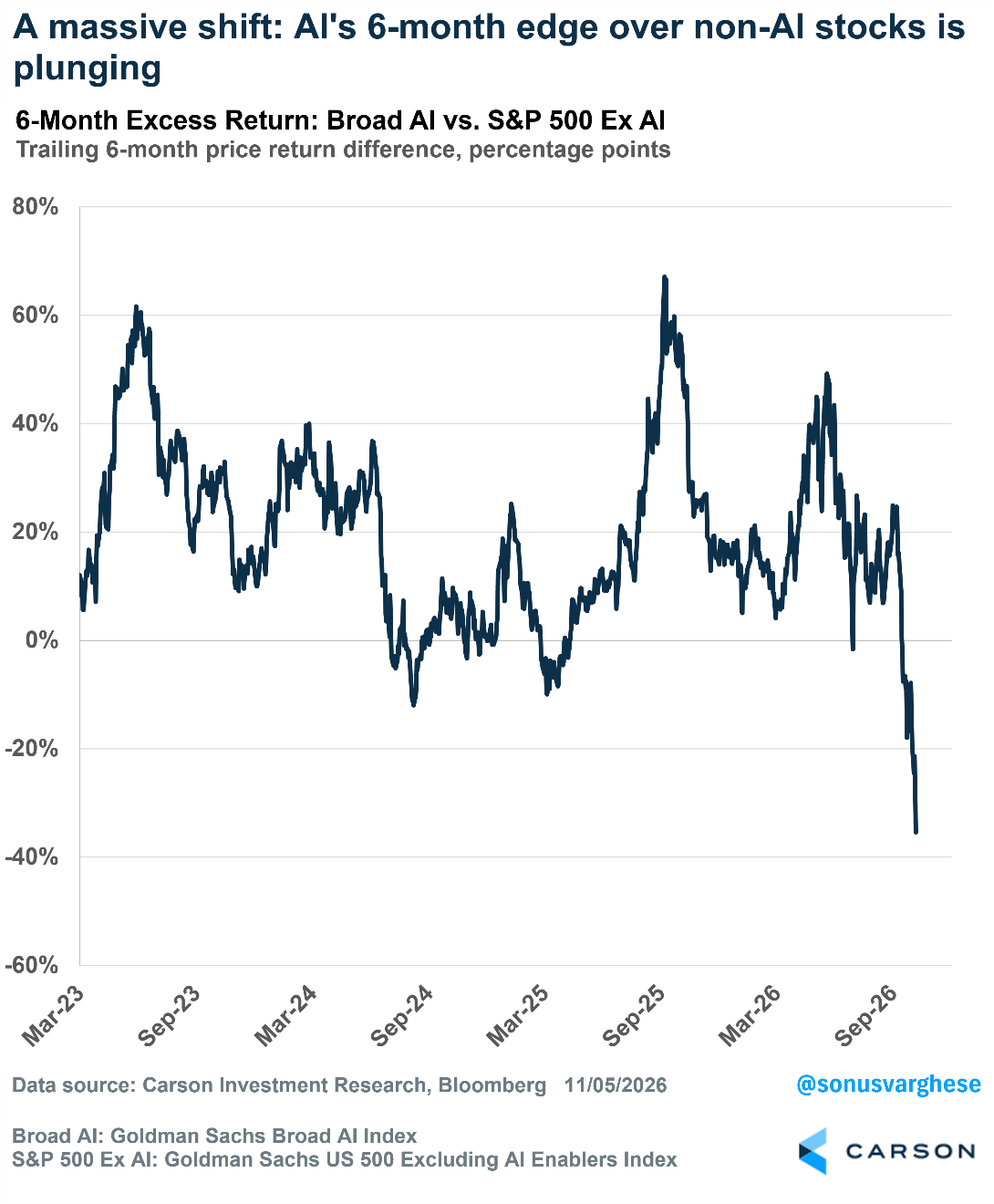
It’s one thing for non-AI stocks to outperform AI stocks for a week or two. But this rotation has been going on for a while. Consider the performance of AI versus non-AI stocks over rolling six-month periods. The differential is now the worst we’ve seen during this four-year bull market. Over the past six months (data via Bloomberg):
- The Goldman Sachs Broad AI Index (“AI stocks”) is down 24.5%
- The S&P 500 Ex AI Enablers Index (“Non-AI stocks”) is up 10.9%
- A performance differential of 35.4%
Back on October 6th, AI stocks outperformed non-AI stocks by 25 points, and on June 18th the outperformance was 49 points. That is an extraordinary reversal.
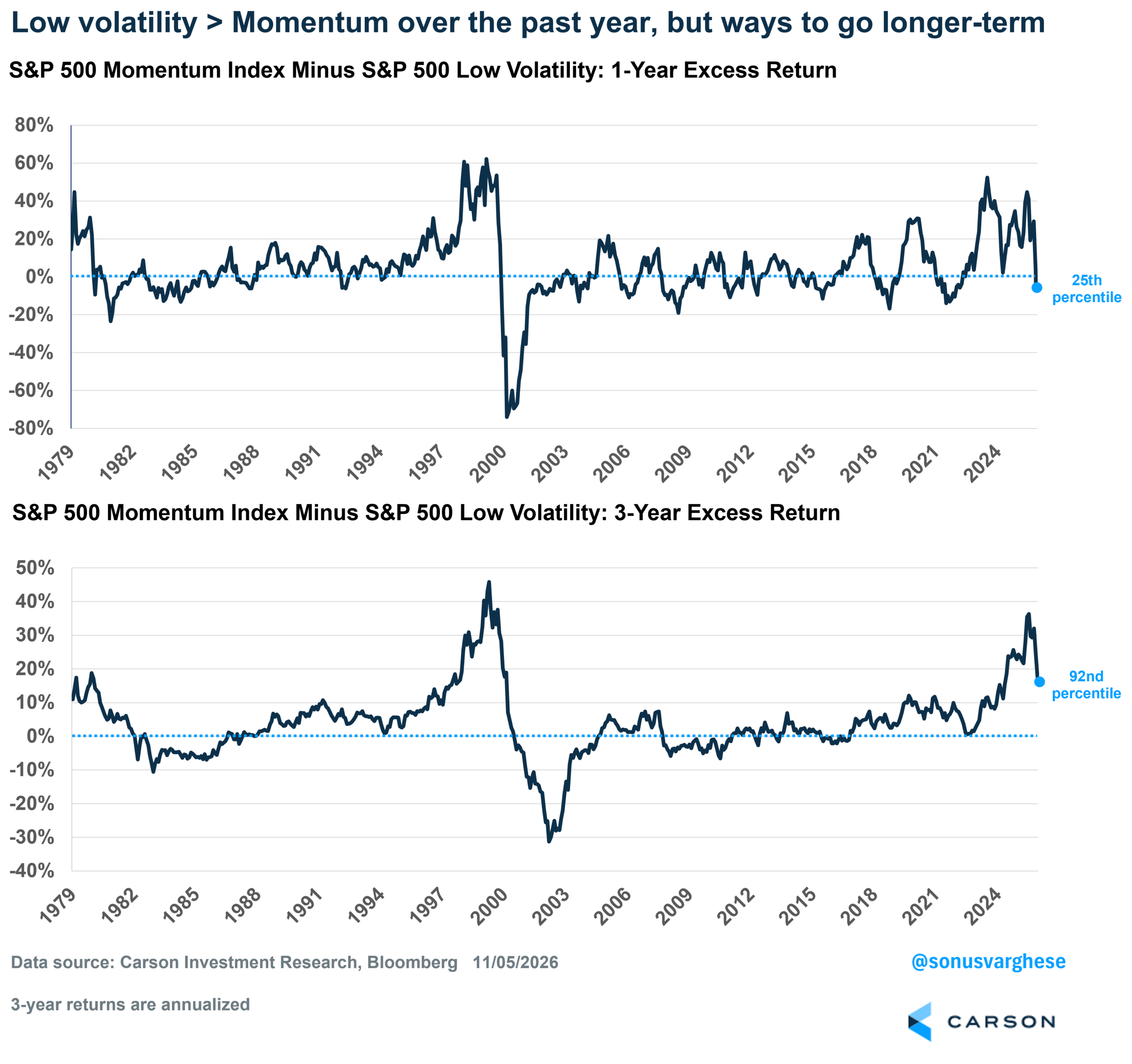
Another way to see this rotation is by comparing momentum stocks with low-volatility stocks, which are about as ‘anti-AI’ as you can get.
- The one-year excess return of the S&P 500 Momentum Index over the S&P 500 Low Volatility Index has fallen to the 25th percentile historically, versus the 96th percentile in June.
- But here’s what’s interesting: The three-year excess return is still in the 92nd percentile, down from the 99th percentile in June. In fact, the three-year outperformance remains greater than anything we saw between February 2001 and April 2025.
If this is the start of a sustained rotation, there’s potentially a long way to go. We’ve been writing about the benefits of barbell technology and momentum exposure with low-volatility stocks since our full-year 2026 outlook, and again in our midyear outlook.
I’m not saying technology stocks can’t come roaring back. They certainly could, and the S&P 500 could rally alongside them. But given the index’s concentration, a broad market recovery would be heavily dependent on technology rebounding. Should you bet on that and consider this a “buying opportunity”? Maybe, maybe not. The important point is that you don’t have to rely entirely on the AI wave continuing, with all the optimistic projections that come with it.

Stay on Top of Market Trends
The Carson Investment Research newsletter offers up-to-date market news, analysis and insights. Subscribe today!
"*" indicates required fields
Of course, if you’re looking beyond AI stocks, another important question is: What about the economy? There’s good news here too.
The Economy Is More Than AI
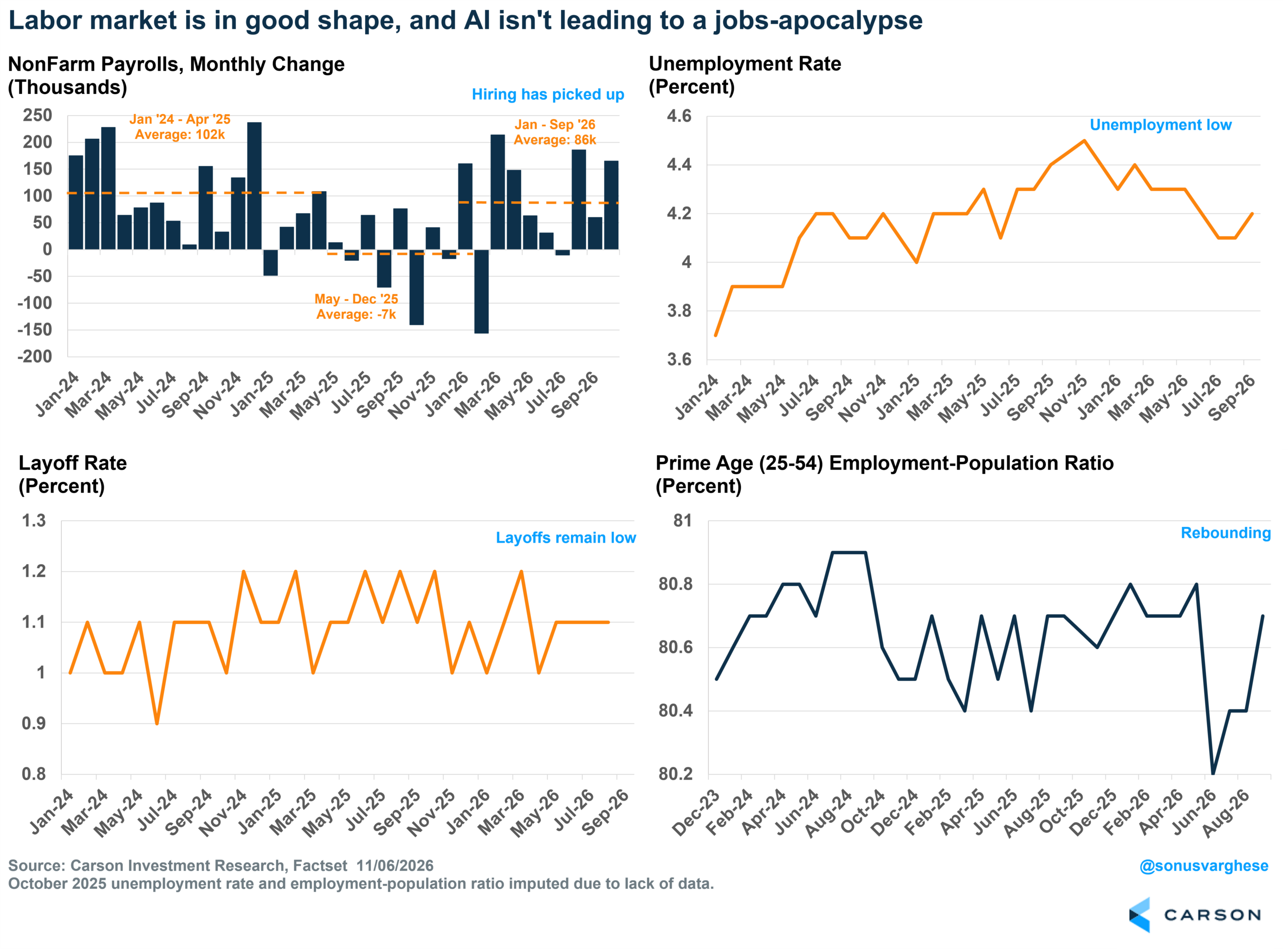
Remember all those predictions about an AI-driven jobs apocalypse? Well, we’re several years into AI deployment across the economy, and the labor market has actually gotten better this year. Some numbers:
- Employers added 165,000 jobs in October, taking the three-month average to 137,000. Monthly job growth has averaged 86,000 this year, a significant recovery from the average loss of 7,000 jobs per month between May and December 2025.
- The unemployment rate is at a historically low rate of 4.1%, and it’s been below 4.5% for a record five straight years.
- The prime-age employment-population ratio is at 80.7%, higher than anything we saw in the 2000s or 2010s economic expansions. It tells you that more people in their prime working-age years are working now than at any point during the last two expansions.
- The layoff rate (layoffs as a percent of the workforce) is just 1%, even lower than the 1.2–1.3% we saw in 2018–2019, when the labor market was exceptionally strong.
This doesn’t mean everything is rosy. Finding a job is still difficult, with the average unemployed jobseeker out of work for more than 27 weeks, the longest since 2021. But the big picture is that the labor market is recovering from a difficult stretch last year. The economy is doing just fine, even beyond the massive investment spending on AI infrastructure.
And despite all the predictions, AI doesn’t appear to be having much impact on employment yet. Economist Guy Berger recently highlighted Census data showing how firms are changing employment and hiring because of AI:
- Among firms using AI, 87–90% report no change.
- Among all firms, at least 95% report no change.
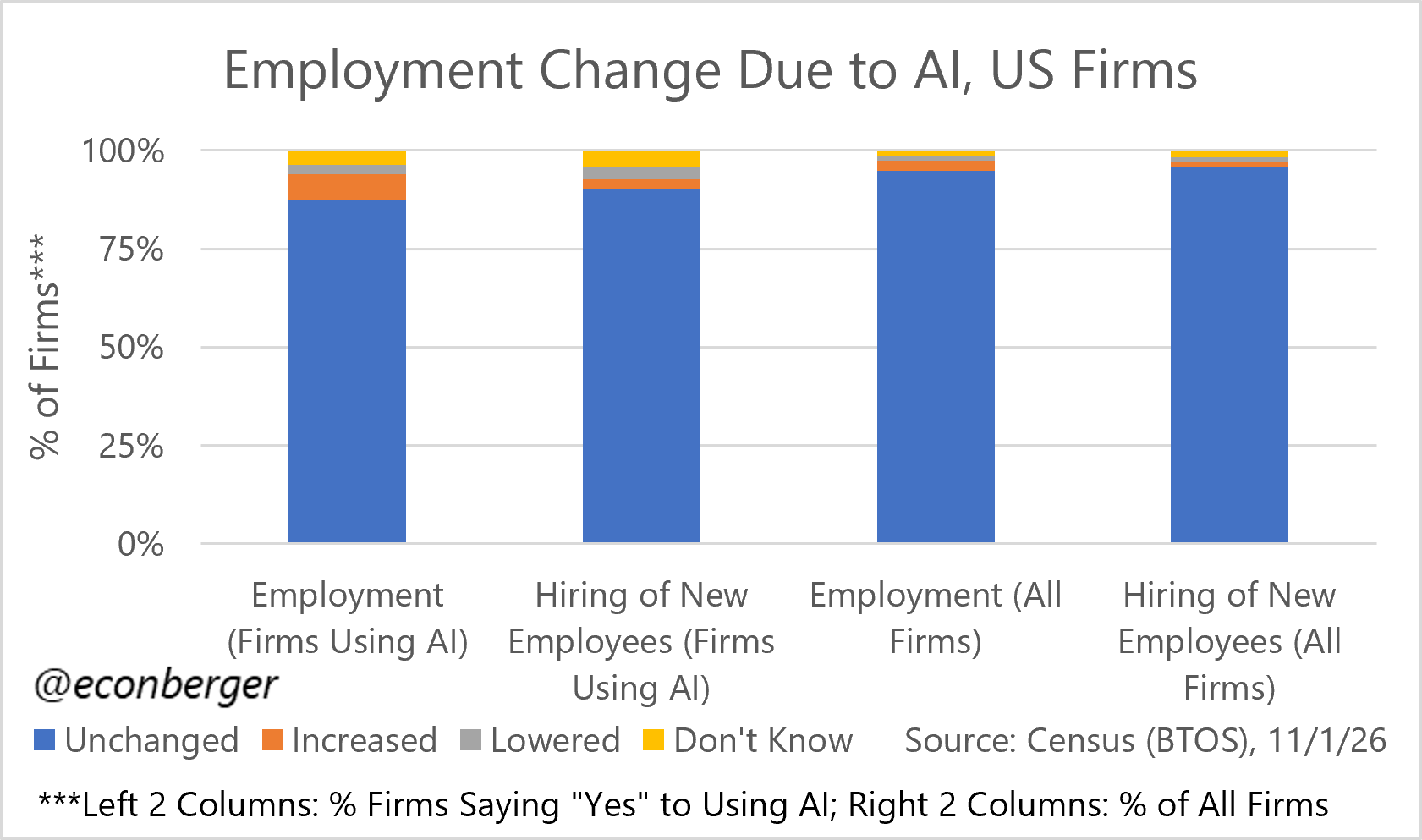
So what exactly is AI doing to the economy beyond the enormous infrastructure buildout?
- At best, AI is being deployed as a tool and boosting productivity (I wrote about this back in August)
- At worst, it’s having minimal impact on employment so far.
That also raises questions about projections for explosive AI demand driven by replacing workers. Remember, in May 2025, Anthropic CEO Dario Amodei predicted AI could eliminate half of entry-level white-collar jobs by the end of the decade. We’re now 18 months past that prediction, and the labor market has improved.
None of this tells us where AI ultimately goes. But it does tell us that the economy is more than just AI, just as the stock market is more than a handful of technology stocks. And that’s important for investors.
We’re facing two risks right now. First, AI could be a bubble, and the recent volatility may signal that we’re getting closer to its end. Second, the S&P 500 is so concentrated in technology that investors are taking on enormous exposure to that single theme, whether they realize it or not.
The good news is that you don’t have to play that game.
Back in late June, when AI and momentum stocks were really extended, I wrote about learning to ‘stop worrying and love the bubble.’ I’ll close with the same thought, because it still applies.
We have no idea what stage of the bubble we’re in, or when it might pop. But rather than trying to time the top and get out before everyone else (good luck with that), we’re increasingly comfortable diversifying judiciously outside AI, even if it means missing some upside. We believe being diversified, even within equities (and especially within equities), is more important than ever.
For more content by Sonu Varghese, Chief Macro Strategist, click here.
9225516.1. – 6NOV26A