Well, Americans have gone to the polls and, in a historic election, have resoundingly rejected how President Trump has governed in the first two years of his second term. What was at stake yesterday? 36 governorships, 35 Senate seats, all 435 House seats and lots of local elections, referendums, and ballot questions (including more than 30 on data centers). But more pointedly, control of Congress. For a reminder of the setup, see my earlier midterm blog. As I discussed there, the president’s party almost always loses ground in midterms, but this was a “blue tsunami.” A few examples of how strong the night was for Democrats:
- Kansas elected a Democratic senator for the first time since 1932.
- Democrats won a majority of governorships for the first time since 2010.
- Democrats could still pick up as many as nine Senate seats: Maine, South Carolina, North Carolina, Ohio, Iowa, Kansas, Texas, likely Alaska (although still unclear with a lot of counting to be done), with almost a dead heat in Mississippi, which will almost certainly require a recount. If they get to nine, that would tie the Republican gain in 2014 for the largest swing since 1958. Trump had won seven of these states (including Alaska and Mississippi) by more than 10%, and he had won Mississippi by more than 20%.
Here’s a look at the vote shift in the midterms based on currently available. If you look at the 2024 presidential election, you’ll see almost all red arrows to the right. Again, this isn’t unusual for a midterm directionally, but the size of the shift is a surprise.
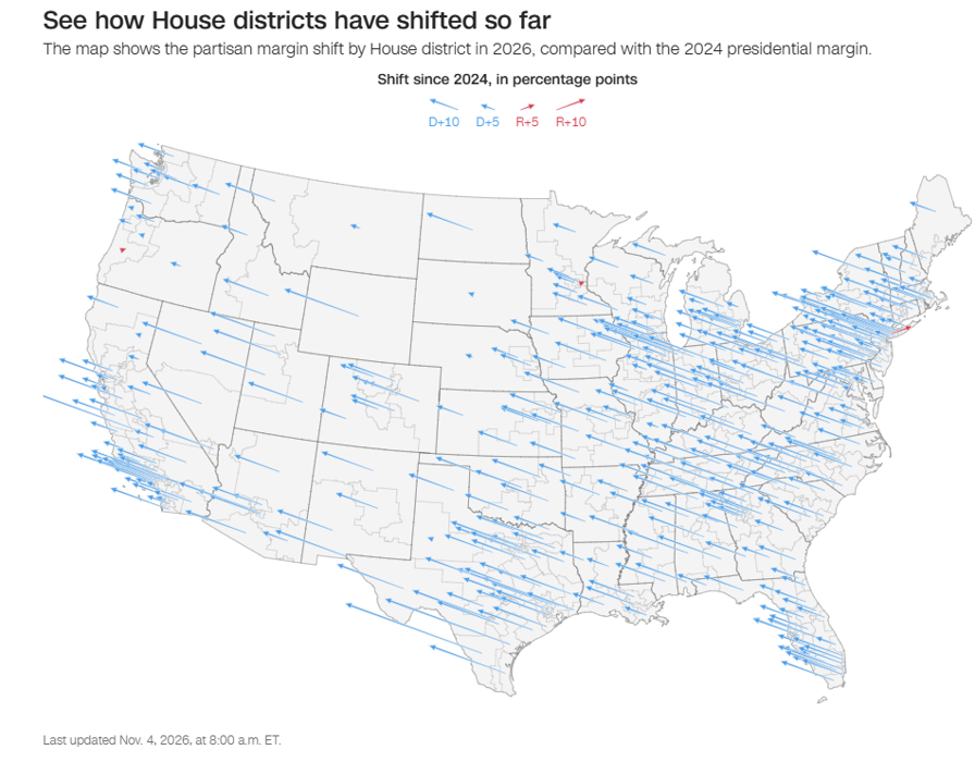
Source: CNN 11/4/2026
Putting the numbers together, Democrats are expected to have a roughly 56-44 majority in the Senate and a 259-176 majority in the House, although those numbers may change as counting continues. The current estimate of the popular vote advantage in the House is roughly 13 percentage points.
The Quick Takeaway
President Trump took his eye off the ball. Voters elected him because they thought he was the better candidate to control inflation, focus on American prosperity, and strengthen the middle class. Instead, he has focused on detonations, renovations, and recriminations. In the process, he tossed out the “establishment” Republican ideas that were central to his signature successes in his first term.
Democrats should not lose sight of this lesson. Political victories seem to bring out politicians’ worst selves, and Democrats need to avoid that trap. Democrats won the night because the American people thought they were now the best option to control inflation, focus on American prosperity, and strengthen the middle class. If they forget that, the political gains won’t last long.
Let’s Put Some Misconceptions to Rest
The midterms help us put some misconceptions to rest. First, American voters are more sophisticated than many give them credit for. We are not simply divided into two partisan camps. Talk to most people and their views will not just echo the Republican or Democratic platform, even if many are more aligned with one or the other. The most prevalent patterns in politics are to vote out the president’s party every one to three terms and to reject the president’s party at midterms. Voters are flexible, or at least flexible enough in aggregate to shift elections. There may no longer be a as much of a “middle” in politics as there once was, but there are still a whole lot of middles from all the different mixes of political perspectives people have.
Second, polling errors can go in either direction. Yes, the president’s performance was underestimated twice by polling. But last night the polls underestimated the Democratic wave by a good margin. Polls have both sampling and modeling error. They’re still good guidelines, but they shouldn’t be taken too seriously. Professional pollsters work hard to avoid bias, and we’ve generally seen errors in both directions.
President Trump Is Still President, but Expect Little Cooperation From Congress
What hasn’t changed in this election is that President Trump is still president, which means broad scope on tariffs, regulation, foreign policy, and his favorite policy tool, the executive order. Through October 20, Trump has averaged 166 executive orders per year in his second term, a faster pace than any president since FDR. (In fact, no president has averaged more than half that since Truman.) Of course, Congress will be less cooperative and try to thwart his agenda through greater oversight. But Congress is unlikely to be able to pass new legislation without significant compromise, since the president has veto power and Democrats don’t have the votes to override a veto.

Stay on Top of Market Trends
The Carson Investment Research newsletter offers up-to-date market news, analysis and insights. Subscribe today!
"*" indicates required fields
With the Senate flipping control, the president will have difficulty getting through any appointments that require Senate approval unless they are compromise candidates. That includes cabinet secretaries, agency heads, all federal judges (including the Supreme Court), US attorneys and marshals, some military appointments, and a variety of boards and commissions. The president can still use recess appointments or, for some positions, appoint “acting” officials. Because of this shift, we may see a flurry of appointments before the new Congress is sworn in on January 3. But this will have little influence on markets.
What About Spending?
If it’s one thing Democrats and Republicans have in common, it’s that both parties love to spend, even if they have different priorities. There is likely some room for horse trading here. Most prominently, the president will likely ask for more military spending, while Democrats will likely try to reinstate Affordable Care Act subsidies and fund other priorities. Divided government isn’t likely to slow down the spend, and in the near term that’s good for markets.
Data Centers Were on the Ballot Too
Another issue running through the state races deserves investors’ attention: data centers. The AI buildout may be a national investment story, but much of the permission to build it is decided closer to home. Governors influence permitting and regulatory appointments, while utility commissions decide electricity rates and how infrastructure costs are recovered. Those decisions matter for how quickly projects move forward and who pays for them.
In Georgia, governor-elect Keisha Lance Bottoms campaigned on pausing new data-center development. In Ohio, governor-elect Amy Acton also called for a temporary halt to new construction and said future projects should pay their own utility costs. These were campaign proposals, so implementation details still matter a ton, but developers have good reason to pay attention.
This isn’t neatly divided along party lines either. Both candidates for governor in Arizona supported ending data-center tax incentives and protecting existing customers from grid-connection costs. Pennsylvania had already tightened its rules before the election. Governor Josh Shapiro’s August executive order removed data centers from fast-track permitting. It required local approval and binding commitments to meet the state’s standards before environmental permit applications would be reviewed.
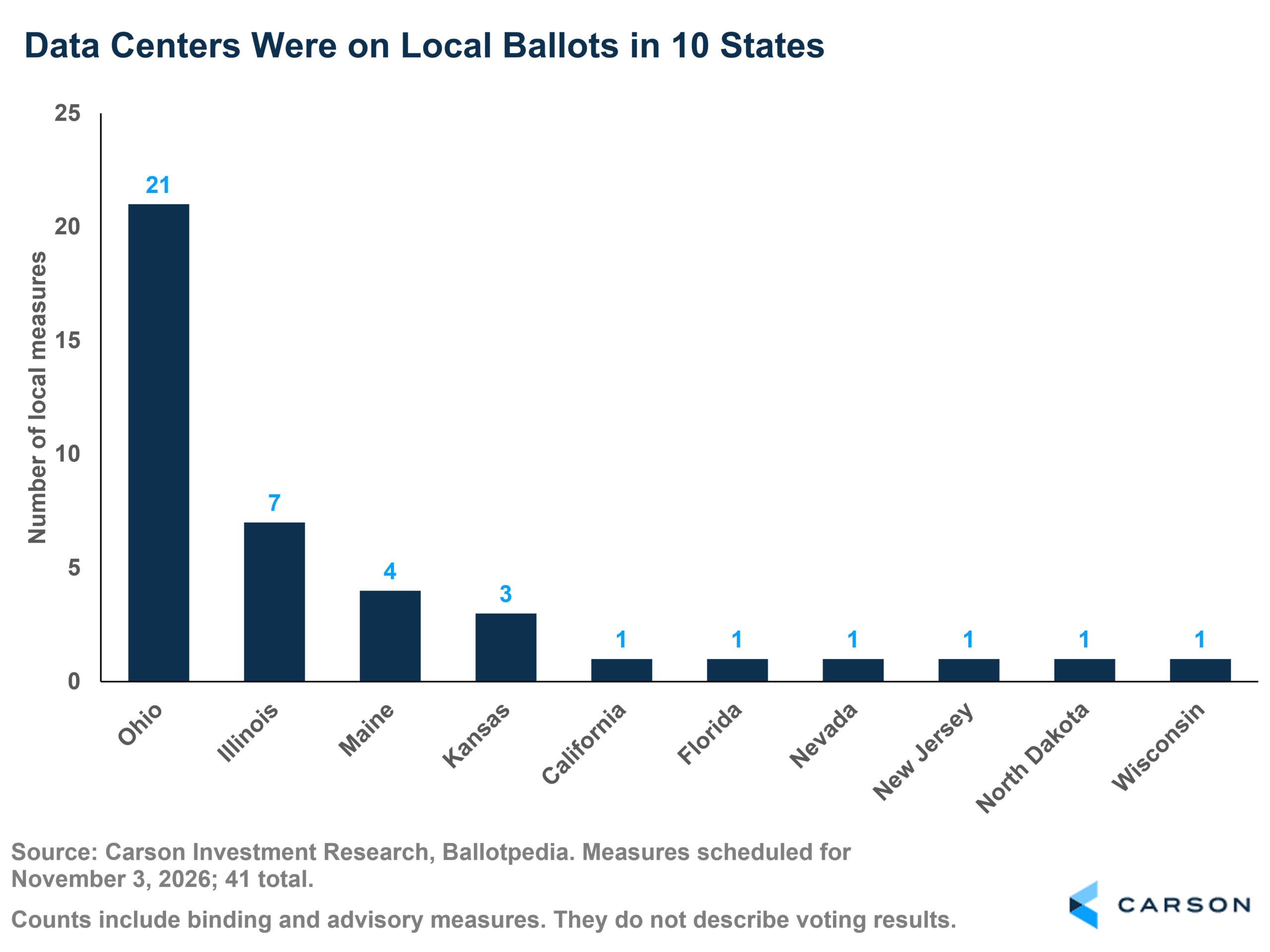
Data centers were also literally on the ballot. Ballotpedia tracked 41 local measures across 10 states on November 3, including 21 in Ohio alone. These covered everything from outright bans and temporary moratoriums to zoning changes that would allow projects to proceed. Some were advisory, while others would directly change what communities permit. That’s a lot of local decisions sitting underneath a national investment boom.
Why has this become such a political issue? Start with the electricity. Lawrence Berkeley National Laboratory estimated that US data centers used 176 terawatt-hours of electricity in 2023, up from 58 in 2014. Its December 2024 report projected demand could reach 325 to 580 terawatt-hours by 2028, roughly double or triple the 2023 level. Those figures cover all data-center workloads, not just AI, and the projections are a range of possible outcomes. Still, they help explain why electricity supply and affordability have become central to the debate.
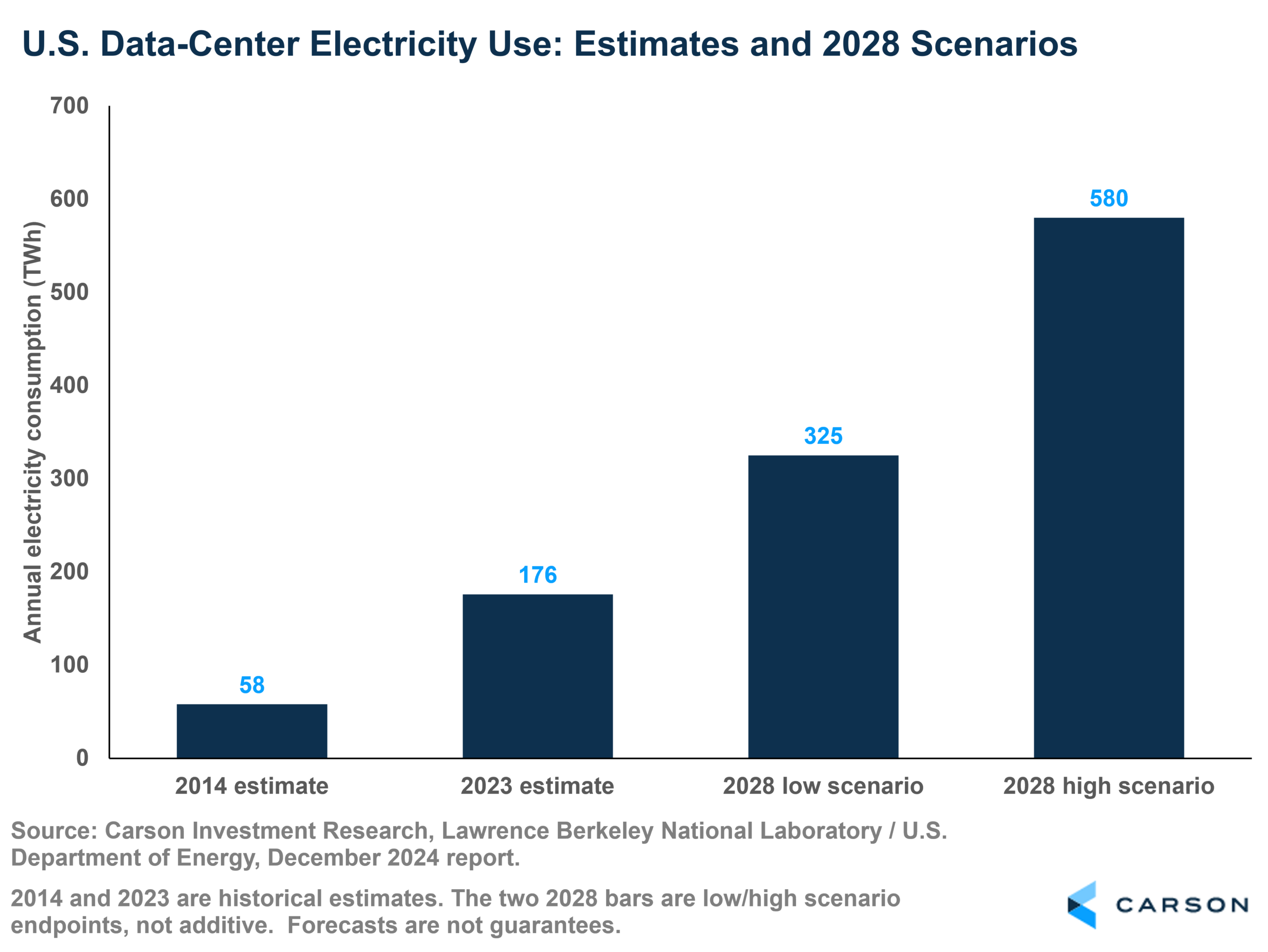
For investors, this adds a practical constraint to the AI spending story. Strong demand and ample financing don’t guarantee a construction permit or a timely grid connection. Tighter rules could delay spending, shift projects to other states, or require developers to absorb more infrastructure costs. Those outcomes differ for the companies involved, even if long-term demand for computing remains strong.
Of course, voters choose governors for many reasons, and it would be a mistake to read these victories as a rejection of AI itself. The economic benefits of investment still matter. But so does the question of whether the people living near that investment share in the benefits or get a higher electric bill.
The Market Reaction
Nasdaq futures were down near 2% overnight as evidence accumulated for a strong night for Democrats. This morning it’s up over 2%. This echoes President Trump’s first presidential election in 2016, when S&P 500 futures dropped about 5% overnight but the index was off to the races by morning. Markets are largely indifferent to the federal government’s party configuration. It looks like they’re sending the same message today.
The Beginning of the End
President Trump has now governed almost six years of the maximum of eight we allot to presidents since the 22nd Amendment was passed in 1951. He is now what some call a lame duck president. Technically, this applies only when a new figure has been elected while the current leader governs. But often we apply it to the last two years of a president’s second term. Even if Congress tries to flummox him, Trump is not one to fade into the background. Still, except for some counting, midterms are over, and Republicans will be thinking carefully about how they want to define themselves moving forward. Let the 2028 presidential election begin!
For more content by Barry Gilbert, VP, Asset Allocation Strategist, click here.
9220052.1. – 4NOV26A