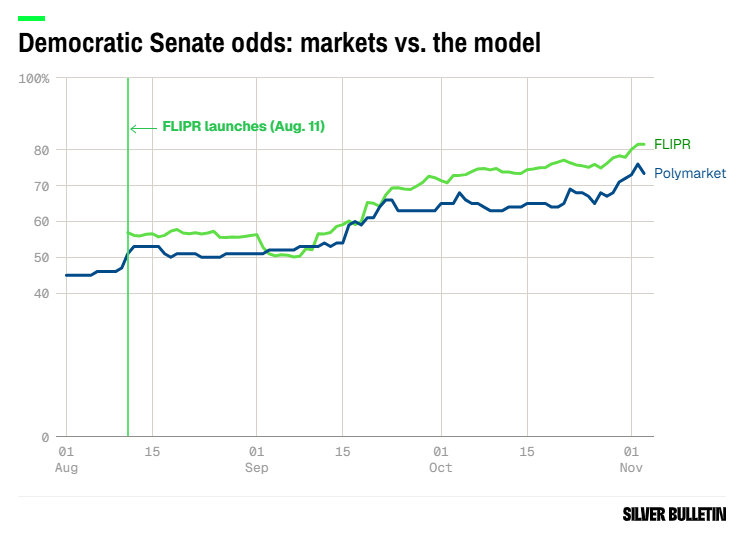
There’s no way to describe the 2026 Midterm election as anything but a blue tsunami. The Democrats gaining 56 seats in the Senate and 255+ seats in the House were tail events with less than 10% chance of happening based on some of the best pre-election models. Prediction markets were even more wrong, considering they put the probability of the Democrats winning the Senate (forget a significant majority) not far from a coin flip a couple of weeks ago (60-65% probability).
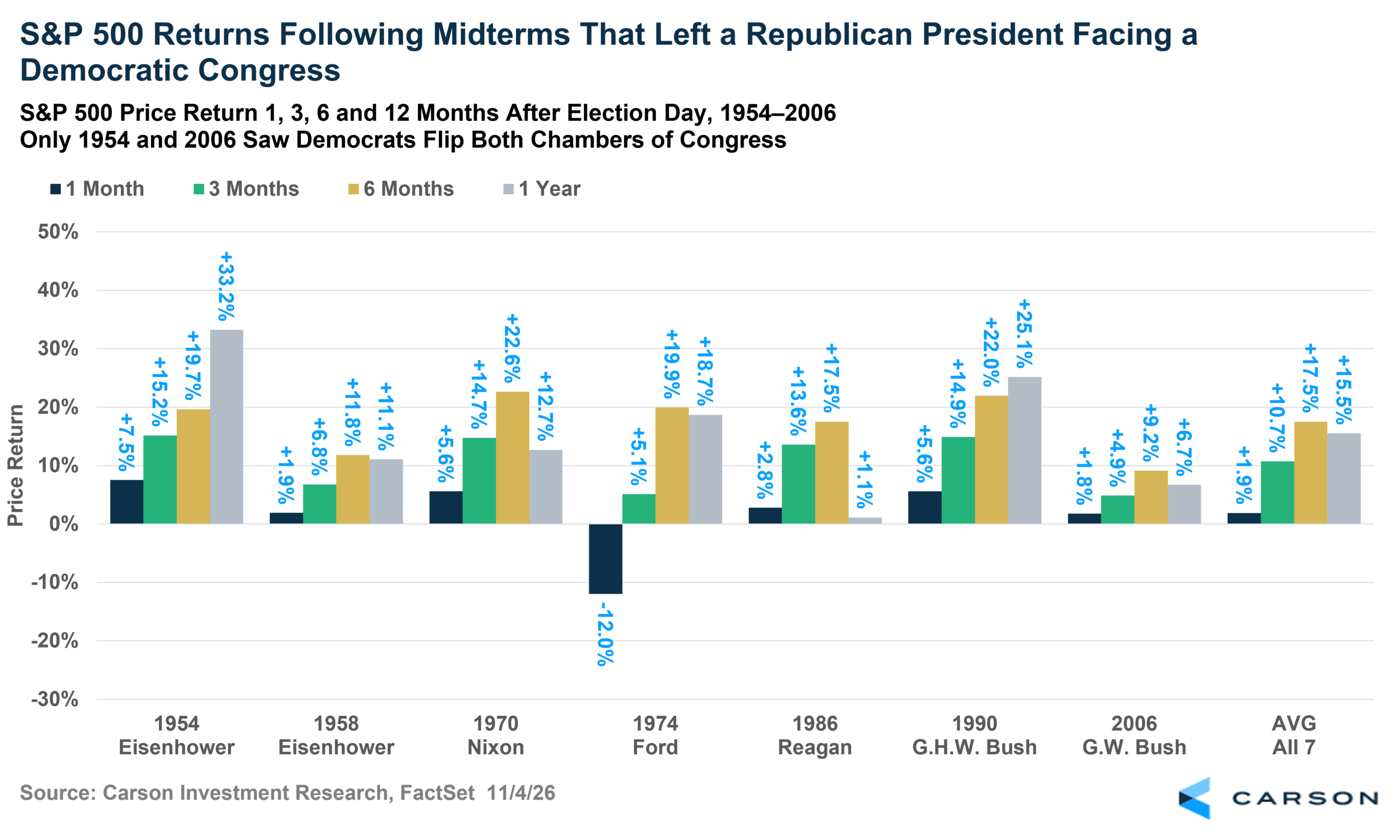
As my colleague Barry Gilbert wrote, it signals the end of an era, and it looks like markets are ok with it so far, going by what happened on the day after the election – with the S&P 500 gaining 1.6% and the Dow gaining a whopping 3%. Par for the course, maybe? Historically, the S&P 500 has gained an average of 15.5% over the year following a midterm election that left a Republican President facing a Democratic Congress.
However, all is not equal in the stock market. The tech-heavy Nasdaq lagged, rising “only” 0.91% (which is why the S&P 500 was that far off the Dow), but this gets to the fact that the election results led to a lot of worries about the future of tech stocks, and especially AI-related capex spending. Specifically, the data center buildout. Remember, all this capex spending gets recycled into earnings, so any slowdown here would slow earnings.
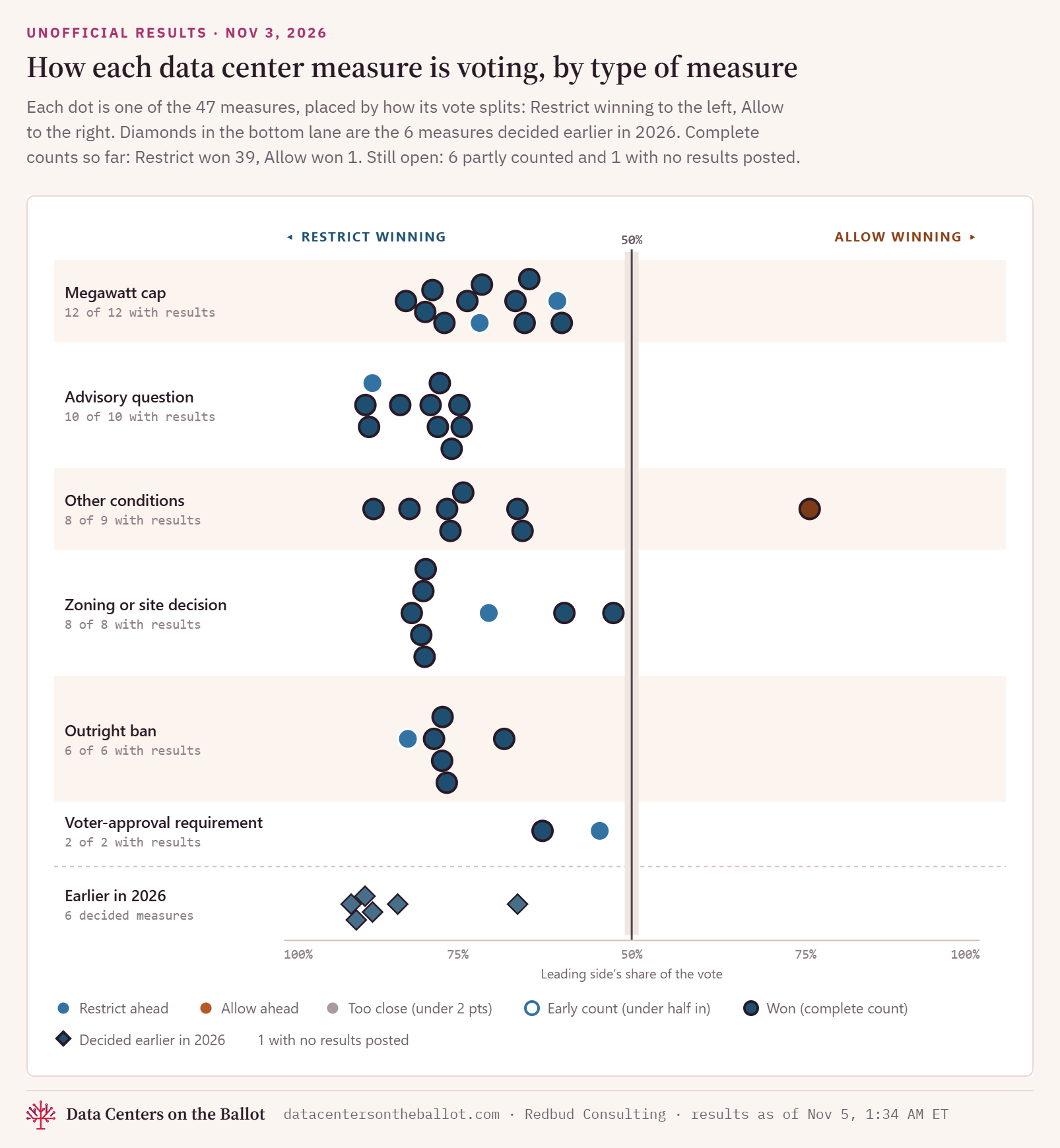
The House and Senate alone can’t stop the buildout. That’s more in the hands of State governors and local authorities. This is why Democrat Gina Hinajosa winning the Texas governorship had implications for markets, though even she can’t completely stop the buildout in Texas by herself, and I’m not even sure she wants to (keep in mind that outgoing Governor Abbott already put a moratorium in place for new data centers). Voters have made their preference quite vehemently – they don’t want data centers. Of 47 measures on the ballot to restrict data centers, 39 passed (including 21 of 21 in Ohio), while 1 failed. Results from the remaining 7 are pending. Across all measures, “Restrict” has almost 73% of the vote. This is in addition to 6 ballot measures decided earlier in 2026 (“Restrict” won all of them).
The groundswell of opposition to data centers doesn’t mean the buildout will end. But it does mean building them will get more expensive (even a delay translates to more expense), and a lot of AI firms are already locked into long-term contracts they can’t get out of. It would be one thing if this were just a little corner of the economy and markets, but it’s not. The scale is simply enormous.
Hyperscalar Capex Estimates Now Top $1 Trillion & Commitments Are Even Larger
The big tech firms reported Q3 earnings last week. As I’ve said before, what matters from a macro perspective is how capex estimates are changing, since one company’s spending is another company’s revenue and profits.

Stay on Top of Market Trends
The Carson Investment Research newsletter offers up-to-date market news, analysis and insights. Subscribe today!
"*" indicates required fields
Long story short, the wave keeps getting bigger, though more of the upgrades are now landing in 2027. Which isn’t surprising, given we’re very close to the end of 2026. Looking at capex estimates for the 5 hyperscalars (Microsoft, Alphabet, Amazon, Meta, and Oracle)
- Capex estimates for 2026 were about $515 billion at the start of the year. That’s risen 55% to $801 billion.
- For 2027, capex estimates have risen 94%, from $596 billion at the start of the year to $1.16 trillion.
SpaceX has also joined the party, which means the numbers are even larger. Its capex is expected to almost quadruple from $21 billion in 2025 to $79 billion in 2026, and then surge to $251 billion in 2027. That would put it behind only Alphabet and Amazon. Including SpaceX, combined capex looks like this:
- 2025: $432 billion (+73% y/y)
- 2026: $879 billion (+103%)
- 2027: $1.41 trillion (+60%), about 4.0% of GDP
- 2028: $1.53 trillion (+9%)
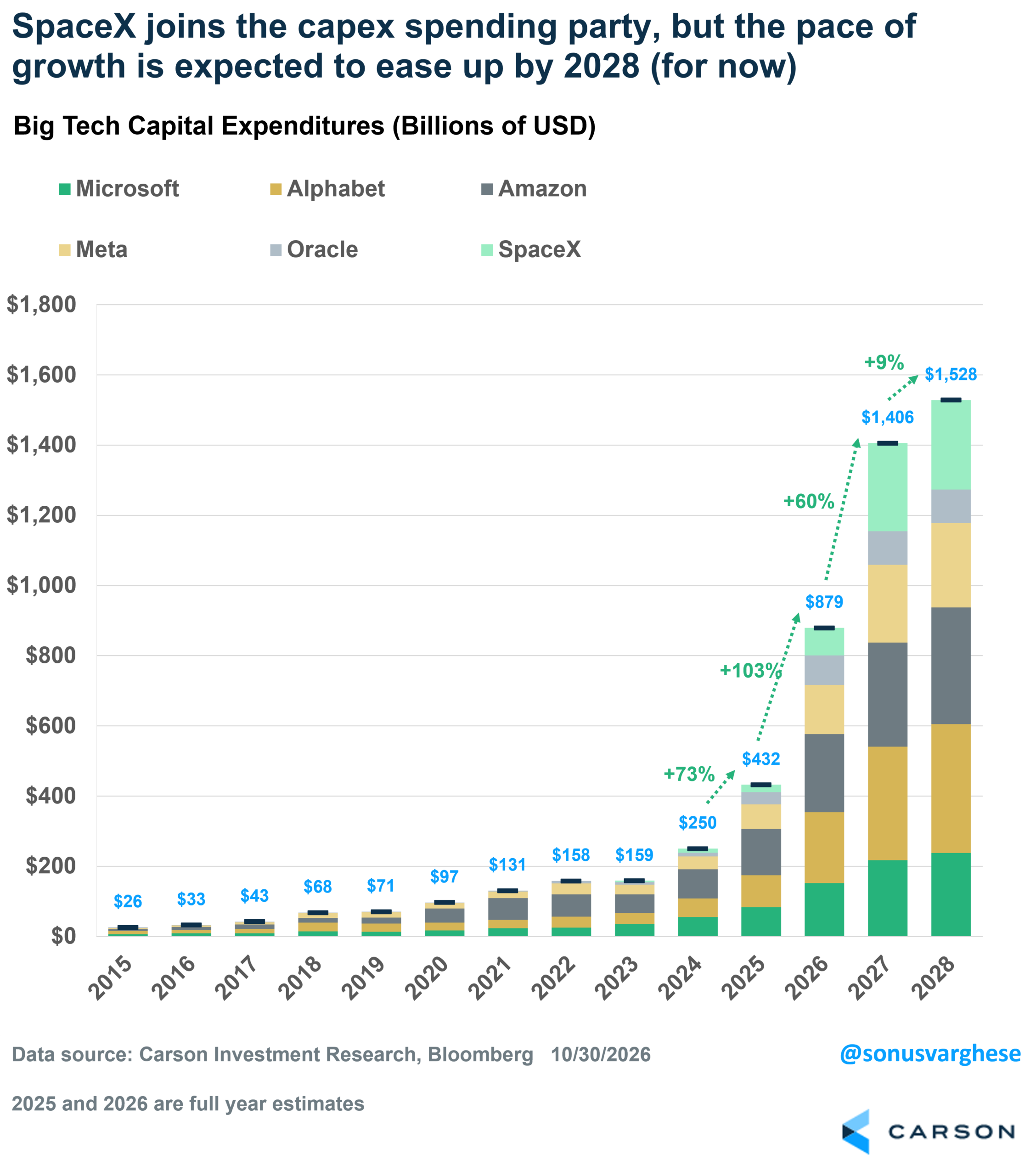
As you can see above, current estimates show growth slowing sharply in 2028. I wouldn’t put too much stock in that, since the initial 2026 and 2027 estimates were revised up a lot, UNLESS the buildout comes to a screeching halt. There’s no nice and easy slowdown here, as it either continues or it doesn’t. That gets to the risk.
Where’s the Money Coming From?
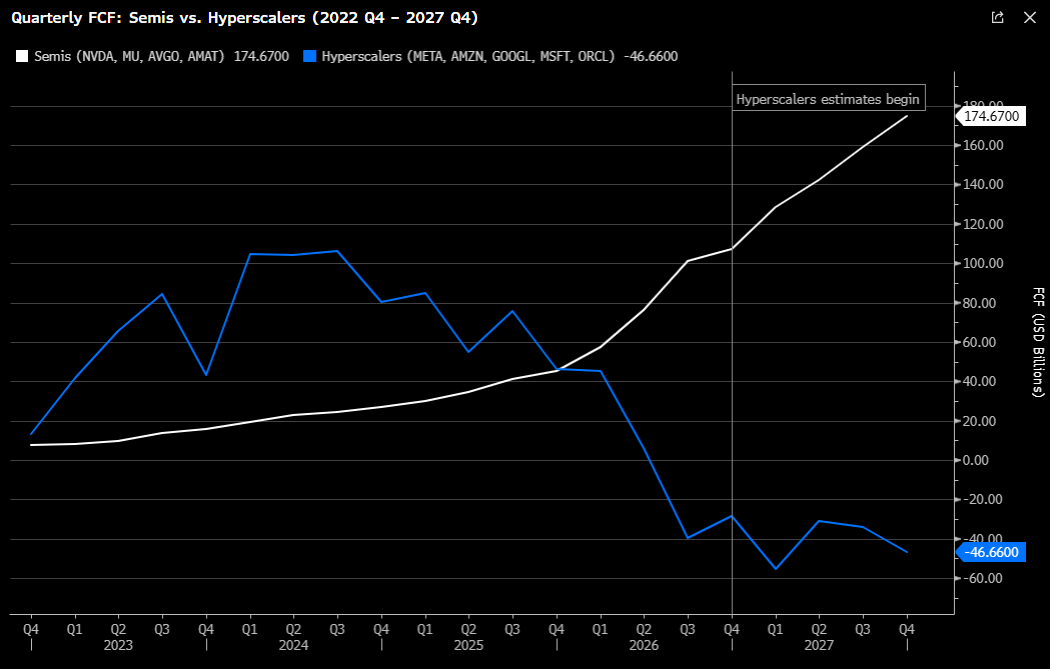
As I wrote back in August, these companies have gone from asset-lite cash machines to asset-heavy spenders. You can see this in their free cash flow, which is the cash left over after running the business and paying for investment. Hyperscaler free cash flow (Meta, Amazon, Alphabet, Microsoft, Oracle) ran around $100 billion a quarter in 2024. It turned negative in Q3 2026, at roughly -$40 billion, and is expected to stay negative through 2027. Meanwhile, free cash flow for the big chipmakers (Nvidia, Micron, Broadcom, Applied Materials) is expected to climb to $175 billion a quarter by the end of 2027.
Source: Carson Investment Research, Bloomberg 11/2/26
That’s the circularity in one picture: buyers’ cash flows straight to sellers. But even then, buyers’ balance sheets aren’t large enough to finance the entire buildout. To fill the gap, the hyperscalers are turning to debt, equity, and increasingly, financial engineering that keeps obligations off the balance sheet.
Actual Commitments Are Even Larger Than Headline Capex
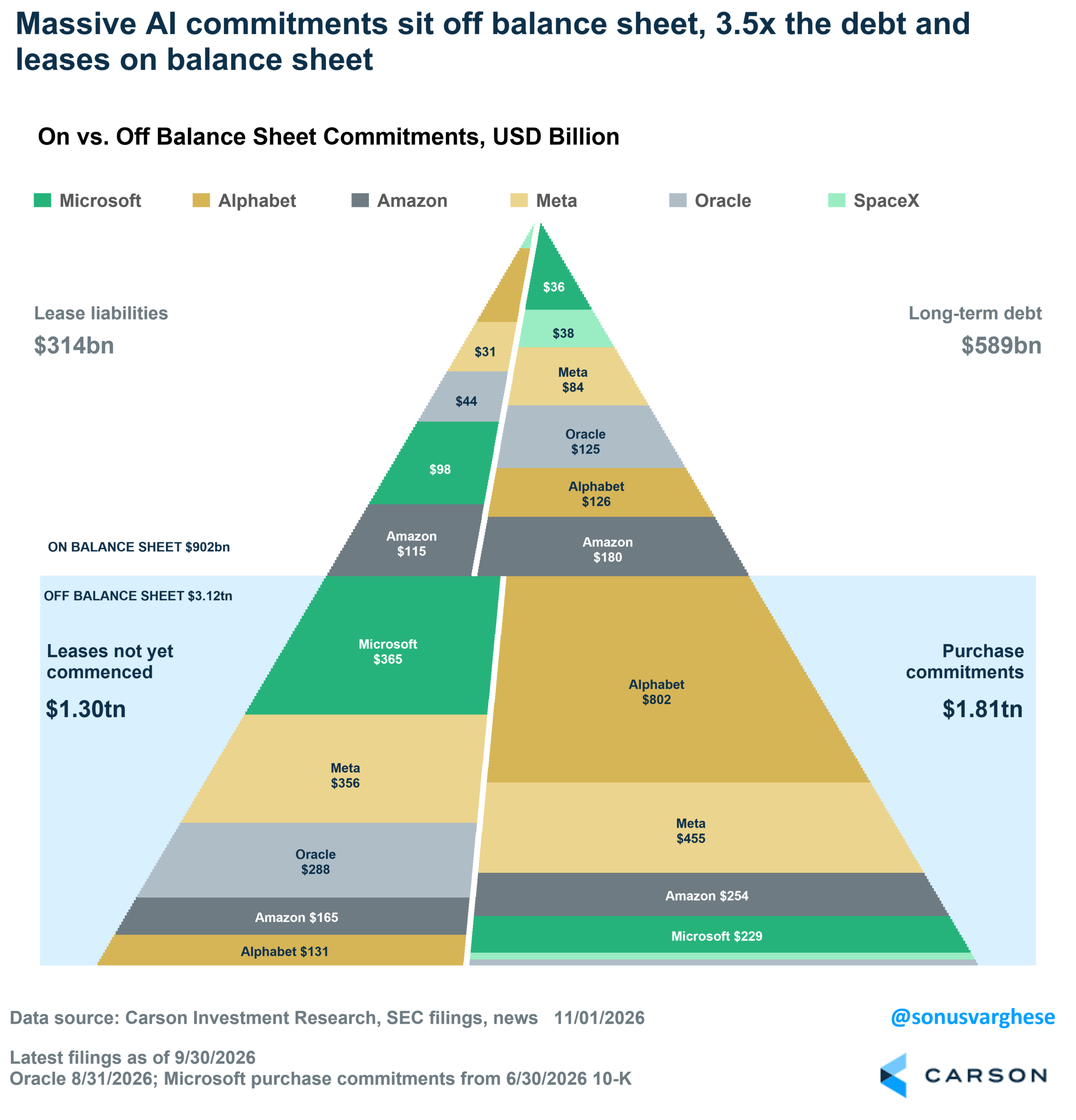
Capex only captures cash spent in a given year. The bigger numbers sit in the footnotes of company filings. On the balance sheet, these six companies carry $902 billion of obligations:
- Lease liabilities: $314 billion – leases that have commenced. They’re the present value of the rent a company still owes on leases that have already started, mostly data centers, offices, and equipment.
- Long-term debt: $589 billion
Note that hyperscalars sit on both sides of the compute markets:
- As landlord-like sellers of compute: they sell cloud capacity to customers like OpenAI, Anthropic and enterprises. That’s booked as service revenue, not as a lease, so none of it shows up in these numbers.
- As tenants: they don’t own all the data centers they run. They lease much of the capacity from developers and financing vehicles. Meta’s Hyperion site in Louisiana is a good example: the Blue Owl joint venture owns it, and Meta leases it, which is also why Meta carries those residual value guarantees (more on that below). Some leases also cover servers and equipment, booked as finance leases.
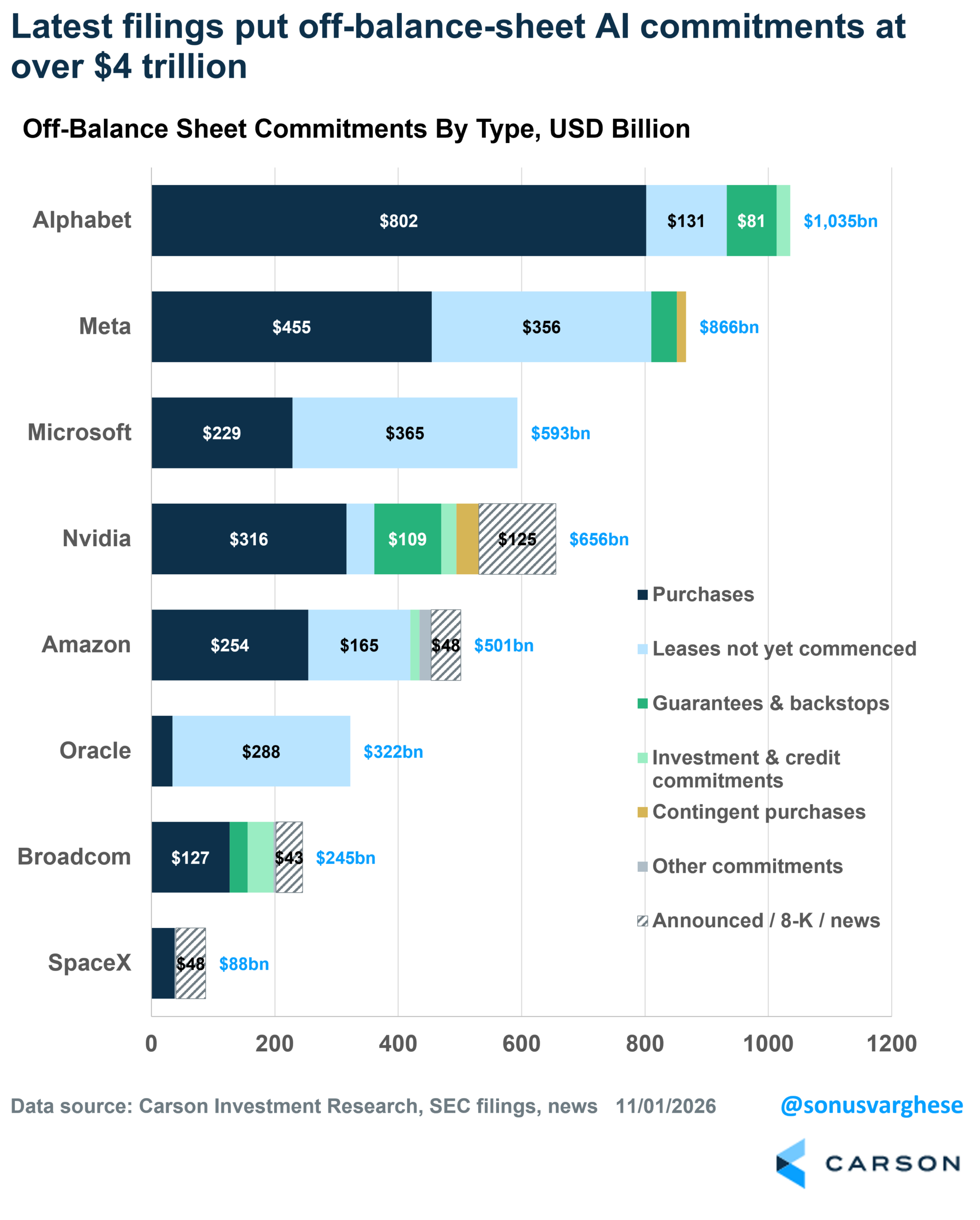
Then we get to off-balance-sheet liabilities, where there’s another $3.12 trillion, about 3.5x as much:
- Leases not yet commenced: $1.30 trillion – these are signed leases, mostly for data centers, that haven’t started yet. They only hit the balance sheet once the lease begins.
- Purchase commitments: $1.81 trillion – these are non-cancelable obligations to buy chips, servers, equipment, and construction.
A few things stand out:
- Alphabet alone has $802 billion of purchase commitments, over 5x its on-balance-sheet obligations ($150 billion).
- Meta has $810 billion off the balance sheet versus $115 billion on it, a ratio of 7x.
- Oracle has $288 billion of leases not yet commenced, with 15-19 year terms, against $169 billion on the balance sheet.
- Microsoft’s $365 billion of leases not yet commenced is almost 4x its existing lease liabilities ($98 billion).
And these commitments are growing fast. For the big four (Microsoft, Alphabet, Amazon, Meta), off-balance-sheet commitments rose from about $2.42 trillion at the end of June to $2.76 trillion at the end of September. That’s an increase of about $330 billion in a single quarter.
$4 Trillion Off-Balance-Sheet Commitments After You Add Chipmaker Guarantees
The iceberg above only counts leases and purchase commitments. Add Nvidia and Broadcom, along with guarantees, backstops, and credit commitments, and the filed total rises to $4.04 trillion.
The guarantees are where the risk transfer happens:
- Nvidia: $105 billion of credit support for an SB Energy data center project on behalf of OpenAI
- Alphabet: $81 billion of guarantees and backstops, including $48 billion of credit derivatives backstopping data center lease payments
- Meta: $41 billion of maximum residual value guarantees to its Louisiana (Hyperion, with Blue Owl) and Texas data center ventures
- Broadcom: a $29 billion backstop of a customer’s rack lease, a $42 billion convertible note facility the customer can draw to pay those leases (press reports point to Anthropic), and up to $43 billion of additional residual value support disclosed in an 8-K last week
A residual value guarantee means that if the data center or chips are worth less than an agreed amount when the lease ends, the guarantor makes up the difference.
One caveat: these figures are undiscounted and spread over many years, and a lot of the purchase commitments will eventually show up as capex. So you can’t simply add them to the capex numbers above.
Big picture: This is how the AI buildout gets financed once free cash flow runs dry. Off-balance-sheet structures aren’t inherently bad (the same machinery finances aircraft and energy projects). Still, they make leverage harder to see and tie hyperscalers, chipmakers, and AI labs closer together.
The wave keeps getting bigger, but it’s getting more expensive, and more and more of it sits below the waterline.
For more content by Sonu Varghese, Chief Macro Strategist, click here.
9222454.1. – 5NOV26A