By Sonu Varghese, Chief Macro Strategist, and Harry McDonald, Analyst, Investment Research
The Fed raised interest rates in September for the first time since 2023, and the AI spending boom hasn’t slowed. The New York Times recently explained why: if a company expects an AI project to earn double-digit returns, borrowing at 6% instead of 5.5% doesn’t change the decision. (In truth, it changes the decision incrementally, especially considering compounding effects, but not much.)
That raises a fair question. If the biggest driver of growth doesn’t care a lot about interest rates, can the Fed still slow the economy down?
The Fed asked itself the same thing during the dot-com boom. We went back through the Fed’s 1999 meeting transcripts, and the parallels are quite striking.
Check out Sonu’s X thread on it here.
1999: The Same Debate
In early 1999, as companies poured money into computers, software, and telecom equipment, one Fed official questioned whether business investment would slow as it normally does when rates rise.
The Fed decided it would need to raise rates further. Economists talk about a “neutral” interest rate, the rate that neither speeds up nor slows the economy. When new technology makes investing more profitable, the neutral rate rises, so a rate that used to slow the economy may no longer do the job.
Greenspan laid out the chain in November 1999. Faster productivity raised the profits companies expected from new projects. That boosted investment and stock prices, and wealthier households spent more, until demand was running ahead of what the economy could produce. The Fed raised rates six times between June 1999 and May 2000, from 4.75% to 6.5%.
Tech Ignored the Hikes, Housing Did Not
At first, tech barely noticed. The Nasdaq rose more than 50% from the first hike in June 1999 to the end of that year, and kept climbing until March 2000.
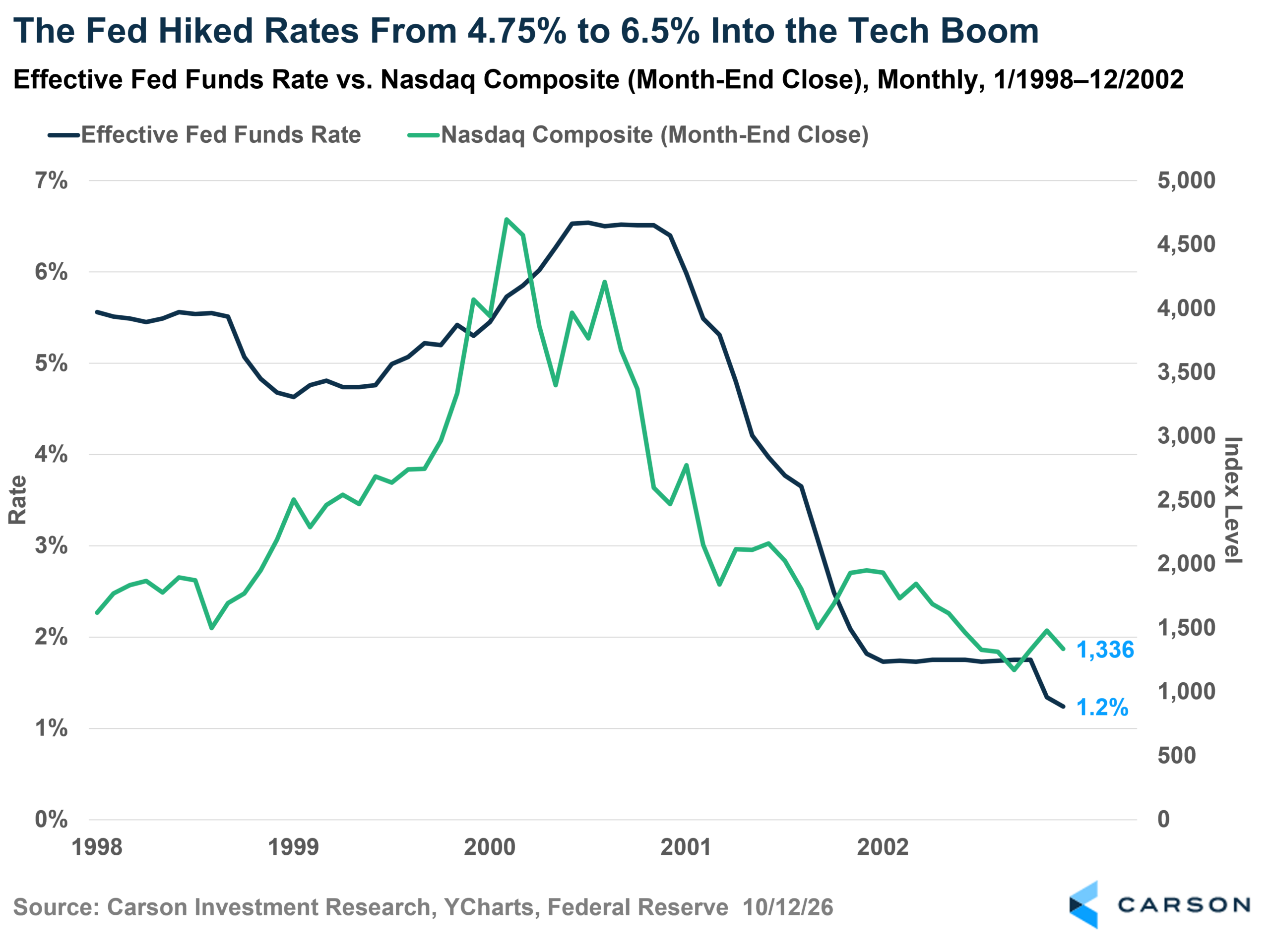
Could the Fed have stopped that rally by hiking more? Probably not. Don Kohn, the Fed staffer who laid out the 1999 tightening options, said years later that even an extra half to full percentage point likely wouldn’t have changed investors’ minds about the new technology.
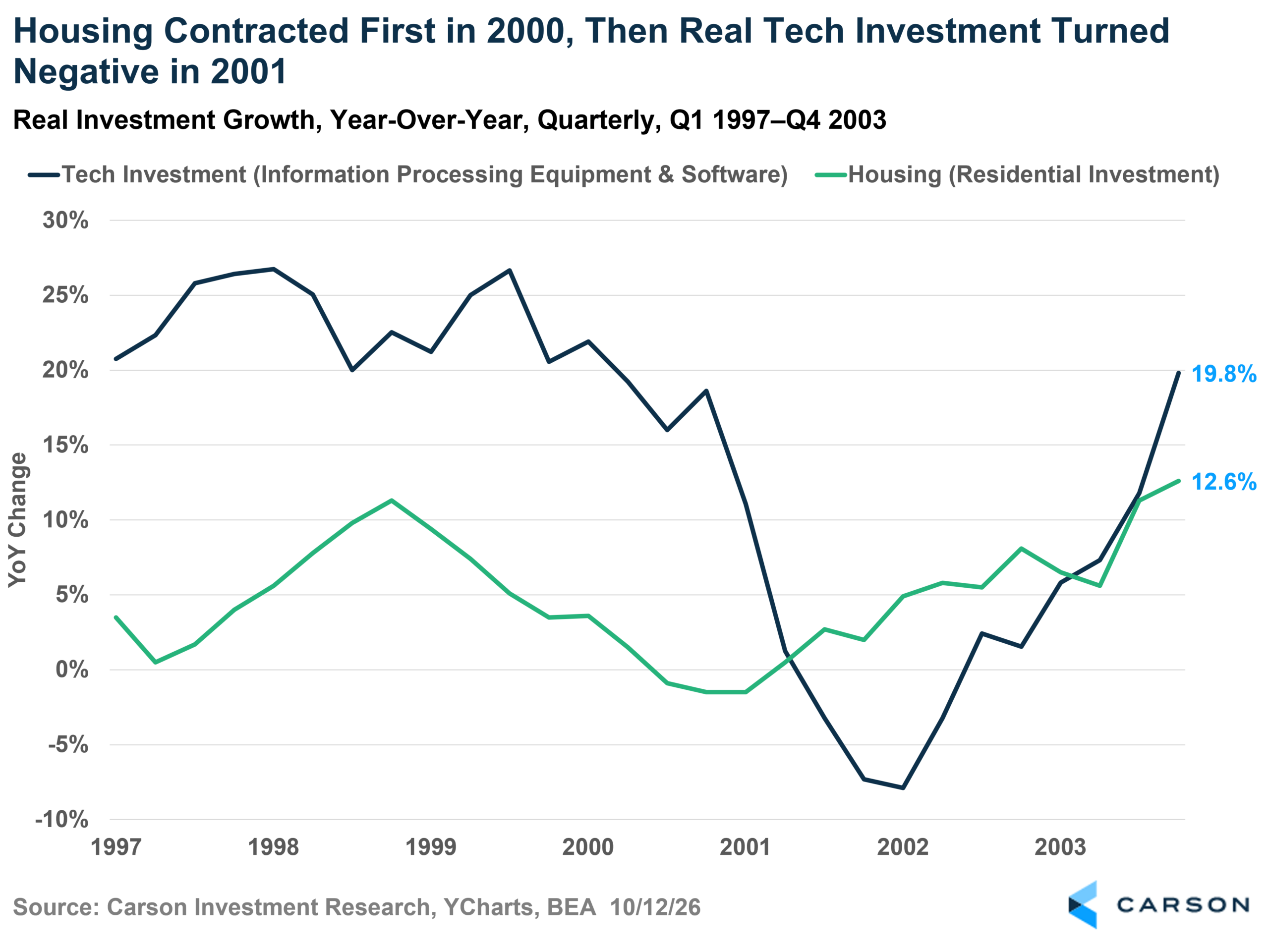
The hikes did show up in housing, one of the economy’s most rate-sensitive parts. After adjusting for inflation, residential investment went from growing 11% a year in late 1998 to shrinking by late 2000. Tech investment still grew by almost 19%.
The Same Split Is Showing Up Today
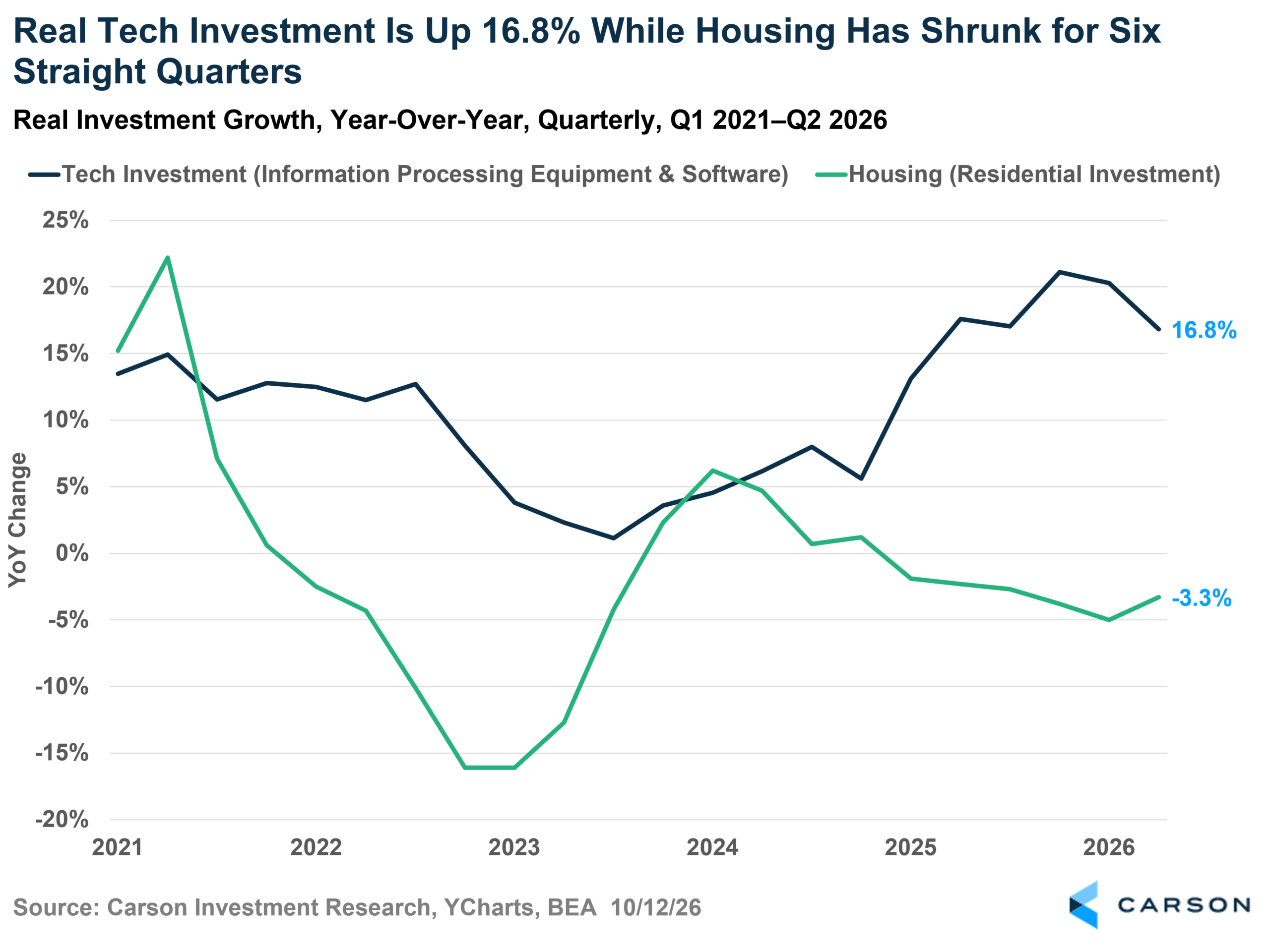
Adjusted for inflation, tech investment is up about 17% from a year ago, while housing investment is down about 3%.
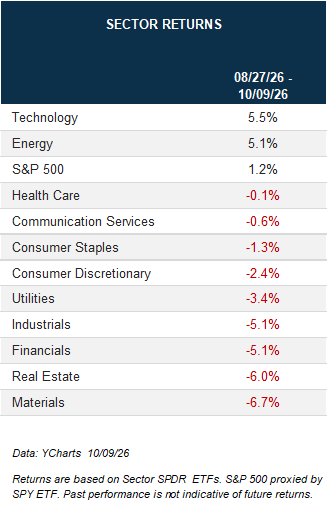
The stock market tells the same story. Since bond yields started climbing in late August, after Fed Chair Kevin Warsh’s Jackson Hole speech, tech stocks are up 5.5%, while rate-sensitive sectors like utilities, financials, and real estate are down 3.4%, 5.1%, and 6.0%, respectively.
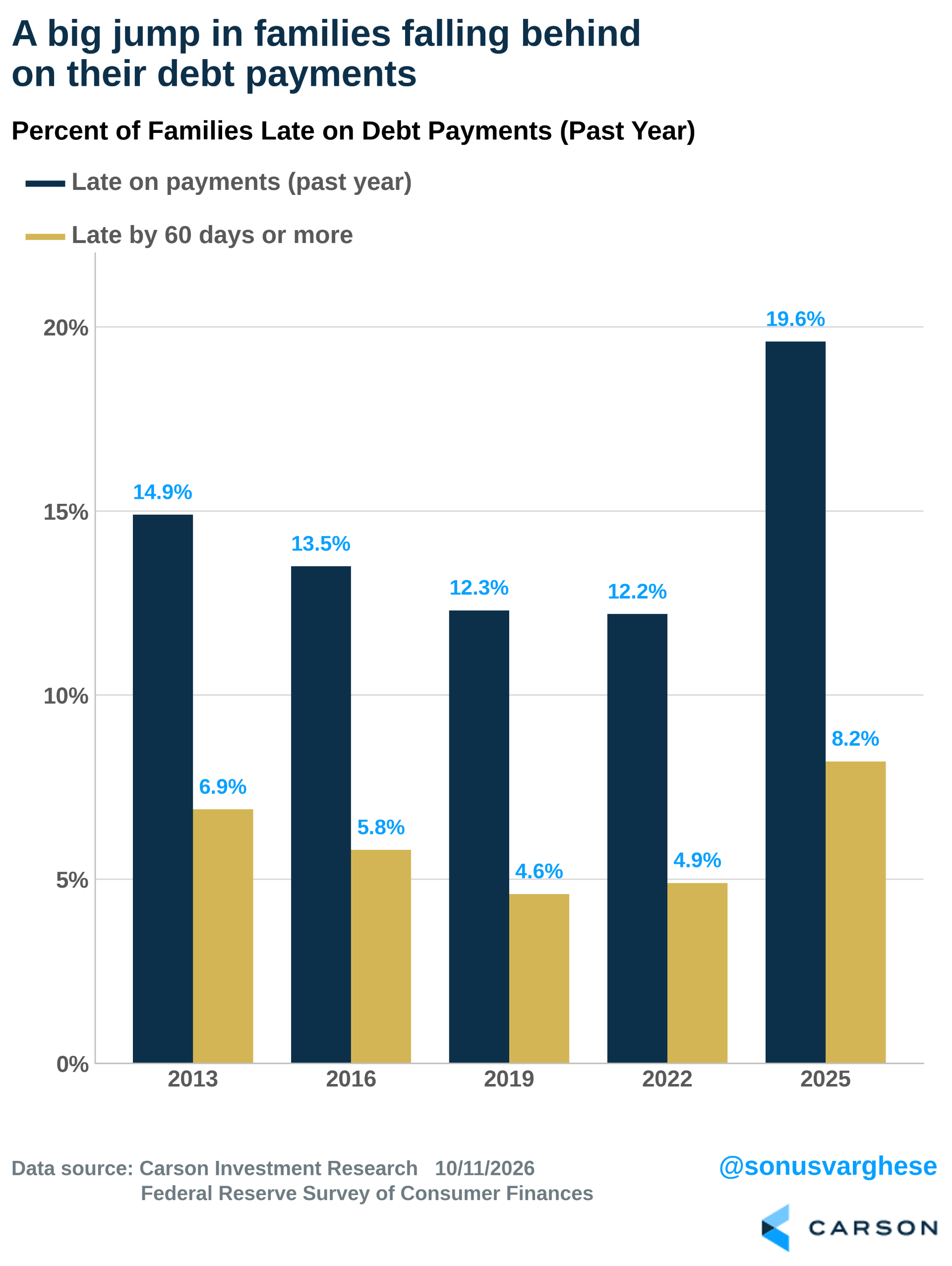
The same thing can also be said about household finances. The Fed’s latest Survey of Consumer Finances found that nearly 1 in 5 families fell behind on a debt payment in the past year, the most since 2010, with higher credit card and car loan rates as a major reason. (Read our latest housing blog here)
How the 1990s Boom Ended
Expectations finally broke the boom. Companies had built a lot of capacity on very optimistic assumptions. Telecom companies, for example, laid far more fiber optic cable than the internet needed at the time. Fed Governor Susan Bies later described a “massive overhang of IT capital,” pointing to all that unused fiber.
Once companies realized returns would be lower than hoped, the math from the top of this piece flipped. A project expected to return 25% doesn’t care much whether it borrows at 5% or 6%. If that expected return drops to 9%, the difference between 5% and 7% decides whether the project makes sense at all. That’s why these booms tend to end suddenly. In about a year, real tech investment went from growing almost 19% to shrinking nearly 8%, as the second chart above shows. Companies know that there’s a distribution of potential outcomes and that there are likely to be winners and losers. The problem is no-one sees themself as one of the losers. Entrepreneurial risk is real and misassessment leads to a lot of bad decisions, but decisions that are in aggregate, still good for the economy.
Could AI Follow the Same Path?
AI demand can keep growing, and investors can still be disappointed. That’s what happened with fiber. Internet traffic kept growing after 2000, but so much capacity had been built that bandwidth prices collapsed, and many of the companies that built it went bust.
AI is showing an early version of the same setup. The price of AI output, measured in “tokens” (the chunks of text AI models produce), has been falling fast, while the cost of renting the chips that produce it has held up (via A16Z). Cheaper AI is good news for users.

Stay on Top of Market Trends
The Carson Investment Research newsletter offers up-to-date market news, analysis and insights. Subscribe today!
"*" indicates required fields
The risk sits with the companies selling it, many of which have signed long-term contracts for computing power that start billing in 2027 and 2028 as new data centers come online. If the price of AI output keeps falling faster than usage grows, revenue may not cover those bills. That’s when expected returns get revised down, and the 2001 math might kick in.
And unlike fiber, which went on to carry the internet for years after the bust, today’s top AI chips will likely be outdated within a few years.
Where the Fed Comes In
The biggest tech companies have the balance sheets to keep building as rates rise. The AI labs renting all that computing power rely heavily on outside investors, and investors’ appetite depends on stock valuations and how easy it is to borrow. That’s exactly where rate hikes begin to hurt. The Fed doesn’t need to stop anyone from building a data center. It just needs to make the next funding round harder to raise.
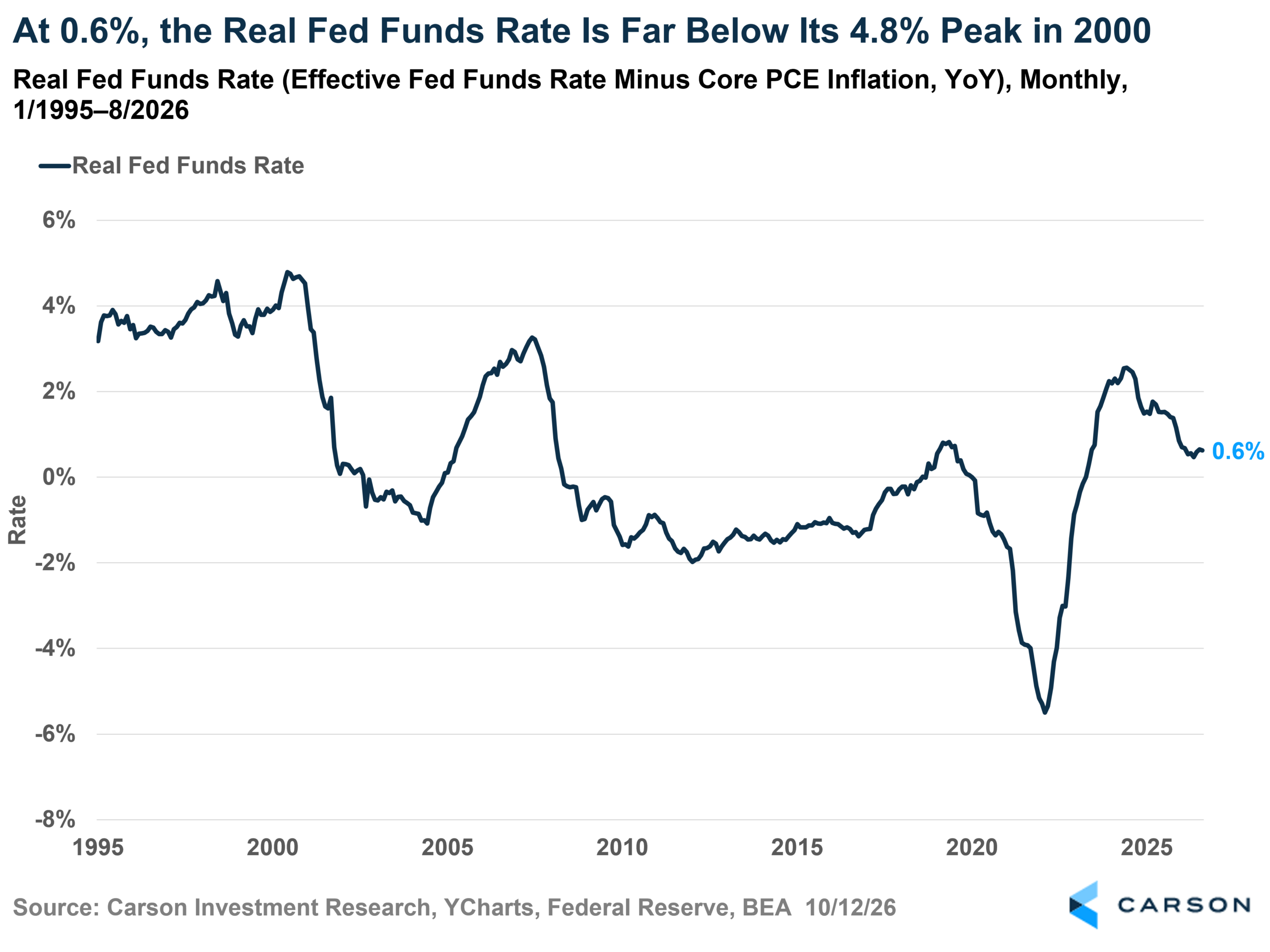
One big difference from 1999 makes the Fed’s job harder: inflation. Core inflation (which leaves out food and energy) is running about 3%, versus about 1.3% in 1999. Subtract inflation from the fed funds rate, and the “real” rate was about 3.4% when the Fed started hiking in 1999. Today it’s under 1%, even after September’s hike. If AI is raising the neutral rate the way technology did in the late 1990s, the Fed may have more work to do.
The Bottom Line
In 1999, booming tech investment seemed to have broken the old rules of monetary policy. It hadn’t. The hikes took longer to work and hit housing first, and when the boom ended, it ended quickly.
So far, AI is following a similar script. We can’t time the top, as Sonu wrote in June, so we’re watching for signs that expected returns are slipping, like AI companies pushing back or renegotiating their computing contracts, or AI labs struggling to raise money. In the meantime, the further momentum runs, the more we lean into diversification.
By Sonu Varghese and Harry McDonald
9177696.1. – 13OCT26A