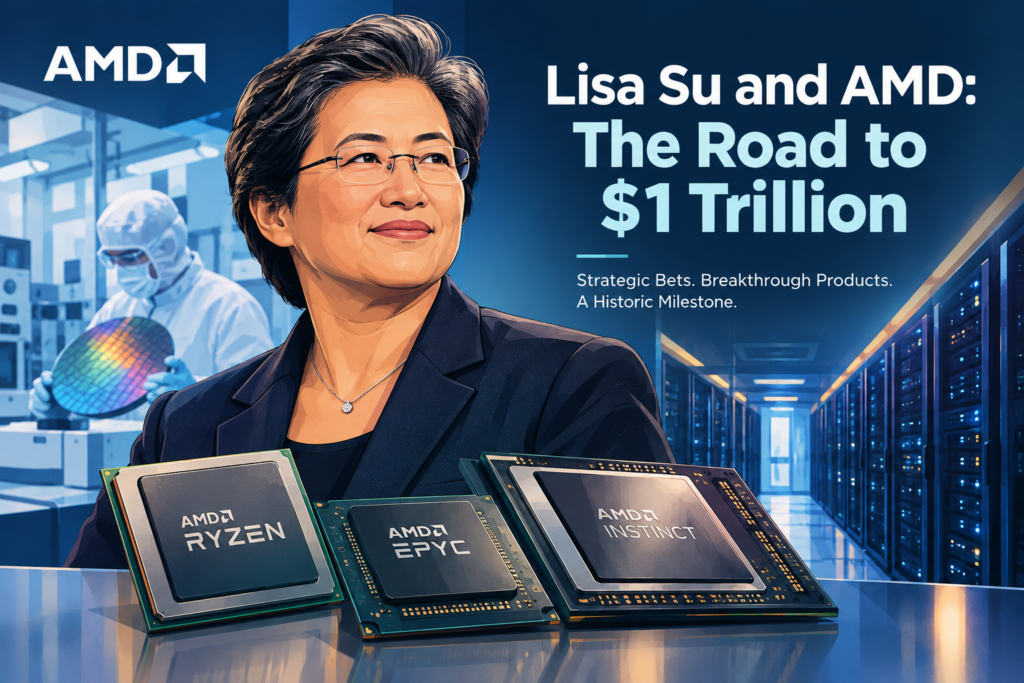
Last week, Advanced Micro Devices became a $1 trillion company for the first time and became the first company led by a Female CEO to cross this level. The achievement represents a remarkable milestone for one of the semiconductor industry’s greatest turnarounds. In an industry known for extreme competition, Dr. Lisa Su’s strategic decisions throughout the last 14 years have brought the company from the brink of irrelevance to a now critical provider of advanced technology.
Brink of Irrelevance before Dr. Su
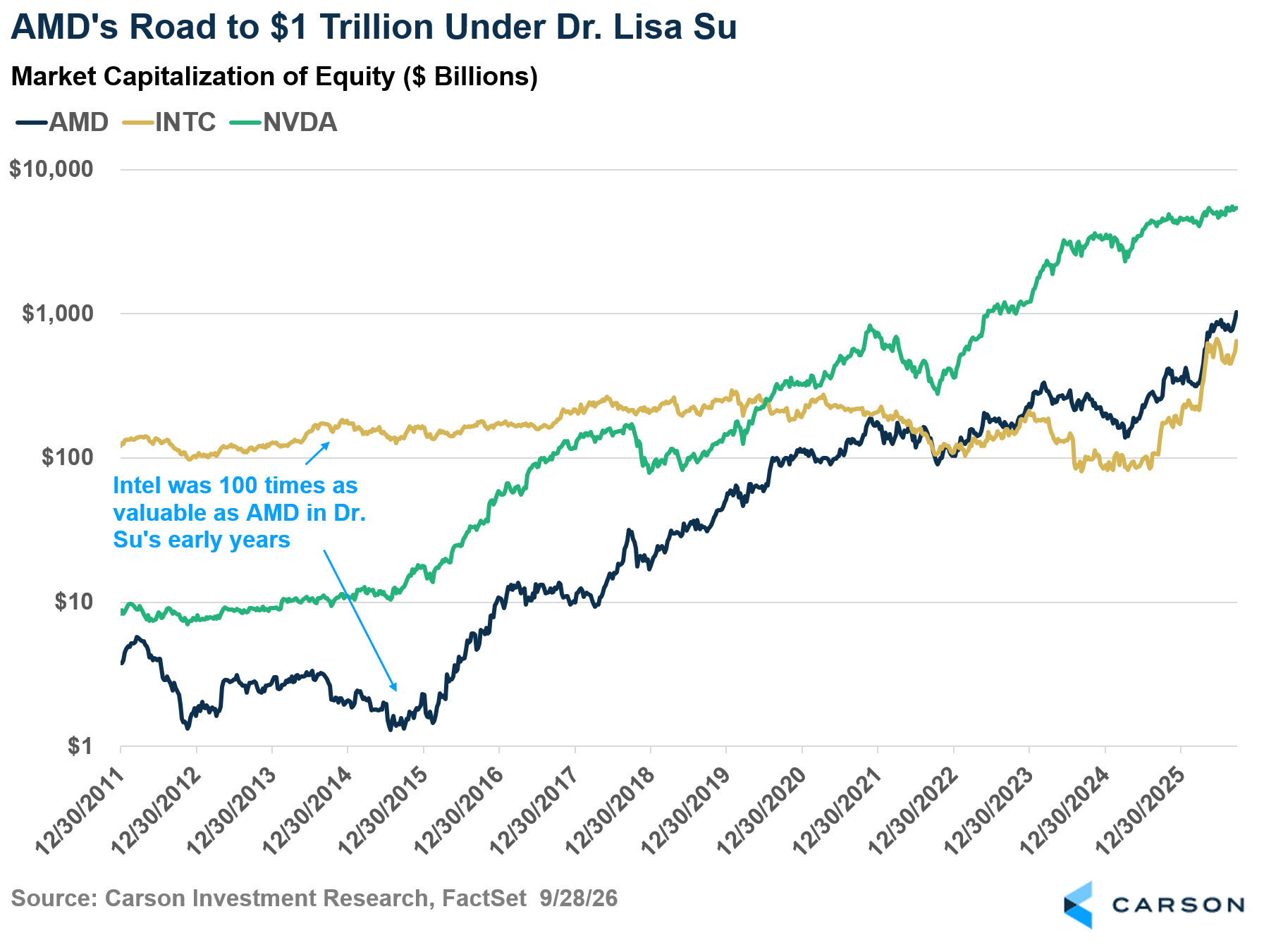
AMD was a clear laggard in the semiconductor industry when Dr. Su joined the company in January 2012. As shown below, AMD’s market capitalization oscillated between $1 billion to $5 billion for the first years of Dr. Su’s CEO tenure. The company was struggling to find competitive advantages in the laptop and mobile phone booms of those years. Meanwhile, Intel was largely viewed as the industry’s stalwart, with a market capitalization typically between $100 billion to $200 billion. Intel was nearly 100 times as valuable as AMD struggled for relevance.
Focus to Grow
Some of Dr. Su’s first strategic decisions included two controversial focuses that ultimately paved the way for AMD’s turnaround: enhance supplier relationships to remain asset-light, and pursue high-performance computing within data centers.
Unlike Intel’s asset-heavy business model and ownership of manufacturing facilities, AMD runs an asset-light business model and relies on supplier partners to manufacture their designed chips. AMD’s willingness to embrace advanced process technology and an asset-light manufacturing model allowed the company to compete aggressively despite having far fewer resources than Intel. This asset-light strategy also allowed AMD to pivot to new technologies, like chip stacking and advanced packaging, earlier than Intel who may have been slowed down by the need to focus on their core manufacturing processes. These innovative decisions helped AMD carve out niches in the industry that won them valuable profit pools they could invest elsewhere.

Stay on Top of Market Trends
The Carson Investment Research newsletter offers up-to-date market news, analysis and insights. Subscribe today!
"*" indicates required fields
Another of Dr. Su’s now hallmark decisions was to focus on high-performance computing within data centers rather than trying to steal market share away from Intel in personal and mobile computing products. Dr. Su emphasized high-performance computing and higher-value markets, particularly servers and data centers. The decision was controversial at the time as cloud computing and large data center customers were still in their infancy. Laptops and cell phones were the industry growth driver of the day – although the trend toward lower power, longer battery life products were the focus of innovation and were not products AMD saw high-value in at the time. The resulting Ryzen and EPYC product families gave AMD a credible growth path back that attacked Intel’s much more profitable server franchise.
These decisions led to one of the greatest technology turnarounds of recent decades. AMD has leveraged these CPU product families to build out an impressive semiconductor portfolio. The company has invested heavily in its GPU business, software stack and networking capabilities to become a diversified business of high-performance compute. AMD’s market cap increased from a little over $1 billion to $170 billion in early 2022, and surpassed Intel’s value shortly thereafter.
A Milestone Achievement
These strategic decisions, among others, propelled AMD to one of the most exclusive achievements in the world: a $1 trillion market cap. AMD’s turnaround under the leadership of Dr. Lisa Su was built through a series of decisions that consistently pushed the company toward larger markets, better technology and greater strategic relevance. From a sub-$2 billion company in 2012 to $1 trillion in 2026, AMD’s growth under Dr. Lisa Su’s leadership is an extraordinary example of what can happen when technical expertise, strategic focus and long-term execution reinforce one another.
For more content by Blake Anderson, CFA®, Director, Portfolio Management, click here.
9148887.1. – 28SEPT26A