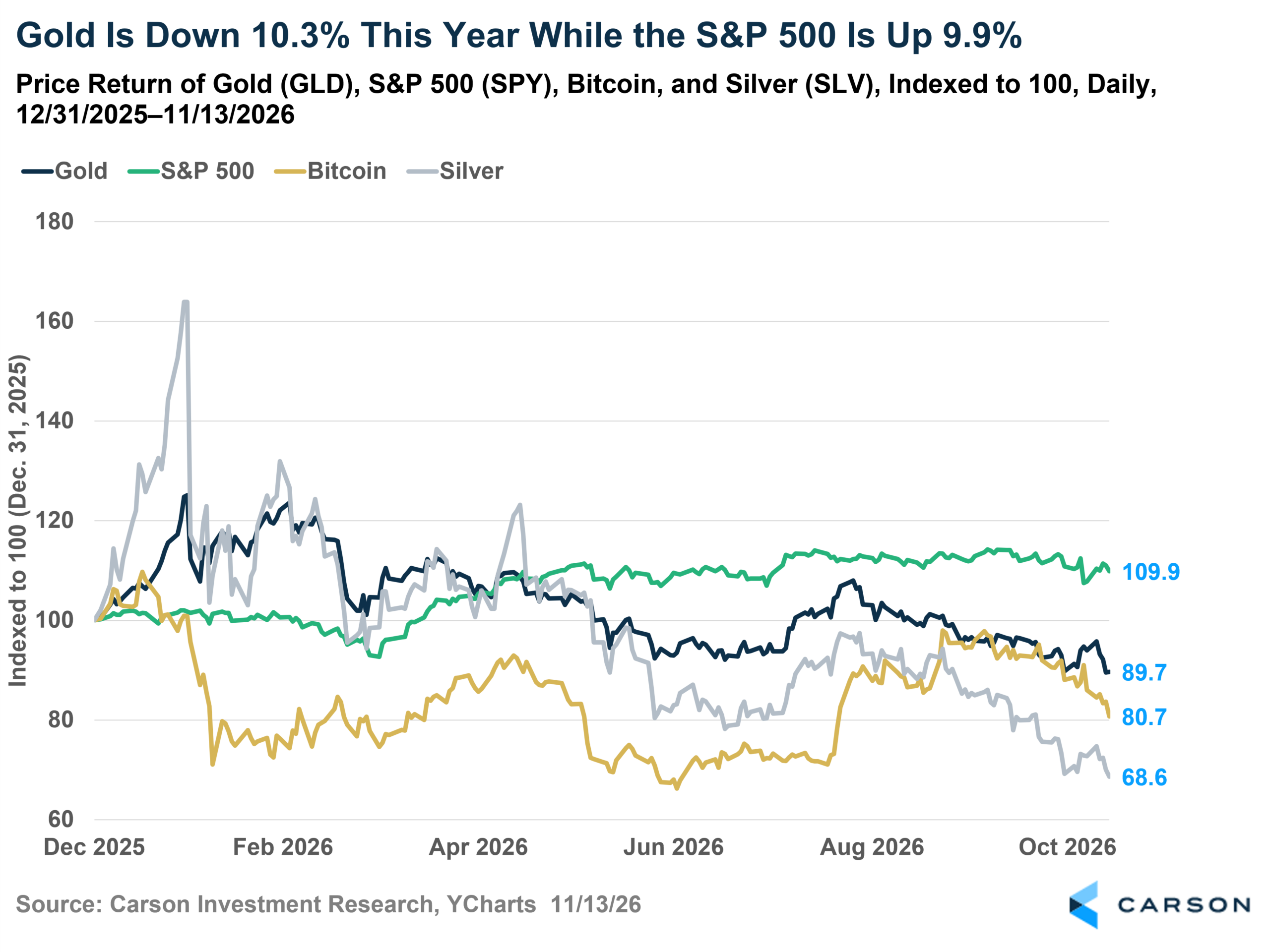
Gold hit a record of roughly $5,600 an ounce at the end of January. On November 12, it closed at its lowest level of the year, about 28% below its closing high. Silver is down 58% from its peak, and bitcoin is down 19% this year, while the S&P 500 is up 10%.
On paper, this is the backdrop gold is supposed to love. Inflation is hot, with consumer prices up 5.7% annualized over the last three months. Deficits keep growing no matter who’s in charge. Both should push gold higher, yet it has fallen in 9 of the last 12 weeks. The dots clearly aren’t connecting. So, is gold still that beloved inflation hedge it once was?
I try to approach questions like this by assuming the map in my head is out of date. When I update mine, the pieces start to make a bit more sense. Let’s break this disconnect down.
What Gold Is Up Against
Gold doesn’t pay a dividend or interest. People hold it because it has held its value through wars, financial crises, and periods when money lost its buying power, and it doesn’t depend on a company or government staying healthy. Economists call that benefit acting as a store of value. It’s real, but at the same time it never shows up as a check, so every year you hold gold, you give up the interest your money could have earned somewhere safe.

Stay on Top of Market Trends
The Carson Investment Research newsletter offers up-to-date market news, analysis and insights. Subscribe today!
"*" indicates required fields
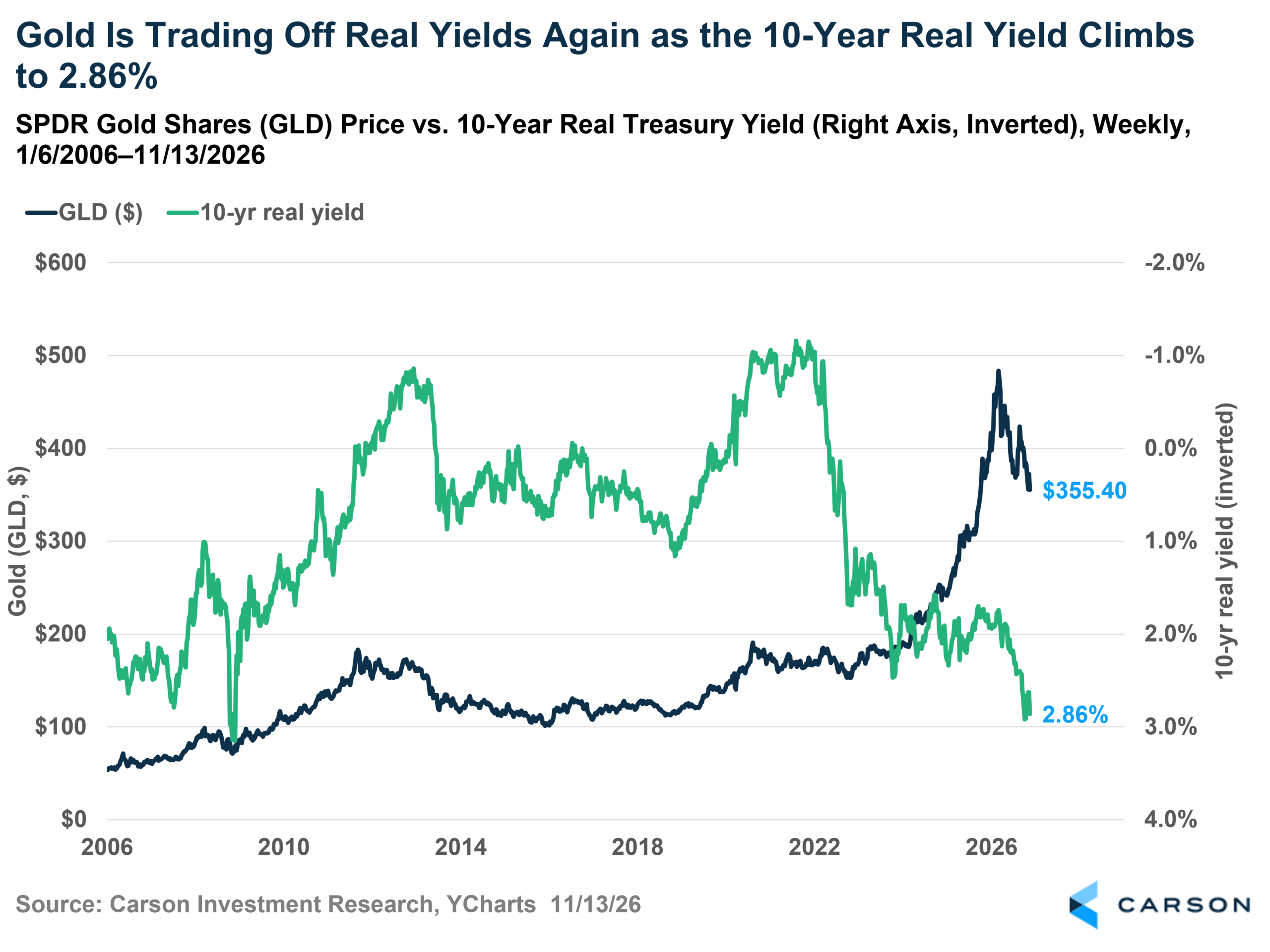
The best measure of what you give up is the real yield, what a bond pays after inflation. A regular 10-year Treasury pays about 5.1%. A 10-year Treasury Inflation-Protected Security (TIPS) pays about 2.9% plus whatever inflation turns out to be. That 2.9% is the real yield. It started the year at 1.9% and is now near its highest since 2008. When the US government pays almost 3% above inflation, an allocation to an asset that pays nothing becomes harder to justify.
For most of the last 20 years, gold has fallen when real yields rose, and vice versa. That broke from 2022 to 2025 for reasons that deserve their own blog, but this year the old pattern seems to be back.
Why Real Yields Are Rising
Real yields rise when the market expects the Fed to fight inflation and the economy gives the Fed fewer reasons to wait.
October’s jobs report was strong, with 165,000 jobs added and unemployment at 4.1%. Sonu, Carson’s Chief Macro Strategist, compared today’s economy to June 2024, when unemployment was also 4.1%, nominal growth was about the same, and core inflation was a bit lower. The Fed ended up holding rates at 5.25-5.5%. Today, rates are 3.75-4%. That’s a much lower rate for such a strong economy. The longer the Fed leaves it there, the more inflation settles in, and the more aggressive the Fed will have to hike later to bring it down.
Markets seem to agree. The odds of a December hike rose from 67% to 78% the day of the jobs report, and gold fell. On November 10, the core Consumer Price Index (CPI) came in hot for a third straight month, with some Fed members even mentioning not just a 0.25% … but a 0.50% hike. The 2-year Treasury yield had its biggest one-day jump since April 2025; markets priced in about three hikes by September 2027, and gold fell 2.7%. Two days later, it fell another 2.8%.

Source: Carson Investment Research, Bloomberg 11/11/26
So is the Fed dovish? Compared to the economy, yes. But markets price where rates are headed, and they expect the Fed to eventually catch up. Every hike priced in pushes real yields up and gold down. That’s the entire disconnect. Hot inflation is hurting gold because it’s forcing the Fed’s hand.
We saw the same thing in 2022. CPI inflation peaked near 9%, the Fed hiked hard, real yields jumped from -1.0% to 1.6%, and gold finished the year down about 1%.
Some people I’ve talked to say the fact that gold isn’t rising is information, and I agree with them. The market believes the Fed will be forced to play catch-up, and gold is simply pricing that in. The flip side is what happens if the Fed doesn’t deliver. If it hikes less than what’s priced while inflation stays hot, real yields would likely fall, and gold would get the backdrop it’s supposed to love.
Where’s the Bottom?
Nobody can put a date on it, since it depends on when the market stops believing the Fed will catch up.
My view is that the Fed won’t hike enough to slow an economy this strong, and inflation sticks around, which is a good backdrop for gold eventually. But I don’t think the selling is done, and I wouldn’t be surprised by more downside first.
The signal I’m watching for is the opposite of November 10, a day when hot inflation data or a hawkish Fed comment hits, and gold goes up. I’d expect it to be violent, something like the 6.4% jump on February 3, gold’s biggest one-day gain since 2010.
Does Gold Belong in Your Portfolio?
For most people, a small amount makes sense as a strategic diversifier, since gold has had almost no week-to-week relationship with stocks since 2006. In 2008, stocks fell 41%, and gold rose 3%.
The unwritten rule is that gold does well when deficits rise, and inflation runs hot. This year shows it only holds when the Fed falls behind. Owning gold is a bet that it will eventually happen.
What Would Change My Mind
If gold starts rising on days when yields jump, the market has stopped trusting the Fed, and gold’s next leg up is probably starting. If real yields fall below 2.5% and gold still can’t rally, something else is weighing on it, and I’ll need to update my map again.
By Harry McDonald, Analyst, Investment Research
9237717.1. – 13NOV26A