Before the opening bell on November 12, 2026, Nvidia notified investors that Mr. Jensen Huang resigned the titles and roles of CEO, President and Board member of Nvidia.1 Mr. Huang’s resignation follows two independent stories – one relating to his involvement with a MegaSpeed executive who is alleged to be a Chinese Intelligence operative2, and the other relating to a relationship with a direct report at Nvidia.3
Personally, this is shocking. Mr. Huang was one of the central technologists and visionaries behind Nvidia’s rise. The company has powered the nascent AI computing boom by forging their own path in GPU development while overcoming numerous skeptics and presumptions that their technology would never become mainstream. I’ve been a proponent of the company’s technology and financial results, though have tried to acknowledge risks of competitors coming after their enormous profit pool.
In my opinion, Huang’s resignation will do little to derail the growth of AI in our everyday lives. This technology continues to astound myself and researchers with intelligence breakthroughs. And the soon-to-be Anthropic IPO may refocus investors on the new breed of AI-native companies growing revenues and pushing the industry forward. The organic growth of AI usage that Mr. Huang has prophesized for so long looks to be here; this may allow the technology and semiconductor industry to remain healthy even without him remaining as the face of the industry.
But today is a day to acknowledge the risks more directly.
Nvidia stock finds itself in a roughly 35% drawdown from its October 5th, 2026, highs (as of early trading on Nov 12, 2026). To me, the move in the stock reflects investors anticipating the potential heightening of two risks: increased regulatory and/or governance oversight, as well as the continuation and extension of business and/or technology risk that the company was already facing.
Business risk
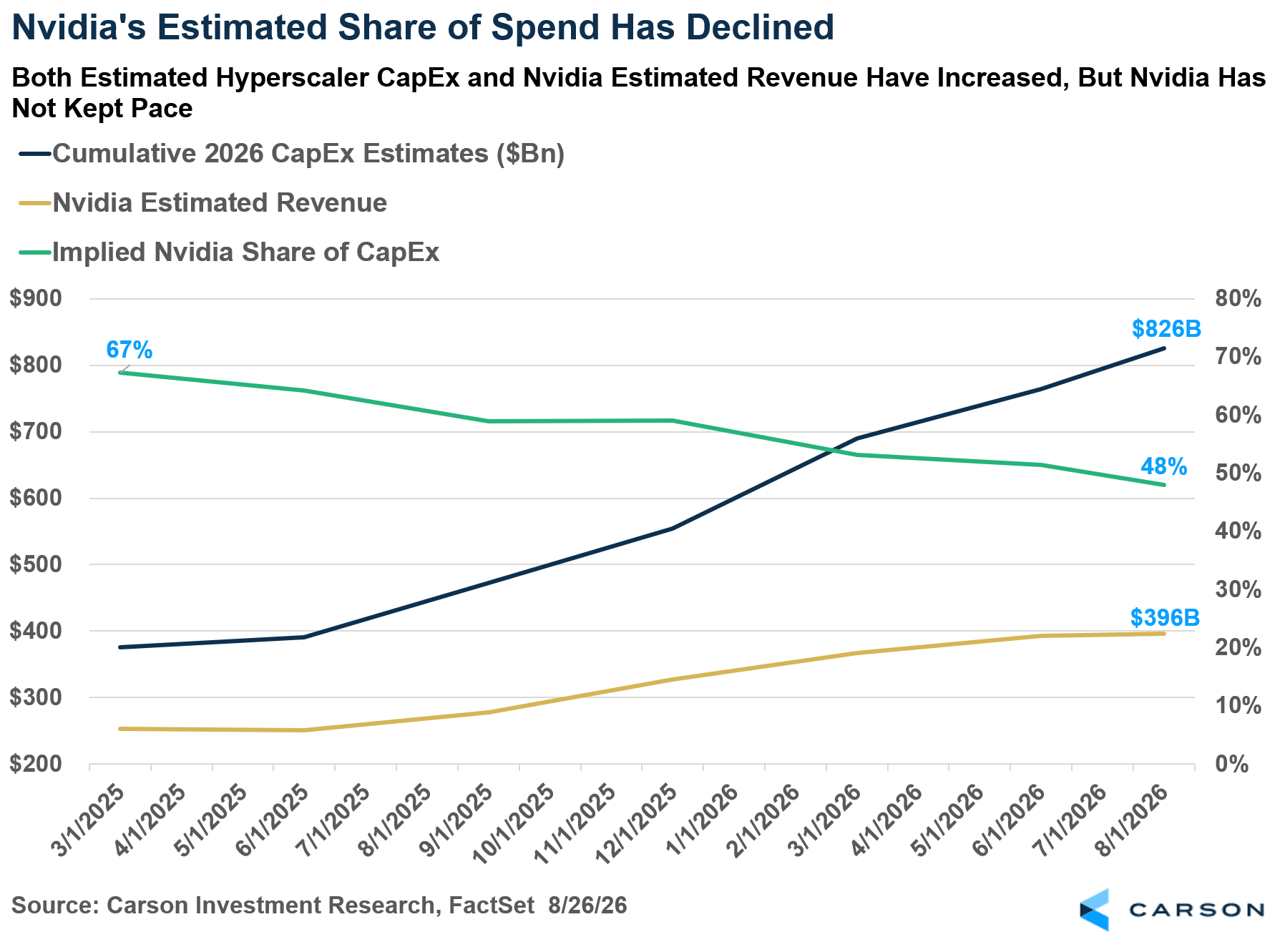
Nvidia found itself in a weakening position within the semiconductor industry before these news stories surfaced. It was losing share relative to other semiconductor competitors. I was worried for Nvidia before this started that other semiconductors were introducing new CPUs and custom silicon offerings that could capture an increasing market share of semiconductor spend. As shown in the chart below, Nvidia’s share of CapEx spend had declined from roughly 67% of the industry to around 48% more recently.
Nvidia’s acquisition of Groq (a unique type of chip) this past December did give me pause that I would be wrong and the company would expand into these different chip types. But they’ve had a lackluster rollout of those offerings in my opinion and have instead largely chosen to focus on cementing the ongoing role of the GPU in data centers. In my opinion, GPUs seem like they’ll remain the workhorse of AI data centers – their flexibility allows novel AI discoveries to occur – which should keep customers buying. But I am on guard for new industry entrants and this business risk seems like it will remain ongoing and perhaps be heightened following this week’s news.
Regulatory and Governance Risk
This week’s news, particularly surrounding potential securities fraud stemming from the MegaSpeed business dealings, does increase the risk of export controls or regulatory oversight on the company, in my opinion. If Nvidia is found to have knowingly breached existing export restrictions (by shipping semiconductors or powerful computing systems to parties blacklisted by the U.S. government), then it seems there is a credible case for securities fraud (as the company published that they did not believe they were shipping to Chinese-related parties4).

Stay on Top of Market Trends
The Carson Investment Research newsletter offers up-to-date market news, analysis and insights. Subscribe today!
"*" indicates required fields
With Congressional hearings already scheduled for next week, investors may receive answers soon. However, with Mr. Huang no longer associated with the company, it may complicate hearings, testimony and factual discoveries.
Nonetheless, if the company does become handcuffed by increased oversight on their international activities, it may likely pressure growth and adoption. Take the customer’s point of view: If Microsoft (or Amazon, or OpenAI, Anthropic, or others in the computing industry) are trying to build data centers in Asia (or internationally) to better serve customers there, are they going to buy Nvidia chips (which might be delayed because of export controls or higher scrutiny), or are they going to buy chips from AMD or other competitors (that may have looser export controls and a therefore quicker time to market)? On the margins, to me it sounds like competitors may benefit from potential restrictions on Nvidia.
Key Man Risk
Many people who are more familiar with the company than me espouse Mr. Huang’s importance in the past growth of Nvidia and necessitate his role in future growth prospects. I don’t doubt that Mr. Huang was the best man for the CEO role. His technological expertise and vision for the capability of GPUs led to the creation of the world’s most valuable company (at least for a time).
But I’m also inclined to believe that the technology transcends one man. I’d like to believe that Nvidia, with over 40,000 employees, has plenty of competent researchers, technologists and visionaries that can successfully lead the company after this shakeup.
In short, the information that has come to light is undeniable. Nvidia’s Key Man risk has reared its head in an ugly way, with the company’s CEO and chief visionary now no longer affiliated with the company. It seems likely that congressional hearings and investigations may illuminate fraudulent or/and illegal product sales with the enforcement of these breaches potentially leading to tighter restrictions. And all of this comes on the heels of Nvidia already losing market share to competitors. Mr. Huang’s resignation is astonishing compared to what was known a week ago, but the progress of AI may prove to be bigger than one man.
- https://nvidianews.nvidia.com/news/nvidia-announces-ceo-transition
- https://www.nytimes.com/2026/11/08/technology/nvidia-investigation-jensen-huang-china.html
- https://www.nytimes.com/2026/11/11/technology/jensen-huang-nvidia-affair.html
- https://www.bloomberg.com/news/articles/2025-11-07/nvidia-ceo-says-no-plans-to-ship-blackwell-ai-chips-to-china
For more content by Blake Anderson, CFA®, Director, Portfolio Management, click here.
9235256.1. – 12NOV26A