Welcome to Carson Investment Research’s Earnings Check-In. This series is built weekly from FactSet’s Earnings Insight report (John Butters, VP, Senior Earnings Analyst with FactSet), with index weights and market caps sourced from YCharts, and aggregation performed in-house. We tie every figure to FactSet’s published numbers, then add Carson’s perspective on top of that. We publish our Earnings Check-In weekly during earnings season.
Wow! This has been a crazy couple of days in the markets. Alphabet lost about $500 billion of market value in a single day. Intel fell 31%. Meta announced plans to raise up to $95 billion by selling new stock. The Fed kept rates unchanged. The VIX touched its highest level since April. Oh yeah, and the midterm elections are today. With this much going on, I want to slow down, ground myself in what we actually know, and lay out the range of outcomes from here.
In The Shortage Quarter, I said AI chips and oil were driving this quarter’s profits, and that the chip side would last only as long as the biggest buyers kept spending. Meta kept spending, and its stock fell anyway, so in The Bill Shows Up in Cash, I asked whether the big AI buyers could still pay for it out of their own cash. This week we got the answer, and it leads to an even better question.
Where the Season Stands
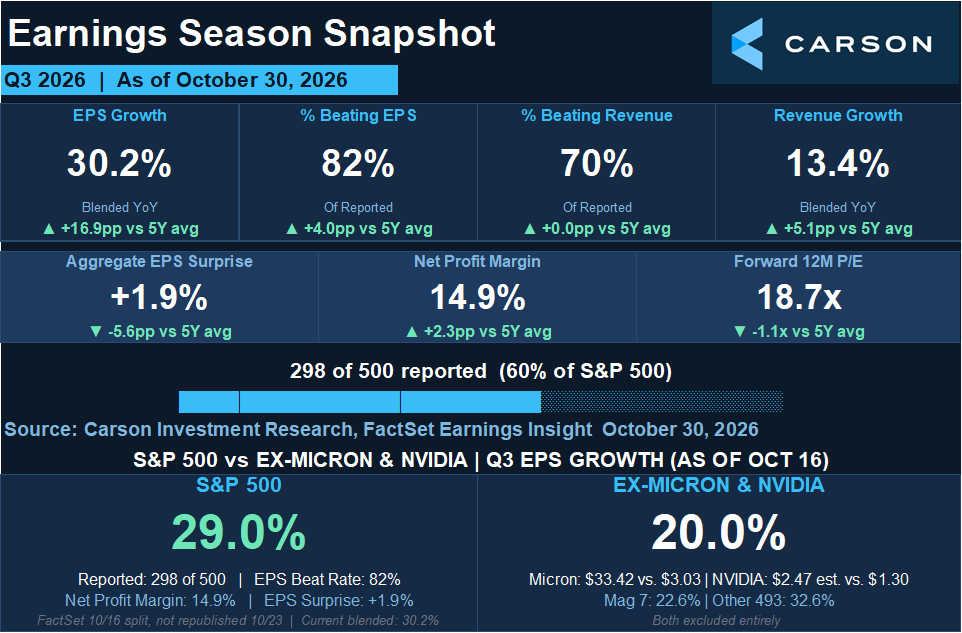
Roughly 60% of S&P 500 companies have reported, and blended earnings growth (which combines actual results with estimates for companies that haven’t reported yet) rose to 30.2% from 29.5% last week. 82% of companies beat estimates, but the average beat was just 1.9%, according to FactSet.
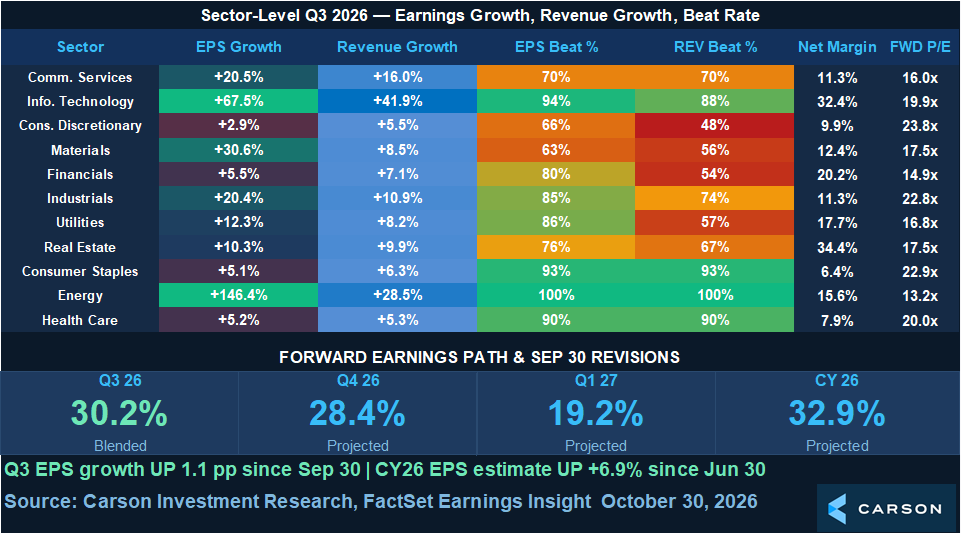
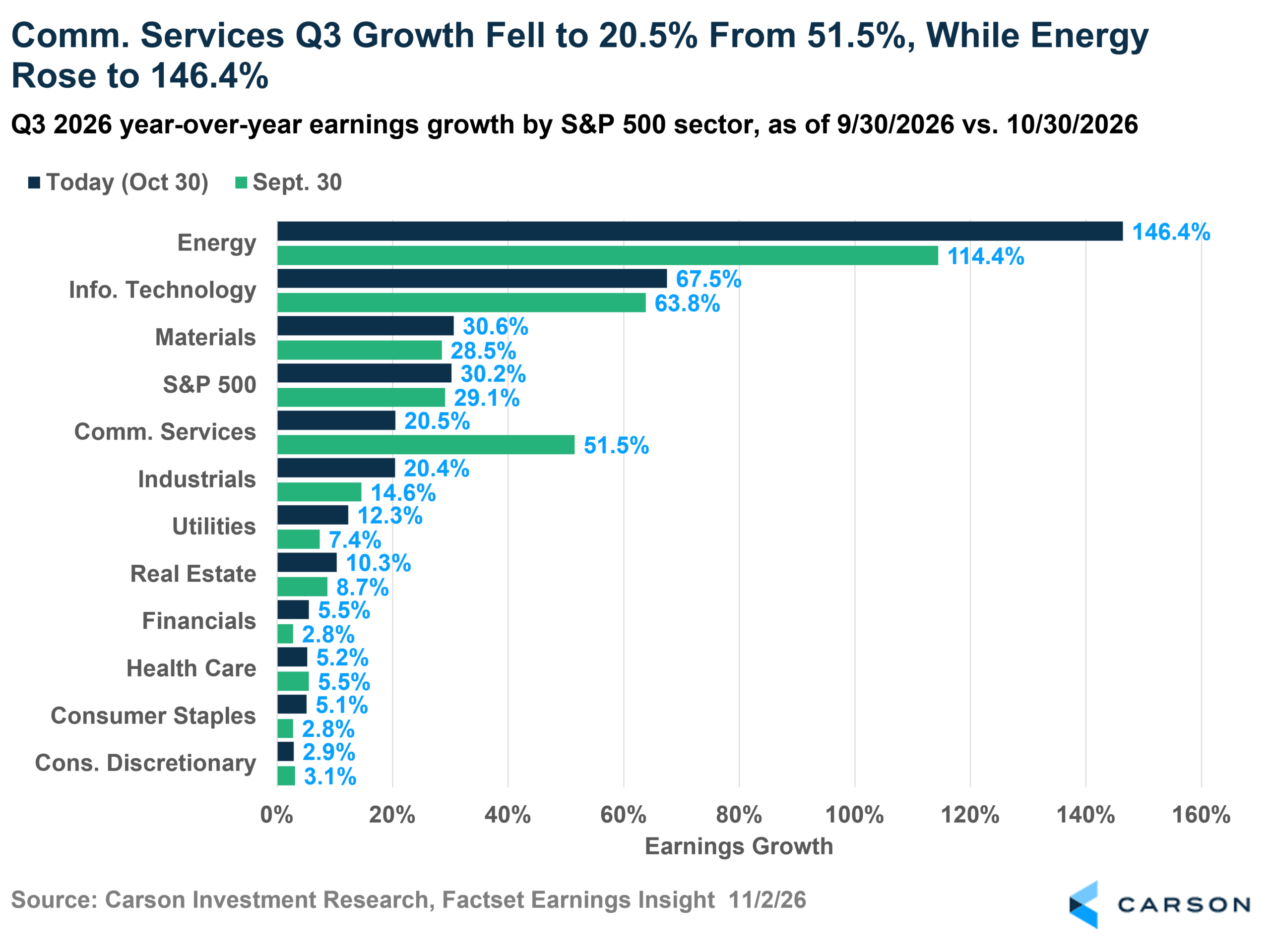
All 11 sectors are now growing earnings for the first time this season, with Energy and Technology still well out front. Communication Services moved the wrong way, falling to 20.5% from 51.5% at the end of September, and that drop is where this week’s story starts.
My First Update: The Buyers Can’t Pay Their Own Way
I try to keep a simple map of how this AI buildout works and update it with what companies actually report, and this week’s biggest update came from the four companies doing most of the buying. Using YCharts data, Microsoft, Alphabet, Amazon, and Meta make up about 16% of the S&P 500, and the companies selling them chips make up another 14%, so nearly a third of the index depends on what these four can afford to spend.
The best way I know to check that is free cash flow, the cash a business brings in minus what it spends, including on buildings and equipment, which for these four mostly means data centers. Think of it as your paycheck minus a home renovation on top of normal expenses. A company can report big profits and still burn cash, because accounting spreads a data center’s cost over many years while the cash leaves all at once. When free cash flow turns negative, the company has to borrow or sell stock to cover the gap.
Last week’s test was whether Alphabet, Microsoft and Amazon were still paying for their buildouts with their own cash, and only Microsoft passed. Combined, the four went from $61.7 billion of free cash flow a year ago to negative $26.4 billion.
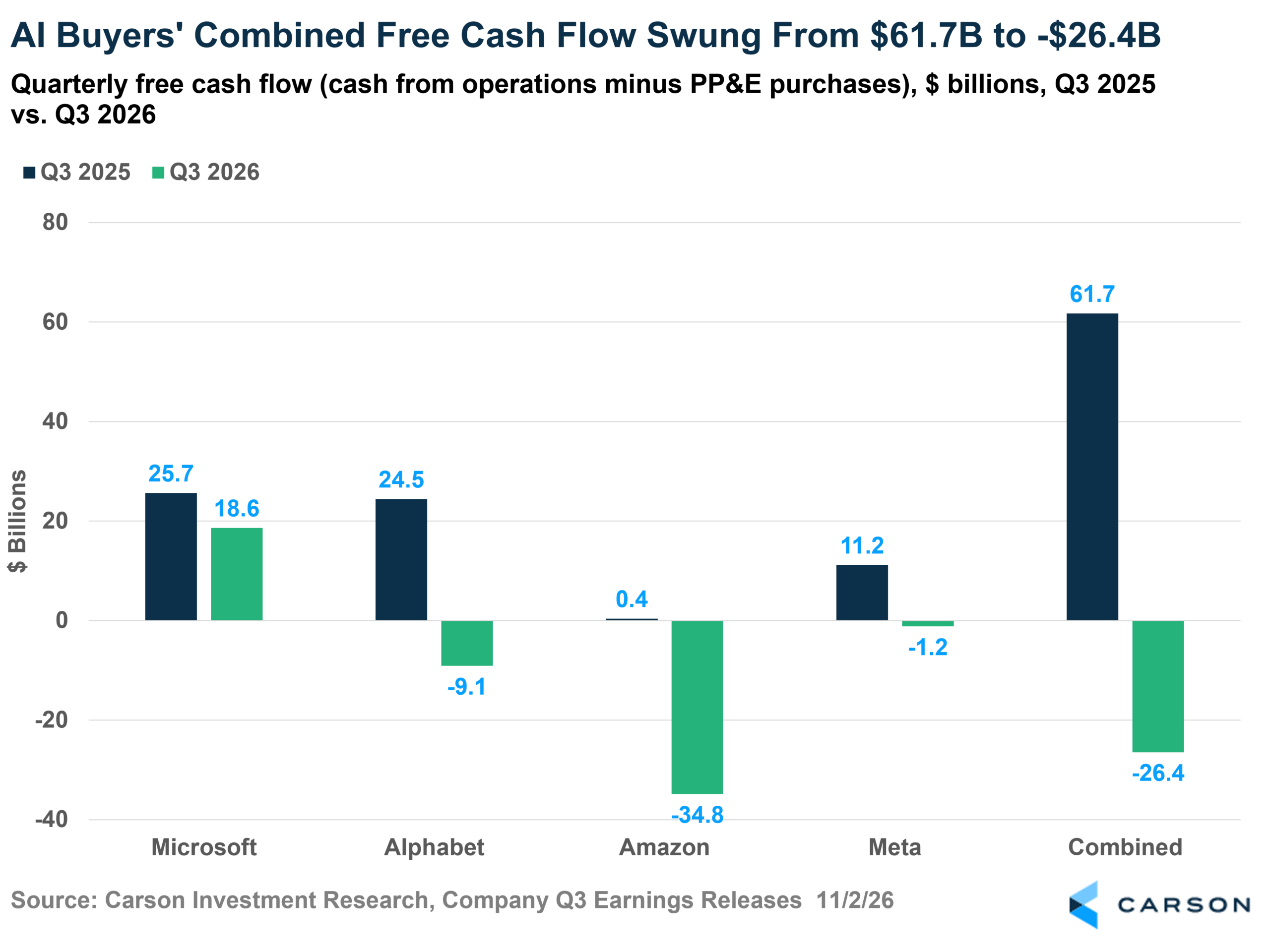
Investors noticed. Microsoft, the only one of the four still bringing in more cash than it spends, is also the only one with a positive return since late September.
That doesn’t mean the other three are wasting their money. My colleague Blake Anderson walked through Alphabet and Amazon in Tech Earnings Spook Investors, and I agree with him that the demand is real. Amazon’s cloud business grew 39%, and Google’s cloud business more than doubled. The problem is timing. Spending is growing faster than revenue right now, so these companies are covering the difference with outside money. Meta is selling new stock, and even Microsoft sold $25 billion of bonds the morning after its report, according to the Financial Times.
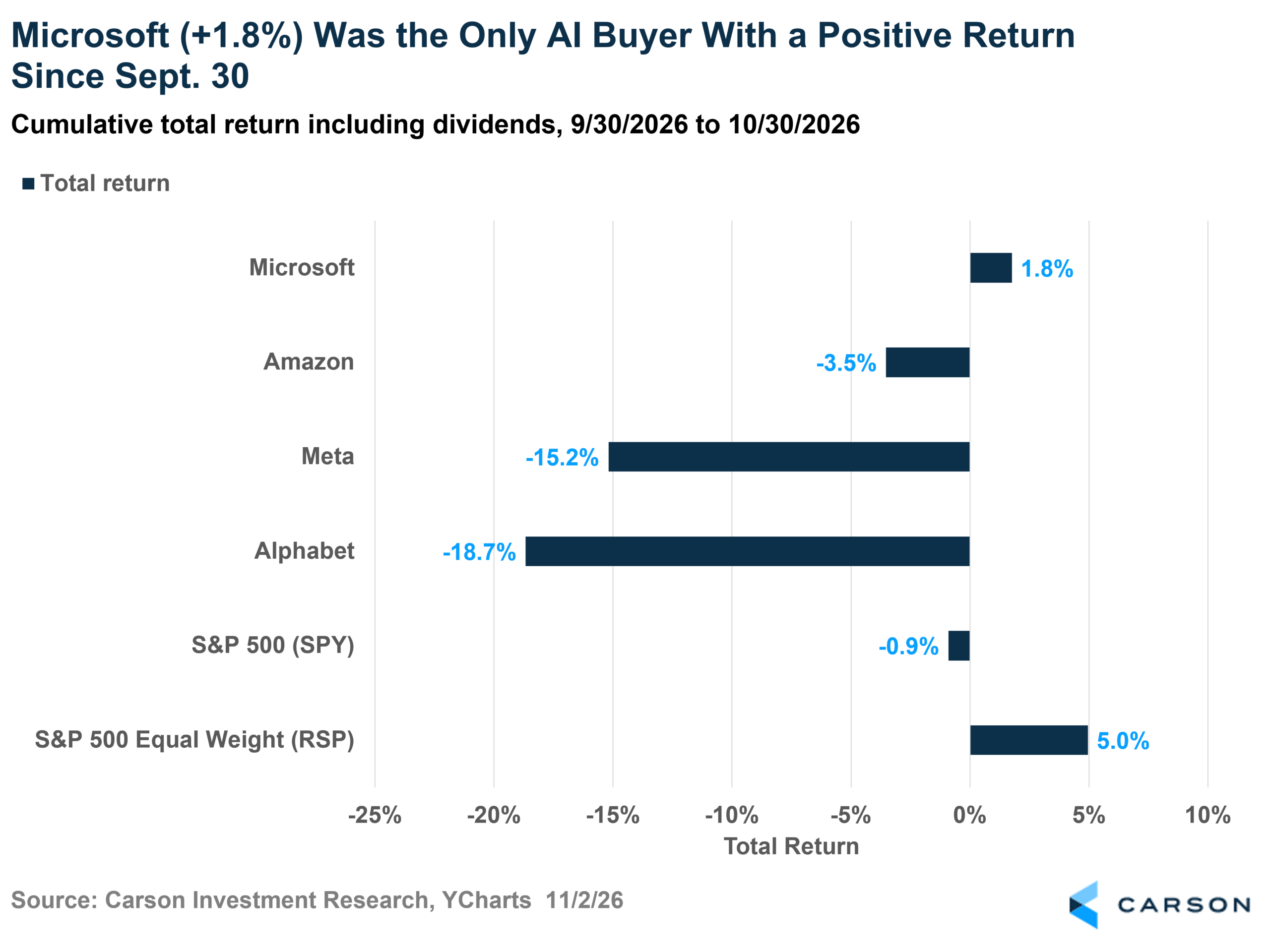
My first update: demand is real, but buyers can’t pay for the buildout on their own anymore.
My Second Update: The Money Is Landing With the Sellers
If the buyers are spending more than they bring in, that money has to land somewhere. FactSet’s numbers show the Magnificent 7 on track to grow earnings more slowly than the other 493 companies in the S&P 500 for the first time since late 2022.
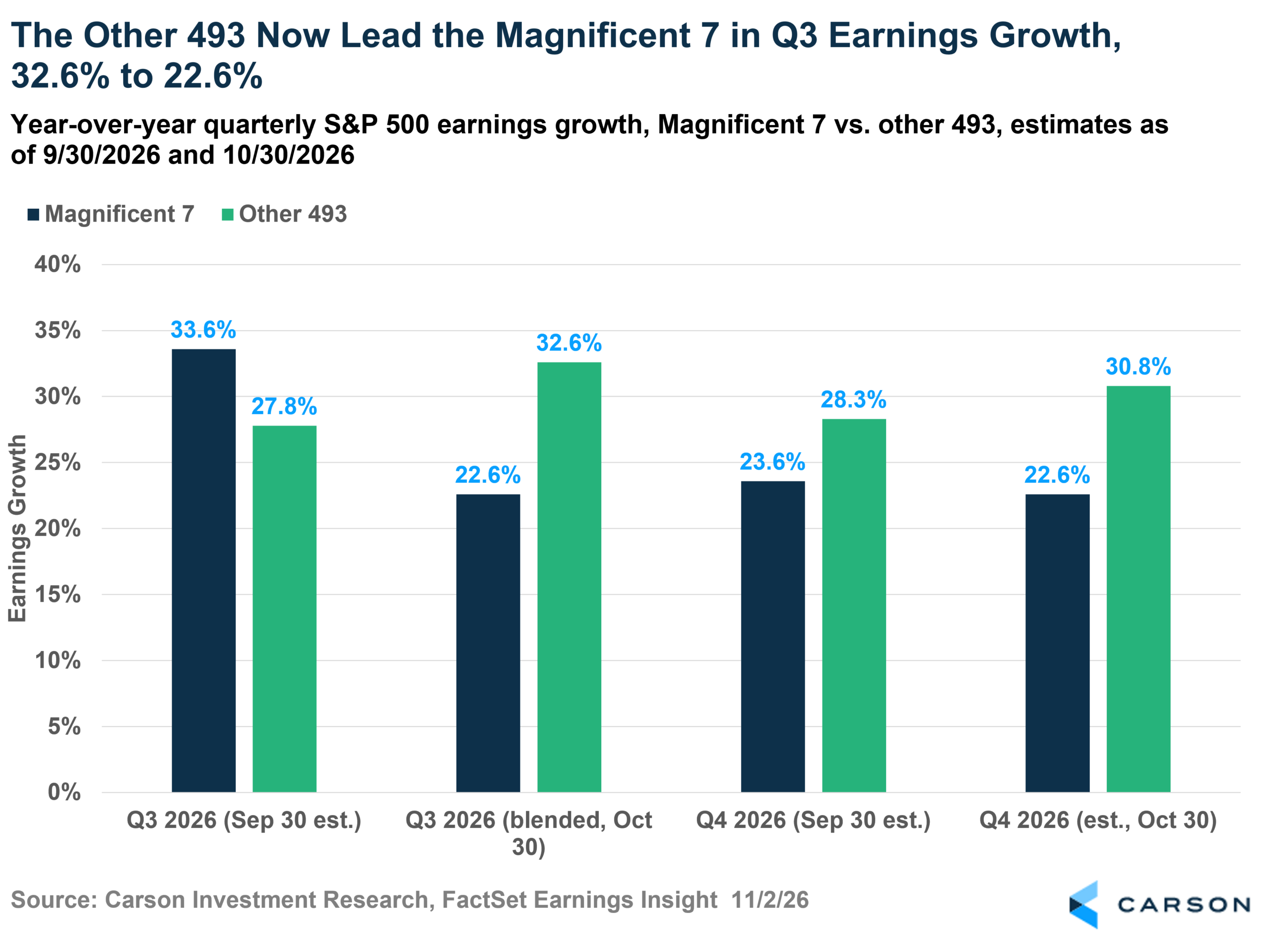
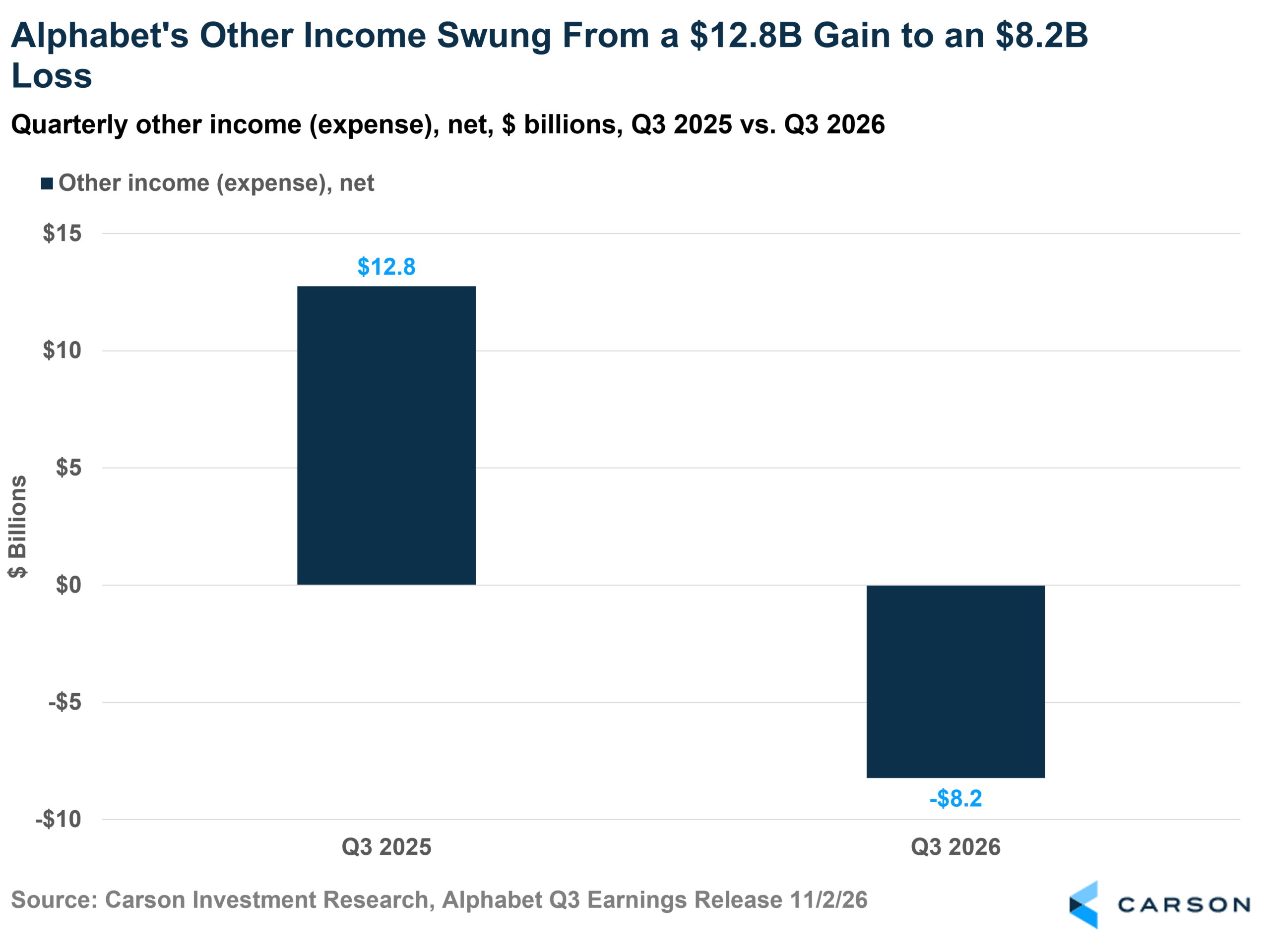
Part of that gap is accounting. Meta took a $9.89 billion legal charge, and Alphabet’s investments swung from a $12.8 billion gain a year ago to an $8.2 billion loss. These are the same paper marks I wrote about in July, running the other way this time, so I’d look through them.
The rest of the gap is real, and it’s where the buyers’ money went. Technology’s gains since September 30 came largely from chipmakers like Micron, Intel, and SanDisk, all of which sit in the 493. Much of the 493’s lead is AI buyers’ spending showing up as someone else’s profit, and the rest is mostly oil.
Carson’s latest Facts vs Feelings Social Hour (which was amazing!) helped me make sense of this. Sonu Varghese, Carson’s Chief Macro Strategist, often says one company’s spending is another company’s revenue, and this quarter’s numbers show that. Our guest, Alvin Graylin, an AI researcher and Stanford fellow, put it well: right now, only the hardware side of AI is making money. In his essay The AGI Windfall Mirage, he writes, “The capability is real. The capture is broken.”
Alvin thinks businesses adopt AI slowly because they first have to redesign how they work and retrain their people. He estimated that only 10% to 15% of U.S. companies are actively deploying AI, with a low single-digit share getting a clear return. If he’s right, the buyers are building for customers still learning to use the product, so cash goes out faster than it comes back.
The Next Question: Can the Sellers’ Profits Last?
I think of the buyers and sellers like a homeowner and a contractor. The homeowner is paying for a huge renovation, and the contractor is booking record profits. Those profits last only as long as the homeowner keeps paying, and this quarter we learned the homeowner now has to borrow to do it. That doesn’t mean the job stops, but it does mean the contractor’s profits now depend on the homeowner’s lenders, too.

Stay on Top of Market Trends
The Carson Investment Research newsletter offers up-to-date market news, analysis and insights. Subscribe today!
"*" indicates required fields
When the sellers report, the good sign would be sellers raising their outlooks while saying new customers beyond the four biggest buyers are ordering, because then their profits don’t rest on four companies’ ability to borrow. The bad sign would be sellers helping pay for their own sales, like a contractor offering to finance the renovation so the job keeps going (which sounds crazy because it is…). Broadcom has already guaranteed part of the debt behind a customer’s chip deal, according to The Wall Street Journal, leaving Broadcom on the hook if that customer can’t pay.
The Market and the Analysts Disagree
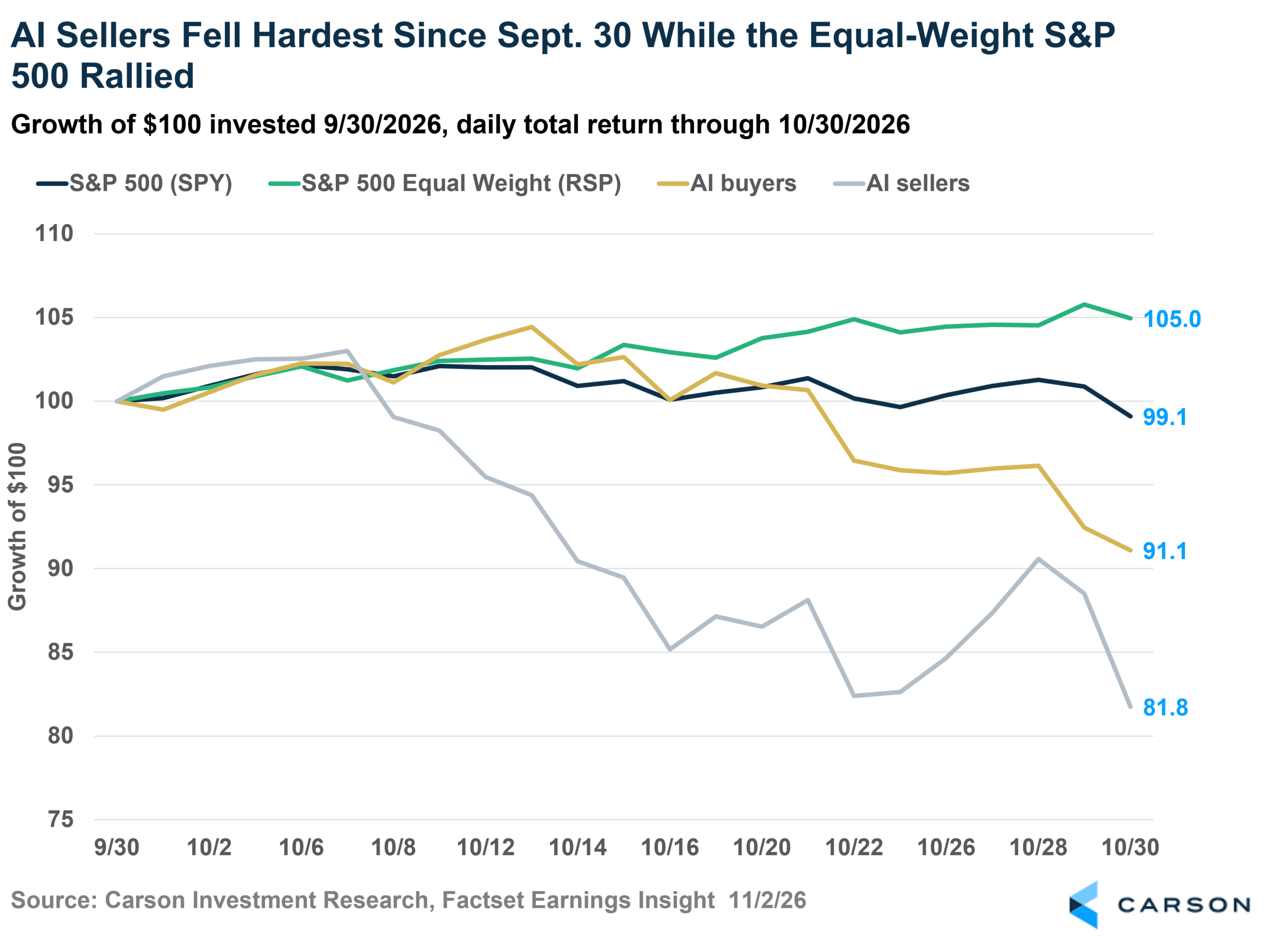
So far, the market’s answer to that question is no. An equal-weighted basket of six AI chip sellers, including NVIDIA, Micron, and Broadcom, fell 18.3% since September 30, twice as much as the four buyers, while the equal-weighted S&P 500 rose 5.0%. That’s how investors usually treat chip profits they think are near a peak. However, as much as I read into this, chip stocks could be giving some of their return back this year since they’ve run up so much.
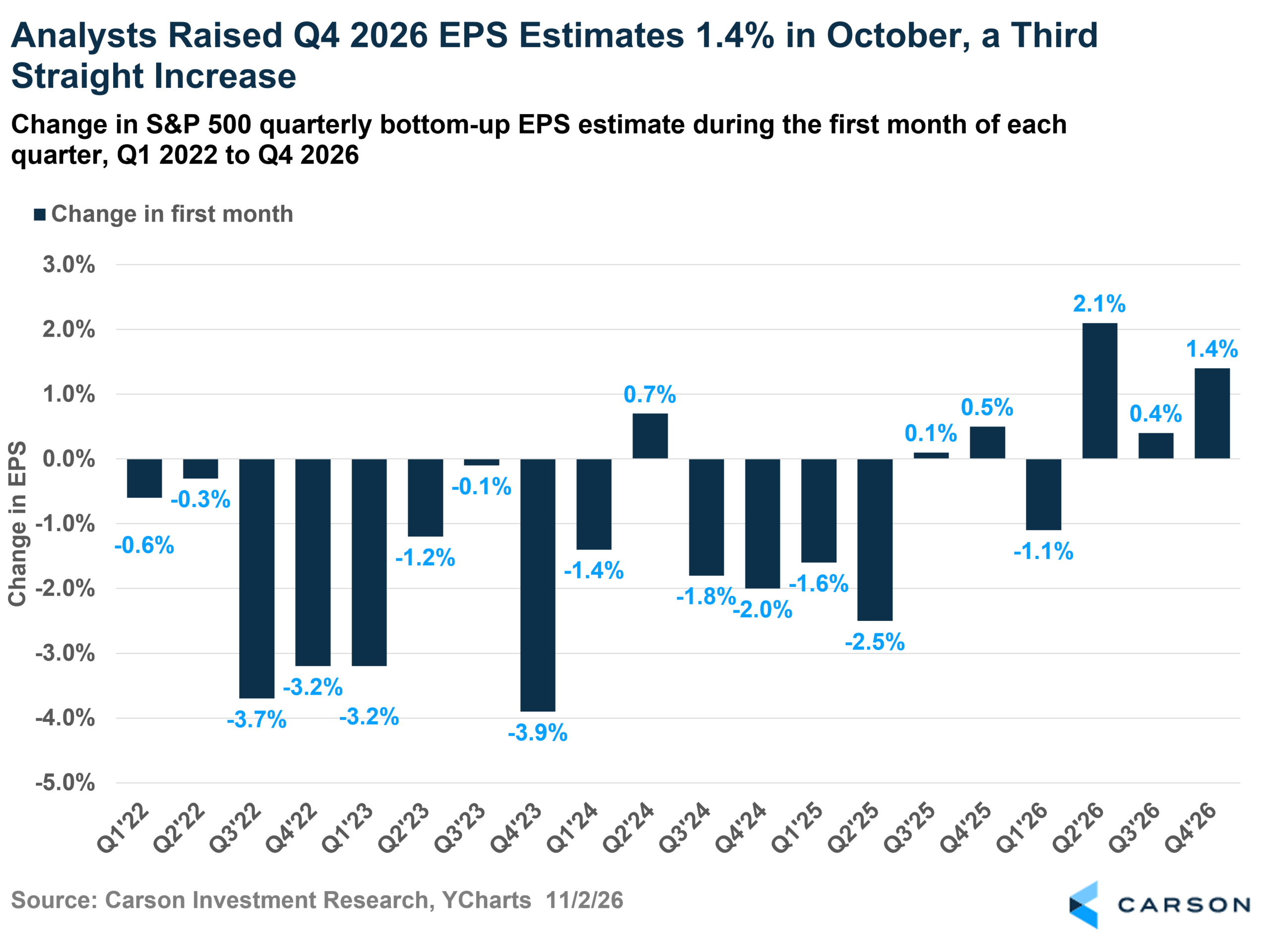
Analysts see it the other way, raising fourth-quarter estimates in October when they usually cut them, according to FactSet.
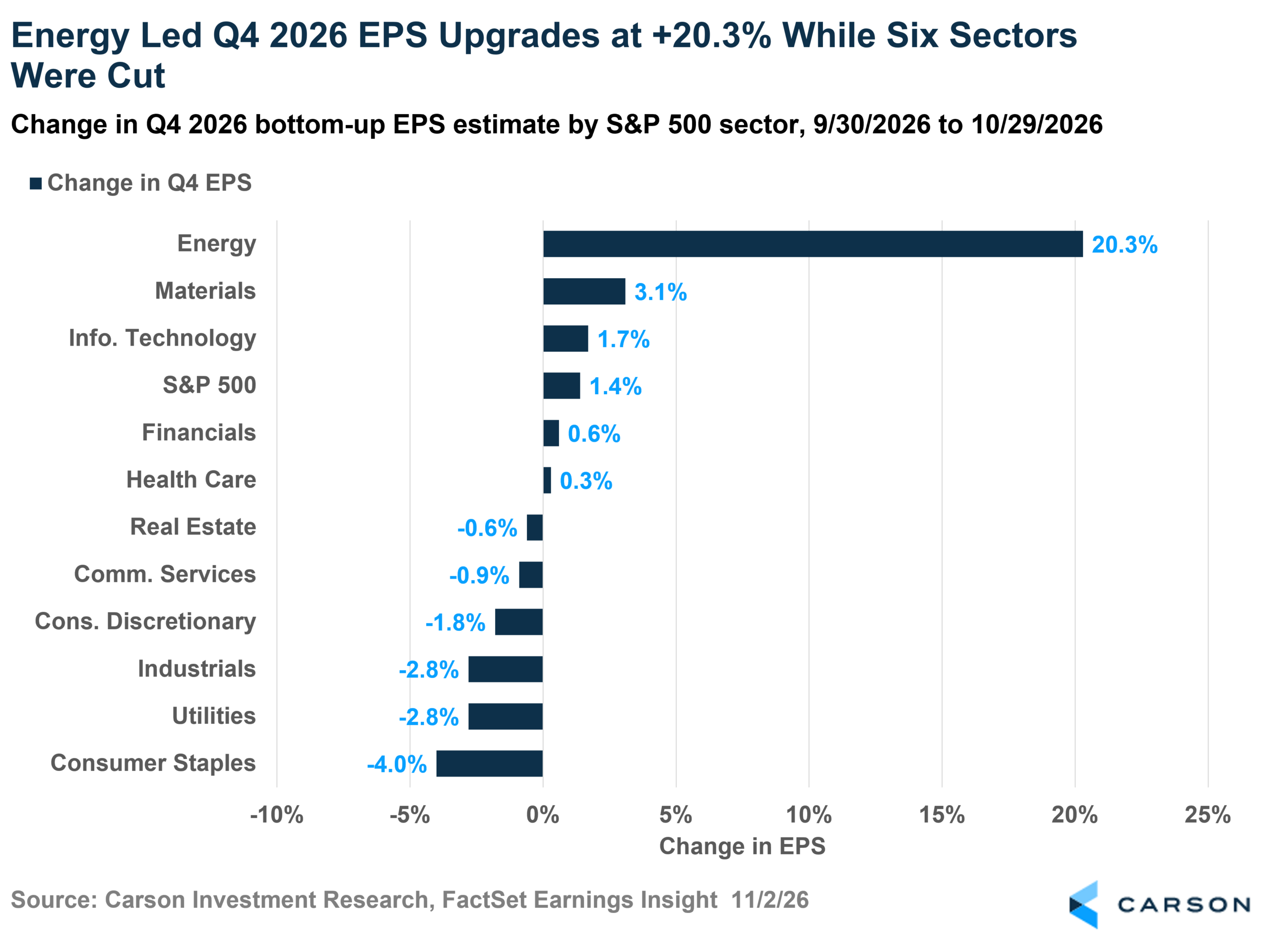
Most of that came from Energy, though, and outside of oil, analysts are only a little more optimistic than a month ago.
The Range of Outcomes
I don’t think anyone knows which side is right yet. In the first path, the buildout stays funded. The sellers keep raising their outlooks, the buyers keep raising money without paying much more for it, and analysts’ estimates hold up.
In the second, the pace slows. Alvin has a great analogy: pour a beer fast, and you get mostly foam, but pour it slowly, and you get mostly beer. The buyers ease off, chip-seller growth cools, and earnings growth drifts back toward normal while the rest of the market picks up some of the slack. In my view, this is the base case.
In the third path, the money gets tight. Lenders demand much higher rates, buyers cut back, and sellers’ profits fall fast, as in past downturns. The 42.3% earnings growth analysts expect for Technology in 2027 would come down hard.
My extended view is that Q3 earnings are strong but their quality has slipped. More of this quarter’s growth is money moving from companies that now have to borrow to keep spending toward the companies selling them chips, which makes those profits harder to sustain. That’s why I side with the market in discounting them. I still think a slower pour is more likely than a sudden stop, since buyers can still raise money, but the price of that money is rising with the 10-year Treasury yield near 5%.
What Would Change My Mind
AMD, Arista Networks, and Super Micro report today, Qualcomm reports tomorrow, and NVIDIA follows on November 17. If sellers keep raising their outlooks while buyers’ cash stays negative, analysts have the better read for now. If sellers start guiding more cautiously, the market saw it first.
Reporting This Week
140 S&P 500 companies report this week, including three in the Dow. We know buyers can’t pay for the buildout out of pocket anymore, and this week sellers will tell us whether that’s changing their orders. Be back next Tuesday.
By Harry McDonald, Analyst, Investment Research
9217772.1. – 3NOV26A