
While we don’t know whether the equity selloff that started October 6 has reached its low, yesterday’s equity bounce is a good time to look at what we’ve seen on the bond side. (For our view on the “tech wreck” even before the bounce, see Carson Chief Market Strategist Ryan Detrick’s outstanding blog yesterday, “15 Things to Know About This Selloff.”)
Here’s the bad news in a nutshell. Bonds are down this year. On top of that, rate hikes are coming with the near inevitability of a Westeros winter, mild at first and possible for a while, but with darker times down the road. Bond declines actually haven’t been too bad. The Bloomberg Aggregate Bond Index, the most commonly used benchmark for US investment-grade bonds, is down 0.4% year to date as of the Monday, November 24 close. Down 0.4% won’t send anyone into fits of panic, but Treasury bills (Bloomberg US Treasury Bill (1-3 Month) Index) are up 3.8% with a whole lot less volatility.
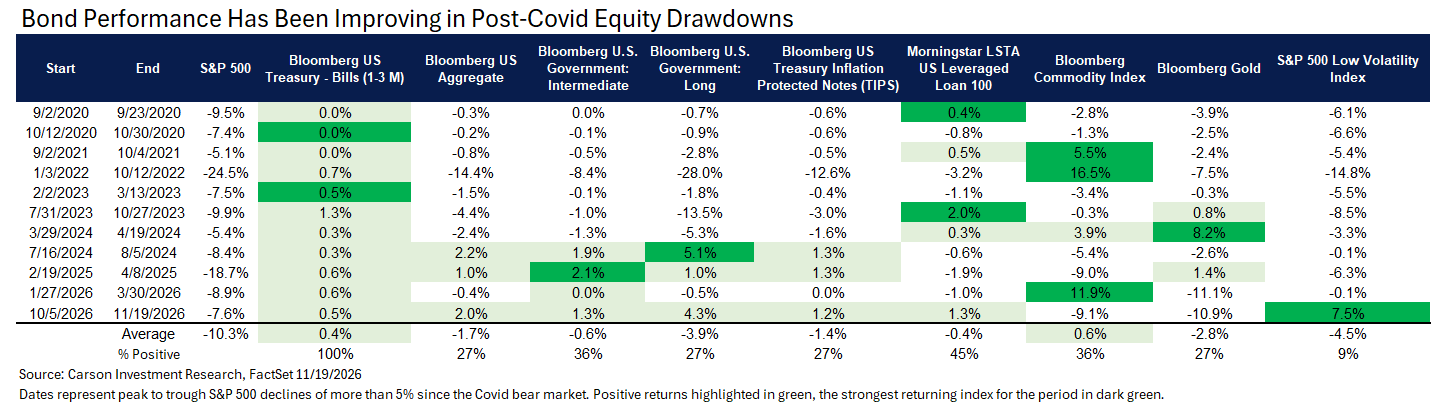
The good news? Bonds seem to have at least a little of their mojo back, diversifying equity drawdowns. Below is a table of all S&P 500 drawdowns of more than 5% since the COVID bear market in 2020. We are now in our 11th mild correction (or more). As you can see, through the first part of 2024, intermediate Treasuries (Bloomberg U.S. Government Intermediate) were down for every drawdown. But it’s been up for the last four, although only by the slimmest of margins earlier this year. A caution that this isn’t what we think we’ll get if there’s an aggressive rate hiking regime. But for growth-scare equity selloffs, investors have again seen value in the potential defensive qualities of intermediate Treasuries.
It’s also worth highlighting that the leading diversifier from this grouping, at least in terms of returns, has rotated around quite a bit. The star of the most recent selloff has been low-volatility stocks, benefiting from a rotation out of tech while still seeing value in stocks. But low-volatility stocks participated in the drawdowns the prior 10 times, although they captured, on average, only about 50% of the downside. Also, within this grouping over this time period, leveraged loans have been the most resilient outside cash, both in terms of performance and batting average.
That’s the good news. Let’s look a little more closely at the bad news. When the Fed raises or cuts rates, the 10-year Treasury yield historically captures about half the move on either side. The relative size of the move varies from cycle to cycle, but the 10-year yield has been higher in every major rate-hiking regime going back to the 1950s.
Additional rate hikes are the consensus right now. Market-based estimates right now are that the Fed will hike once in December and twice more in the first half of 2026. That would typically imply a 10-year yield that’s 0.34-0.40% higher. Given the recent decline in the 10-year yield due to the equity selloff, I would take the over on that number. That does imply some price declines for bonds over the next year.

Stay on Top of Market Trends
The Carson Investment Research newsletter offers up-to-date market news, analysis and insights. Subscribe today!
"*" indicates required fields
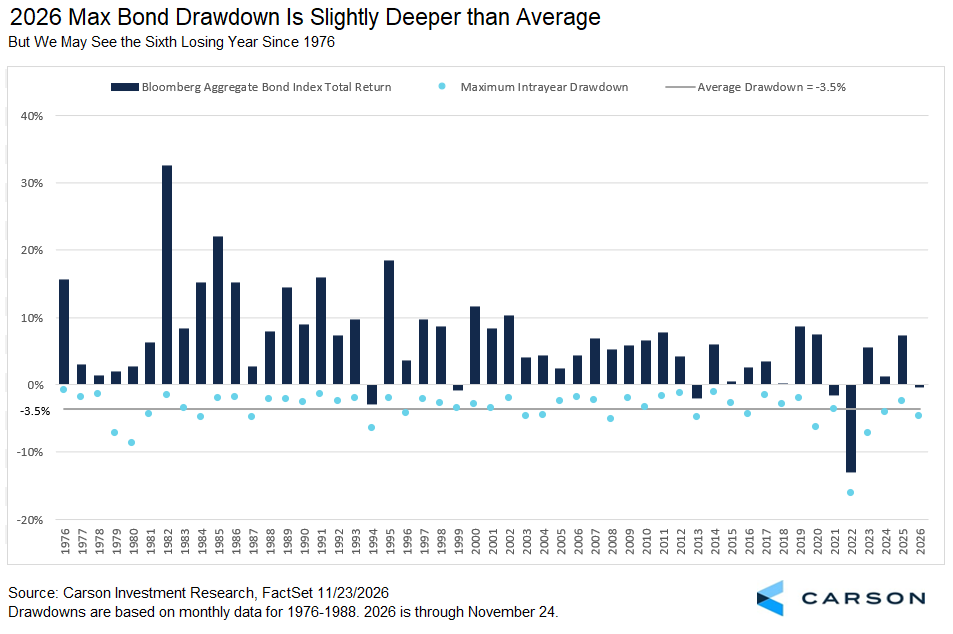
The silver lining is that yields are attractive, and that helps offset some price declines. Even this year, despite some bumps and a negative return for the Bloomberg Aggregate year-to-date, the maximum drawdown for the index is in line with the historical average thanks to strong starting yields. The max drawdown this year is -4.6%, reached on October 5, versus a long-term average of -3.5%. Also, since even the starting fed funds rate is quite high compared to 2022, Fed hikes are extremely unlikely to be anything like what we saw then, even when the Fed eventually does get aggressive.
How to position for an environment like this? For us, we are willing to allocate meaningfully to shorter maturity bonds to insulate against rising rates, and we’ve reduced our Tactical allocations to about 60% the interest rate sensitivity of the Bloomberg Aggregate. Because of our emphasis on Treasuries and our view that economic growth will keep credit risk contained, we are willing to have modest aggressive positioning in leveraged loans for extra potential resiliency in the near-term rising rate environment. Leveraged loans do carry credit risk, though, and would likely underperform if true winter comes sooner rather than later.
At the same time, we do still want some core bond exposure given bonds’ resilience against intermittent equity drawdowns. But given our view of the economy, we think the Fed, not the growth scares that have led to intermittent drawdowns, is the biggest risk. The growth scares probably won’t be really serious until the Fed gets serious about fighting inflation.
There is both good news and bad news for bonds right now. If you’re overly inclined toward one or the other, try to see the other side. But if rate hikes are coming and the economy remains resilient until the Fed is forced to be more aggressive, some caution on interest rate risk is warranted.
For more content by Barry Gilbert, VP, Asset Allocation Strategist, click here.
9254608.1. – 24NOV26A