
We are about six weeks from mid-term elections, and we’ve been getting questions about what the outcome might mean to markets. The short answer is typically not a lot. Political outcomes matter broadly, of course, but they tend to mean a lot less for markets than people think and even more so for mid-terms. In fact, one of our most enduring pieces of market advice is to generally ignore your political enthusiasm or anxiety when making investment decisions. It rarely serves investors well.
There are other reasons mid-terms don’t usually have a large impact, beyond markets generally being indifferent to the party in power. Presidents typically pass their signature legislation in their first two years, and the president’s influence usually wanes after midterms, especially for second-term presidents. Midterms also usually check presidential power (more on that below).
Here are the basics on the upcoming election:
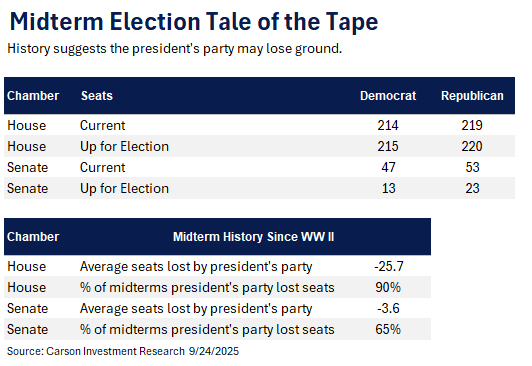
- Republicans currently control both the House (219 – 214) and Senate (53 – 49) by fairly narrow margins.
- Given the Republicans’ narrow majority in the House and the historical tendency of the president’s party to lose ground at mid-terms, Democrats are likely to take control.
- The Senate is closer to a coin toss, although recent evidence suggests the odds may now tilt in Democrats’ favor.
- Whatever the outcome, Donald Trump will still be president and anything properly within the scope of the executive branch will continue as before, although we could see a legislature more likely to argue that scope and use its checks on presidential power.
The Battle for Senate Control Currently Tilts Towards Democrats
Since Senate terms are for six years, about 1/3 of the Senate faces voters in each federal election (mid-term or presidential election years), unlike the House, where every seat is up for election every two years. That means the “map” of which seats are up for election can matter, but the number of safe versus at-risk seats can matter more. This year, 35 seats are being contested: 33 in the regular cycle, plus special elections in Florida and Ohio. Republicans currently hold 22 of those seats, and Democrats hold 13. But most of those are considered safe, so the number of seats that have a real possibility of changing control is much narrower.
Republicans currently control the Senate 53-47. The vice president is the tie-breaking vote in the Senate, so Republicans can lose up to three seats and still retain control. While polls and other factors that impact mid-term elections have been improving marginally for Democrats, we would still call the battle for Senate control basically a coin flip. That means Democrats need to net four seats to take control, and Republicans can lose up to three net and retain control.
First, if Democrats are to take control, they need to hold serve. If they lose even a single seat, not only does it raise the number they have to flip, but it also likely signals they are not having a strong night, and they need a strong night to net four seats. Michigan and New Hampshire are considered the most vulnerable current Democratic seats. If Democrats lose either, there are still paths to Democrats taking control, but the odds have grown long.
North Carolina, where Democrats are currently favored, is the most likely seat to go from Republican to Democrat. If Democrats can’t flip North Carolina, they are unlikely to flip four of the more closely contested current Republican seats while avoiding losing seats themselves.
If Democrats hold Michigan and New Hampshire and flip North Carolina, they would need to flip three more seats to take control. The most vulnerable current Republican seats (outside North Carolina), in rough order of vulnerability, are Alaska, Maine, Texas, Ohio, and Iowa.

Stay on Top of Market Trends
The Carson Investment Research newsletter offers up-to-date market news, analysis and insights. Subscribe today!
"*" indicates required fields
From a Republican perspective, they can retain control of the Senate, losing North Carolina if they hold three of Ohio, Texas, Maine, Iowa, and Alaska. If they flip Michigan or another vulnerable Democratic seat, they only need to hold two of five.
Historically, the Senate has not moved as much against the president’s party as often as the House. But then a lot depends on “the map.” Senators also tend to have broader appeal, since everyone in the state votes for Senators, while you vote for only one representative in your district. Since 1914, the first election after the passage of the 17th amendment when Senators moved from being appointed by state legislatures to popular vote, the president’s party has lost an average of 3.5 Senate seats during midterms and lost seats in 19 out of 28 elections, or a little worse than 2/3 of the time. If you look only at post-WWII (since 1946), the average is a similar 3.6 seats lost, with the president’s party losing ground 13 out of 20 times.
History Is on the Side of Democrats Taking Control of the House
The story in the House is more dire for Republicans. If you exclude 1902, where the election was impacted by House expansion where Democrats already picked up seats following the 1900 census, the president’s party has lost ground in every election since 1862 except 1934 (FDR’s first midterm and the best midterm performance in modern presidential history), 1998 (Bill Clinton’s second midterm), and 2002 (President George W. Bush post-9/11). Since 1946, the president’s party has lost an average of 25.6 seats at mid-terms, losing ground 18 out of 20 times.
Right now, the Republicans control the House by a 219-214 count (including an independent who caucuses with Republicans), with two seats vacant: one held by a Republican and one by a Democrat. That means a three-seat swing flips control of the House. Were all else equal, Democrats would already be favored to take control given history. Add in the president’s approval rating, an unpopular war, and inflation concerns, and it’s a very tall order for Republicans to maintain House control. But voters decide elections, not models, and outcomes can surprise, so Republicans’ chance of maintaining control is non-negligible.
Republicans also have a structural advantage from district construction and the tendency of Democratic voters to cluster in dense urban centers. Each congressional district votes only for its own candidate, but a rough estimate is that Democrats need to win the national House vote by roughly 3-4% to have a 50/50 chance of controlling the House. The Real Clear Politics polling average for the generic congressional vote, for what it’s worth, currently has Democrats at +8.5%.
Markets Seem to Like Mixed Government
The most important outcome may simply be structural. Markets seem to like mixed government. You can choose your reason why. Maybe when a single party rules they they tend to give in to their own excesses and become the worst version of themselves. Or it could be that compromise leads to better government. Or maybe it’s that gridlock is good ?— government functions best when it governs least. Likely it’s some combination, depending on circumstances.
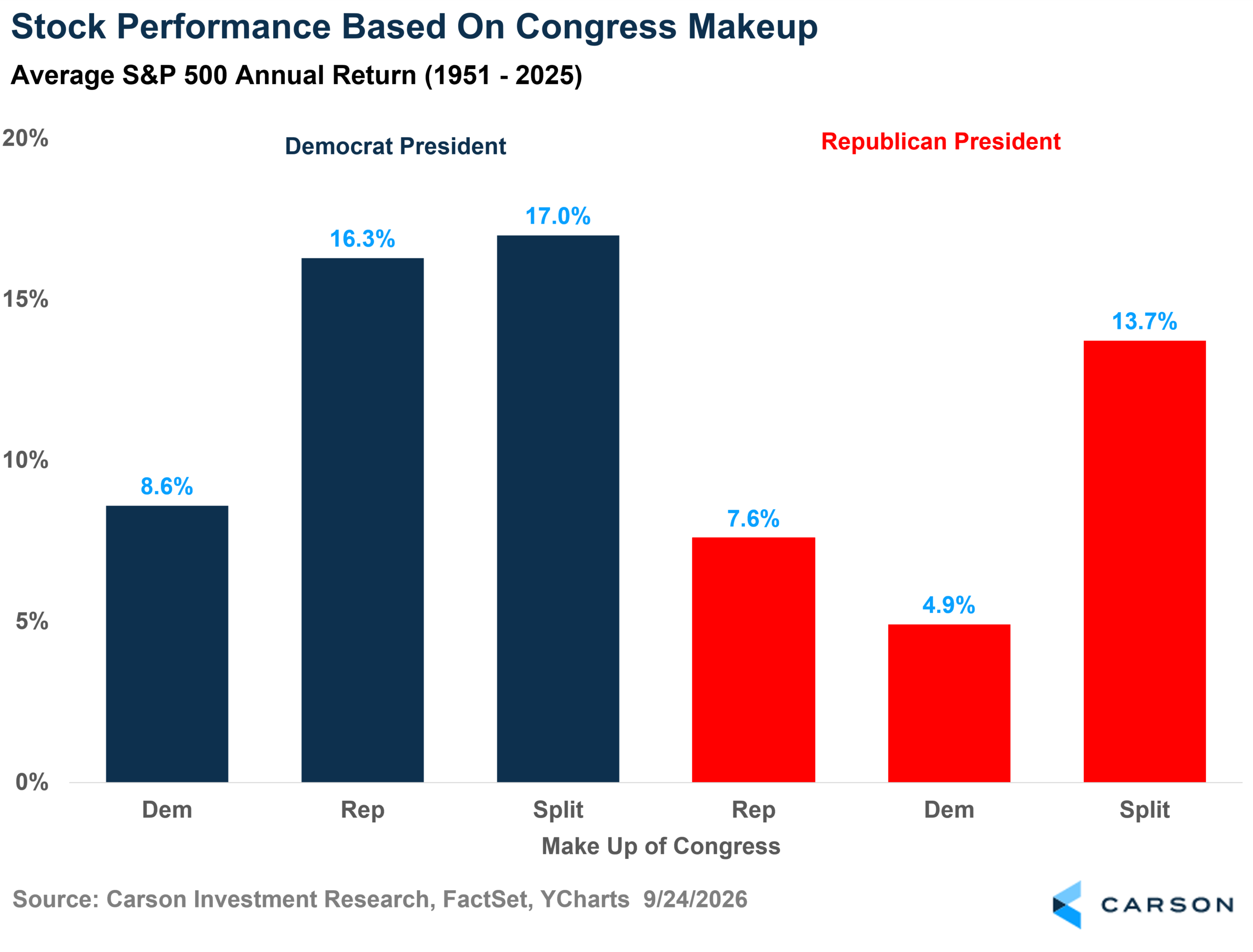
The stock market has certainly been happy the last couple of years despite unified government, helped by stimulus, a Fed willing to let the economy run hot, but independent of all that (most important), strong earnings growth supported by the AI boom. Earnings from the AI build are genuine, but we caution that a meaningful chunk of those gains is supported by capex spending not appearing immediately on income statements and large gains in private company valuations (such as Anthropic and OpenAI) on some major tech firms’ books. Still, the earnings boom has been extraordinary.
Bond Yields May Be More Insulated
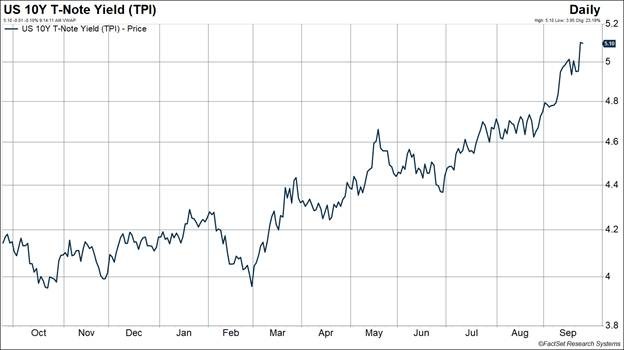
Bond yields have been on a tear. Both the 10-year and 5-year Treasury yields have reached levels not seen since the mid-2000s before the Great Financial Crisis. We’ve written quite a bit about the combined impact of inflation, government deficits, oil prices, and AI-driven demand on yields. Since the start of the conflict in the Middle East and the consequent closing of the Strait of Hormuz, the 10-year Treasury yield has climbed sharply from 3.96% to 5.10%. (Sonu was ahead of this in late August when he asked, “Should Interest Rates Be Even Higher?”)
Source: Carson Investment Research, FactSet 9/24/26
The election outcome may help limit added pressure on yields for two main reasons. First, additional checks and balances may help rein in some policy excesses. Second, Republicans will no longer be able to use the reconciliation process, which only requires a simple majority, to pass additional tax cuts or spend as freely. However, mixed government may still imply stimulus, as legislative horse trading may mean both parties get to spend on some favored initiatives.
Republicans and Democrats Both Like to Spend
If there’s one thing politicians from both parties have in common, it’s a love of spending more than the government takes in. Granted, priorities are different, but there’s no real argument that either party is the party of fiscal discipline, and our current president fits right in. Both parties make a similar claim about their spending habits that is true in theory — that it’s an investment that will eventually pay for itself. Perhaps, but given the direction of deficits, it doesn’t seem we’ve received much return on investment.
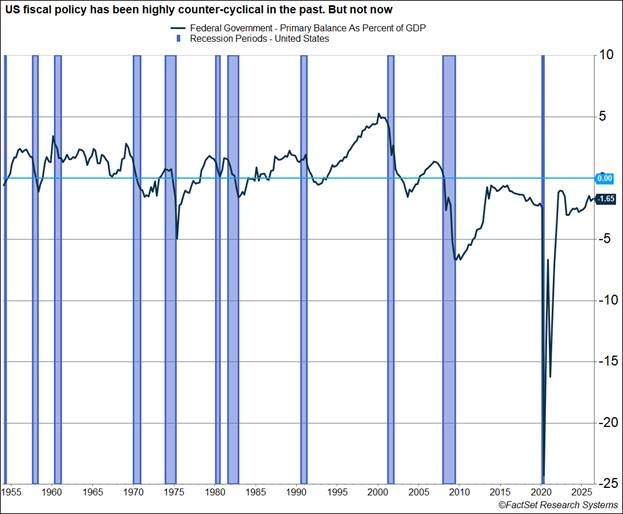
The Trump administration has been particularly profligate given the absence of a major economic disruption or major war (the conflict in the Middle East notwithstanding). As shown below, the primary deficit (including interest payments for a better apples-to-apples comparison) is currently stable rather than showing the improvement more typical of a healthy expansion.
Source: Carson Investment Research, FactSet 9/24/26
The takeaway is that deficits probably won’t be as bad as they could be with mixed government, but mixed government would by no means move us into a period of austerity. And it’s important to remember that, whatever the longer-run dangers, in the near term deficit spending supports corporate profits.
Sectors Are Hard to Read, but Expect Minor Regulatory Headwinds
Forecasting sector outcomes based on elections is difficult. Macro forces typically outweigh policy, and you have to get both the policy and the macroeconomic impact right, which can be counterintuitive. If there’s any sector takeaway, it’s added caution around sectors most vulnerable to regulatory impact, but take it with a big grain of salt, as the president will still have considerable influence. Financials may be one sector to watch. On the other hand, some horse trading on spending could lead to additional flows into healthcare via broader insurance coverage.
The Wisdom of the Electorate
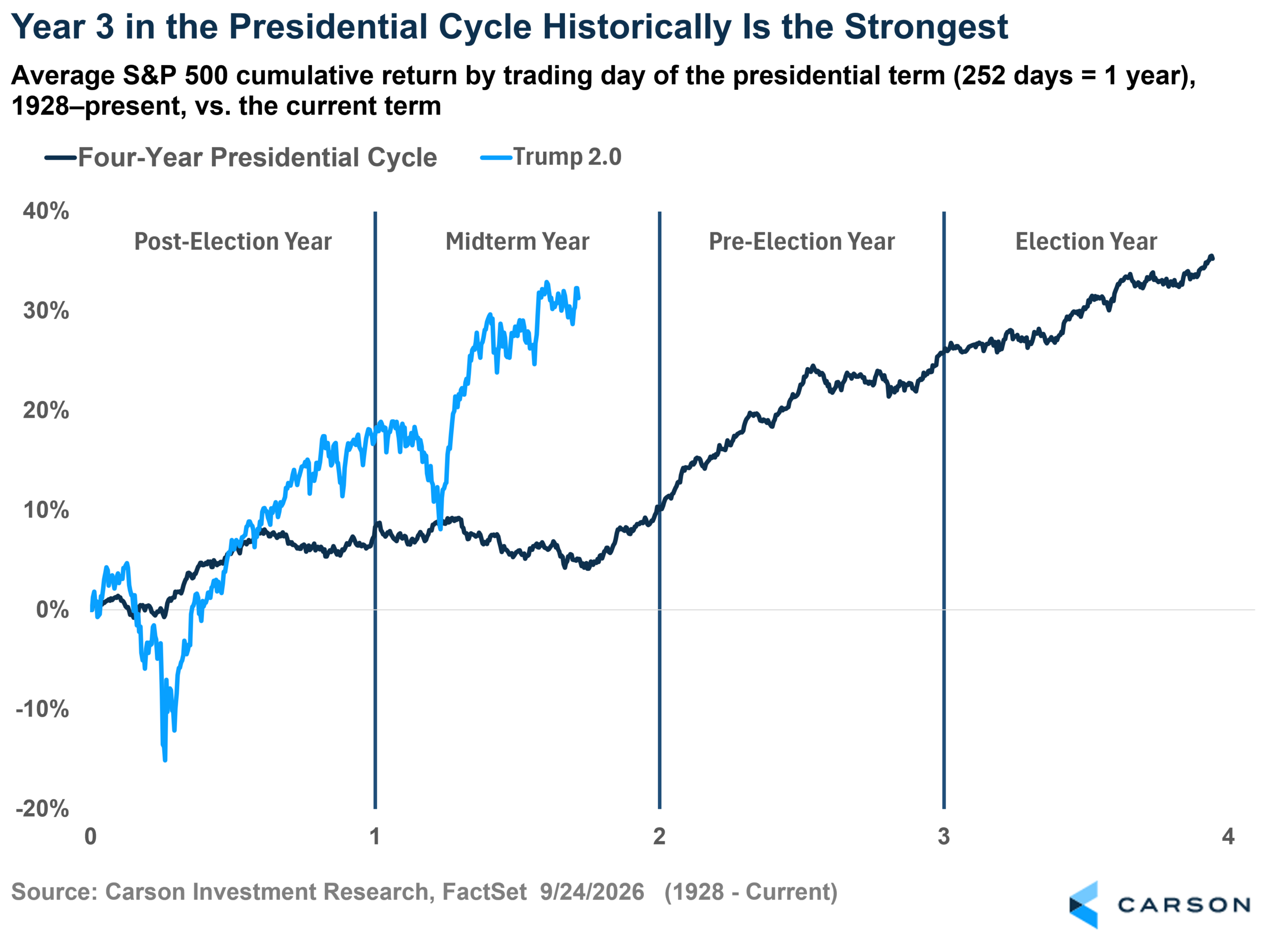
There’s an old saying, famously quoted by Winston Churchill, that democracy is the worst form of government except for all the other ones. The electorate is not always truly wise, but democracy creates a dynamic where accountability often minimizes mistakes. Nearly every president has faced that reckoning in midterm elections. We don’t expect President Trump to be the exception. Maybe that’s why the third year of the presidential cycle is historically the strongest.
For more content by Barry Gilbert, VP, Asset Allocation Strategist, click here.
9144714.1. – 24SEPT26A