
Kevin Warsh didn’t want to give forward guidance. But guidance from his fellow members more or less trapped the Fed into holding rates unchanged in October, despite their own description of 1) a “strong” economy (upgraded from “solid”), 2) job gains keeping pace with the workforce and steady unemployment, and 3) elevated inflation. The Fed wants more information to ensure a “timely return” to its 2% inflation target. The only surprise is that this was called a hawkish hold. In John McEnroe’s words, “you cannot be serious!”
Since the Fed wants more information, let’s look at the data. We just got plenty of it.
The economy grew 3.4% annualized in Q3, after adjusting for inflation. Headline GDP can be distorted by net exports and inventories, so it’s useful to look at final sales to private domestic purchasers: spending by households and businesses, excluding government. That surged 4.9% annualized in Q3 and is up 3.3% from a year ago. For perspective, it grew 3.3% annually in 2023–2024 and 3.0% in 2010–2019.
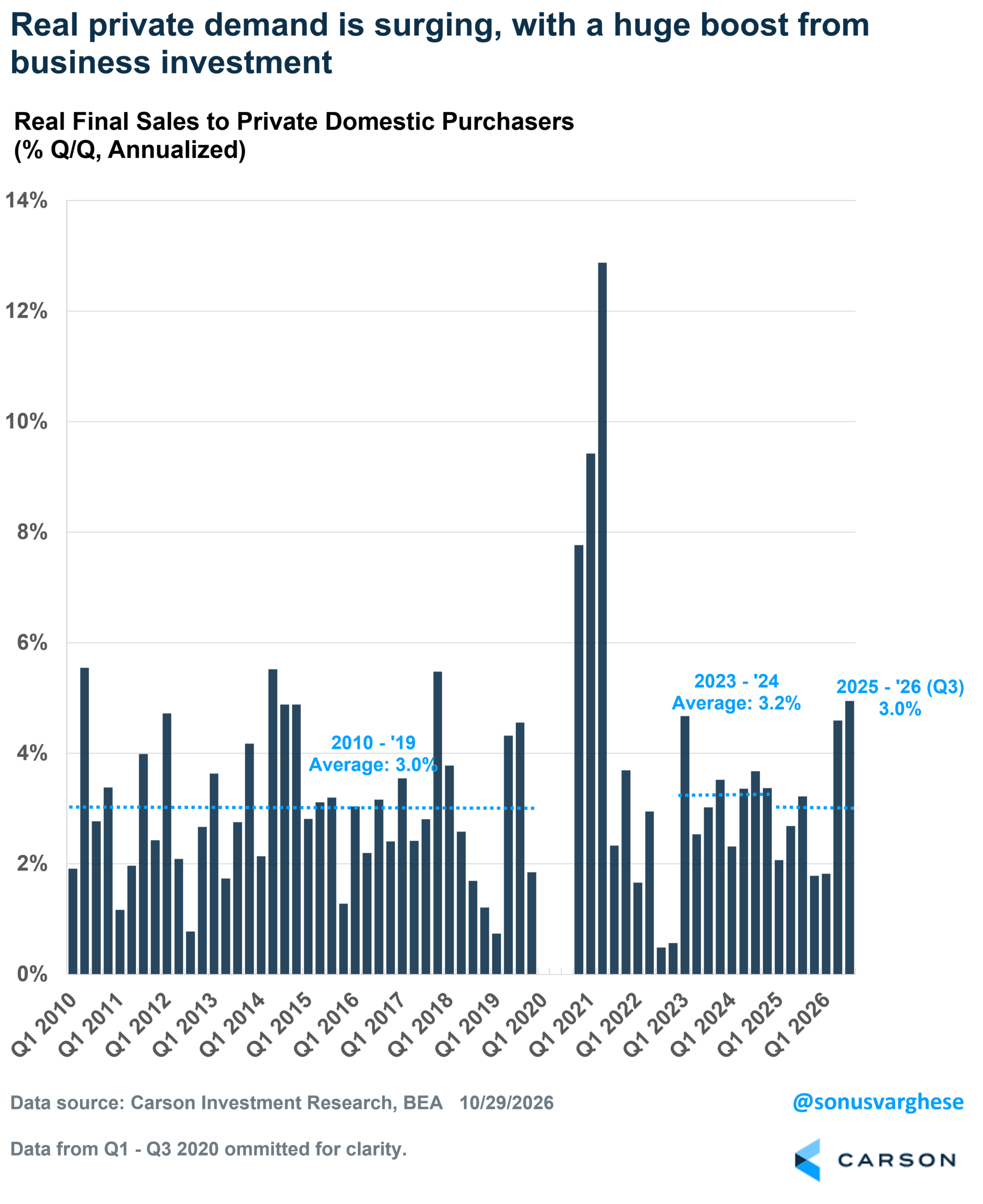
Not all that spending translates into domestic production, since imports satisfy some of the demand. Imports subtract from GDP because they are produced abroad, even though they show up in domestic spending. But the message is clear: private domestic demand is booming, and that matters for how we should think about monetary policy.

Stay on Top of Market Trends
The Carson Investment Research newsletter offers up-to-date market news, analysis and insights. Subscribe today!
"*" indicates required fields
Of course, if you’ve been following us for a while, one major driver shouldn’t be surprising: the AI buildout. Business investment contributed 1.7 percentage points (pp) to Q3 GDP growth, roughly half the total. AI-related spending was key:
- IT equipment investment surged 37% annualized in Q3 and averaged 29% over the past seven quarters, versus just 6% annually in 2010–2024.
- Software investment rose 10% annualized in Q3 and averaged 15% over the past seven quarters, versus 9% in 2010–2024.
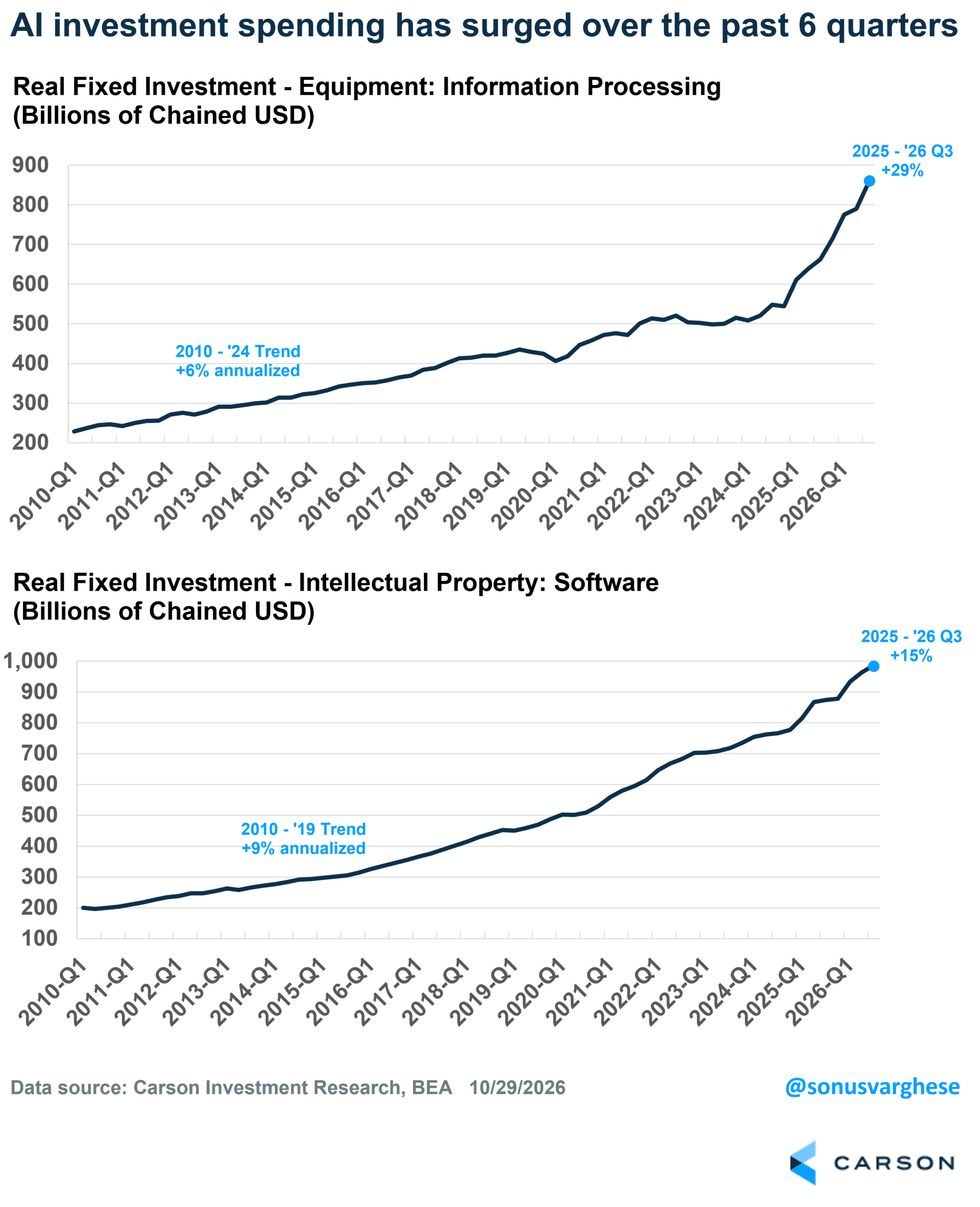
These numbers are simply massive, and their contribution to economic growth has been extraordinary. Real GDP averaged 2.3% annualized over the past seven quarters, with IT equipment and software investment contributing 0.91 pp per quarter, almost 40% of total growth. Consumption contributed 1.59 pp, but it accounts for 68% of GDP, whereas these investment categories are only a small fraction of the economy.
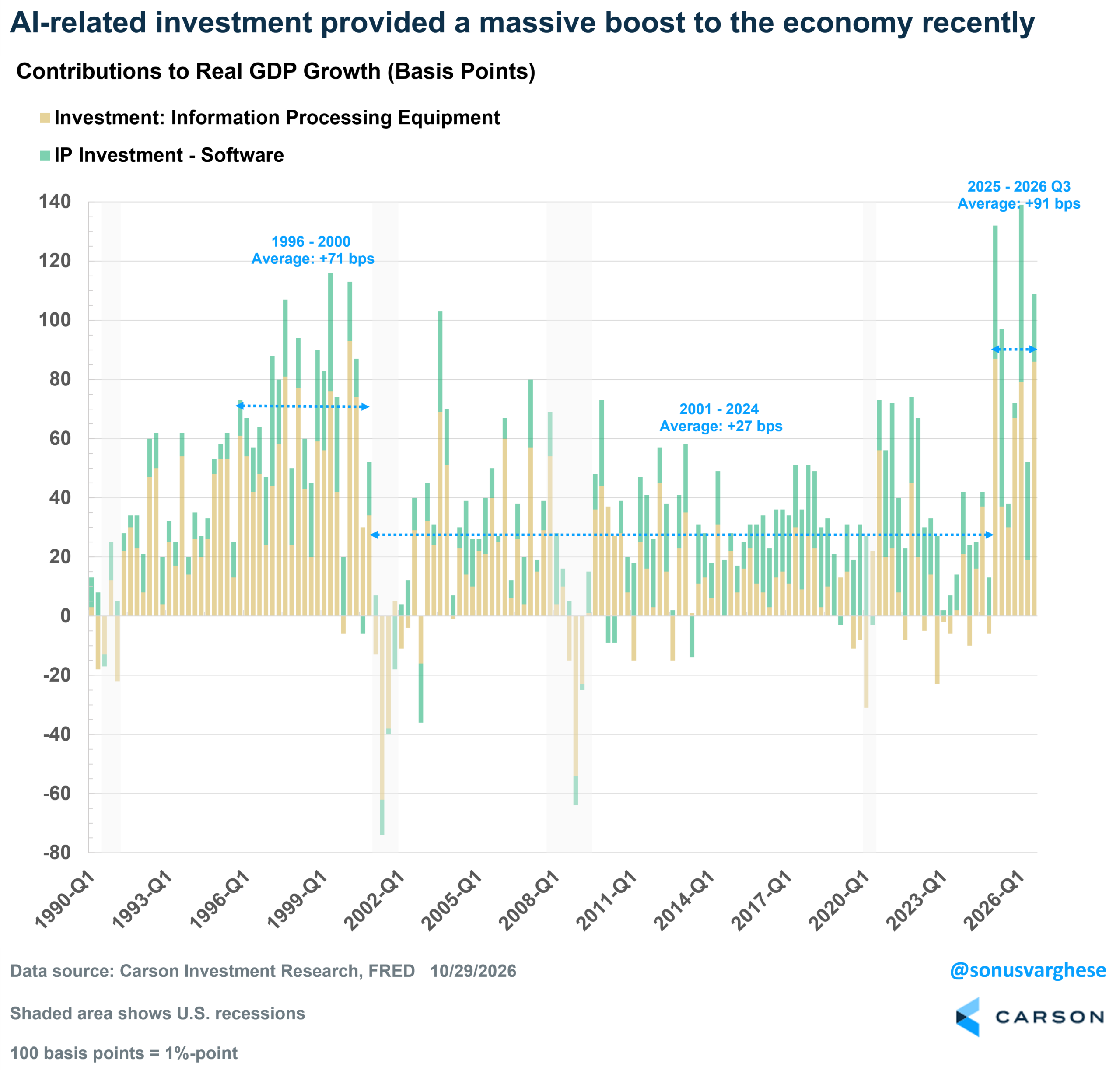
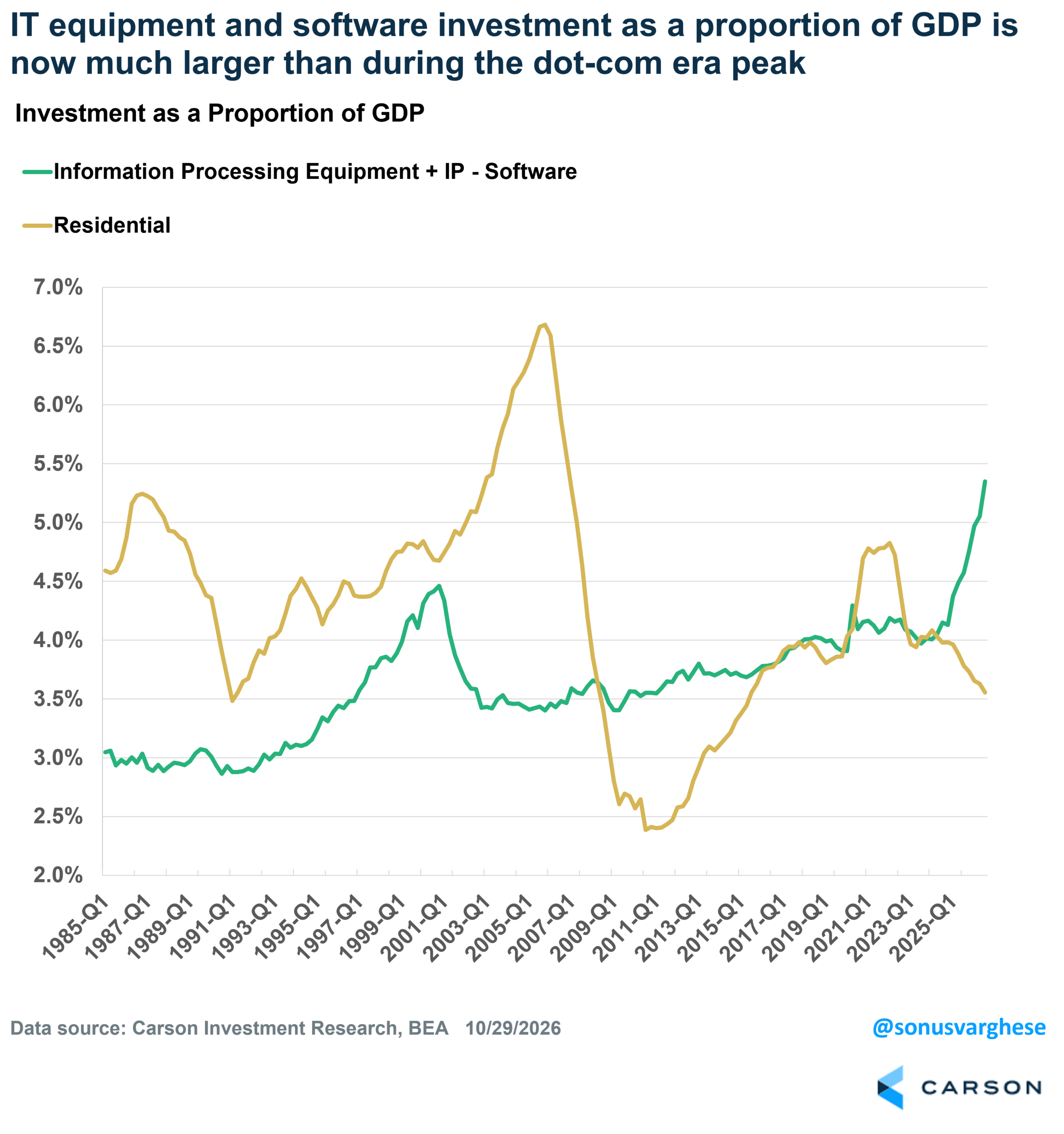
For perspective, IT equipment and software contributed just 0.27 pp per quarter from 2001–2024, and 0.71 pp during the internet boom of 1996–2000. Together, those categories now account for nearly 5.5% of GDP, above the dot-com-era peak of 4.5%. The share would exceed 7% if we include datacenter construction and AI-related industrial equipment. For perspective, residential investment made up over 6.5% of GDP at the peak of the housing bubble (it’s collapsed to about 3.5% since then). That tells you the scale of what’s happening. The AI investment surge is doing much more of the heavy lifting for growth than its relatively small share of the economy would suggest. This is hardly a minor part of the expansion anymore.
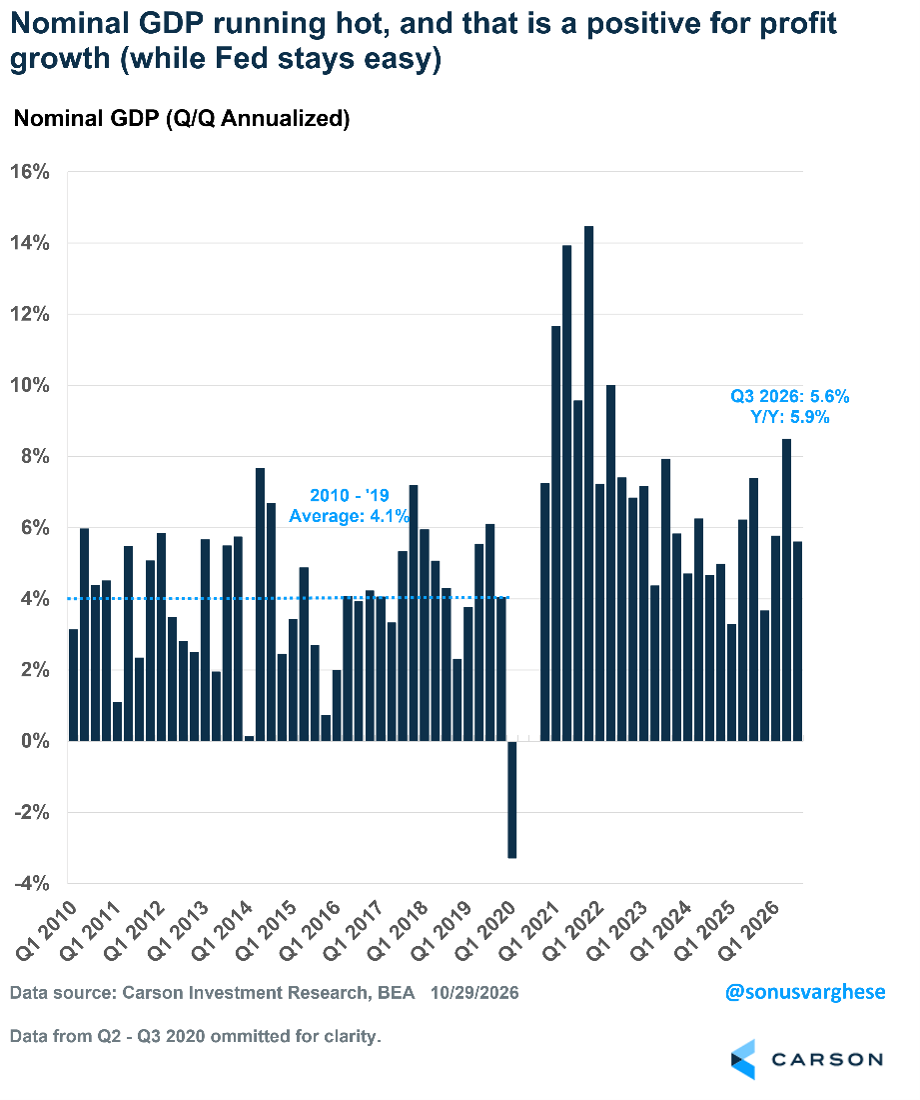
The numbers above are adjusted for inflation. Add that back, and the economy is running even hotter. Nominal GDP grew 5.6% annualized in Q3 and is up 5.9% year over year, well above the 4.1% annual pace in 2010–2019. Which brings us back to the Fed.
The Fed has raised rates by 0.25 pp this year, barely reversing the 1.75 pp of cuts in 2024–2025. In Q2 2024, before those cuts, nominal GDP was growing 6.2% year over year, unemployment was 4.1%, and the upper end of the Fed’s policy range was 5.5%. Today, nominal growth is close to that pace, unemployment is 4.14%, but the policy rate is just 4.0%. That captures how dovish policy actually is, regardless of the rhetoric. The Fed is willing to let things run hot, and that is a meaningful change from where policy stood just over two years ago, despite broadly similar nominal growth and labor market conditions. If anything, the latest data make it harder to argue that the economy urgently needs additional monetary support.
One thing to keep in mind is that strong nominal growth supports corporate revenues and profits, which is a near-term positive for stocks. At least until the Fed feels compelled to rein things in. And that brings us to inflation.
The inflation numbers are ugly, and the only consolation is that they’re not as bad as in 2022. At the end of 2023, the median Fed official expected core PCE inflation to reach 2% in 2026. By the end of 2024, that had slipped to 2027; in 2025, to 2028; and now to 2029. “Timely return” clearly doesn’t mean what you and I think it means. The Fed has repeatedly pushed back the expected date of victory over inflation, without a corresponding sense of urgency in its policy decisions.
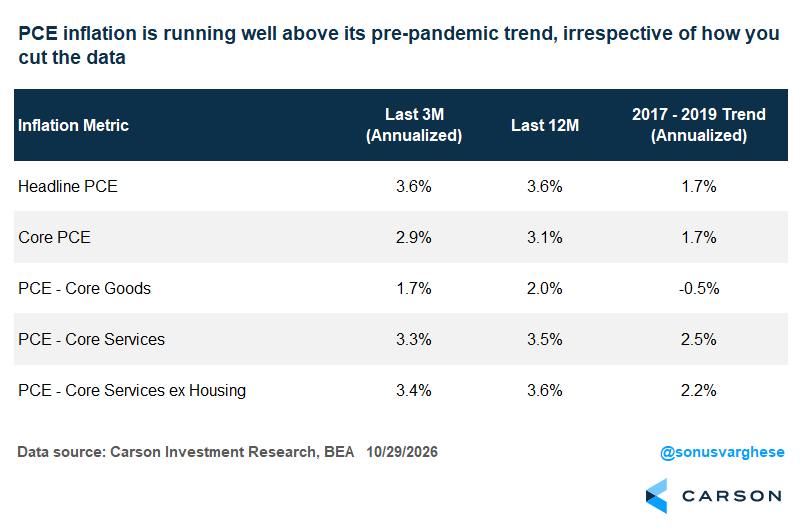
The latest PCE report showed headline inflation running at 6.1% annualized in September and 3.6% over three months. Energy is a big driver, but inflation remains problematic even without it. Core PCE rose 3.9% annualized in September and 2.9% over three months. Both goods and services are contributing:
- Core goods prices increased 1.7% annualized over three months, amid tariffs and AI-related bottlenecks. That may sound modest, but goods prices generally fell from 1995 through 2021.
- Core services excluding housing rose 3.4% annualized over three months. You can’t simply blame energy, tariffs, or AI for that.
The table below puts these numbers in context. Every measure is running above its 2017–2019 trend. And this is no temporary spike: year-over-year core PCE inflation has exceeded 2.5% for 66 consecutive months and currently stands at 3.1%. In other words, the inflation problem predates the latest energy shock and cannot be dismissed as just another one-off supply disruption. Price pressure remains broad, across goods and services.
Over the past five years, headline PCE inflation has averaged 3.8% annually, versus 3.6% for core. Remember, the Fed targets headline inflation; core is simply a guide to where it may be heading. The difference between 2% and 3.8% inflation compounds quickly. A basket costing $100 five years ago would now cost $110.41 at 2% inflation, versus $120.50 at 3.8%.
The Fed is waiting for more information, but it’s hard to understand what additional evidence they need. Staying on hold suggests officials are comfortable letting the economy run hot, even as inflation remains entrenched. Warsh has also announced fewer meetings at which the Fed will consider rate changes: seven in 2027, down from eight, and six in 2028. That adds to the risk of falling further behind. And the longer the Fed waits, the greater the chance it ultimately has to inflict more economic (and market) pain to bring inflation down. What looks supportive for markets today can therefore create the conditions for a much tougher policy response later. That’s the risk of fiddling while the economy runs hot.
For more content by Sonu Varghese, Chief Macro Strategist, click here.
9209676.1. – 20OCT26A