The Fed raised rates by 0.25%-points at their September meeting, taking the policy rate to 3.9% (3.75-4.0% range). That wasn’t a surprise, with Fed funds futures pricing in over a 90% probability of a hike on the eve of the meeting. But make no mistake: we’ve come a long way from early March, when the probability of a 2026 rate hike was zero. Odds rose in mid-March, fell back to zero by April, and didn’t move above 50% until May. Even then, uncertainty lingered through late August.
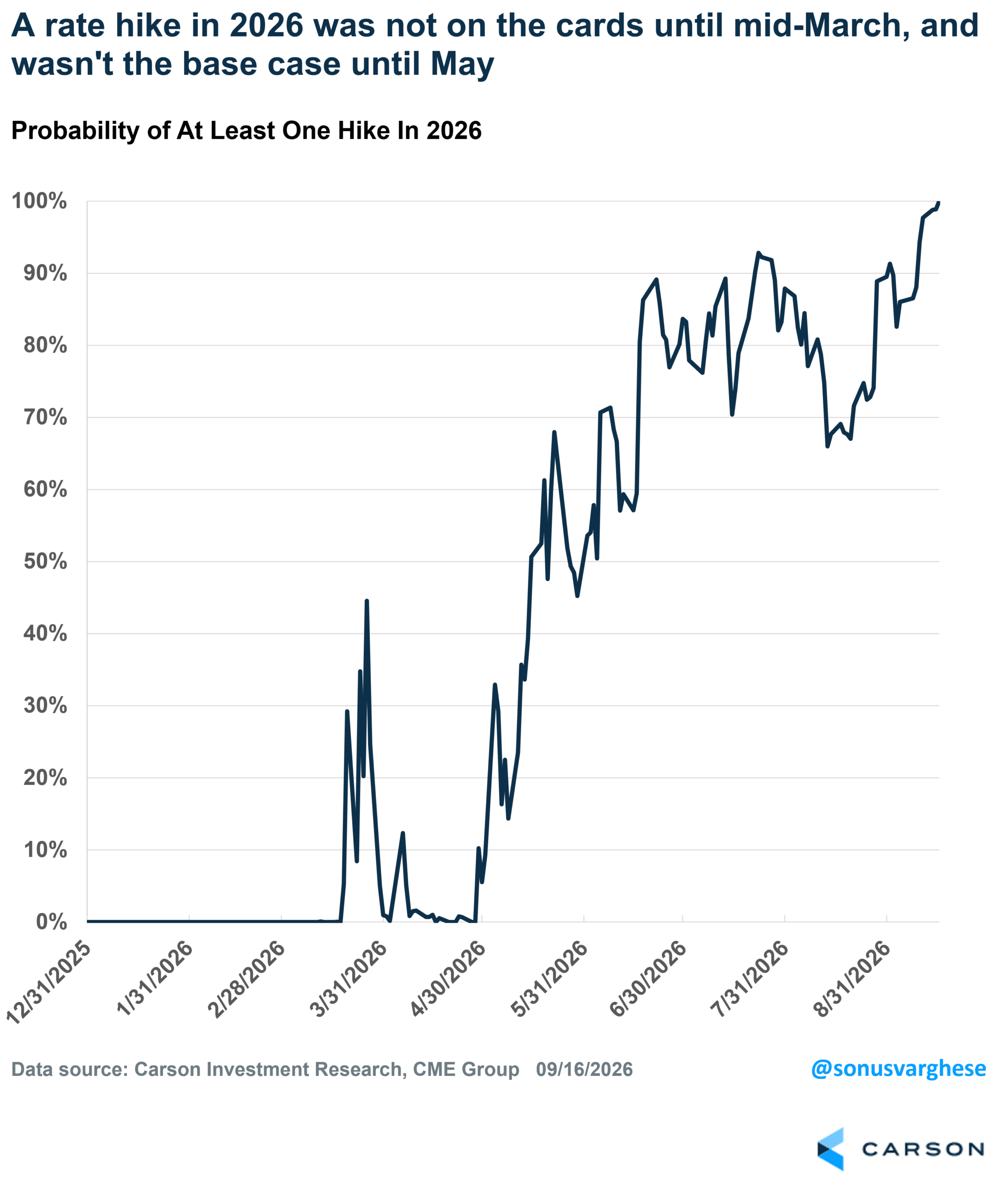
From the perspective of what was expected at the start of the year, this rate hike is a big surprise. Even a couple of weeks ago, the probability was closer to a coin toss than a near certainty.
So what changed?
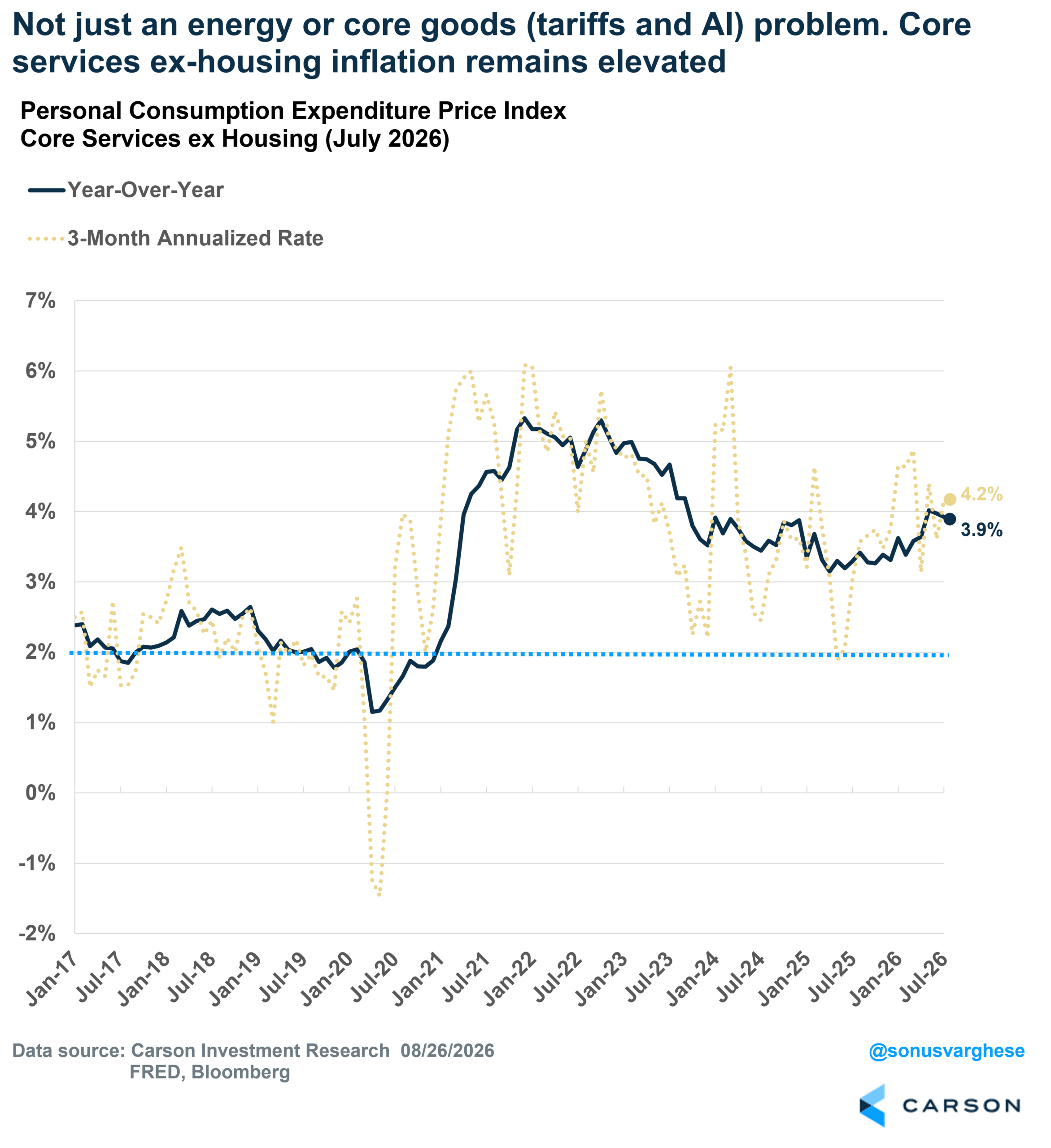
Well, obviously the inflation picture, though we were arguing all the way back in January (before the Iran war) that inflation remains a problem. That’s best captured by core services PCE, which excludes oil prices, tariffed goods, and AI-related bottlenecks. It’s up 3.9% from last year, well above what’s consistent with the Fed’s 2% target.
Are the projections really hawkish?
The September meeting also brought an update to the Fed’s Summary of Economic Projections (the “dot plot”), with Fed Chair Warsh the only one of 19 members to skip giving any “forward guidance.” On the face of it, the dots leaned hawkish, even beyond the move to 3.9%.
For 2026:
- The median member projected rates at 4.1%, up from 3.8% in June, implying one more rate hike
- 4 of 18 members projected 2 more hikes this year, taking the policy rate to 4.4%, versus just one member in June
But what’s interesting is that the median Fed member doesn’t think more hikes are necessary, i.e., beyond 2026. For 2027:
- The median projection was 4.1%, implying no hikes in 2027 – a shift from June, when 3.6% implied a rate cut next year
- 8 of 18 members do think one more rate hike in 2027 will be warranted, taking the policy rate to 4.4%
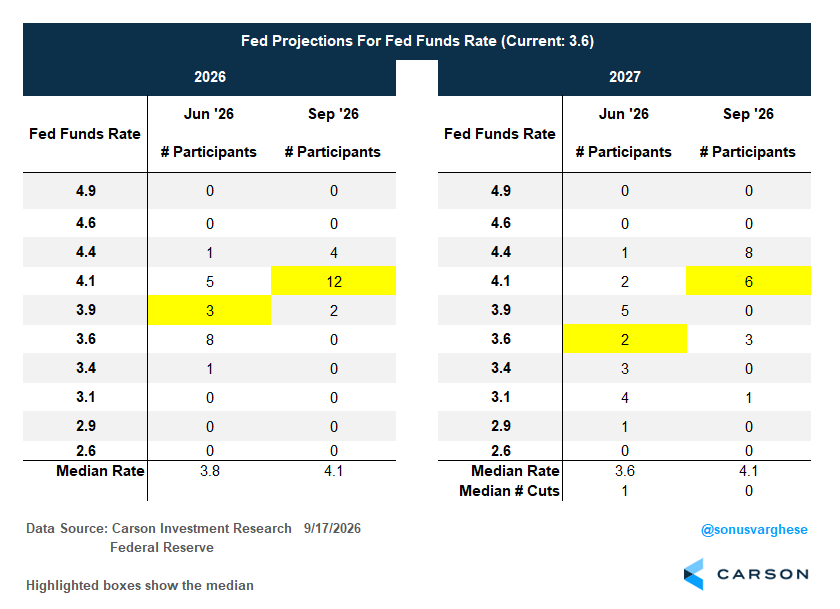
In short, the median Fed official expects one more hike this year, and most believe no more than that is necessary. Not a single member sees this hiking cycle requiring more than three hikes overall (0.75%-points). That’s despite stronger real GDP growth, lower unemployment, and higher inflation:
- The median 2026 real GDP growth expectations were revised up from 2.2% to 2.3%
- The unemployment rate for 2026 was revised down from 4.3% to 4.1%
- Core PCE inflation for 2026 was revised up from 3.3% to 3.4
The core PCE expectation for 2027 was unchanged at 2.5%, but inflation’s now expected to hit the Fed’s target of 2% only in 2029 (it was 2028 in June). By which time, inflation would’ve run above target for a good eight years. That’s a very, very patient Fed. In fact, Warsh said they’re only “removing a dose of accommodation.” That implies there’s more to remove, meaning policy remains loose while they wait for inflation to pull back on its own – something even they don’t expect anytime soon.

Stay on Top of Market Trends
The Carson Investment Research newsletter offers up-to-date market news, analysis and insights. Subscribe today!
"*" indicates required fields
Even more interesting is how the September projections compare with June 2025. Back then, the policy rate was 4.4%, and officials expected two more cuts, taking the 2026 rate to 3.6%. Instead, amid labor market jitters, they cut 0.75%-points from September-December 2025. That makes June 2025 a useful baseline, before last year’s “insurance cuts.” The shift in 2026 projections is striking:
- For 2026, the real GDP growth rate has been revised up from 1.6% to 2.3%
- The unemployment rate has been revised down from 4.5% to 4.1%
- Headline PCE has been revised up from 2.4% to 3.7%
- Core PCE has been revised up from 2.4% to 3.4%
- Nominal GDP growth (real GDP growth + inflation) implicitly revised from 4.0% to 6.0%
Despite these big shifts, the median 2026 policy rate projection moved up from just 3.6% to 4.1%. Another way to gauge how “dovish” that is: look at the “real” policy rate, or the projected policy rate minus projected inflation:
- In June 2025, the implied real policy rate for 2026 was projected to be 1.2%
- In September 2026, the implied real policy rate for 2026 was projected to be 0.4%
Yet the median Fed official doesn’t think all of last year’s interest rate cuts need to be reversed; 4.1% is enough. That’s despite much hotter inflation, historically low unemployment, and nominal GDP running well above trend (6% versus 4% from 2010-2019). Over the last fifteen months, they’ve also revised their “longer-run” policy rate from 3.0% to 3.2%. Think of that as their steady-state “neutral” rate, neither tight nor accommodative. Relative to neutral, policy is currently more accommodative than it was in June 2025. I don’t know how you can interpret this as anything but dovish.
Markets expect rates to be much higher
It’s one thing for the Fed to make projections, but another for the market to believe them. The entire expected policy-rate curve is above the current 3.9% rate and the Fed’s 4.1% terminal-rate projection. What’s incredible is that at the start of the year, markets expected a policy rate near 3% (at least two cuts) by the end of this year, versus 4.3% now (1-2 more hikes this year), followed by more hikes in 2027 to above 4.6%.
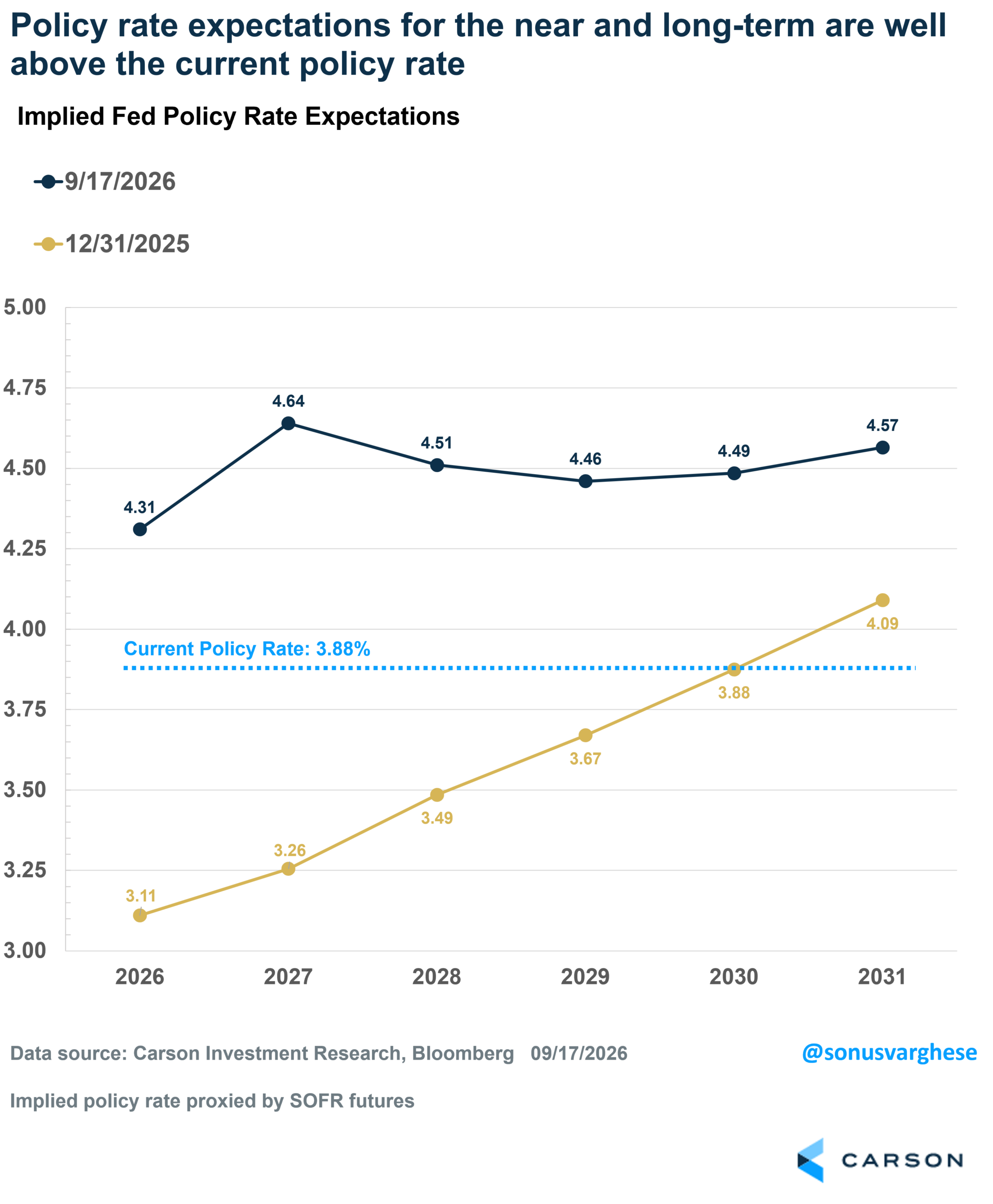
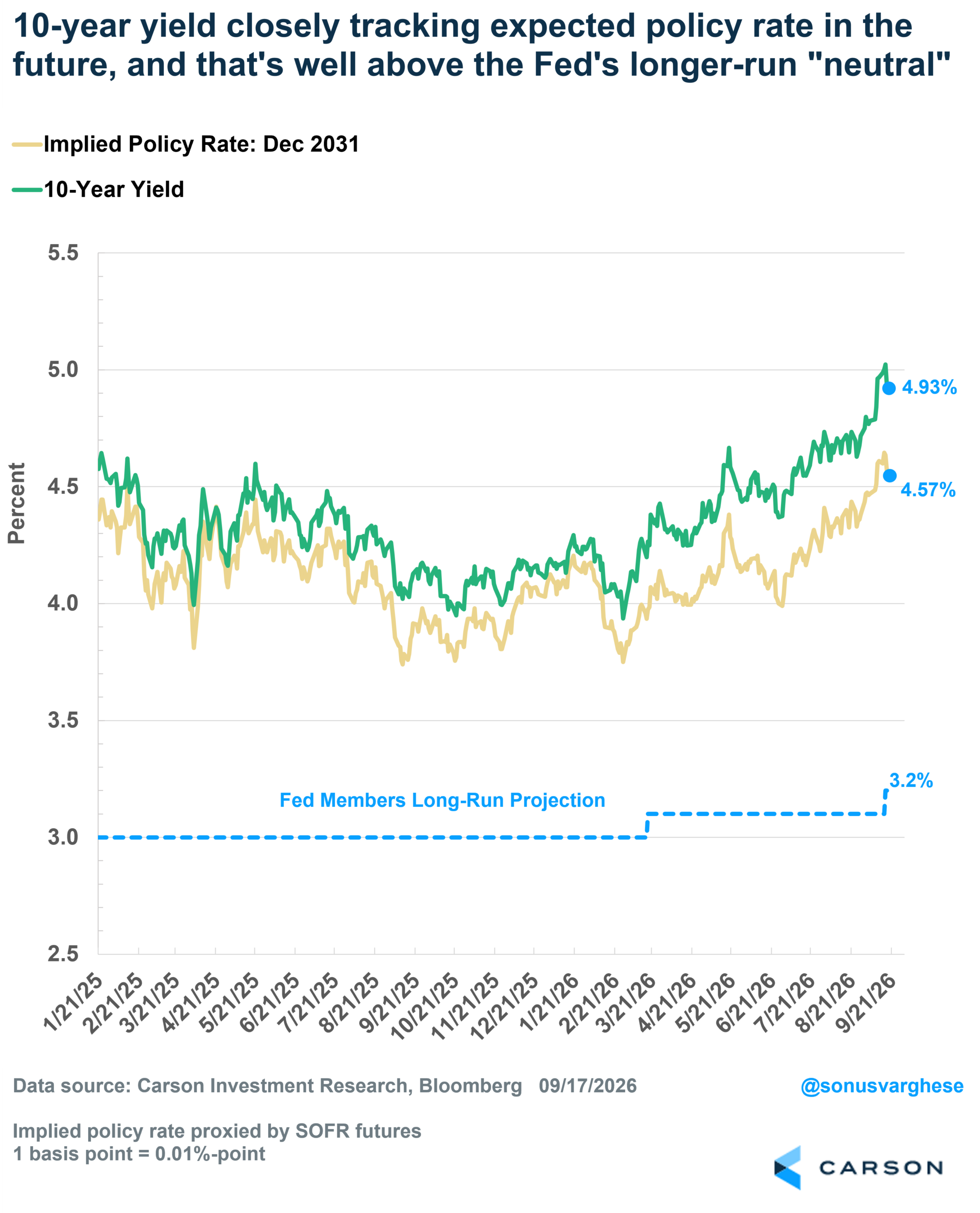
Look further out, and the disconnect is just as large. Fed officials put the longer-run rate at 3.2%. Using the 2031 expected policy rate as a proxy for “long run,” the market is at 4.57%. The 10-year yield, now almost 5%, has closely tracked that expectation. In other words, markets expect more hikes than officials project and rates to stay higher for longer to tamp down inflation.
Rates may not be high enough for a hot economy driven by AI-capex
In the near term, a dovish Fed facing a hot economy and persistently elevated inflation is bullish for the stock market. I was looking for any hint from Warsh that they’re worried about the AI boom and its potential to keep things hotter than they’d like. There was nothing on that front, which means the wave is likely to get bigger. I’ve pointed out that nominal GDP growth is currently running at the same pace as it was in the late 1990s (~6%), but interest rates are much lower.
Another way to look at this is via S&P 500 revenue growth. Revenue growth isn’t exactly analogous to nominal GDP growth, because the latter is “value-add” (revenue minus intermediate inputs). But it’s still a useful coincident indicator of nominal GDP growth in this AI-capex-heavy cycle, much more than in a consumption/services-driven cycle (especially for the trend, rather than the level since revenues likely will show greater amplitude):
- From 1976-2026, S&P 500 revenues have grown at a trend of about 5% per year
- Revenue growth in the 2020s has averaged about 7.5%, and accelerated recently, with Q2 2026 clocking in at 15% year-over-year and Q3 expected to be 12%
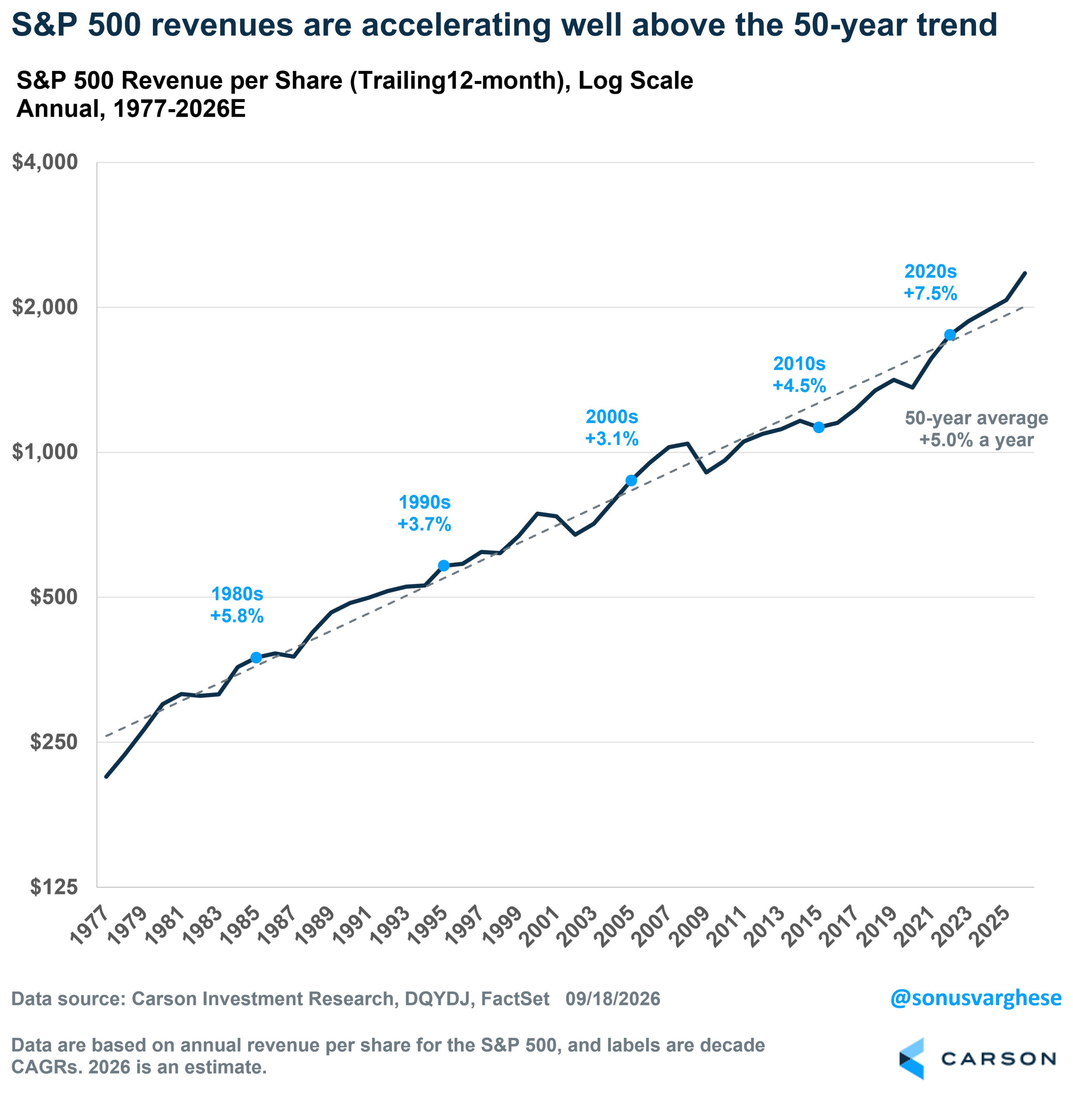
It would be one thing if AI was driving revenue and GDP growth because AI was boosting productivity as it was increasingly deployed across the economy. But right now that’s not the case, and the boost is coming from investment spending. But that’s inflationary as well. The big bump in revenue growth is driven primarily by Technology, where revenue is expected to grow 40% in Q3. That, in turn, is driven by semiconductors (+80%), technology hardware and storage (36%), communication equipment (25%), and electronic equipment and components (22%). Surging revenues for companies making these key inputs for the AI buildout are the other side of a hot economy (with hot inflation).
For now, the Fed doesn’t want to spoil the party. But the longer they remain dovish, the greater the risk they’ll have to make a bigger adjustment later. That may be really painful.
For more content by Sonu Varghese, Chief Macro Strategist, click here.
9134683.1. – 18SEPT26A