We just released our Midyear 2026 Outlook: Still Riding the Wave, raising our estimate for the S&P 500’s full-year return from 12-15% to 15-18%. This is on the back of an AI wave that continues to roll, though the water is choppier than it looked at the start of the year. While the labor market picture has improved over the last six months, the inflation picture has deteriorated (partly due to AI-related bottlenecks and rising stock markets). Economic growth, especially after adjusting for inflation, has eased to about 2%, but activity is largely being held up by the AI infrastructure buildout. However, nominal GDP growth is what matters for revenues and profits, and that’s clocking in around 5-6% currently (thanks to inflation). All this to say, the AI wave is both a markets story and a macroeconomic story. And what’s important to remember here is that one company’s investment spending is the source of another company’s revenue and profits. And margin expansion, which has largely driven profit growth this year, is yours and my inflation.
With profit growth being the big story, and given we’re moving into the meat of earnings season, here are three things I’m watching.
One: AI-Related CapEx Spending
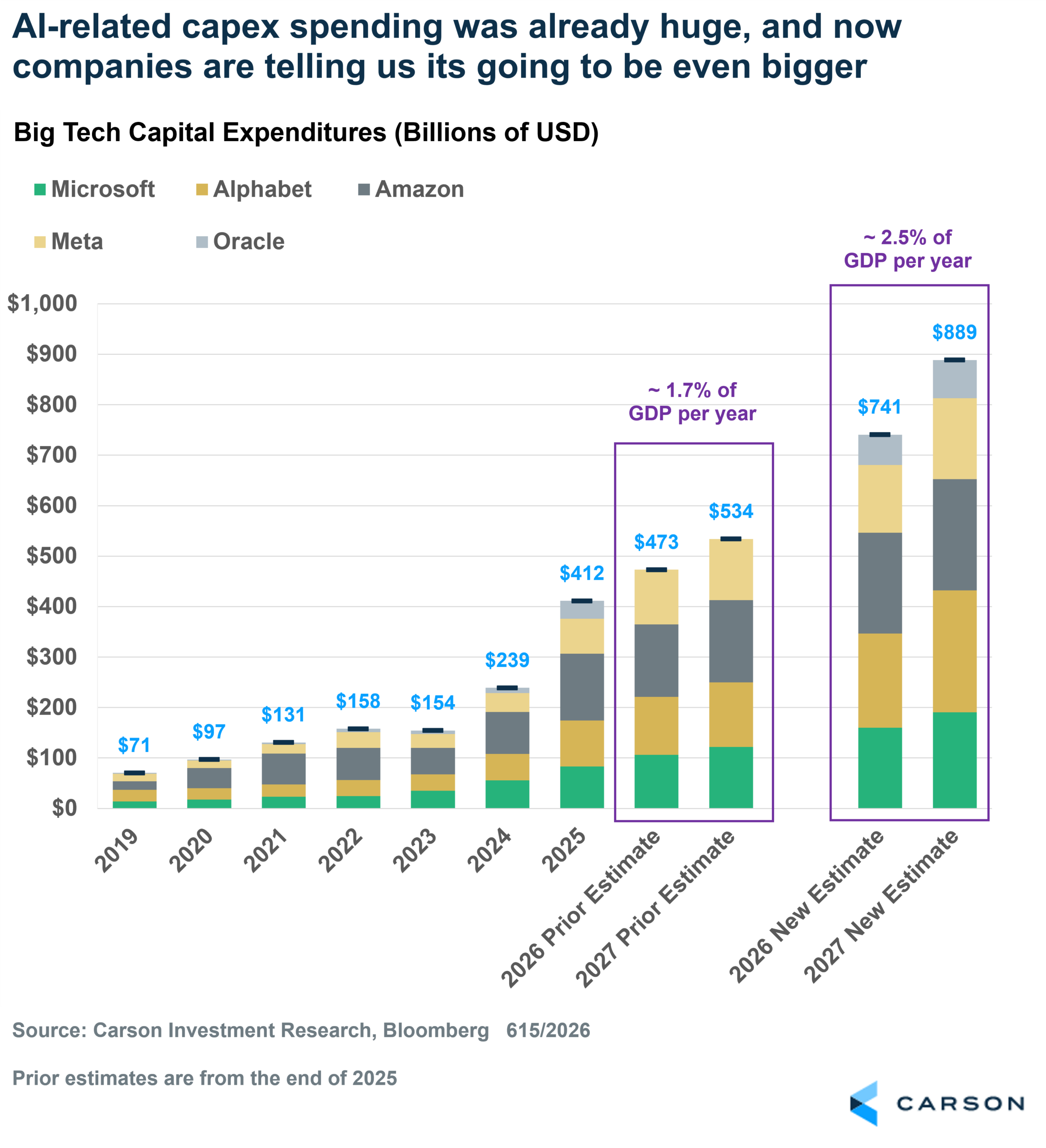
The first thing I’ll be looking at is the rate of growth of AI-related capex spending. The big tech firms, especially those that provide large-scale cloud capacity and operate hyperscale-level data centers (Microsoft, Alphabet, Amazon, Meta, Oracle), have ramped up spending even over the course of this year. At the end of last year, these firms were estimated to spend a total of $515 billion on CapEx in 2026, up from almost $400 billion in 2025. That amounts to about 1.6% of GDP, which is staggering. The most recent updates take the 2026 CapEX estimate to a whopping $740 billion, which is about 2.3% of GDP—over 4x the level of CapEX in 2023 (0.5% of GDP) and 7x the size in 2019 (0.3%). 2027 is expected to be even larger.
The big question is whether this will continue to increase, and if so, at what rate. As I mentioned above, one company’s investment is another company’s revenue and profit opportunity. So the rate of growth of CapEx will matter for the rate of profit growth.
Two: Forward-Looking Earnings Estimates
Since market returns are mostly driven by profits, this is a bit of a no-brainer. During earnings season, it’s easy to focus on how much companies surprised analysts (and investors in general) on the prior quarter’s earnings and revenues. But it’s forward-looking earnings that matter.
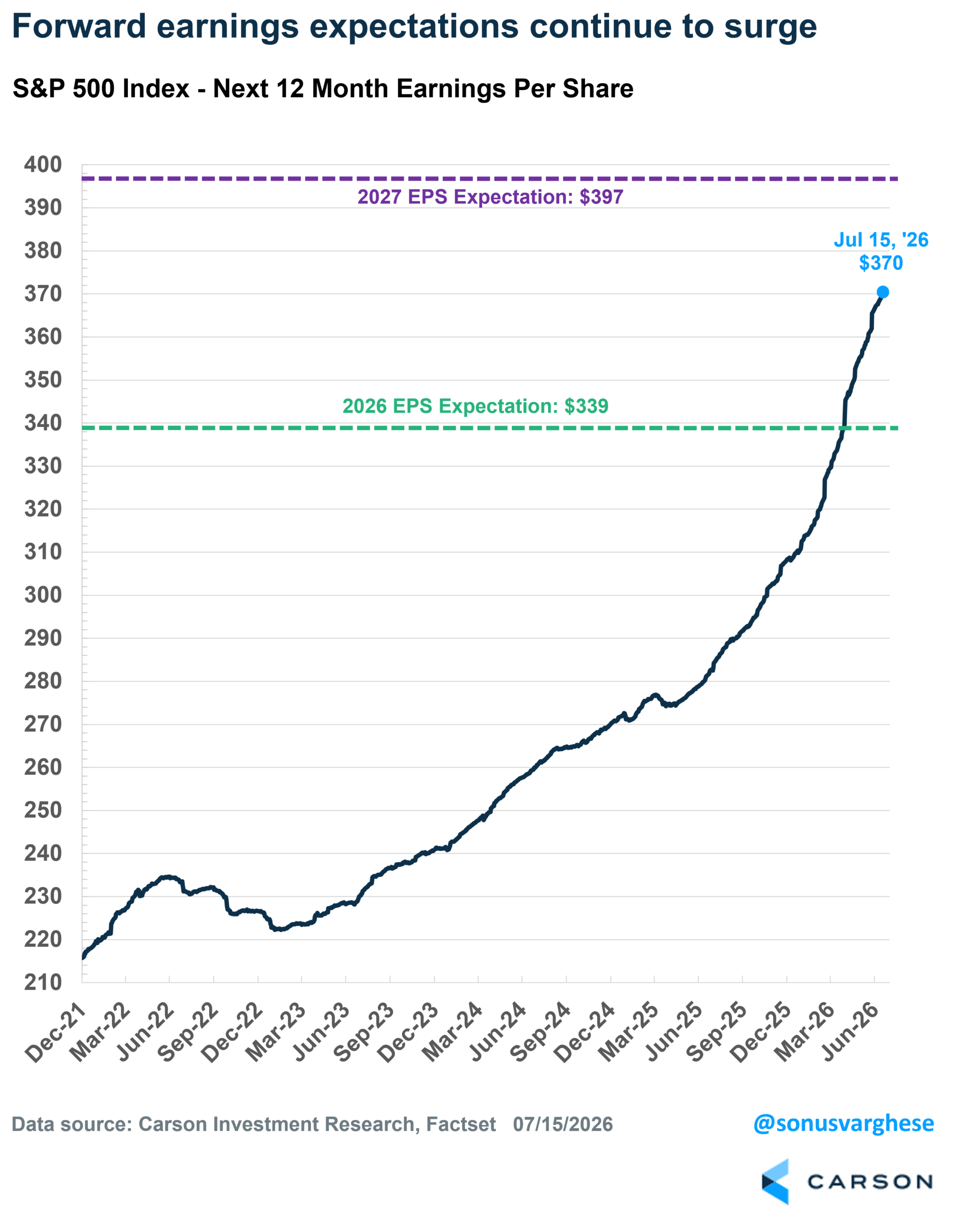
The S&P 500’s next 12-month (NTM) EPS is currently $369/share, up 20% since the end of last year and 4% since the end of May (just after the bulk of Q2 earnings season). The war was hardly an obstacle in the earnings estimate surge, with NTM EPS up 16% since February 27th (the eve of the US-Iran war). In other words, most of the increase in NTM EPS has come over the last 4.5 months, since the war started.

Stay on Top of Market Trends
The Carson Investment Research newsletter offers up-to-date market news, analysis and insights. Subscribe today!
"*" indicates required fields
Keep in mind that the next-12-month (NTM) EPS is now almost equally about 2026 EPS and 2027 EPS expectations – just under half of NTM EPS is expected EPS for 2026 ($339) and just over half is expected EPS for 2027 ($397). At the end of the year, the NTM estimate will match the 2027 estimate exactly. As 2026 gets underway, the next 12-month EPS should continue rising, as it incorporates more of the 2027 EPS expectation (as long as 2027 EPS doesn’t fall significantly). In other words, we’re looking at yet another year of strong EPS growth.
Right now, the expectation is that 2027 EPS will be 17% higher than 2026 EPS. At the start of the year, 2027 expected EPS growth was 15%.
- At the start of the year, 2026 EPS estimate was $308, and now it’s $339 (+10%)
- At the start of the year, 2026 EPS estimate was $355, and now it’s $397 (+12%)
All this to say, the increase in 2026 EPS is not a “pull forward” from 2027. In fact, 2027 EPS estimates have increased even more.
Let’s take a look at how the sectors contributed to the increase in 2026 and 2027 EPS estimates. I also thought it would be interesting to see how the sector contributions have changed since we wrote our Midyear Outlook about a month ago, in which we discussed this breakdown. It’s really a technology story (the AI wave), where earnings estimates for both 2026 and 2027 have surged:
- The S&P 500 has seen 2026 estimates increase by 10% (up from 9% a month ago) and 2027 estimates increase by 12% (up from 10% a month ago)
- The tech sector has seen 2026 EPS estimates grow by 21% (up from 18% a month ago) and 2027 estimates grow by 33% (up from 26% a month ago)
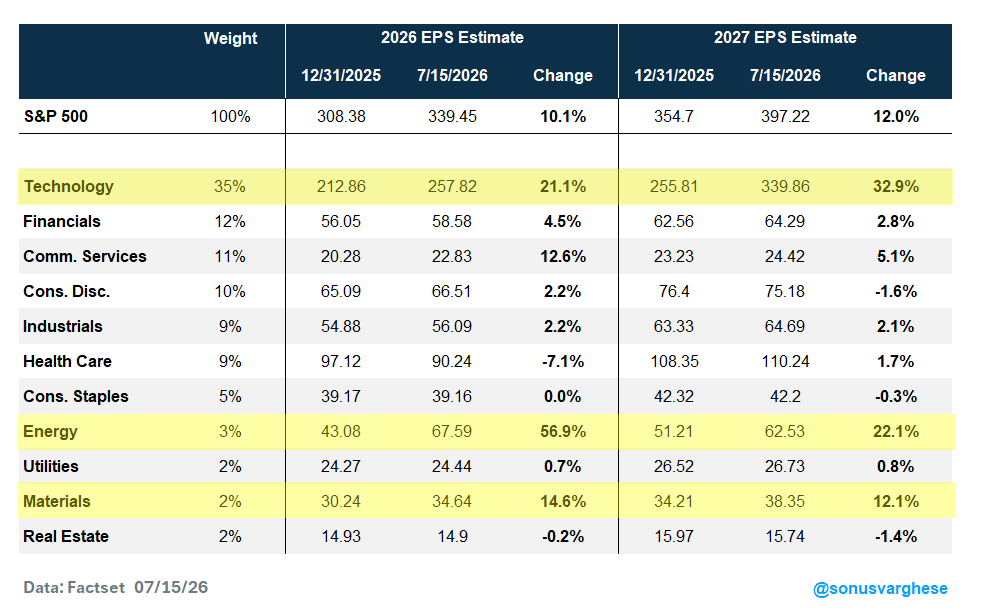
Profit growth and margin expansion also translate to inflation. The three sectors that have seen profit growth estimates soar are technology, energy, and materials, which are all benefiting from inflation related to AI bottlenecks and the energy spike due to the Middle East conflict.
Three: Private Market Revaluations Within Public Company Profits
Here’s another thing we wrote in the Midyear Outlook: one big source of “surprise” in the Q1 earnings season was how valuations for AI firms showed up on the income statement for the hyperscalers and Nvidia. This essentially shows up as gains on “non-marketable securities,” which are mostly investments in Anthropic and OpenAI. A significant chunk of earnings growth came from increasing valuations for these private AI firms.
For Alphabet and Amazon, it was over 50% of GAAP earnings. This network of AI cross-holdings, with private valuations boosting profits for public mega-cap tech firms (and stock prices), has benefited these mega-cap hyperscalers, and the effect is expected to be even larger in future quarters (as long as private valuations hold up).
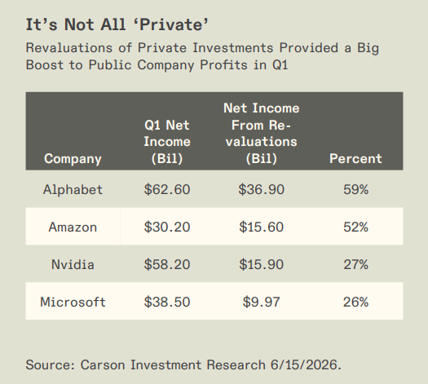
This is one of the charts I’ll be keen to update once Q2 earnings season is wrapped up, and to see how much more of net income (and the “earnings surprise”) comes from revaluations of private investments.
Big picture: we expect the AI wave to continue to roll on, boosting profits and driving the bull market into its fifth year. But we’ll be keeping a close eye during earnings season to get a sense of where we are in this investment (and profit) cycle, and whether near-term choppiness will translate to something larger, or not.
Ryan and I discussed our Midyear Outlook on our latest Facts vs. Feelings episode. Take a listen:
For more content by Sonu Varghese, Chief Macro Strategist, click here.
9030081.1. – 20JULY26A