“People calculate too much and think too little.” Charlie Munger, Former Vice Chairman of Berkshire Hathaway
First things first, stocks were flat last week, but the S&P 500 continues to hold above its June peak. This level is a logical area of support. The 50-day moving average, which is just below this area, provides additional support. For now, we’d expect these two areas of support to hold.
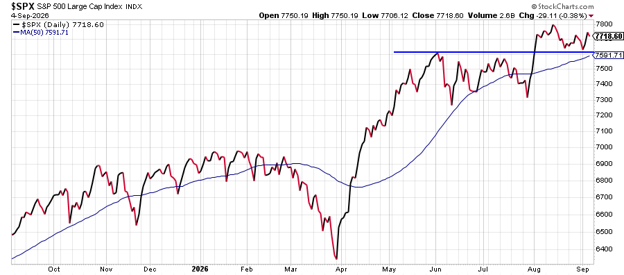
We noted last week that historically the month of September can be dicey for stocks, but we continue to expect this year to buck that trend, similar to the past two years in this most bearish month of the year. The longer stocks consolidate at current levels, the more we’d expect that eventual resolution to be higher.
All Eyes On The Fed
The upcoming Fed decision on interest rates on September 16 is going to be what most traders focus on this week, specifically the inflation data we will see at the consumer and producer levels. But how much would a 0.25% hike really matter? We do have a $31 trillion economy, after all. Also, last week saw strong manufacturing and services data, along with a much better picture of the labor market. The economy continues to improve (and runs hot in some cases), and a stronger labor market is a major positive.
Let’s be clear: our base case remains that the Fed is probably on hold the rest of this year and a hike in September isn’t likely, although it’s certainly possible. We don’t think they should be on hold, because inflation is high and the economy is more than capable of absorbing a hike, but that’s the direction Warsh is still leading them in. After last week, the odds of a rate hike are hovering around 60%. Depending on the inflation data this week, the odds of a hike could go much higher or lower.

Stay on Top of Market Trends
The Carson Investment Research newsletter offers up-to-date market news, analysis and insights. Subscribe today!
"*" indicates required fields
Think about that one more time. The chance of a hike in September is 60%, and the Fed funds futures are pricing in only one hike the rest of this year. This, with various commodity prices (specifically the grains lately) soaring, copper at all-time highs, rates trending higher, and a labor market that appears to be turning the corner and improving. To us, the Fed is overall quite net dovish, and the market knows it. We’ve said for a few months now that the Fed will run it hot, and little has changed our views there.
The Size of the Hike Matters
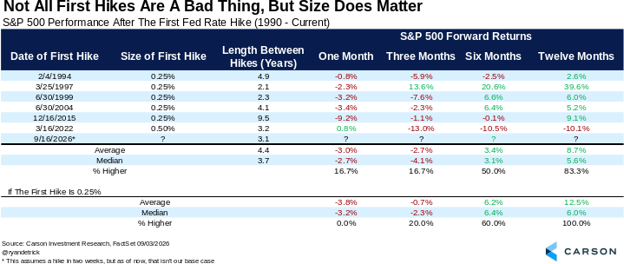
Now let’s get to what history says about the first rate hike in a new cycle. Let’s say the Fed does hike. If they do, the odds are wildly in favor of it being just a 0.25% hike, and history says a smaller hike to start things off isn’t a bad sign overall.
Looking at the five recent rate hike cycles that started with a 0.25% hike, stocks were lower one month later every single time, so some early rockiness is possible. But going out a year, stocks were never lower. The fly in the ointment is that the one time the first hike was larger at 0.50% (in March 2022), stocks were lower a year later by double digits, and interestingly higher after one month. Of course, if there is a hike in September, though, it is overwhelmingly going to be 0.25%.
Let’s cross this bridge when we get there, but the reality is all we hear about on TV is whether the Fed will hike 0.25% or not. To us, the potential improvement in the labor market is a more welcome development and one that suggests the economy should continue to improve. Should there be a hike, the economy will take it in stride.
I had the honor of joining Morgan Brennan on CNBC’s Morning Call this morning, and I discussed the Fed running it hot. You can watch the full interview below.
For more content by Ryan Detrick, Chief Market Strategist, click here.
9114830.1. – 8SEPT26A