

Jargon alert! Tracking error is thrown around by investment professionals as often as “basis points”, “synthetic”, and “private credit” without a full realization of what the term means. Tracking “error” is an important concept that is only an “error” in certain situations and can be a good thing in other situations. Bear with me – let’s look at the true definition of what tracking error is:
Tracking error = Standard deviation of differences between a security and its benchmark (Portfolio return – Benchmark)
In plain(er) language, that means tracking error measures the degree to which a security or portfolio deviates from its benchmark. This is important, if you don’t deviate from your benchmark – that’s fine – but it also means that you are the benchmark, and that exposure should be very inexpensive. But if you don’t deviate from your benchmark, then you also realistically cannot outperform your benchmark (mathematically) unless you are generating some additional source of returns above and beyond.
Equations are a surefire way to lose readers, so let’s look at that again in visual form:
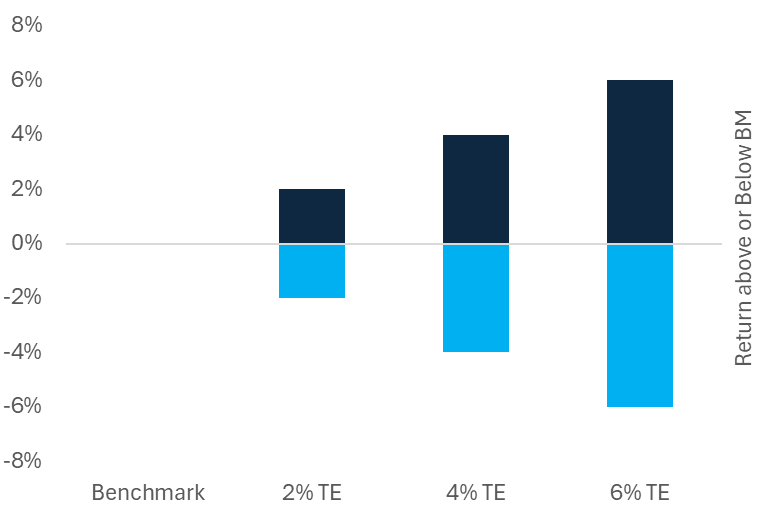
I have heard it said many times that “Clients don’t care about tracking error”. While there is truth to that, understanding is halfway to caring. Tracking error can measure a few things that may or may not be important to clients, but are important to us:

Stay on Top of Market Trends
The Carson Investment Research newsletter offers up-to-date market news, analysis and insights. Subscribe today!
"*" indicates required fields
Risk
Tracking error by design is a measure of risk – active risk – of a portfolio. Knowing the degree to which a portfolio has historically and should be expected to deviate from a benchmark is an important consideration for both what could go right (upside tracking error) and what could go wrong (downside tracking error). This is a great way to set expectations with clients.
Degree of freedom
We also use tracking error/active risk within portfolios we manage as guardrails. We “spend” this active risk as wisely as we can, realizing that we should be deviating from our benchmark in areas that we have the highest conviction in. We also use a variety of tools to measure this active risk and monitor it closely – knowing where risks lie is very important as well. We want to watch out for unintended risks that we are not explicitly trying to take.
Active Manager Evaluation
Tracking error is also a great way to monitor, measure, and assess active managers. A simple rule of thumb is that a manager should have a higher tracking error than their fees – if they don’t, how should they be expected to overcome the drag from expenses? Low tracking error can be acceptable if the manager is doing that on purpose and keeping fees very low; if not, they could be labeled a “benchmark hugger”. Low tracking error strategies that add incremental outperformance over time can be very beneficial if they maintain a high degree of consistency. Higher tracking error strategies should be especially criticized for consistency. These managers likely look very different from their benchmark, which is a necessity to deliver high degrees of outperformance, but it can just as easily go the other way. Tracking error goes both ways, so when we analyze higher tracking error managers (usually more concentrated as well), we want to think about portfolio sizing and even pairing a lower tracking error strategy with a higher one to deliver a smoother ride for investors.
If you made it this far in the blog, I really appreciate it! Tracking error is an important measurement tool that finds itself listed in a lot of the various strategy materials we offer at Carson. It is important to keep an eye on and understand what it means. Tracking error is necessary for outperformance – but that also opens the door for underperformance. Balance is key – thanks for reading.
For more content by Grant Engelbart, VP, Investment Strategy & Research, click here.
8845000.1. – 27MAR26A