“People calculate too much and think too little.” Charlie Munger
Happy April Fool’s Day for those who celebrate! Stocks have been struggling lately, and this is no joking matter. Could we see a bear market in 2026?
The S&P 500 recently was down about 9% from the late January peak. We did a lot of work on mild pullbacks, corrections, and bear markets in Five Lessons All Investors Need To Know in Today’s Volatile Times, but today I wanted to dive more into the odds of going into a bear market.
We are using the traditional definition of a bear market, a 20% decline on a closing basis from recent highs, and the good news is we don’t see this happening.
Sure, should things spiral out of control in the Middle East, it’s possible, but here are some reasons we think it’s unlikely.
Earnings and Profit Margins Hit New Highs
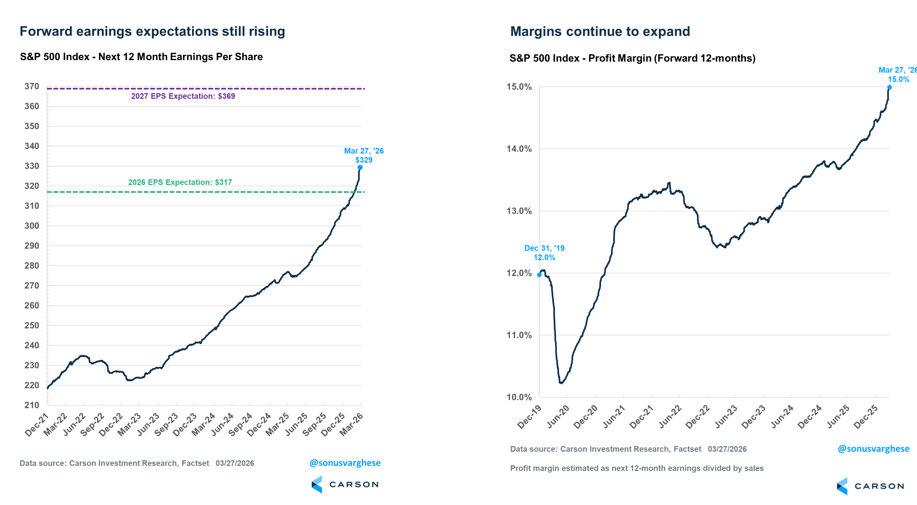
I’ve called these two the dual tailwinds to the bull market for going on three years now, and things aren’t slowing down yet. In fact, the next 12-month S&P 500 earnings are up a very impressive 6.7% so far this year, with 3.6% of that coming just since the war started. In fact, all 11 sector earnings estimates have increased since the war started, but most of the index earnings gains have come from technology. On top of this, S&P 500 forward profit margins have hit a new all-time high of 15.0%, up from 12.0% at the end of 2019. It is hard to get overly bearish when both earnings and profit margins are hitting new highs.
Bull Markets Usually Don’t End Now
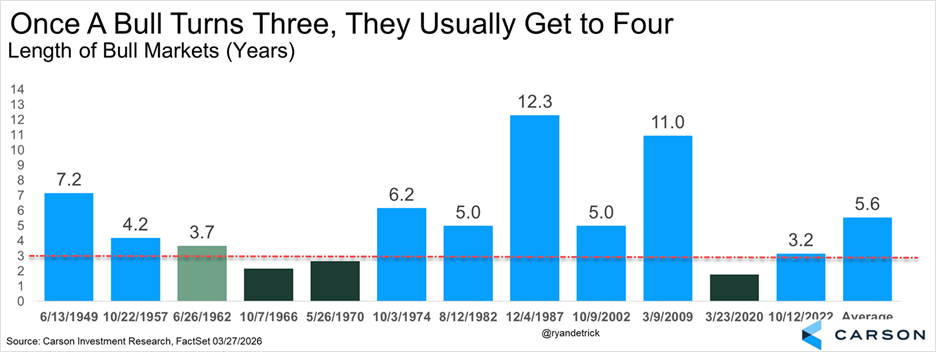
Another reason we don’t see a 20% bear market now is that this bull market has made it past its third birthday, and when that happens, it is quite normal for it to see a cake with four candles on it. I’ve long said that bull markets are like a cruise ship—once they get moving, they are hard to slow down and very hard to turn around. Yes, we’ve had short bull markets (like the not even two-year bull off the Covid lows in March 2020), but historically, once a bull has reached this point, it’s failed to make it another year only once (the 1960s bull market). Seven of the eight other bull markets that made it this far all reached at least their fourth birthday. In fact, all five bull markets of the past 50 years that lasted at least three years made it at least to their fifth birthday. The bottom line, this is another reason to expect this bull market to continue.

Stay on Top of Market Trends
The Carson Investment Research newsletter offers up-to-date market news, analysis and insights. Subscribe today!
"*" indicates required fields
Bears Start Off Bad
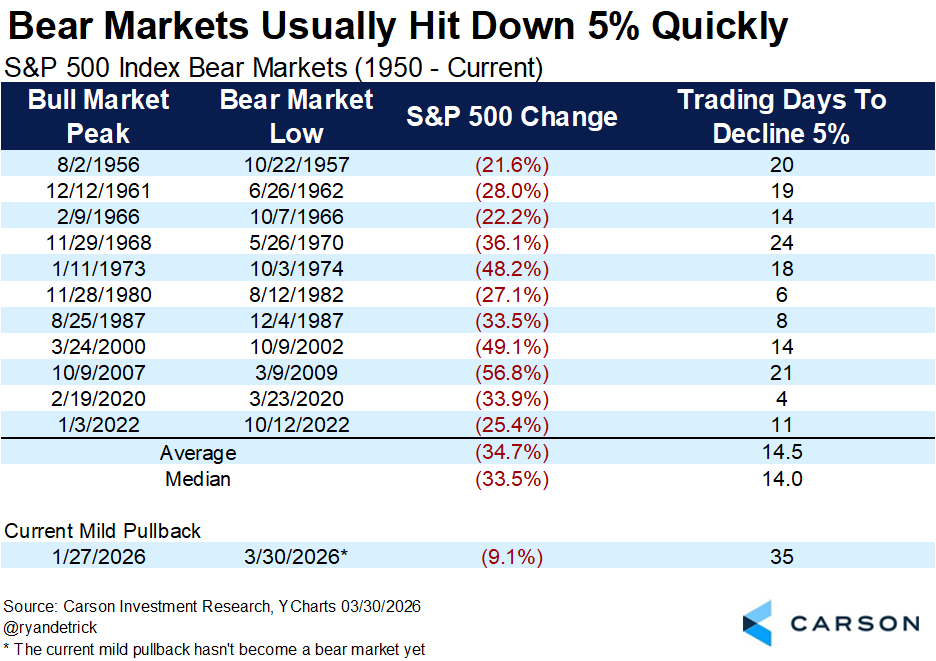
The S&P 500 peaked on January 27, and it wasn’t down 5% until March 18, some seven weeks later. I was watching CNBC yesterday, and I saw my friend Sam Stovall, CFRA’s U.S. Equity Strategist, who noted that a bear market has never started when it took so long for the initial 5% mild pullback to occur.
I dug in some and found similar results. Using trading days, this time it took 35 days to be down 5%, and the previous 11 bear markets saw things down 5% in less than 15 days. In other words, at the start of a bear market, it typically takes about three weeks to be down 5%, but this time it took seven weeks to get there. The longest initial down 5% to then move into a bear market? 24 trading days in late 1968. The bottom line? Bear markets tend to start off with a bang, and the action so far simply doesn’t fit.
As always, thanks for reading and following what our team has to say right now. For more of our thoughts, please be sure to watch our latest Facts vs Feelings below.
For more content by Ryan Detrick, Chief Market Strategist, click here.
8852342.1. – 1APR26A