

Eli Lilly’s market cap eclipsed $1 trillion in Friday’s trading session (according to FactSet data). They became the first healthcare company to achieve this milestone. The simple explanation for how this company joined the four-comma club is ‘diversified growth’ as a product of research and development. The company has cultivated numerous blockbuster drugs culminating with GLP-1s. While it’s a simple formula, the results have been anything but slim.
Diversified Growth
Eli Lilly’s development pipeline has consistently produced ‘blockbuster’ products – classified as those which reach $1 billion in annual sales. In the past decade, Lilly has grown nine separate medicines to above $1 billion in annual sales as shown below (FactSet data). While their latest anti-obesity medicines (Zepbound & Mounjaro) have stolen the show recently, the breadth of Lilly’s portfolio remains a differentiator.
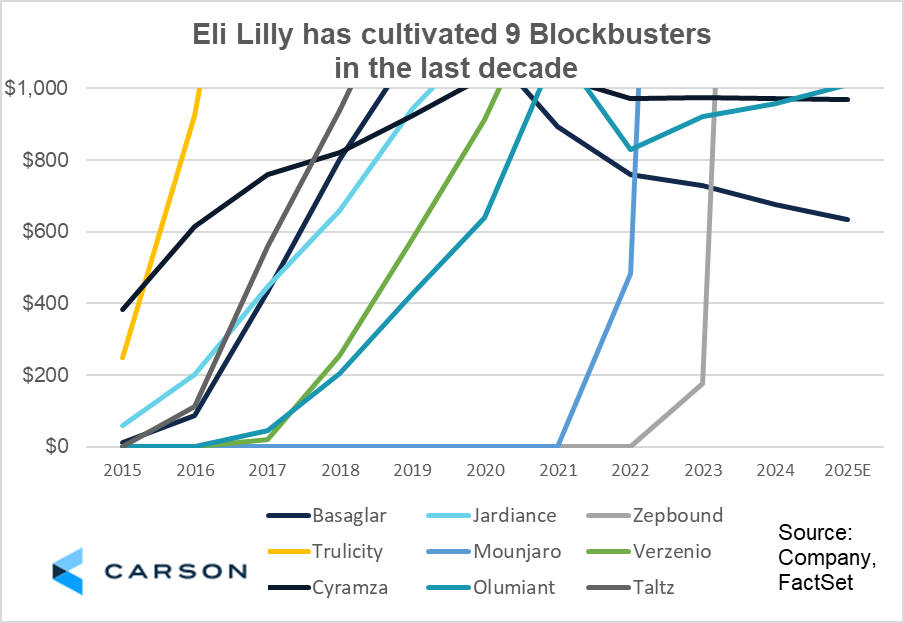
Developing nine blockbusters is quite a unique feat. Within the pharmaceutical and biotech universe (comprised of 283 publicly traded companies currently in IHE and IBB), 231 see under $1 billion in expected total sales in 2025 (FactSet data). Said differently, any one of Lilly’s nine blockbuster drugs in the past decade would place the company in the top 20% of pharma and biotech companies by sales alone. But there’s a bigger reason why Lilly stands at #1 in healthcare.
Hitting a Grand Slam
The most nascent of Lilly’s blockbusters are Zepbound & Mounjaro, collectively known as ‘anti-obesity medicine’ (AOMs). These medicines deliver glucagon-like peptides (‘GLPs’) to patients with the intent to achieve weight loss and a reduction in A1C. If Lilly’s history of producing blockbusters was like consistently hitting home runs, these medicines have been two grand slams. Combined revenue for these AOMs is expected to total $34.3 billion in 2025 (according to FactSet estimates as of 11/21/2025). As shown below, this franchise alone would be the sixth largest company by revenue in the pharma and biotech universe.
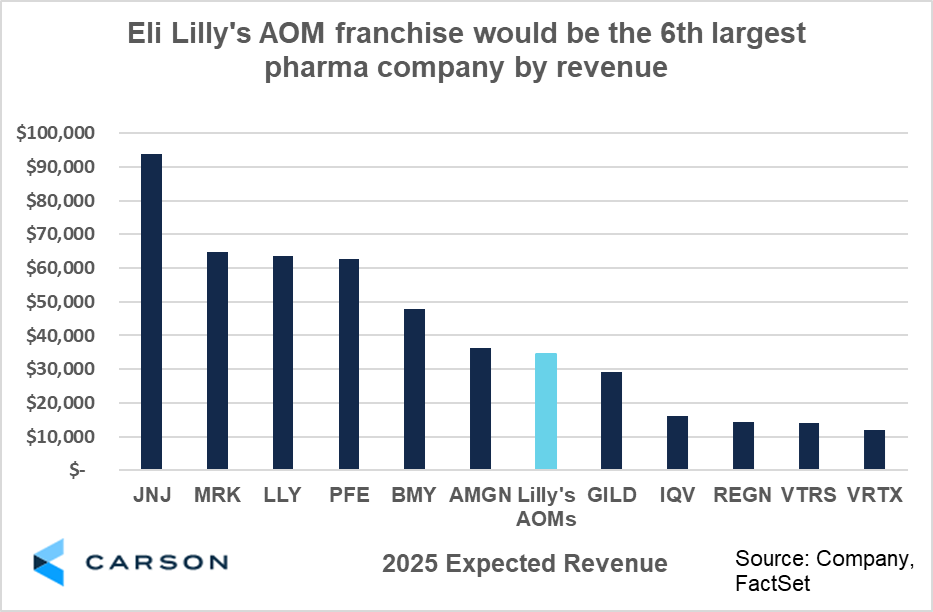
The realized revenues and projected growth from this portfolio of AOMs is expected to make this line of medicines “the bestselling medicine in history” according to a recent Wall Street Journal article.1 Positive trial readouts and robust revenue growth from these AOMs have catalyzed the most recent run in Lilly’s stock price.
Exceeding Expectations
Lilly’s blockbuster-rich pipeline and grand slam in AOMs have powered the company to vastly exceed Wall Street’s long-term estimates of revenue growth. Let’s look at Lilly’s realized revenue compared to analysts’ expectations three years in advance. As shown below, on December 31, 2020, analysts expected Lilly’s full year 2023 revenue (three fiscal years ahead) to be $29.3 billion. The company achieved $34.1 billion in sales in 2023, or 17% higher than analysts expected.
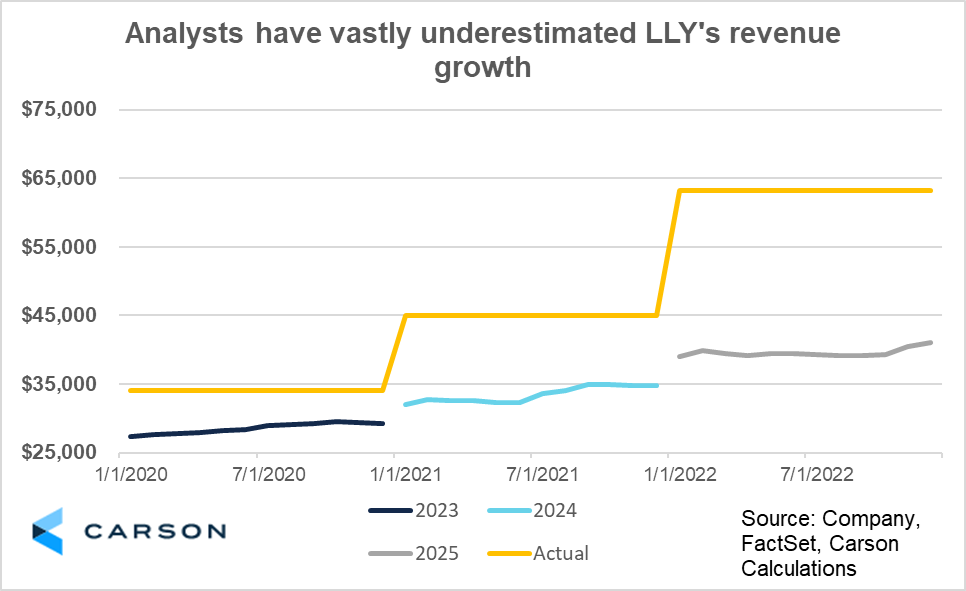
The company’s outperformance has only grown in recent years. At year end 2021, analysts expected Lilly’s 2024 sales to be $34.8 billion. The company achieved revenues of $45.0 billion in 2024, a 29% beat. Lilly’s 2025 revenue, based on the company’s most recent guidance, is forecasted to be around $63.3 billion, whereas three years ago analysts expected $41.1 billion in 2025 revenue. If Lilly achieves their guidance, it will represent a whopping 54% revenue outperformance compared to analysts’ forecasts (all FactSet data, as of 11/21/2025).
A Strong Moat
Lilly is also thinking about the future by increasing its research & development spending. Lilly’s spending on R&D has more than doubled in the previous five years, jumping from $6.1 billion in spending in 2020, to an expected $13.3 billion in 2025 (based on FactSet consensus estimates as of 11/21/2025). To put this amount of spending in perspective, Lilly’s R&D spending this year is more than the market capitalization of 254 companies of the total 283 constituents in the IHE and IBB ETFs combined. While Lilly has been an active acquirer of biotechs as of late, this level of internal-focused spending may be a signal to investors that the company believes the next blockbuster already lies within Lilly’s laboratories.
This past week, Eli Lilly became the latest addition to the $1 trillion market cap club. The company’s history of developing blockbuster medicine has powered it to beat long-term revenue estimates in recent history. And their newest anti-obesity medicines have supercharged growth – these medicines are so impactful that they may become the best-selling medicine in history. Eli Lilly has grown big by selling slim, and they’re using these breakthroughs to reinvest in internal research & development to power potential growth.
Wainer, David, November 18, 2025, The Weight-Loss Craze Is About to Mint a Trillion-Dollar Company, https://www.wsj.com/health/pharma/the-weight-loss-craze-is-about-to-mint-a-trillion-dollar-company-f92d51d0?gaa_at=eafs&gaa_n=AWEtsqf2qyfCnxuZCrgQ-0DhgPG87Wa0XVbOjRQV3_yM8Wz5YNweEcLEX0BBXBSgOTU%3D&gaa_ts=69208c83&gaa_sig=AabZW4HDQmq_dSTBM4v0FCSchCT-eZBthsBviPXhoGiFVE3a_j4GSWAizmuxF2jfNAEV_Kg1I83xJ5xxk5mIrw%3D%3D
For more content by Blake Anderson, CFA®, Associate Portfolio Manager click here
8627431.1.-21NOV25A